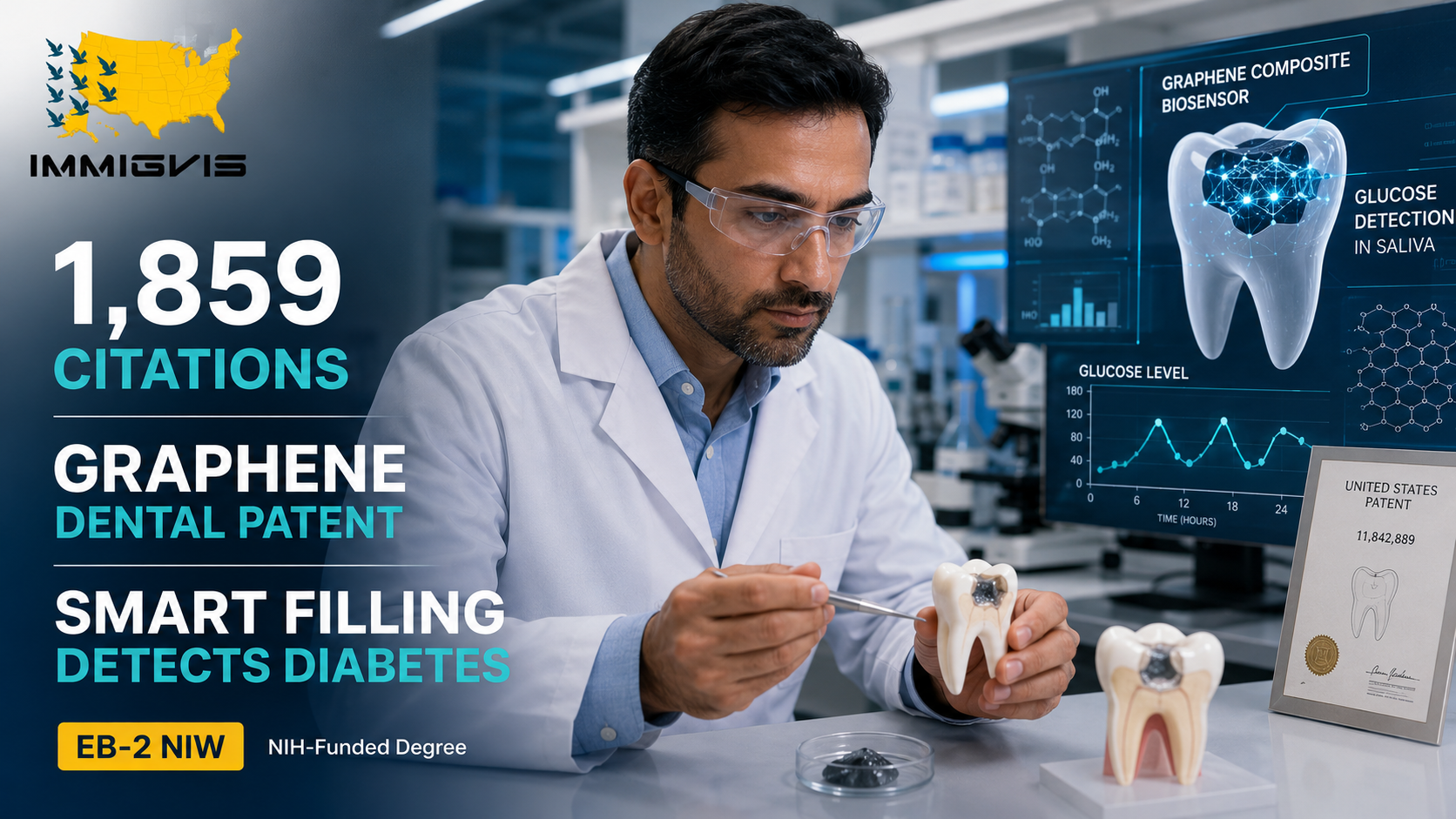
EB-2 NIW dental biomaterials scientist: A dental biomaterials scientist with 79 peer-reviewed publications, 1,859 Google Scholar citations, and a PhD from Finland who has spent a decade advancing smart, bioactive, and AI-integrated dental materials at a leading Middle Eastern research university – approved for an EB-2 NIW to bring next-generation AI-driven, biosensor-embedded dental restorations to the United States.
In short: A dental biomaterials scientist holding a Doctor of Philosophy in Biomaterials Science from a Finnish research university, a Master of Science in Dental Materials from a UK research university, a NIH-USA funded Master in Bioethics, and a Bachelor of Dental Surgery, with over 15 years of combined clinical, academic, and research experience, was approved for an EB-2 National Interest Waiver as a self-petitioner.
Pakistani national, Saudi Arabia-based. He currently serves as a researcher at a leading Middle Eastern research university, where he has produced 79 peer-reviewed publications with 1,859 Google Scholar citations (H-index 21, i10-index 43), filed a patent for graphene nanosheet-enhanced dental adhesives, and collaborates with internationally recognized biomaterials researchers. He holds memberships in the International Association for Dental Research (IADR) and has served as a peer reviewer for 15+ top-tier journals.
He received a scholarship from the U.S. National Institutes of Health for his bioethics graduate studies. Proposed endeavor: develop AI-driven, self-healing, antimicrobial, and nanotechnology-enhanced dental biomaterials, and biosensor-embedded dental restorations capable of real-time monitoring of salivary biomarkers linked to systemic conditions including diabetes and cardiovascular disease. Approved under Matter of Dhanasar.
The petitioner’s name and employer names have been withheld for privacy. Publication record, citation count, patent, and outcome are real.
What the Citations Mean
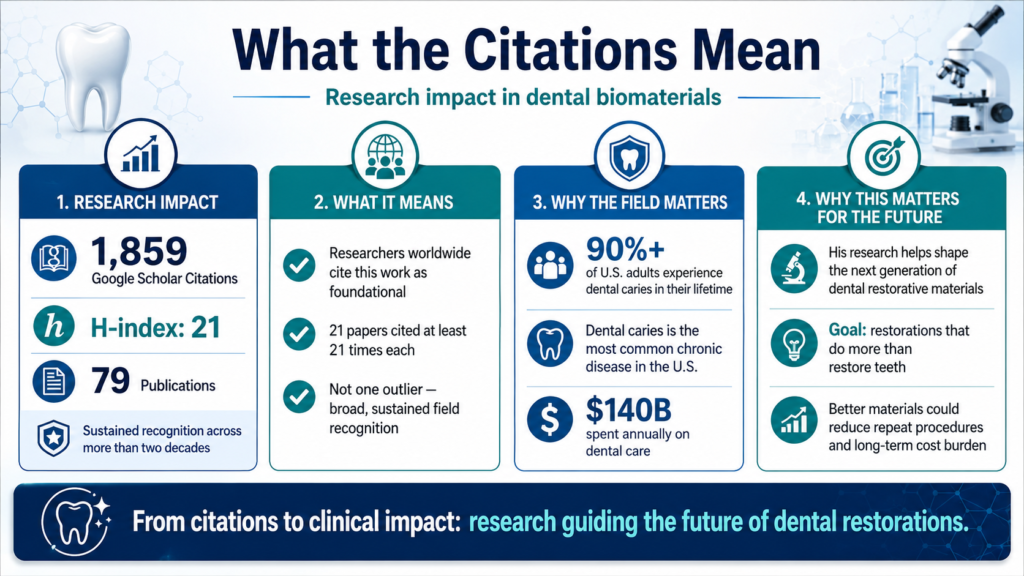
1,859 Google Scholar citations means 1,859 instances of researchers worldwide looking at published dental biomaterials work and concluding: this is foundational to what I am doing. An H-index of 21 means 21 of those papers have each been cited at least 21 times – not one heavily-cited paper pulling up the average, but sustained recognition across more than two decades of active contribution to the field.
For context: the field of dental biomaterials directly affects the clinical materials used to treat a condition that more than 90% of U.S. adults will experience in their lifetime. Dental caries is the most common chronic disease in the United States. The $140 billion spent annually on dental care – much of which is attributable to the failure of existing restorative materials and the cascading cost of repeat procedures – represents a healthcare cost burden that better materials could meaningfully reduce. His 79 publications are not abstract academic contributions. They are part of the research base that will determine what dental materials are made of next.
His proposed endeavor is the application of that research base to the most consequential open problem in the field: dental restorations that do more than restore teeth.
Phase One: The Restoration That Heals Itself
Secondary caries – decay that forms at the margins of an existing restoration – is the leading cause of restoration failure and repeat dental procedures in the United States. The problem is not inadequate initial placement. It is that current materials are static: they seal the tooth on day one and degrade over time without responding to the bacterial and acidic environment around them.
His Phase One proposed work engineers materials that respond. pH-responsive polymers that release antimicrobial agents precisely when the local environment becomes acidic – the condition that signals active bacterial colonization. Microencapsulated monomers that trigger self-repair when structural stress occurs. Graphene oxide and nanofiber reinforcements that simultaneously strengthen mechanical properties and inhibit bacterial adhesion.
He has already filed a patent on graphene nanosheet enhancement of dental adhesive strength – this is not a proposal to start new research. It is a proposal to advance active work that has already produced a patentable innovation.The AI dimension makes personalization possible at scale. Generative AI models trained on dental structure datasets, saliva chemistry profiles, and treatment response histories can formulate patient-specific material compositions – replacing the current one-size-fits-all approach with precision-engineered alternatives. Physics-Informed Neural Networks allow in-mouth performance simulation under chewing stress, temperature variation, and pH fluctuation before a material is ever placed in a patient, dramatically reducing development timelines.
A dental filling that releases antimicrobials when it senses acid, repairs itself under stress, and is designed using AI to match the specific oral microbiome of the patient receiving it. The component technologies exist. Integrating them is the proposed research.
Phase Two: The Restoration That Detects Diabetes
The second phase is where the proposed endeavor moves from dental materials into a broader national health infrastructure argument. Saliva contains a remarkable amount of diagnostic information: pH levels reflecting acid-base balance, glucose concentrations correlated with systemic blood sugar, cortisol reflecting stress load, and inflammatory markers like IL-6 that signal active infection or chronic disease progression.
He proposes to embed ultrathin microfluidic biosensors within dental restorations, aligners, and implants – using two-dimensional nanomaterials (MoS₂ and graphene derivatives) miniaturized through soft lithography so they integrate seamlessly with existing restorative devices without compromising comfort. These sensors communicate wirelessly via Bluetooth Low Energy to AI-driven mobile health platforms that track trends, trigger alerts, and facilitate remote diagnosis.
For a country where 38 million Americans have diabetes and approximately 23% of them are undiagnosed according to the CDC, a dental restoration that passively monitors glucose levels and flags anomalies to a patient’s health app represents a meaningful public health infrastructure investment. For the 61 million adults in rural America who face documented barriers to primary care access, a biosensor embedded in an existing dental device enables decentralized, continuous monitoring that does not require a clinic visit.
The blockchain chain-of-custody system he proposes adds regulatory traceability: every stage from AI design to clinical fabrication to patient delivery is logged, supporting FDA compliance pathways and providing auditable records for customized biomaterial solutions.
The Career Behind the Proposed Work |EB-2 NIW dental biomaterials scientist
He began his career as a practicing dentist in Karachi, working full-time as a general dental practitioner from 2002 and then as a clinical consultant for several years. This clinical foundation is unusual for a biomaterials researcher: he started not in a laboratory but in a clinic, where he encountered directly the failures of existing materials – the secondary caries, the marginal gaps, the premature restoration failures – that motivate his research.
He then completed his MSc in Dental Materials at a UK research university, followed by his PhD in Biomaterials Science at a Finnish research university. His PhD supervisor, a leading figure in dental biomaterials science with an international reputation in fiber-reinforced composites and bioactive materials, provided the research foundation from which his current program of work has developed. After two assistant professor roles in Pakistan, he joined a major Middle Eastern research university in 2014, where he has remained as a researcher for more than a decade.
The NIH-USA funded scholarship for his Master in Bioethics represents a direct connection to U.S. research infrastructure: the United States National Institutes of Health specifically evaluated and funded his advanced study. His IADR membership connects him to the leading international professional body for dental research, whose annual meetings and working groups drive the global dental research agenda.
His technical capabilities are documented through advanced instrument certifications that go beyond what most dental researchers hold: Atomic Force Microscope (AFM) for nanoscale surface analysis, Fourier-Transform Infrared Spectroscopy (FTIR) for molecular characterization, Raman Spectroscopy for phase composition analysis, Universal Testing Machine (UTM) for mechanical testing, chewing simulator and tooth brushing simulator for fatigue and wear assessment. These are the instruments the proposed research directly requires.
The National Importance Case
The national importance argument for dental biomaterials research is unusually well-grounded in documented statistics.
– CDC: Over 90% of U.S. adults experience dental caries in their lifetime; 26% of adults have untreated decay.
– $140 billion+ spent annually on U.S. dental care, much driven by restorative failure and repeat procedures.
– NIDCR Strategic Plan explicitly targets development of novel biomaterials, nanotechnology applications, and digital health integration as national priorities.
– CDC-HRSA rural health data: rural Americans have significantly higher rates of untreated dental disease and lower dental care access; telehealth and biosensor-based remote monitoring directly addresses this gap.
– CDC: 38 million Americans have diabetes (23% undiagnosed); NIDCR recognizes oral-systemic health links as a priority research domain.
– ARPA-H: Established to accelerate biomedical breakthroughs; AI-integrated dental biomaterials fall within its mandate for transformative, scalable, patient-centered health solutions.
– FDA: Class II dental restoratives and embedded biosensors; 510(k) pathway already identified in the proposed regulatory roadmap.
– Green healthcare goals: AI-LCA sustainable material screening aligns with EPA and HHS environmental health priorities.
How the Petition Was Built
This was a direct petition. The publication record, citation impact, patent, certifications, and proposed technical frameworks were already in place.
– Well-positioned evidence: 79 peer-reviewed publications, 1,859 Google Scholar citations (H-index 21, i10-index 43), filed patent for graphene nanosheet-enhanced dental adhesives, PhD from Finnish research university, MSc from UK research university, NIH-USA funded Bioethics scholarship, IADR membership, 15+ journal peer review responsibilities, advanced instrument certifications (AFM, FTIR, Raman, UTM, chewing/brushing simulators), decade of research at a major Middle Eastern research university, active collaborations with leading dental biomaterials researchers in Finland and UK, clinical dental practice background (8+ years as BDS), $50,000 personal investment committed.
– National importance sourcing: CDC caries and dental disease burden data, CDC diabetes prevalence (38M Americans, 23% undiagnosed), $140B+ U.S. annual dental expenditure, NIDCR Strategic Plan priorities (biomaterials, nanotechnology, digital health), CDC HRSA rural oral health access data, ARPA-H mission, FDA regulatory pathway for Class II dental devices, EPA/HHS green healthcare goals, ADA and WHO oral health priorities.
I-140 filed as a self-petition without a U.S. employer.
The Outcome
Approved.
A self-petitioned EB-2 NIW for a dental biomaterials scientist who started as a practicing dentist, earned a PhD in Finland and an MSc in the UK, produced 79 publications with 1,859 citations and an H-index of 21, filed a graphene nanomaterial patent, received a NIH-USA funded scholarship, and proposes to develop AI-driven self-healing dental materials and biosensor-embedded restorations that detect systemic disease – addressing the $140 billion annual dental care cost burden and the oral health access gap affecting millions of Americans.
When the U.S. National Institutes of Health funds your graduate studies, and your dental biomaterials research has been cited nearly 2,000 times by researchers worldwide, the well-positioned argument is not about potential. It is about what is already established.
For Dental and Biomedical Researchers in Materials Science
If your career is in dental biomaterials, bioactive materials, nanotechnology in dentistry, or AI-integrated biomedical materials and you have a publication record with meaningful citation impact, recognized professional memberships, and a proposed endeavor that addresses documented U.S. oral health challenges – the NIW is worth a serious assessment. The NIDCR and CDC both document ongoing national need in exactly the domains dental biomaterials research addresses. The Dhanasar well-positioned analysis rewards depth of research contribution, not just credential collection.
Questions Dental and Biomedical Researchers Ask Us
Can a dental biomaterials scientist qualify for an EB-2 NIW?
Yes. Dental diseases are among the most prevalent chronic conditions in the United States, and the NIDCR Strategic Plan explicitly identifies dental biomaterials research and AI integration as national priorities. A proposed endeavor developing AI-driven, self-healing, antimicrobial dental restorative materials addresses a documented $140 billion national healthcare cost burden driven by restorative failure and repeat procedures. A dental biomaterials scientist with 79 peer-reviewed publications, an H-index of 21, and a filed patent in graphene-reinforced dental adhesives is well-positioned to advance it.
Does an H-index of 21 and 1,859 Google Scholar citations help a NIW case more than a smaller citation record?
Yes, quantitatively and qualitatively. The H-index and citation count are the primary metrics USCIS uses to evaluate researcher impact under the Dhanasar well-positioned prong. An H-index of 21 means 21 papers have each been independently cited at least 21 times — reflecting sustained field recognition across a broad body of work. 1,859 total citations reflects the cumulative impact of that work on the broader research community. Both metrics are independently verifiable through Google Scholar, making them strong, objective well-positioned evidence that is difficult to challenge. The citation count places this petitioner well above the median for dental biomaterials researchers.
Does having a NIH-funded scholarship help a non-U.S. researcher’s NIW case?
Yes. The U.S. National Institutes of Health specifically evaluated and funded this researcher’s advanced education. That funding decision reflects NIH’s independent judgment that his work and potential justified U.S. government investment. For the NIW well-positioned argument, it provides a direct institutional connection: the petitioner is not proposing to contribute to the U.S. research ecosystem for the first time. NIH already recognized his work as worth supporting. This connection supports the argument that continued U.S. access to his research contributions is in the national interest.
Does a filed patent in dental biomaterials specifically help the NIW national importance argument?
Yes, for two distinct reasons. First, a patent application is evidence of original technical contribution that has crossed the threshold of novelty – it reflects a specific innovation (graphene nanosheet-enhanced dental adhesive cohesive strength) that is sufficiently novel and non-obvious to merit patent protection. This directly supports the well-positioned argument by demonstrating that the petitioner’s contributions produce innovations, not merely literature reviews. Second, for a proposed endeavor involving nanotechnology in dentistry, the patent demonstrates that the petitioner is already advancing the specific technology domain at a level that creates protectable intellectual property – the type of innovation the U.S. aims to lead in.
How does Phase Two (biosensor-embedded dental restorations for systemic disease monitoring) strengthen the national importance case beyond conventional dentistry?
It expands the scope of national importance from oral health alone to systemic health monitoring infrastructure. Dental diseases are treated in isolation, but the oral cavity contains biomarkers for diabetes, cardiovascular disease, stress, and infection. Biosensors embedded in dental restorations that continuously monitor glucose, cortisol, and inflammatory markers bridge dentistry with chronic disease management – directly relevant to CDC, NIH, and HRSA priorities for early detection, rural health equity, and decentralized care. The Phase Two proposal is not a separate endeavor; it is the same materials science and nanotechnology expertise extended to a broader national health infrastructure problem. This expansion from dental biomaterials into digital health and chronic disease monitoring significantly strengthens the Prong One national importance argument.
1,859 citations and an NIH-funded degree are exactly the kind of independent validation USCIS looks for. See how Immignis turns deep research records into approved EB-2 NIW cases.