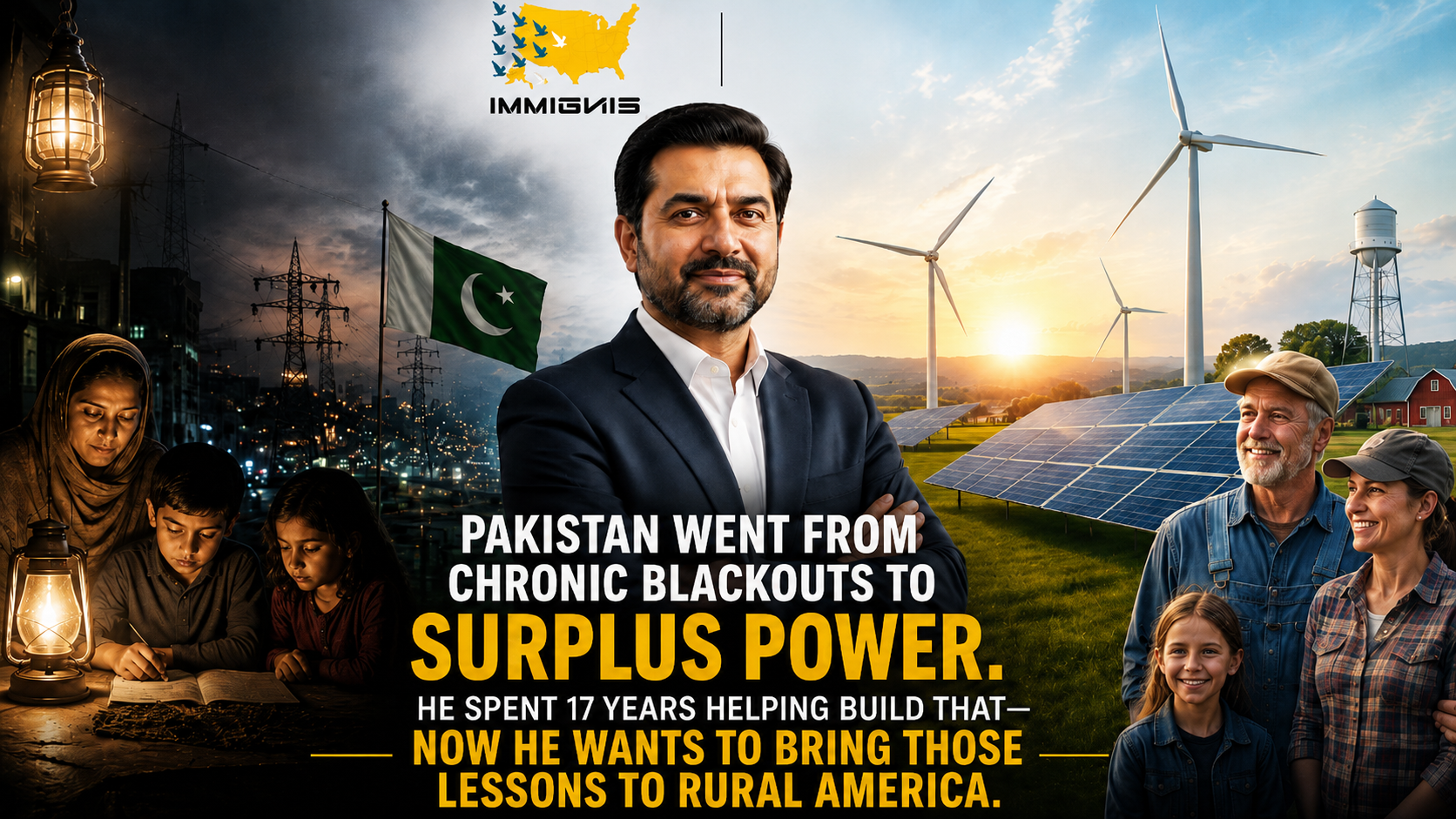
EB-2 NIW electrical distribution case of a distribution engineer who led over 100 rural electrification projects, managed the electrical infrastructure for Pakistan’s first urban metro rail, and spent 17 years at the utility serving 30 million people approved for an EB-2 NIW to modernize grid infrastructure in underserved U.S. communities.
In short: An electrical engineer holding a Master of Science in Electrical Engineering, an MBA Executive from one of Pakistan’s leading business schools, and a Bachelor of Electrical Engineering, with over 17 years of progressive experience in electrical distribution design, construction, and rural electrification at one of Pakistan’s largest utility companies (serving 6.5 million customers and 30 million residents), was approved for an EB-2 National Interest Waiver as a self-petitioner. Pakistani national, Pakistan-based. His career includes leading over 100 rural and village electrification projects, managing the electrical system for Pakistan’s first urban metro rail project, and supervising more than 146 infrastructure projects in the last five years alone. Proposed endeavor: modernize U.S. distribution infrastructure and expand rural electrification in underserved communities through eight integrated technical components including AMI, DERMS, substation and feeder automation, and decentralized microgrid deployment. Approved under Matter of Dhanasar.
The petitioner’s name and employer details have been withheld for privacy Career record, projects, credentials, and outcome are real.
Learning to Fix a Grid Under Pressure:
When he began his career in electrical engineering in 2008, Pakistan was experiencing one of the worst power crisis in its history, a context later central to his EB-2 NIW Electrical Distribution case. Daily outages stretched 8 to 12 hours in many cities. Factories shut down or relocated. Hospitals ran on generators. Homes went dark in the middle of winter. The gap between what the grid could deliver and what the country needed was enormous, and the political and economic cost of that gap was measured in factories lost, workers laid off, and daily life made harder for tens of millions of people.
He spent the next 17 years working inside that gap not studying it, not advising on it, but doing the engineering work that gradually closed it as an EB-2 NIW Electrical Distribution professional. Rural villages received electricity for the first time. Distribution lines were upgraded and modernized. Feeder losses were reduced. Substation systems were improved. The country’s grid position improved to the point where Pakistan now occasionally sees energy surplus rather than deficit. The turnaround did not happen by itself. It happened because engineers built and rebuilt the infrastructure that makes electricity reach people.
His proposed endeavor is to bring that same infrastructure engineering discipline to the documented gaps in U.S. rural and underserved electricity systems through an EB-2 NIW Electrical Distribution framework.
The U.S. Infrastructure Problem He Is Positioned to Address:
In 2025, the American Society of Civil Engineers assigned U.S. energy infrastructure a grade of D+, a downgrade from the C- it received in 2021, a national context directly relevant to an EB-2 NIW Electrical Distribution case. More than 70% of U.S. transmission lines and transformers are over 25 years old, approaching or exceeding their intended operational life. The DOE projected in July 2025 that without significant intervention, the U.S. could face a 100-fold increase in widespread power outages by 2030 as aging capacity retires faster than dependable replacements come online. In January 2025, the White House declared a National Energy Emergency.
The problem is not uniform. Large urban utilities in major metropolitan areas have the capital, the regulatory attention, and the technical capacity to modernize. Rural utilities, electric cooperatives, and the communities they serve often do not. Tribal areas, historically marginalized counties in Appalachia, in the Gulf States, in the Southwest these are the communities that face disproportionately long outage durations when extreme weather hits, that lack access to advanced metering and customer side energy management, and that are last in line for grid modernization investment under the EB-2 NIW Electrical Distribution framework.
That is not a different problem from what he has been solving. It is a variation of the same problem, and it strengthens the EB-2 NIW Electrical Distribution argument.
Seventeen Years and Over 200 Projects;
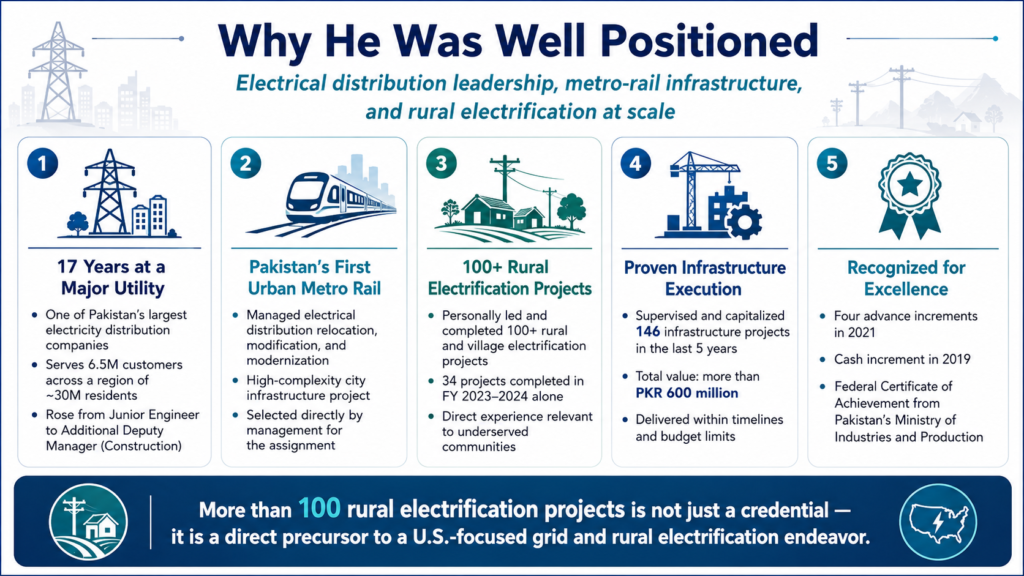
He has spent his entire career at one of Pakistan’s largest electricity distribution companies, serving 6.5 million customers across a service area of approximately 30 million residents. He started as a junior engineer. He is now Additional Deputy Manager (Construction), leading the design and implementation of large scale rural electrification and distribution modernization initiatives across one of the country’s most densely populated and economically diverse regions.
His most prominent single project was Pakistan’s first urban metro rail system a multi billion dollar project executed under a major bilateral infrastructure program. The electrical distribution system relocation, modification, and modernization for that project was entrusted to him by company management. Urban rail electrification in a dense, complex city environment, where existing distribution infrastructure had to be redesigned around a new transit corridor, is not standard utility work. He was chosen for it specifically.
His rural electrification record is equally specific. He has personally led and completed more than 100 rural and village electrification projects as part of the government’s sustainable development goal targets for universal electricity access. In the fiscal year 2023–2024 alone, 34 projects were completed under his leadership. In the last five years, he has supervised and capitalized 146 infrastructure projects worth more than PKR 600 million, all within their given timelines and budgetary limits.
Other notable projects include a major Lahore bridge infrastructure project completed under emergency timelines he was chosen to lead it after a Prime Ministerial visit highlighted the urgency, reporting directly to the CEO and finishing within the mandated schedule. A major central business district modernization project. The first housing scheme under a government-backed low-cost housing authority, electrified according to modern and sustainable standards.
Along the way, he was formally recognized multiple times. Four advance increments in 2021 for professional excellence. A cash increment in 2019. A federal government Certificate of Achievement from Pakistan’s Ministry of Industries and Production. These are not just performance reviews they are institutional declarations that his work exceeded his peers.
More than 100 rural electrification projects is not a credential item. It is a direct and specific precursor to a proposed endeavor centered on rural electrification in the United States. The well positioned argument does not require inference.
The Eight Component Proposed Endeavor:
His proposed endeavor is an eight component integrated framework for U.S. distribution infrastructure modernization, with a specific focus on rural and underserved communities, under an EB-2 NIW Electrical Distribution strategy.
The foundation is distribution infrastructure modernization retrofitting aging systems with AI enabled diagnostics, digital twin modeling, and bi-directional power flow capabilities. The goal is to convert reactive grid management into predictive asset health monitoring. This is the prerequisite for everything that follows: modern grid automation cannot be layered onto infrastructure that cannot support it.
Built on that foundation rural electrification using decentralized hybrid systems solar plus battery storage plus backup, designed using GIS based community mapping that prioritizes communities by health, economic, and environmental impact. Modular, scalable architectures that do not require expensive grid extensions into remote areas.
The next layer isautomated distribution networks with fault detection, isolation, and service restoration automation (FLISR), enabling self-healing grid behavior that shortens outage durations without waiting for a crew to arrive on site, supporting the EB-2 NIW Electrical Distribution framework.
On top of automation: Advanced Metering Infrastructure (AMI) for two-way digital communication, dynamic pricing, remote outage management, and demand response programs. Customer Information Systems (CIS) to provide real time usage insights, billing transparency, and AI driven consumption forecasting for consumer engagement.
Then: Distributed Energy Resources Management Systems (DERMS) to integrate and orchestrate solar rooftops, battery systems, EV charging, and other distributed assets into the broader grid. And substation and feeder automation to complete the picture at both the centralized and decentralized levels enabling autonomous fault recovery at substations and the ability for mini-grids to island from the main grid and operate independently during outages.
Together, these eight components address the full stack of what rural and underserved U.S. communities lack: access to electricity where it is still inadequate, reliable delivery where it is fragile, and the modern grid management capabilities that make clean energy integration and consumer empowerment possible through EB-2 NIW Electrical Distribution.
The Federal Policy Support Is Direct and Current:
The federal backing for this proposed endeavor is extensive and recent, strengthening the EB-2 NIW Electrical Distribution case.
National Energy Emergency Declaration (January 2025): White House formally acknowledged imminent risk to economic stability from energy insecurity; mandated accelerated deployment of resilient energy systems.
Executive Order on Strengthening the Reliability and Security of the Electric Grid (April 2025): Directed agencies to modernize grid infrastructure, promote grid-hardening technologies, and expand domestic generation and transmission capacity.
National Energy Dominance Council (February 2025): Established to coordinate U.S. energy policy, accelerate domestic infrastructure development, and support grid modernization.
DOE Grid Resilience and Innovation Partnerships (GRIP) program: Focused on wildfire mitigation, neighborhood microgrids, lower consumer energy costs, and targeted upgrades in disadvantaged communities all areas directly addressed by the proposed endeavor under the EB-2 NIW Electrical Distribution framework.
DOE Empowering Rural America (New ERA) program: 157 cooperative utility proposals totaling $93 billion in combined public and private investment, reflecting the depth of rural infrastructure need.
Bipartisan Infrastructure Law: $65 billion committed to grid modernization.
Justice40 Initiative: Federal commitment that 40% of benefits from clean energy investments reach disadvantaged communities.
Critical and Emerging Technologies List 2024: Energy technologies, advanced computing, and integrated infrastructure explicitly designated as national priority domains.
The convergence of a National Energy Emergency declaration, a D+ infrastructure rating from the ASCE, a DOE warning of 100-fold outage increases by 2030, and billions in active federal funding for rural electrification and grid modernization constitutes one of the most directly documented national importance cases in the EB-2 NIW Electrical Distribution series.
How the Petition Was Built:
This was a direct petition. The career record, the project portfolio, and the proposed endeavor were already in place.
National importance sourcing: ASCE 2025 Infrastructure Report Card (D+ energy grade), DOE July 2025 Resource Adequacy Report, DOE 100-fold outage projection (Reuters July 2025), White House National Energy Emergency declaration, EO on Grid Reliability and Security, National Energy Dominance Council EO, GRIP and New ERA program documentation, Bipartisan Infrastructure Law grid commitments, Justice40 Initiative, Critical and Emerging Technologies List, Wall Street Journal reporting on grid fragility, peer reviewed outage research.
Well positioned evidence: 17 years at Pakistan’s largest electricity distribution utility serving 30 million residents, personally led 100+ rural and village electrification projects, trusted to lead electrical system work for Pakistan’s first urban metro rail project, 146 projects in last 5 years worth PKR 600M+, federal government Certificate of Achievement, advance increments and cash awards for above-peer performance, MS Electrical Engineering, MBA from one of Pakistan’s leading business schools.
Proposed endeavor: eight integrated technical components each tied to documented U.S. infrastructure gaps, supported by specific federal programs, and directly mirrored by work the petitioner has already delivered in a comparable context over 17 years.
I-140 filed as a self petition without a U.S. employer
The Outcome:
Approved.
A self-petitioned EB-2 NIW for a distribution engineer with 17 years of infrastructure delivery at one of Pakistan’s largest utilities, more than 100 completed rural electrification projects, personally trusted with the electrical system of a landmark national infrastructure project, and a proposed endeavor that maps directly onto the documented national urgency around U.S. rural and underserved grid infrastructure.
The best evidence that someone can modernize rural U.S. electricity infrastructure is not a plan or a credential. It is 100 completed rural electrification projects and 17 years of field delivery. That is what the well positioned argument is built on here.
For Electrical Engineers and Distribution Utility Professionals:
If your career is in electrical distribution engineering, rural electrification, grid modernization, smart grid implementation, or utility operations and you have a documented track record of large scale project delivery that directly mirrors U.S. infrastructure needs, the NIW is worth a serious assessment. The U.S. national importance case for electrical infrastructure modernization has never been better documented than it is today, with a D+ infrastructure grade, a National Energy Emergency declaration, a DOE warning of exponential outage growth, and billions in active federal programs. An engineer whose career has been built on delivering exactly this work, at scale, is well-positioned to advance it.
Questions Electrical and Distribution Engineers Ask Us:
Can a distribution utility engineer working outside the United States qualify for an EB-2 NIW?
Yes. The EB-2 NIW evaluates the national importance of the proposed endeavor and whether the petitioner is positioned to advance it not the petitioner’s current country of residence. A distribution engineer with 17 years of large scale utility infrastructure delivery, 100+ completed rural electrification projects, and a proposed endeavor directly targeting documented U.S. grid gaps is well positioned under the Dhanasar test. The career evidence does not need to be from a U.S. employer to be directly relevant to the U.S. proposed endeavor.
Does rural electrification experience from another country help a U.S. NIW case?
It can help substantially, particularly when the proposed U.S. endeavor is focused on rural electrification. The technical skills involved in planning, designing, and constructing distribution networks in underserved communities (load mapping, microgrid design, HT/LT network construction, feeder management) are the same skills the U.S. needs to expand and modernize its rural electricity infrastructure. A petitioner with 100+ completed rural electrification projects in their existing career has a more direct and specific well positioned argument for a U.S. rural electrification proposed endeavor than one who can only describe the plans.
How does the ASCE D+ infrastructure grade and the DOE outage projection support a national importance argument?
Directly and specifically. The ASCE Infrastructure Report Card is an independent, professionally conducted national assessment published every four years. A D+ grade (a downgrade from C in 2021) is independent documentation that the specific infrastructure the proposed endeavor addresses is critically deficient by national standards. The DOE’s projection of exponential outage growth by 2030 is federal agency documentation that the problem is urgent and worsening. Combined with the White House’s National Energy Emergency declaration, these sources establish national importance without requiring inference, they state it directly.
Does managing infrastructure for a landmark national project (like a first-of-its-kind metro rail) help the well-positioned argument?
Yes. Being entrusted with the electrical distribution system for a landmark national infrastructure project particularly a first of its kind project selected for implementation by senior management despite its complexity demonstrates that the petitioner has been formally recognized as capable of handling infrastructure work at the highest level of difficulty and public visibility. This type of recognition, from a major institutional employer with national infrastructure responsibilities, is directly relevant to the Dhanasar well positioned analysis.
Does having an MBA alongside an engineering degree help an NIW case for an infrastructure specialist?
It depends on how the proposed endeavor is structured. For a petitioner who proposes to work as an independent consultant and system designer across multiple utilities and public sector clients, the MBA demonstrates the commercial, strategic, and stakeholder management capabilities needed to operate independently. This is directly relevant to the third Dhanasar prong whether the national interest benefits from waiving the job offer requirement because an independent specialist with business planning and execution skills is more credibly positioned to operate without employer constraints than one who only holds technical credentials.
To see whether your electrical distribution, grid modernization, or rural electrification experience can support an EB-2 NIW strategy, start with a free assessment through immignis.