A success story showing how field EIA/ESIA experience, ISO-aligned compliance work, renewable-energy assessments, and digital monitoring tools were organized into an EB-2 NIW Environmental Specialist national-interest framework for U.S. environmental permitting, sustainability, and infrastructure modernization.
Approval Snapshot
| Client profile | Pakistani environmental specialist residing in Bahrain with more than 15 years of international environmental consultancy and compliance experience. |
| Field | Environmental sciences, EIA/ESIA, renewable-energy compliance, industrial sustainability, environmental monitoring, and risk mitigation. |
| Core proposed endeavor | Advance renewable-energy integration and industrial sustainability in the United States through digitally enabled environmental consultancy, EIA/ESIA work, EMP/ESMP design, digital twins, GIS dashboards, and AI-supported risk scoring. |
| Profile-building focus | Move the profile from a general environmental-consultant description to a national-interest story tied to U.S. permitting modernization, clean-energy deployment, environmental justice, and infrastructure resilience. |
| Outcome | EB-2 NIW I-140 approved. |
The Approval Result
This case ended with an EB-2 National Interest Waiver approval for an environmental specialist, an EB-2 NIW Environmental Specialist approval, an EB-2 NIW for Environmental Specialist case, whose record became strongest when it was organized around one U.S. public-interest problem: clean-energy and infrastructure projects need faster, more transparent, and more reliable environmental compliance systems without weakening environmental protection or public trust.
The client had already built a practical international record in environmental consulting, EIA, ESIA, environmental monitoring, industrial compliance, marine and infrastructure assessments, renewable-energy project support, and ISO-aligned systems. The challenge was not lack of experience. The challenge was translating a broad consultancy profile into a focused national-interest endeavor that USCIS could evaluate under Dhanasar as an EB-2 NIW Environmental Specialist.
The successful strategy for this EB-2 NIW Environmental Specialist and EB-2 NIW for Environmental Specialist presented him as an environmental-compliance modernization specialist whose work could help developers, agencies, infrastructure owners, and communities use data-driven tools to forecast environmental risk, monitor compliance, improve transparency, and support responsible clean-energy and infrastructure development in the United States.
The National Problem: Clean-Energy and Infrastructure Projects Need Better Environmental Compliance Systems
The United States needs to accelerate renewable-energy deployment and infrastructure modernization while maintaining environmental integrity and public confidence, a national context directly relevant to an EB-2 NIW Environmental Specialist. Traditional environmental review and monitoring can depend on static reports, fragmented data, delayed field updates, and limited public visibility. For major infrastructure and clean-energy projects, these weaknesses can contribute to permitting delays, litigation risk, compliance failures, community opposition, and avoidable environmental harm.
This case did not present environmental consulting as a routine professional service. It framed environmental compliance as a national implementation issue for an EB-2 NIW Environmental Specialist. If the United States is to expand renewable energy, modernize infrastructure, and support industrial sustainability, environmental assessment and post-permit monitoring must become more accurate, transparent, and adaptable.
The petition connected the client’s work to permitting modernization, renewable-energy integration, environmental justice, climate resilience, state clean-energy mandates, industrial risk reduction, and responsible infrastructure growth. That national-interest framing moved the case beyond a standard employment profile and strengthened the EB-2 NIW Environmental Specialist argument.
The Proposed Endeavor
The proposed endeavor was to advance renewable-energy integration and industrial sustainability in the United States through digitally enabled environmental consultancy, including EIA/ESIA work, EMP/ESMP design, digital-twin forecasting, GIS dashboards, remote sensing, AI-supported risk scoring, and dynamic environmental monitoring systems, as an EB-2 NIW Environmental Specialist.
The endeavor was effective because it identified a specific method, not just a general environmental goal, for an EB-2 NIW Environmental Specialist. It showed how the client would use digital tools and field-based environmental expertise to help projects identify risk earlier, improve compliance accuracy, make monitoring more transparent, and reduce the chance that environmental issues would be discovered only after construction or operation had already begun.
This practical method also strengthened the EB-2 NIW Environmental Specialist case.
The Client’s Starting Profile
The client already had a practical field record that could support a serious NIW petition as an EB-2 NIW Environmental Specialist. He held graduate and undergraduate education in environmental sciences, served as a Senior Environmental Specialist with Bureau Veritas, and had earlier worked in environmental health, safety, auditing, and compliance roles with SGS Pakistan. His human-rights and public-engagement experience with Amnesty International in Norway also supported the community-facing side of the environmental-justice narrative for the EB-2 NIW Environmental Specialist case.
His record as an EB-2 NIW Environmental Specialist included EIA, ESIA, IEE, environmental monitoring, environmental compliance audits, industrial hygiene studies, oil-spill and waste-management plans, marine reclamation assessments, renewable-energy project assessments, power-plant monitoring, and ISO-aligned environmental systems work. Those facts showed real credibility, but they needed to be organized around a U.S.-focused endeavor with national scope.
What Immignis and AdvanceMyProfile Built in This EB-2 NIW for Environmental Specialist Case
The profile-building work created a clear bridge between the client’s past project experience and a future U.S. execution model. The strategy avoided presenting him as a routine environmental employee. It positioned him as an independent environmental consultant and technical lead who could design and deploy scalable environmental compliance systems for developers, regulators, infrastructure owners, and affected communities.
We refined the endeavor around renewable-energy integration, environmental permitting modernization, and industrial compliance frameworks. The broad EIA/ESIA experience was converted into five practical technical pillars: digital-twin forecasting, structured alternatives assessment, open-source energy modeling, remote sensing and GIS dashboards, and AI-assisted siting and permitting.
The evidence was then connected to U.S. needs in permitting efficiency, clean-energy deployment, environmental justice, grid modernization, climate resilience, and state-level sustainability policy. The client’s ISO 14001 Lead Auditor and ISO 14064 Lead Verifier training supported credibility in environmental management systems and greenhouse-gas reporting. A consulting-execution plan gave the proposed work a practical U.S. implementation path, including initial focus on states with significant clean-energy, industrial, and infrastructure activity.
How the Evidence Supported Dhanasar
| Dhanasar prong | Evidence used | Why it mattered |
| Prong 1: substantial merit and national importance | Renewable-energy permitting, environmental compliance, digital monitoring, environmental justice, and infrastructure modernization. | Showed that the work could affect national systems, not only one employer or one project. |
| Prong 2: well positioned | Bureau Veritas and SGS experience, EIA/ESIA/IEE work, marine and industrial assessments, ISO training, GHG verification, and multi-sector compliance audits. | Showed that the client had already performed similar work in demanding international settings. |
| Prong 3: beneficial to waive labor certification | Independent consulting, cross-state applicability, fast project-based deployment, and tools that can serve agencies, developers, and communities. | Supported the argument that a single job offer would limit, rather than enhance, the broader value of the proposed work. |
The Technical Story Made Simple
The final petition made a technical environmental-services profile understandable for a non-specialist officer. Instead of relying on a long list of projects, the story explained how the client’s tools would work in practice. Digital twins would create living models of energy and infrastructure projects. GIS dashboards and remote sensing would improve transparency. AI-assisted risk scoring would help identify environmental and community risks early. Smart compliance dashboards would monitor permit conditions after approval. EMPs and ESMPs would become active management tools, not static reports.
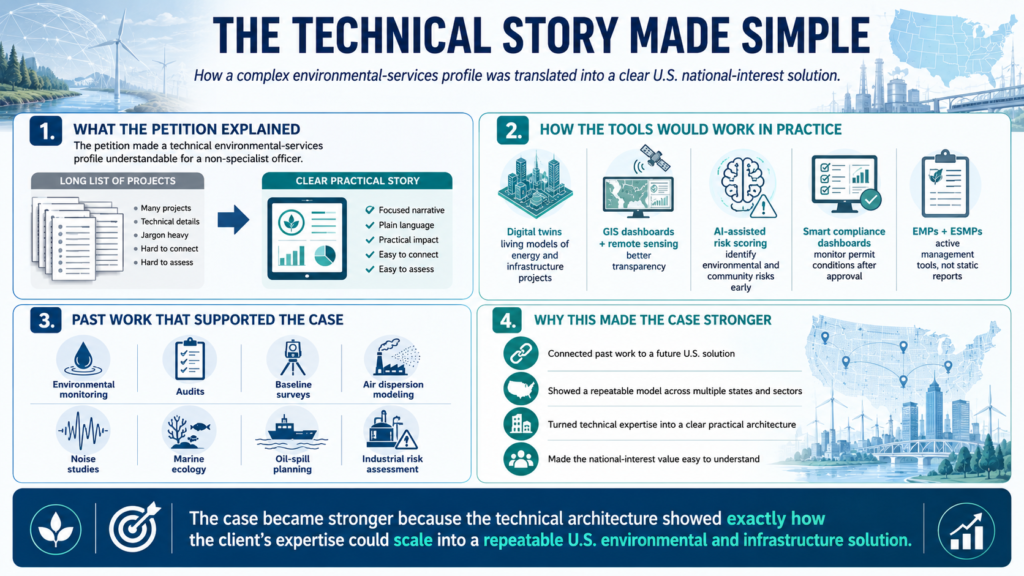
This technical architecture made the case stronger because it connected the client’s past work in environmental monitoring, audits, baseline surveys, air dispersion modeling, noise studies, marine ecology, oil-spill planning, and industrial risk assessment to a future U.S. solution that could be repeated across multiple states and sectors.
Filing and Approval
The final EB-2 NIW petition was filed as a structured national-interest record. The proposed endeavor explained the U.S. environmental-compliance problem. The client’s education and international consulting work showed technical credibility. The digital compliance model showed a forward-looking implementation path. The Dhanasar analysis connected the evidence to national importance, well-positioned capacity, and the benefit of waiving the job-offer requirement.
USCIS approved the EB-2 NIW I-140. The approval confirmed that an environmental consultancy profile can succeed when the work is framed around a specific national problem, supported by a practical implementation model, and documented through credible field experience.
What Changed Beyond Approval
The approval was the immigration result, but the profile-building work also gave the client a clearer professional identity. He was no longer presented only as a senior environmental specialist with many projects. He became identifiable as a digital environmental-compliance and renewable-energy permitting specialist with a practical model for modernizing how environmental risk is forecasted, monitored, reported, and explained.
That positioning made the profile stronger for professional conversations with clean-energy developers, infrastructure owners, environmental consulting firms, public-sector stakeholders, and sustainability-focused organizations. The same record that supported the petition also made his expertise easier for the market to understand.
What Professionals Can Learn From This Case
- A strong NIW case should not describe ordinary job duties. It should explain the national problem, the proposed solution, and the evidence showing the person can execute it.
- Environmental professionals can build strong national-interest arguments when their work is tied to permitting modernization, climate resilience, infrastructure safety, environmental justice, and measurable compliance outcomes.
- International experience can be valuable when it is translated into U.S.-relevant standards, agencies, states, industries, and implementation models.
- Profile building is ethical when it organizes real experience into a credible public-interest record. It should document expertise, not manufacture a false profile.