EB-2 NIW ERP architect: An ERP architect with 12 years building enterprise systems for major organizations across oil & gas, financial services, retail, and insurance – approved for an EB-2 NIW to bring AI-powered, blockchain-integrated, predictive supply chain intelligence to U.S. industries where outdated ERP is costing billions.
In short: A data scientist and enterprise software engineer holding a Master of Science in Data Science and a Bachelor of Science in Computer Science, with over 12 years of progressive experience designing, building, and integrating enterprise resource planning systems for major organizations across energy, financial services, retail, and insurance sectors, was approved for an EB-2 National Interest Waiver as a self-petitioner.
Pakistani national, Dubai-based. He currently leads Microsoft Dynamics 365 Finance & Operations development and lifecycle management at a leading global tower infrastructure company, and has previously delivered custom ERP platforms, real-time integrations, and enterprise-wide digital transformations for organizations including a major UAE state oil company, a major Gulf conglomerate, and a major international retail body.
He holds a Microsoft Dynamics 365 Finance & Operations Developer certification (MB-500). Proposed endeavor: develop and implement AI-powered ERP systems integrating machine learning, blockchain, IoT, and sustainability analytics to optimize supply chain operations in U.S. healthcare, manufacturing, and logistics sectors. Approved under Matter of Dhanasar.
The petitioner’s name and employer names have been withheld for privacy. Career record, projects, certifications, and outcome are real.
What ERP Actually Is, and Why It Matters
Enterprise Resource Planning is the software that runs organizations. Not the customer-facing software – the internal infrastructure that tracks inventory, manages financial transactions, controls production schedules, processes payroll, and integrates data across every function from procurement to distribution. When a hospital runs out of a critical drug, when a manufacturer misses a delivery deadline, when a logistics company loses visibility of a shipment, the problem is almost always rooted in the ERP system that should have been tracking it.
U.S. supply chains rely on ERP to function. And they are not functioning well. Nearly 70% of U.S. manufacturers reported supply chain disruptions in recent years. More than 75% of supply chain executives report insufficient real-time visibility. Inventory carrying costs exceed $1 trillion annually. The problem is not a shortage of data. It is that the ERP systems managing that data are still largely reactive: they record what happened and generate reports about it, rather than predicting what is about to happen and taking action before it does.
His proposed endeavor changes that. Not by replacing existing ERP systems, but by transforming what they are capable of: turning passive enterprise record-keeping into active, predictive, self-optimizing intelligence.
Twelve Years Building the Systems That Run Enterprise Operations
He currently serves as Senior Specialist at a leading global tower infrastructure company in Dubai, where he leads the development, deployment, and lifecycle management of Microsoft Dynamics 365 Finance & Operations – the enterprise ERP platform used by more than 220,000 organizations worldwide. His responsibilities include architecting scalable ERP solutions, integrating real-time business intelligence with machine learning models, and managing cross-functional DevOps pipelines for continuous deployment across cloud-hosted environments.
Before this role, he spent 18 months as Principal Consultant at a technology consulting firm in Dubai, implementing ERP automation for organizations including a major UAE state oil company (integration of retail and fuel station operations with Dynamics AX), a major Gulf diversified conglomerate (globally integrated intercompany accounting module), and a major international retail sector body (near real-time CRM-to-Finance integration). Before Dubai, he served for nearly five years as Principal Consultant at a leading IT services company in Karachi, delivering enterprise-scale ERP implementations across financial services, insurance, and manufacturing clients.
His most technically distinctive project was the full-stack development of a custom ERP platform for a major Pakistani financial services firm. Most ERP consultants configure and customize existing platforms. Building a production-grade enterprise system from scratch requires a different caliber of engineering: designing the data architecture, the business logic layer, the integration interfaces, and the front-end workflows simultaneously, while ensuring the system meets the compliance and operational requirements of a regulated financial institution. He led that project end-to-end.
Building a custom ERP from scratch for a major financial services firm is not ERP consulting. It is enterprise software engineering at the most demanding end of the discipline.
The Four-Component Proposed Endeavor |EB-2 NIW ERP architect
His proposed endeavor is an integrated four-component system, where each component plays a distinct role but all four depend on each other to function.
The foundation is the AI/ML Decision-Making Core – the intelligence layer of the system. It integrates three advanced capabilities rarely combined in production ERP: Digital Twin simulation (virtual replicas of entire supply chains for disruption stress-testing without impacting live operations), Reinforcement Learning (self-adapting agents that continuously optimize inventory routing and production decisions based on real-world outcomes), and Causal AI (which identifies the underlying causes of problems, not just correlations – detecting a degrading supplier quality trend weeks before it causes delays). Together, these capabilities shift ERP from reporting on the past to actively managing the future.
Built on that intelligence is the Composable and Headless ERP Architecture – a modular, API-first microservices platform where organizations can select only the components they need, customize interfaces for different user roles (mobile apps for warehouse workers, voice controls on factory floors), and integrate new technologies without rebuilding the entire system. This is a fundamental departure from traditional monolithic ERP, where a change to one module can require reconfiguring the entire system.
Connecting the intelligence layer to the physical supply chain is the Real-Time Data Integration Fabric: IoT edge computing collecting live data from assets and sensors, blockchain-enabled smart contracts automating payments and customs clearance when physical events are verified, and asset tokenization using NFTs for pharmaceutical and manufacturing counterfeit prevention. This replaces fragmented, delayed, and tamper-vulnerable data flows with continuous, immutable, and automated information across all supply chain stakeholders.
Completing the system is the Advanced Sustainability and ESG Tracking Module – AI-driven automated tracking of Scope 3 emissions (the full upstream and downstream carbon footprint, including suppliers and logistics), energy consumption monitoring, and compliance report generation. This converts ESG from a retrospective audit exercise into a live operational function, enabling companies to meet FDA Drug Supply Chain Security Act requirements in healthcare, meet federal climate disclosure obligations, and improve environmental performance without additional manual overhead.
The National Importance Case
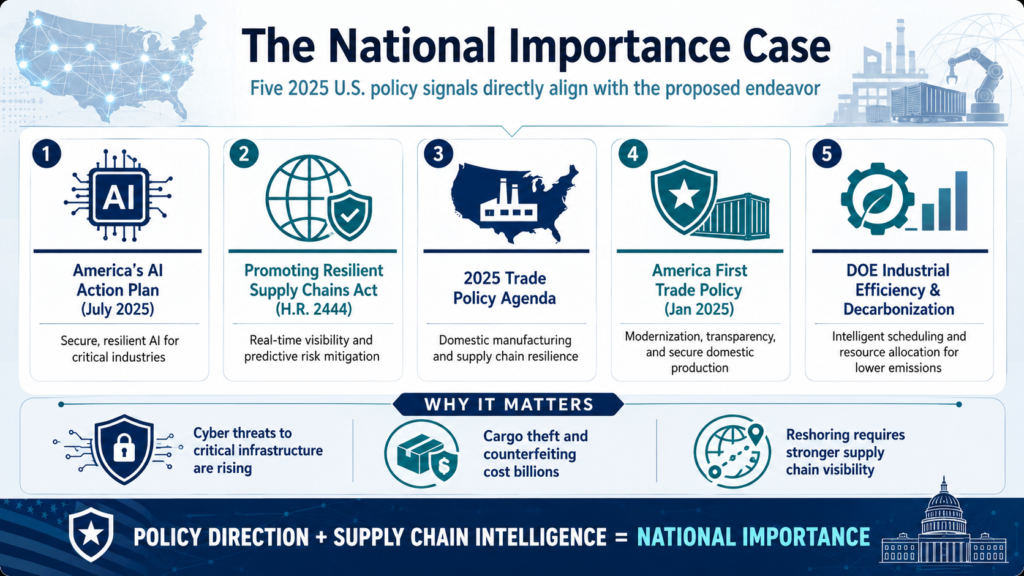
Five federal policy documents published in 2025 directly align with the proposed endeavor.
– America’s AI Action Plan (July 2025): Prioritizes AI integration into critical industries and explicitly calls for secure-by-design, robust, and resilient AI systems – exactly what the AI Decision-Making Core delivers to supply chain operations.
– Promoting Resilient Supply Chains Act of 2025 (H.R. 2444): Mandates identification and mitigation of supply chain risks to national security and economic stability through real-time visibility and predictive risk assessment.
– President Trump’s 2025 Trade Policy Agenda: Prioritizes domestic manufacturing, supply chain resilience, and reducing dependency on foreign suppliers – all directly addressed by supply chain intelligence ERP.
– America First Trade Policy EO (January 2025): Strengthens domestic production and supply chain security through modernization and transparency.
– DOE Industrial Efficiency and Decarbonization Office: Focuses on reducing industrial emissions through intelligent scheduling and resource allocation – the direct application of the ESG tracking module.
The supply chain vulnerabilities these policies address are quantified and current: the FBI reports a 300% increase in cyber incidents targeting critical infrastructure since 2019; cargo theft and counterfeiting cost the U.S. economy billions annually; over 40% of U.S. companies are exploring reshoring manufacturing – a transition that requires the supply chain visibility infrastructure his proposed system provides.
The Scholarly Foundation Is Solid
Eight peer-reviewed studies are cited in the First Prong, each directly validating a technical component of the proposed endeavor: Digital Twin supply chain resilience (RA Journal of Applied Research, 2025), Reinforcement Learning in supply chain management (Wiley review, 2024), Causal machine learning for risk prediction (International Journal of Production Research, 2025), microservice ERP architecture (Electronics, MDPI, 2024), IoT-blockchain supply chain traceability (Engineering Proceedings, MDPI, 2025), AI-driven ESG performance (Sustainability, MDPI, 2024), blockchain in ERP for supply chain transparency (IEEE, 2023), and the foundational link between digital supply chains and resilience (Sustainability, MDPI, 2024). The petition cited eight peer-reviewed studies, each connected to a specific technical component of the proposed endeavor and reviewed for source reliability.
How the Petition Was Built
This was a direct petition. The 12-year career record, enterprise client portfolio, certifications, and proposed technical framework were already in place.
– National importance sourcing: America’s AI Action Plan (July 2025), Promoting Resilient Supply Chains Act of 2025 (H.R.2444/CBO), Trump Trade Policy Agenda (2025), America First Trade Policy EO (January 2025), DOE IEDO decarbonization mission, Critical and Emerging Technologies List (2024), Drug Supply Chain Security Act (DSCSA), Industry 4.0 digital transformation framework, FBI cyber incident data (300% increase), supply chain disruption statistics (70% manufacturers, 75% executives), inventory cost data ($1T+ annually).
– Well-positioned evidence: Senior Specialist at a global tower infrastructure company managing D365 F&O lifecycle; Principal Consultant at technology firms delivering ERP for UAE oil company, Gulf conglomerate, and international retail body; custom ERP platform built from scratch for a major financial services firm; near real-time D365 CRM-Finance integration; globally integrated intercompany accounting module; Microsoft MB-500 Dynamics 365 Developer certification; MS Data Science; Employee of the Quarter; Exceptional Contribution Award; $100,000 personal investment committed.
I-140 filed as a self-petition without a U.S. employer.
The Outcome
Approved.A self-petitioned EB-2 NIW for an enterprise software architect who spent 12 years building, integrating, and optimizing ERP systems for major organizations across oil and gas, financial services, retail, and insurance, proposing to bring the next generation of AI-driven predictive intelligence to U.S. supply chain ERP at a moment when federal policy explicitly identifies supply chain modernization as a national priority.
U.S. supply chains lose over $1 trillion annually to inventory inefficiency alone, and 70% of manufacturers have experienced costly disruptions. The ERP systems running those supply chains can record those failures after the fact. His proposed endeavor builds the system that prevents them.
For ERP Architects and Enterprise Software Professionals
If your career is in enterprise software, ERP implementation, or digital transformation – particularly with platforms like Microsoft Dynamics 365, SAP, Oracle, or similar enterprise systems – and you have a track record of delivering complex integrations and custom implementations for major organizations, the NIW is worth a serious assessment. The Dhanasar test asks whether the proposed work has national importance and whether you are positioned to advance it. A 12-year record of enterprise ERP delivery for major clients, combined with a proposed system that addresses documented national supply chain vulnerabilities, is a direct answer to both.
Questions ERP and Enterprise Software Professionals Ask Us
Can an ERP architect or enterprise software developer qualify for an EB-2 NIW?
Yes. The Dhanasar test evaluates national importance and positioning, not the prestige of the field. Enterprise Resource Planning systems are the operational backbone of U.S. healthcare, manufacturing, and logistics – sectors that the federal government has specifically identified as critical infrastructure. A proposed endeavor that introduces AI-driven predictive intelligence, blockchain supply chain transparency, and automated ESG compliance into ERP systems addresses documented national supply chain vulnerabilities identified in the 2025 AI Action Plan, the Promoting Resilient Supply Chains Act, and the Trump Trade Policy Agenda. An ERP architect with 12 years of large-scale enterprise system delivery is well-positioned to advance it.
How does building a custom ERP from scratch differ from configuring an existing platform, and why does it matter for an NIW case?
Building a custom ERP from scratch is fundamentally different from configuring or implementing a commercial platform like Microsoft Dynamics 365, SAP, or Oracle. Custom development requires designing the data architecture, business logic layer, integration interfaces, security model, and user experience simultaneously, while ensuring regulatory compliance and operational reliability at enterprise scale. The distinction matters for an NIW case because it demonstrates a depth of software engineering capability that distinguishes the petitioner from the large pool of ERP configuration and implementation consultants. Someone who has built a production-grade custom ERP for a major regulated financial institution has demonstrated system design authority at the highest end of the discipline.
Does a Microsoft Dynamics 365 Finance & Operations Developer certification (MB-500) help a NIW case?
It contributes to the well-positioned argument by providing independent, Microsoft-issued validation of technical competency in the specific platform the petitioner works with and proposes to enhance. The MB-500 certification validates expertise in designing, customizing, and extending enterprise-scale ERP solutions, integrating with external systems, and managing application lifecycle on Microsoft’s cloud infrastructure. For a proposed endeavor centered on AI-powered ERP enhancement, a certification from the primary ERP platform’s vendor confirms the petitioner’s authority to propose and execute the envisioned technical improvements.
Twelve years building the ERP systems that run major enterprises is rare, specific evidence, see how Immignis turns enterprise software careers into approved NIW national-interest cases.