EB-2 NIW Financial Crime AI Case Study: He could not disclose his strongest algorithms, patent his core methods, or publish sensitive implementation details. The successful refile showed USCIS the national-security value of his work without exposing the trade secrets that made it valuable.
| Client profile | Pakistani fintech engineer working in London in AI-driven financial-crime detection and fraud prevention |
| Initial problem | Attorney-filed NIW denied because the case was framed around business value, not national importance |
| Profile-building engagement | Approximately 9 months |
| Corrected endeavor | AI-driven financial-crime detection and fraud-prevention systems for U.S. financial-system integrity |
| Outcome | Refiled EB-2 NIW approved without a Request for Evidence |
The success result
This case began after a denial and ended with an EB-2 National Interest Waiver approval without a Request for Evidence. The client was already a serious fintech engineer. He had spent about a decade building AI-driven systems for fraud detection, transaction-network analysis, behavioral risk scoring, and financial-crime prevention. His problem was not lack of expertise. His problem was that the first petition described his work as a commercial fintech solution instead of a national financial-security contribution. EB-2 NIW financial crime ai case study
The successful refile changed the record. It repositioned the case around U.S. financial-system integrity, critical financial-infrastructure resilience, and the need to defend payment and banking networks against organized criminal activity, state-sponsored threats, sanctions evasion, and systemic fraud. EB-2 NIW financial crime ai case study
The national problem behind the case
Financial crime is not only a private loss for banks or fintech companies. At scale, it affects consumer trust, sanctions enforcement, terrorism-financing controls, anti-money-laundering systems, digital-payment infrastructure, and the stability of the financial system. Criminal networks and state-aligned actors increasingly use synthetic identities, mule accounts, cross-border payment channels, account takeovers, and automated fraud to exploit financial infrastructure. EB-2 NIW financial crime ai case study
That was the stronger national-interest frame. The client’s work was no longer presented as a tool that helped one company reduce fraud. It was presented as AI-driven financial-crime infrastructure that could help protect the integrity of U.S.-linked financial systems. EB-2 NIW financial crime ai case study
Overall, the case demonstrated how AI-driven fraud detection can move beyond commercial application and become part of critical financial-system protection and national security resilience. EB-2 NIW financial crime ai case study
The weak starting point: valuable work hidden behind confidentiality
The most difficult part of the case was that his strongest work could not be shown directly. His core methods were proprietary, sensitive, and protected by employer and client confidentiality. In financial-crime detection, publishing the full detection logic can help criminals learn how to avoid it. Patenting can also be the wrong choice, because patent filings require public disclosure of methods that may be safer and more valuable as trade secrets.
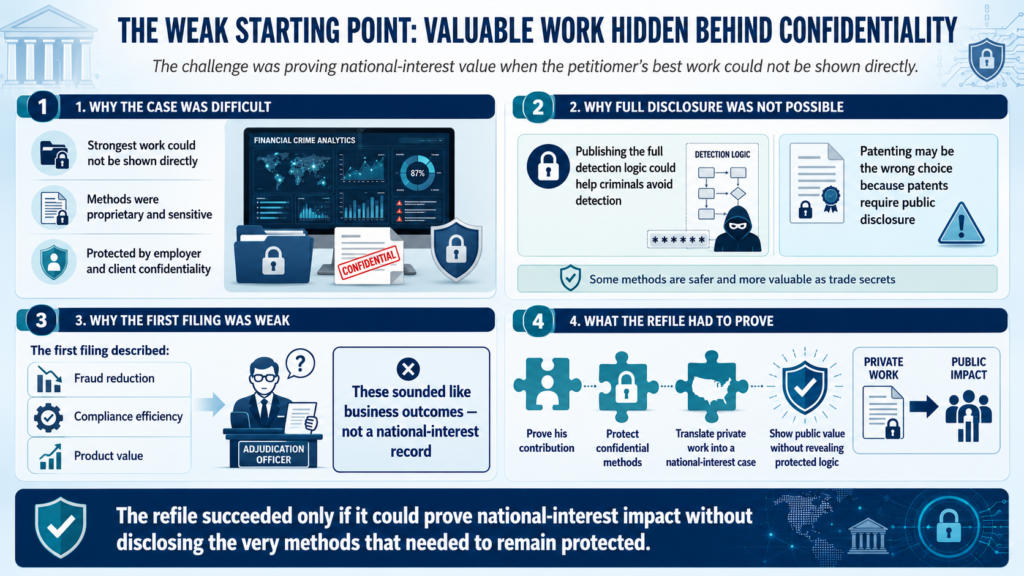
The first filing did not solve this problem. It described fraud reduction, compliance efficiency, and product value, but those points sounded like business outcomes. USCIS needed to see a national-interest record. The refile therefore had to prove his contribution without revealing the very methods that needed to remain protected.
The corrected proposed endeavor
Proposed endeavor: To develop and deploy AI-driven financial-crime detection and fraud-prevention systems that protect the integrity of the U.S. financial system against state-sponsored attacks, organized criminal networks, and large-scale systemic fraud, strengthening national financial security and the resilience of critical financial infrastructure.
This corrected endeavor changed the case. It identified the threat, the technical mechanism, and the national benefit. It also matched the client’s real work. He was not turned into an academic researcher, a patent-heavy inventor, or a general cybersecurity commentator. He was presented as what he was: a fintech engineer whose protected technical work belonged to a nationally important problem space.
What Immignis and AdvanceMyProfile built
1. A safe evidence strategy for proprietary work
We separated the record into three categories: what could never be disclosed, what could be discussed at a general technical level, and what could be independently verified. Proprietary algorithms, internal detection rules, client-specific performance data, and confidential deployment details stayed protected. Methodology-level concepts, such as graph-based anomaly detection, behavioral transaction modeling, financial-network risk scoring, and evaluation methods, became the public technical language of the case.
2. Methodology publications without exposing trade secrets
Working with domain support, we helped prepare focused papers that explained general methods relevant to financial-crime AI without disclosing employer systems or client-specific logic. The publication record was not inflated into an academic identity. It was modest, legitimate, and suited to an industry engineer working under confidentiality constraints. Independent citations then helped show that the methodology had relevance beyond his workplace.
3. Trade media and expert commentary in the right field
The visibility strategy avoided broad publicity and focused on specialist audiences: fintech, AML, fraud prevention, financial regulation, cyber-financial security, and compliance technology. Expert commentary addressed AI fraud detection, sanctions evasion, transaction-network monitoring, false-positive reduction, and financial-infrastructure resilience. This helped move the public record from “senior fintech employee” to “recognized voice in financial-crime AI.”
4. A targeted white paper for financial-crime stakeholders
A white paper was prepared on AI-driven fraud detection and financial-infrastructure resilience. It was written without exposing proprietary algorithms and shared with relevant audiences, including financial-crime compliance professionals, fintech and payments networks, and AML-focused stakeholders. Its value was practical and evidentiary: it showed that his expertise had been organized into a serious field-facing contribution.
5. Recognition, professional standing, and industry participation
The record was strengthened through a selective senior-grade professional membership, a conference presentation on AI and financial-crime prevention, and participation in a technical panel focused on fraud detection and financial-infrastructure resilience. These were not random profile additions. Each supported the same professional identity and the same proposed endeavor.
6. Independent letters that explained protected contribution
Because the strongest technical work could not be fully disclosed, recommendation letters had to translate protected expertise into evidence USCIS could evaluate. The letters came from independent professionals who could explain the significance of AI-driven financial-crime detection, the national-security relevance of financial-system integrity, and the value of methodology-level work without revealing confidential systems.
How the evidence supported Dhanasar
| Dhanasar issue | How the rebuilt profile answered it |
|---|---|
| Substantial merit and national importance | The endeavor was reframed from fintech business efficiency to protection of financial-system integrity, AML controls, consumer trust, and critical financial infrastructure. |
| Well positioned | Methodology publications, citations, specialist commentary, conference work, senior membership, white paper outreach, and independent expert letters showed capacity to advance the endeavor without exposing trade secrets. |
| Waiver benefit | The record showed that his work could contribute to a problem larger than one employer: preventing organized financial crime and strengthening the systems on which U.S.-linked financial activity depends. |
The refile and approval
The refile was built as a coherent evidence architecture rather than a bundle of unrelated achievements. The cover letter calmly addressed the prior denial and explained the difference between a commercial benefit and a national-interest contribution. The petition did not attack the prior filing. It showed how the new record corrected the deficiency. EB-2 NIW financial crime ai case study
USCIS approved the refiled EB-2 NIW petition without a Request for Evidence. The approval confirmed the value of the rebuilt strategy. EB-2 NIW financial crime ai case study Proprietary work can support a strong NIW when the case explains what can be shown, what must remain protected, and why the protected contribution matters to a national-interest problem. EB-2 NIW financial crime ai case study
What the client gained beyond approval
The approval was not the only result. The profile-building process gave him a public professional identity connected to financial-crime AI and financial-infrastructure resilience. His searchable record now included methodology publications, citations, expert commentary, a white paper, professional recognition, conference activity, and independent expert support.
After the profile was built, he moved into a stronger senior role connected to AI-driven financial-crime systems serving U.S.-linked financial institutions and compliance environments. His compensation improved, his professional inquiries became more serious, and his work was easier to explain without breaching confidentiality. The evidence supported the petition and also improved how the market understood his value.
Lessons for fintech, cybersecurity, and trade-secret professionals
- Proprietary work is not a disqualifier. A strong NIW can be built around protected contribution if the public evidence is designed carefully.
- A business case is not a national-interest case. Reduced losses and compliance efficiency help clients; financial-system integrity and resilience support the national-interest argument.
- Methodology papers can help when full technical disclosure is impossible, provided they do not reveal confidential systems or client-specific logic.
- White papers should be shared with relevant professional audiences, such as AML, fintech, payments, fraud-prevention, and compliance communities.
- Independent letters should explain the protected contribution without exposing it.
- The best profile-building strategy documents the client’s real expertise. It does not force an industry engineer into an artificial academic or patent-heavy profile.