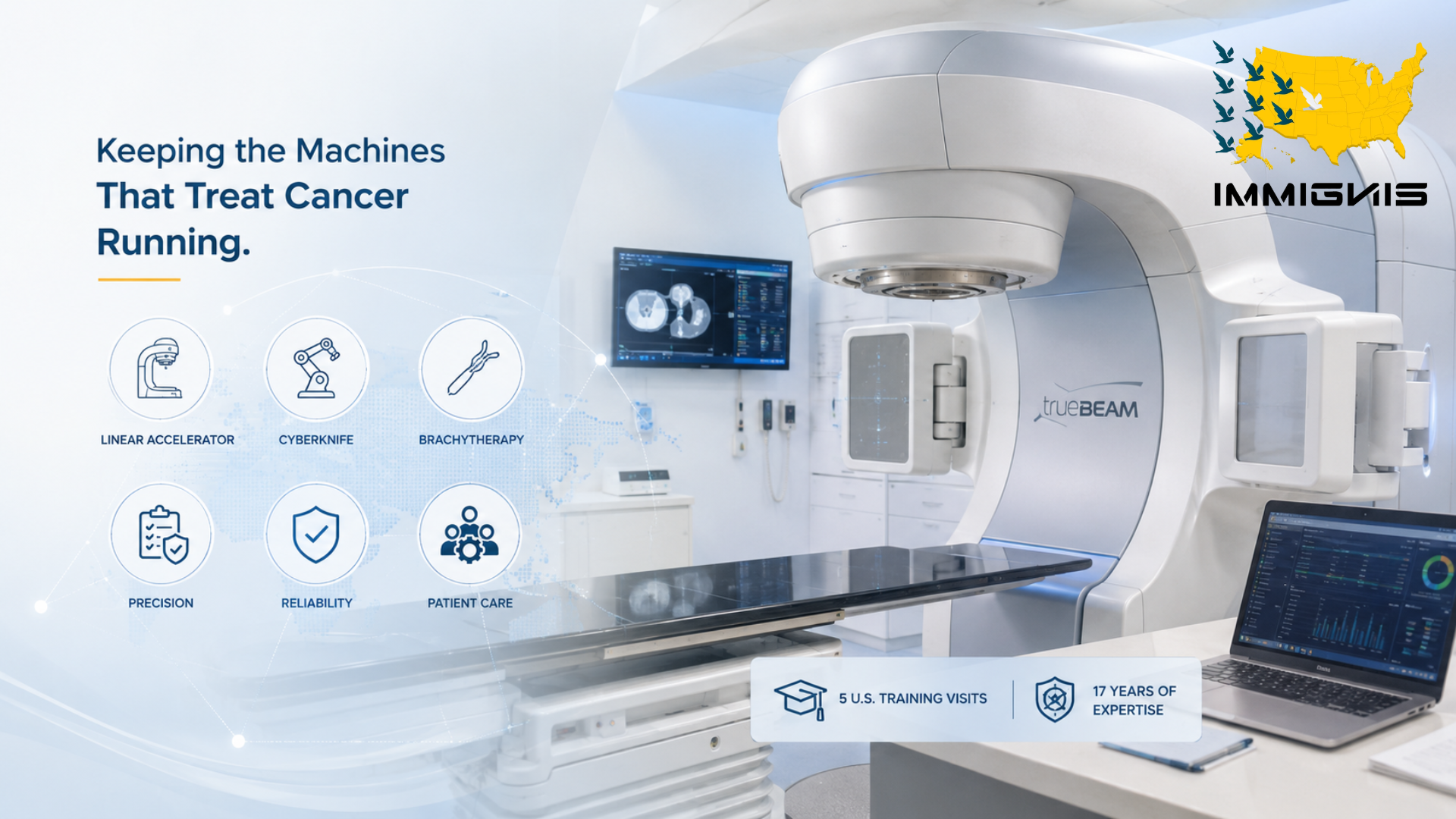
A radiation oncology technical officer and biomedical engineer, EB-2 NIW for Biomedical Engineer, who maintained linear accelerators, CyberKnife, and brachytherapy systems for 17 years, including five training visits to U.S. manufacturer facilities in Nevada and Wisconsin, was approved for an EB-2 National Interest Waiver after the case was framed around radiation oncology equipment reliability, patient access, and specialized biomedical workforce needs, making it a strong EB-2 NIW for Biomedical Engineer example.
| In short: A biomedical engineer holding a Bachelor of Science in Biomedical Engineering, with 17 years of progressive specialization in radiation oncology equipment, including TrueBeam, Trilogy, CyberKnife, brachytherapy systems, and CT simulators used in cancer treatment, was approved for an EB-2 National Interest Waiver as a self-petitioner. Western Australia-based Pakistani national. He was trained by Varian Medical Systems at their Las Vegas, Nevada facilities four times and by Accuray Incorporated in Madison, Wisconsin once. His role involved sole technical responsibility, with no manufacturer service contracts, for five TrueBeam Linacs, one CyberKnife, and two additional radiation oncology systems at the largest public cancer treatment hospital in Western Australia. He held Radiation Service Licenses from the WA Radiological Council and was registered as a Professional Engineer with Engineers Australia. Approved under Matter of Dhanasar. |
The petitioner’s name, contact details, and employer names have been withheld for privacy. Career record, training certifications, licenses, and outcome are real.
The Machines That Deliver Radiation to Cancer Patients: EB-2 NIW for Biomedical Engineer
Most people understand that cancer treatment involves radiation therapy. Fewer understand what makes that radiation therapy possible at a physical level: linear accelerators, or Linacs, that produce precise, high-energy X-ray beams aimed at tumors; CyberKnife systems that deliver radiation from hundreds of angles with sub-millimeter accuracy; and brachytherapy units that place radioactive sources directly inside or near tumors, which made this an important EB-2 NIW for Biomedical Engineer case.
These are not machines that a general biomedical technician services. They involve high-voltage RF systems, electron beam generation, dosimetry calibration, radiation safety compliance, and real-time treatment planning software. When they are down, cancer patients wait for treatment. When they are miscalibrated, the consequences are clinical.
At the largest public cancer treatment hospital in Western Australia, he was responsible for five Varian TrueBeam Linacs, one Varian Trilogy iX, one GammaMed Brachytherapy system, one M6 CyberKnife, and one Toshiba CT Simulator, all without manufacturer service contracts. When something failed or required a software upgrade, his team handled it internally. He acted as team manager during normal operations, further supporting the EB-2 NIW for Biomedical Engineer argument.
Five Trips to U.S. Manufacturer Facilities
A central strength of the EB-2 NIW for Biomedical Engineer case was his direct U.S. manufacturer training.
He completed four visits to Varian Medical Systems’ training facility in Las Vegas, Nevada: TrueBeam Technical Maintenance 1, TrueBeam Technical Maintenance 2, Eclipse 15.6-16.1 Upgrade Training, and TrueBeam Technical Maintenance 3 Enhanced Support. These were sequential, level-by-level certifications in one of the world’s most widely deployed radiation oncology platforms.
He also completed CyberKnife Service and Maintenance training for M6 and Legacy Systems at Accuray Incorporated in Madison, Wisconsin. Accuray’s CyberKnife is one of the most precise stereotactic radiation therapy platforms available.
These training visits mattered because they showed that his technical expertise had been evaluated, verified, and certified by the American companies that manufacture the systems used across U.S. cancer treatment centers. Varian and Accuray do not provide manufacturer-level maintenance training to engineers who are not qualified to execute it. He received that training five times.
U.S. cancer treatment centers run on Varian and Accuray equipment. His training was completed at the same U.S. manufacturer facilities that support those machines. There was no meaningful technology gap between his qualifications and what U.S. hospitals need, strengthening the EB-2 NIW for Biomedical Engineer argument.
Seventeen Years, Four Countries, Every Major Radiation Oncology Platform
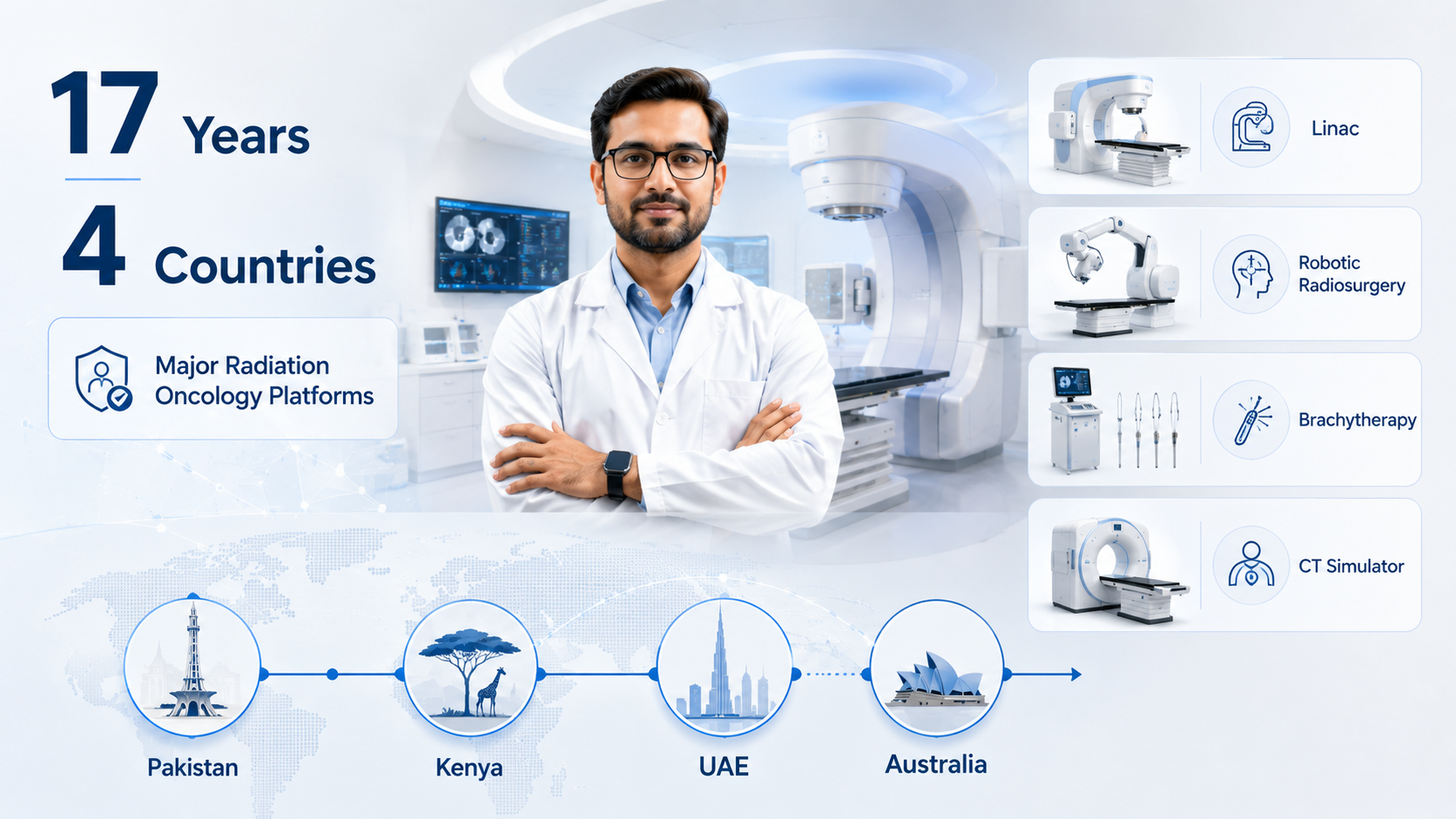
His career followed a specific path through radiation oncology engineering, with each step expanding his equipment range and operational responsibility.
He began in 2008 at a major Pakistani hospital as a biomedical engineer responsible for a Siemens Linac, Cobalt-60 machine, Varian Simulator, and Nucletron Brachytherapy system. He worked directly with Siemens engineers on tube replacements and beam calibration, and coordinated with Pakistan’s Nuclear Regulatory Authority for source output verification. That early experience with legacy equipment, radioactive source handling, and regulatory compliance formed the technical baseline for his later work.
He then moved to a Varian Medical Systems distributor in Pakistan and was deployed as the onsite project engineer at a major international teaching hospital in Nairobi, Kenya. There, he commissioned High Energy Clinac DHX systems and GammaMed Brachytherapy with Varian engineers, installed Eclipse Treatment Planning System, and performed regular radioactive source exchanges. Being trusted with the commissioning of radiation oncology equipment at a major teaching hospital reflected institutional confidence in his technical capability.
He later served as Senior Biomedical Engineer at a JCI-accredited hospital in Dubai, responsible for the Varian Trilogy Linac, Eclipse TPS, and Philips Brilliance CT Big Bore Simulator. At a JCI-accredited institution, every process is audited against international standards. His performance in that environment confirmed his ability to operate within high institutional expectations.
Since January 2017, he had held his role in Perth, where his responsibility expanded to five TrueBeam systems, a CyberKnife, a Brachytherapy unit, and a CT Simulator, all maintained internally with no manufacturer fallback.
The Western Australia Licenses
Maintaining radiation oncology equipment in Australia requires formal regulatory authorization, which supported the EB-2 NIW for Biomedical Engineer case. He held three relevant licenses: a Restricted Electrical Worker’s Permit from the Electrical Licensing Board of Western Australia, a Radiation Service License for Diagnostic X-ray and Linear Accelerator from the WA Radiological Council, and a Radiation Service License for Radiation Sources/Radioactive Substances from the WA Radiological Council.
The radioactive substances license specifically authorized his handling of iridium-192 sources used in brachytherapy. These source exchanges are safety-sensitive procedures involving radioactive material, clinical treatment equipment, and strict regulatory control.
These Australian regulatory authorizations showed that independent regulatory bodies had evaluated his qualifications and authorized him to work with ionizing radiation equipment and radioactive materials. This evidence was separate from his employer’s assessment of competence and directly supported the well-positioned EB-2 NIW for Biomedical Engineer argument.
Why the Case Worked
The approval was built around a rare combination of U.S. manufacturer training, hospital-based radiation oncology responsibility, formal radiation licenses, and long-term experience across multiple countries.
- Five U.S. manufacturer training visits at Varian in Las Vegas and Accuray in Madison, creating a direct U.S. technology connection to equipment widely used in American cancer treatment centers.
- Varian Hardware Level 2 Beam Certified Engineer status, an advanced technical certification requiring demonstrated ability to calibrate and verify beam output on clinical machines.
- Sole technical responsibility for five TrueBeam systems, CyberKnife, and Brachytherapy equipment without manufacturer service contracts, one of the highest accountability levels a hospital-employed radiation oncology engineer can hold.
- Western Australia Radiation Service Licenses for both Linac/X-ray equipment and radioactive substances, giving the case independent regulatory validation.
- Professional engineering recognition through Engineers Australia, along with engineering registrations across multiple countries.
- A career covering Pakistan, Kenya, the UAE, and Australia, with U.S. manufacturer training throughout, showing adaptability across different healthcare systems, regulatory environments, and institutional standards.
The Proposed Endeavor
The proposed endeavor was framed around supporting U.S. cancer treatment centers through specialized radiation oncology equipment engineering, with a focus on Linac, CyberKnife, brachytherapy, and CT simulator reliability.
The work connected directly to patient access. Radiation therapy depends on machines that must remain calibrated, functional, and available. When a Linac or CyberKnife system goes down, treatment schedules are disrupted and patients may face delays in care. His proposed work addressed that gap by bringing advanced manufacturer-certified service capability, radiation safety experience, and clinical equipment reliability expertise to U.S. healthcare facilities.
The case also connected his expertise to the documented shortage of specialized biomedical and healthcare technology professionals. Radiation oncology engineering is a narrow subspecialty inside biomedical engineering. The machines are complex, the safety standards are high, and the workforce capable of independently maintaining these systems is limited.
The Outcome
Approved.
A self-petitioned EB-2 NIW, an EB-2 NIW for Biomedical Engineer case, for a radiation oncology equipment engineer with 17 years of specialized experience across Linacs, CyberKnife, brachytherapy, and CT simulators; five US manufacturer training visits; formal Australian radiation licenses; and direct responsibility for major cancer treatment equipment without manufacturer service contracts.
The case succeeded because it did not present him as a general biomedical engineer. It presented him as a specialized radiation oncology equipment engineer whose work directly affects cancer treatment continuity, equipment safety, patient access, and the reliability of critical healthcare infrastructure, making it a strong EB-2 NIW for Biomedical Engineer example.
For Radiation Oncology Engineers
If your career involves maintaining, installing, calibrating, or troubleshooting Linacs, CyberKnife, brachytherapy systems, CT simulators, or other radiation oncology equipment, the EB-2 NIW can be a serious option when the case is framed around patient access, specialized workforce shortages, equipment reliability, and national healthcare needs.
The strongest cases are built around specific equipment expertise, manufacturer certifications, regulatory licenses, measurable responsibility, and a proposed endeavor that explains how the professional’s work can benefit U.S. healthcare facilities beyond a single employer.
Questions Radiation Oncology Engineers Ask Us
Can a radiation oncology equipment engineer qualify for an EB-2 NIW?
Yes. The EB-2 NIW evaluates whether the proposed endeavor has substantial merit and national importance and whether the petitioner is positioned to advance it. Radiation therapy depends on linear accelerators, CyberKnife, and brachytherapy systems maintained by highly specialized engineers. A radiation oncology engineer with 17 years of documented, licensed, manufacturer-certified experience across major treatment platforms can present a strong case when the proposed endeavor is tied to U.S. healthcare access and specialized workforce needs.
Does repeated manufacturer training at U.S. facilities help a non-U.S.-resident NIW case?
Yes. Five training visits to U.S. manufacturer facilities, four at Varian Medical Systems in Las Vegas and one at Accuray Incorporated in Madison, established that the petitioner’s technical expertise had been directly evaluated and certified by the American companies whose equipment dominates the U.S. radiation oncology market. That connection strongly supported the well-positioned argument.
What is Varian’s Hardware Level 2 Beam Certified Engineer status, and why does it matter?
Varian’s Hardware Level 2 Beam Certification is an advanced technical certification for field service engineers. It reflects the ability to perform beam calibration and dosimetry verification on clinical Linacs, one of the most safety-critical maintenance functions in radiation oncology. Independent, manufacturer-issued authorization for this work directly supports the claim that the engineer is positioned to advance a radiation oncology equipment reliability endeavor.
What made this case different?
The case was strong because it combined five U.S. manufacturer training visits, 17 years of radiation oncology equipment experience, sole responsibility for major hospital treatment systems, radiation licenses covering both Linac/X-ray equipment and radioactive substances, and a proposed endeavor tied to cancer treatment continuity in the United States.
If you work with Linacs, CyberKnife, or brachytherapy systems, Immignis can help assess whether your radiation oncology engineering background supports an EB-2 NIW strategy. Start with a free assessment today.