
A chemical and safety engineer with 18 years in major onshore oil operations secured approval for a National Interest Waiver built around flare reduction, methane detection, carbon utilization, and integrated HSE systems for the U.S. energy sector.
In short: A Pakistani chemical and safety engineer with 18 years of oil and gas HSE experience was approved for EB-2 NIW based on a proposed U.S. endeavor focused on safer and cleaner oil and gas operations. This EB-2 NIW for Oil and Gas Engineers case included a 100-well flare-elimination program, LDAR surveys, drone-based methane detection, carbon capture and utilization exposure, biodiversity studies, and a U.S.-issued Certified Safety Professional credential. The petition succeeded by presenting emissions reduction, process safety, and carbon-management expertise as a practical national-interest contribution to U.S. energy operations.
Privacy note: The petitioner’s name, employer identity, project location details, and personal identifiers have been suppressed for public publication.
The Problem: Production Cannot Be Separated From Safety and Emissions Control
The United States remains one of the world’s most important oil and gas producers. That position creates a practical challenge: production growth, energy security, methane control, carbon management, worker safety, and community confidence must be managed together. A petition in this field cannot rely on broad environmental language alone. It must show a professional record that connects engineering, operational safety, measurable emissions reduction, and economic value. This EB-2 NIW for Oil and Gas Engineers case did exactly that.
The strongest fact in the record was direct and numerical. In a simultaneous program across 100 oil wells, the petitioner helped implement a flare-free methodology that reduced gas flaring by 23 million cubic feet per day, avoided approximately 2,300 tons of CO₂-equivalent emissions, and generated about USD 19.5 million in recovered economic value in a single year. That kind of evidence is highly useful in an NIW petition, especially an EB-2 NIW for Oil and Gas Engineers petition, because it shows both environmental benefit and operational value.
Eighteen Years Inside Major Oil and Gas Operations
The petitioner began his HSE career in field safety engineering and later spent more than 15 years with a major Middle Eastern national oil company, progressing through successive safety, environmental, and sustainability roles across large onshore oil-field operations in this EB-2 NIW for Oil and Gas Engineers case. His work covered field development, process safety, asset integrity, contractor safety, environmental monitoring, emergency response planning, and operational sustainability.
His professional credentials strengthened the EB-2 NIW for Oil and Gas Engineers case. He held the Certified Safety Professional designation from the U.S.-based Board of Certified Safety Professionals, Functional Safety Engineer certification from TÜV SÜD, ISO 45001 Lead Auditor certification, credentials in international and oil-and-gas operational safety, and membership in the Society of Petroleum Engineers. For USCIS, this mattered because the proposed endeavor required proof that he could operate within technical, safety, and regulatory systems, not only describe them.
The Proposed Endeavor in an EB-2 NIW for Oil and Gas Engineers Case: Practical Emissions and Safety Modernization
The approved endeavor, in this EB-2 NIW for Oil and Gas Engineers case, was framed around independent consulting for U.S. oil and gas operators, with emphasis on three connected areas.
First, he proposed to apply flare-reduction and flare-free debris-management methods to help operators reduce unnecessary gas burning during testing and production activities. The petition did not present this as theory. It tied the methodology to a documented 100-well implementation history.
Second, he proposed carbon capture and utilization support, including CO₂ injection and enhanced recovery applications where technically and economically suitable. This was connected to his direct exposure to carbon capture and active CO₂ injection projects.
Third, he proposed integrated HSE and environmental systems, including LDAR surveys, drone-based methane detection, biodiversity protection, waste-management planning, and emergency-response frameworks. This made the proposed work, in this EB-2 NIW for Oil and Gas Engineers case, broader than a single environmental technology. It became a field-ready safety and emissions-management model for operators that need practical implementation.
Why the Case Had National Importance
The national importance argument in this EB-2 NIW for Oil and Gas Engineers case was built around the scale of the U.S. oil and gas sector, the federal focus on methane and air-pollution control, the continuing relevance of carbon capture incentives, and the role of safety engineering in responsible energy development. The petition avoided a narrow “green energy” narrative and instead explained that U.S. oil and gas production still requires better methods for reducing emissions, improving safety, and preserving economic output.
This was a stronger approach for an EB-2 NIW for Oil and Gas Engineers case because it aligned with both sides of the current policy environment: energy security and responsible operations. Expanded domestic energy activity increases the need for professionals who know how to reduce flaring, detect methane, manage carbon streams, and protect workers and surrounding communities.
How the Petition Was Built
The petition’s First Prong in this EB-2 NIW for Oil and Gas Engineers case focused on the public importance of emissions reduction, carbon management, oil and gas safety, and efficient domestic energy operations. EPA methane and air-pollution frameworks, DOE carbon-management resources, and Section 45Q carbon-capture incentives gave the argument a concrete policy foundation.
The Second Prong was the center of the EB-2 NIW for Oil and Gas Engineers approval strategy. Instead of relying on general experience, the petition highlighted specific, verifiable achievements: the 100-well flare-elimination program, LDAR implementation, drone-based methane detection, biodiversity work, process-safety leadership, clean-energy transition exposure, and direct participation in carbon capture and utilization initiatives. The U.S.-issued CSP credential also helped show readiness for American safety expectations.
The Third Prong explained why the proposed work was best advanced without tying him to one employer. A single oil and gas company could use his expertise internally, but the national value of the endeavor came from applying the methodology across multiple operators, fields, and compliance environments.
What Made This Case Distinct
Many energy NIW petitions focus on equipment, production, project management, or process engineering. This case stood out because it sat at the intersection of oil and gas operations, environmental compliance, carbon management, and worker safety. It was not simply a climate petition and not simply a safety petition. It showed how a safety engineer can reduce emissions, preserve economic value, and improve operational reliability at the same time.
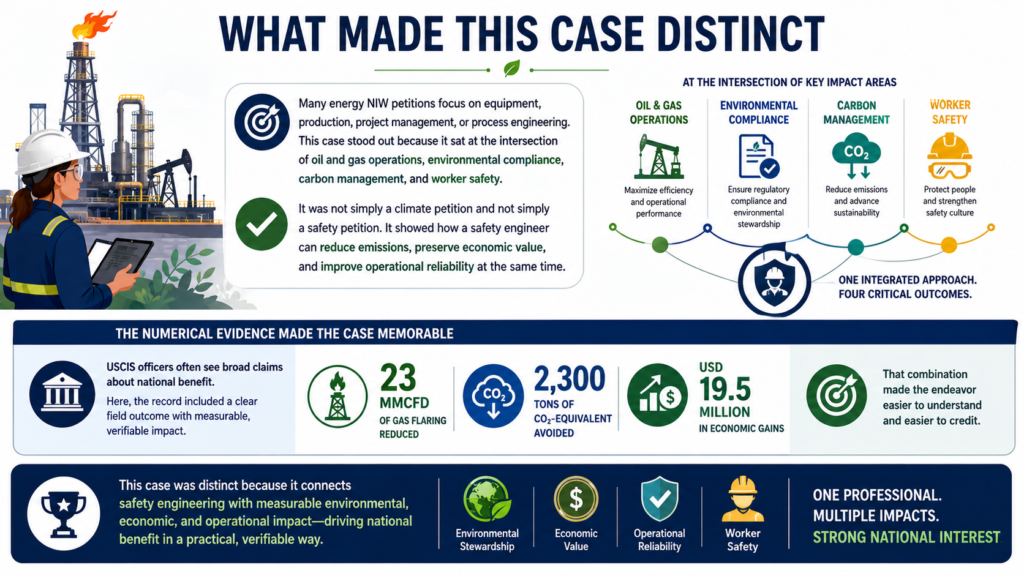
The numerical evidence also made the case memorable. USCIS officers often see broad claims about national benefit. Here, the record included a clear field outcome: 23 MMCFD of gas flaring reduced, 2,300 tons of CO₂-equivalent avoided, and USD 19.5 million in economic gains. That combination made the endeavor easier to understand and easier to credit.
The Outcome
USCIS approved the EB-2 National Interest Waiver petition. The approval recognized that the petitioner’s proposed work in oil and gas safety, emissions reduction, flare elimination, and carbon-management implementation carried substantial merit and national importance; that his 18-year professional record positioned him to advance the endeavor; and that the United States would benefit from waiving the job-offer and labor-certification requirements.
For engineers in HSE, process safety, oil and gas emissions, methane control, carbon capture, and energy operations, this case shows that NIW success does not require a purely academic research profile. A field-based engineer with strong credentials, measurable outcomes, and a practical U.S. implementation plan can present a compelling national-interest case.
Questions This Case Answers
Can an HSE or safety engineer qualify for EB-2 NIW?
Yes. The case must show that the work affects a broader U.S. interest, such as worker safety, emissions reduction, operational reliability, carbon management, or responsible energy production.
Does oil and gas work still fit a national-interest argument?
Yes, when framed carefully. The strongest cases connect domestic energy operations with safety, methane control, emissions reduction, compliance, and economic efficiency.
Was the U.S.-issued CSP credential important?
Yes. It helped show that the petitioner’s safety expertise was not only international but also aligned with U.S. professional expectations.
What made the Second Prong strong?
Quantified field achievements. The petition did not simply say the petitioner was experienced. It showed measurable reductions in flaring, emissions, and operational waste.
| “The petition succeeded because the national-interest story was connected to measurable field outcomes: reduced flaring, avoided emissions, recovered economic value, methane detection, carbon utilization, and safety leadership.” |
Your HSE, oil and gas, methane control, or carbon capture experience may be stronger than it first appears.
Immignis helps turn measurable field impact into focused EB-2 NIW strategies built around U.S. national interest.