EB-2 NIW HR professional case showing how a Pakistani HR professional’s background in youth development, large-scale recruitment, inclusive HR operations, and workforce technology was converted into an approved national-interest case focused on underserved communities and job-seeker-centered employment access.
Case Snapshot
| Client profile | Pakistani human resources professional and entrepreneur based in the United States, with an MBA in Human Resource Management and ongoing U.S. graduate study. |
| Professional field | Human resource management, youth development, workforce inclusion, recruitment operations, training, and employment access. |
| Proposed endeavor | To drive U.S. economic growth and inclusivity in underserved regions through youth empowerment programs and an employment-seeker-centric HR platform. |
| Initial challenge | The record contained strong HR and youth-development experience, but it needed to be converted into a clear national-interest narrative focused on a U.S. workforce-development problem. |
| Evidence built around | BRAC youth programs, large-scale HR operations, recruitment scale-up, inclusive remote-work opportunities, training programs, LinkedIn influence, SHRM membership, and HR entrepreneurship. |
| Outcome | EB-2 NIW I-140 approved. |
The Approval Result
This case ended with an EB-2 National Interest Waiver approval for a Pakistani human resources professional, an EB-2 NIW HR professional, whose record was strongest when it was organized around one specific U.S. problem: many underserved young people and marginalized job seekers need clearer pathways from education, training, and informal experience into real employment opportunities.
The client’s background as an EB-2 NIW HR professional could easily have been presented as ordinary HR management. That would have weakened the petition. The successful strategy reframed the record around youth workforce development, inclusive employment access, AI-assisted job matching, training, mentoring, and employer-facing recruitment systems that could support broader labor-market participation.
The approval showed that human resources work can support a strong NIW case when the proposed endeavor is not limited to internal hiring. The case became persuasive because it connected the petitioner’s HR experience as an EB-2 NIW HR professional to a scalable workforce-access model with public and economic value.
The National Problem: Workforce Access Remains Unequal
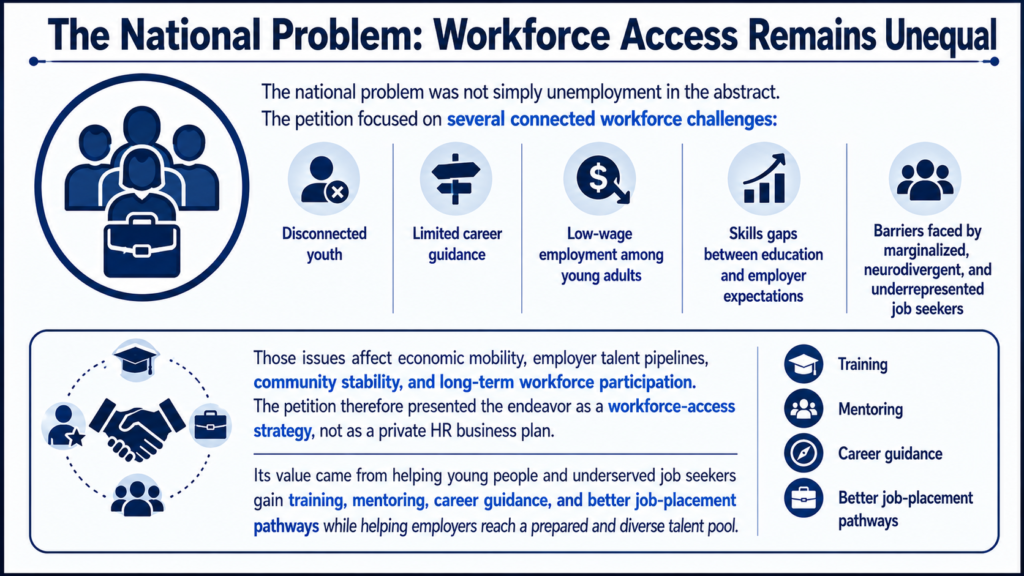
The national problem was not simply unemployment in the abstract. The petition focused on several connected workforce challenges: disconnected youth, limited career guidance, low-wage employment among young adults, skills gaps between education and employer expectations, and barriers faced by marginalized, neurodivergent, and underrepresented job seekers.
Those issues affect economic mobility, employer talent pipelines, community stability, and long-term workforce participation. The petition therefore presented the endeavor as a workforce-access strategy, not as a private HR business plan. Its value came from helping young people and underserved job seekers gain training, mentoring, career guidance, and better job-placement pathways while helping employers reach a prepared and diverse talent pool.
The Proposed Endeavor
To drive U.S. economic growth and inclusivity in underserved regions through youth empowerment programs and an employment-seeker-centric HR platform that provides personalized career guidance, skill-development pathways, AI-assisted job matching, mentoring, and employer-facing recruitment tools as an EB-2 NIW HR professional.
This formulation gave the EB-2 NIW HR professional case a stronger national-interest foundation because it connected two practical components. The youth-development component addressed barriers at the community level. The HR-platform component addressed inefficiencies in job matching, candidate preparation, recruitment operations, and employer access to diverse talent for an EB-2 NIW HR professional.
What Immignis and AdvanceMyProfile Built
The profile-building strategy converted a broad HR background into a focused EB-2 NIW story for an EB-2 NIW HR professional. The client was not presented only as an HR manager. She was positioned as a workforce-inclusion professional with a record of building HR systems, scaling recruitment operations, training young people, and creating employment access for marginalized groups.
• A clear proposed endeavor focused on underserved youth, workforce inclusion, and job-seeker-centered HR innovation.
• A Dhanasar-ready national-importance theory linked to youth unemployment, opportunity youth, skills gaps, inclusive hiring, and economic mobility for an EB-2 NIW HR professional.
• A well-positioned argument based on BRAC youth programs, HR department building, large-scale recruitment, training, remote-work inclusion, and entrepreneurship.
• A stronger evidence architecture connecting prior work in Pakistan and global HR practice to a future U.S. implementation model.
• A public-facing professional identity that translated HR leadership into a workforce-development and inclusive-employment mission as an EB-2 NIW HR professional.
How the Evidence Supported Dhanasar
| Dhanasar prong | Evidence used | Strategic value |
| Prong 1: Substantial merit and national importance | Youth workforce development, job-market inclusion, skills training, inclusive hiring, and modern HR technology. | Moved the case from routine HR management to a national workforce-access and economic-mobility problem. |
| Prong 2: Well positioned | BRAC youth programs, recruitment scale-up, HR department building, remote-work inclusion, entrepreneurship, LinkedIn influence, and SHRM membership. | Showed the client had already worked in the kinds of HR, training, and employment-access environments required to advance the endeavor. |
| Prong 3: Waiver benefit | Cross-community, cross-employer implementation involving community partners, educational institutions, employers, and technology-enabled HR support. | Supported the argument that the endeavor was broader than one employer-specific HR role and better suited to a self-directed national-interest pathway. |
Why the Profile Became Stronger After Reframing
The original materials contained useful facts, but the strongest case emerged only after the record was organized around a clear U.S. workforce-development problem. General statements about HR experience were converted into evidence of implementation capacity: youth programming, recruitment operations, remote-work inclusion, training, employer coordination, and platform-based employment support.
The transformed story also made the public value easier to understand. It showed that an HR professional can support a national-interest petition when the endeavor is framed around a measurable public workforce problem, supported by implementation history, and connected to scalable tools that go beyond one employer.
Filing and Approval
The final petition was filed as an evidence architecture, not as a general employment history. The proposed endeavor explained the workforce-access problem. The client’s HR and youth-development record showed practical implementation capacity. The Dhanasar analysis connected each item to the legal standard.
USCIS approved the EB-2 NIW I-140. The approval confirmed that a human resources and workforce-development case can succeed when the petition clearly explains the national problem, the scalable proposed solution, and the petitioner’s ability to advance that solution.
What the Client Gained Beyond Approval
The approval was the immigration result, but the profile-building process also gave the client a clearer professional identity. Her work could now be explained as a focused contribution to inclusive workforce access, youth employment pathways, and job-seeker-centered HR technology, rather than as a general HR background.
That clarity strengthened her professional positioning for conversations with workforce organizations, employers, community partners, training providers, education institutions, and inclusive hiring stakeholders. The same record that supported the petition also made her value easier for the market to understand.
What Professionals Can Learn From This Case
- Human resources work should not be presented as routine hiring; it should be connected to a specific national workforce challenge.
- Youth development and underserved-community work become stronger when supported by implementation history, partnerships, training outcomes, and employer-facing tools.
- AI-assisted job matching should be framed responsibly as decision support, not as a replacement for human judgment or fair hiring safeguards.
- Profile building is strongest when it documents real work already performed and organizes that work into a credible U.S. implementation plan.
- Ethical profile building does not manufacture a false profile. It identifies the strongest real evidence and organizes it around a defined national-interest problem.
Professionals in human resources, workforce development, training, education, inclusion, and community employment can often underestimate the national-interest value of their work. The key is to show how their experience solves a broader U.S. problem, how their work can scale, and why their record supports future implementation.To explore whether your profile can be developed into a credible EB-2 NIW strategy, visit Immignis.us