Eb-2 NIW Hydropower Engineer: A control and instrumentation engineer who spent years making critical modifications to Pakistan’s largest hydropower project – approved for an EB-2 NIW to build an IIoT-based predictive monitoring system for U.S. hydropower plants.
In short: A control, instrumentation, and automation engineer holding a Master of Science in Electrical and Electronic
Engineering from a UK university and a Bachelor of Science in Electronic Engineering, with extensive experience spanning
hydropower plant control systems, industrial automation, and renewable energy, was approved for an EB-2 National
Interest Waiver as a self-petitioner. Pakistani national. He serves as Assistant Executive Engineer (Electronics) at Pakistan’s
national water and power authority, stationed at Pakistan’s largest hydropower project (four 243MW turbines), where the
Control & Instrumentation section he works in oversees the entire plant’s control systems. He holds a Pakistan Engineering
Council license (14 years), a government-funded research grant from Pakistan’s National Technology Fund, a published
research paper, and a peer-reviewed conference speaking invitation in Canada. He has received a Letter of Intent from a
U.S. professor of data science supporting his proposed endeavor. Proposed endeavor: design and develop an advanced
real-time IIoT-based monitoring system for U.S. hydropower plants using polynomial neural networks, SCADA integration, |
and AI-driven predictive maintenance. Approved under Matter of Dhanasar.
The petitioner’s name and employer names have been withheld for privacy. Career record, technical projects, credentials, and outcome are real.
The Problem With Losing One Node
Pakistan’s largest hydropower project manages 12,000 control signals across six Local Control Units. Each LCU connects to three Remote Input/Output modules. Each RIO connects through six Network Interface Units. In the original configuration, those NIUs were linked in series. If a single NIU failed, the chain broke. Every control signal to every turbine would be lost simultaneously. Four turbines totaling 969 megawatts, suddenly without control.
He saw the vulnerability. He redesigned the network: STAR topology within each LCU and RIO, RING topology between them. The result: a single NIU failure now affects only its own node. The rest of the network continues functioning. The turbines keep running.
That modification is one of twelve he made to the same facility. Each one addressed a real failure mode. Each one kept the plant operating when it would otherwise have tripped, flooded, or needed an emergency shutdown.
His proposed U.S. endeavor is to build a system that catches those problems before they require a modification at all.
Why U.S. Hydropower Needs This Now
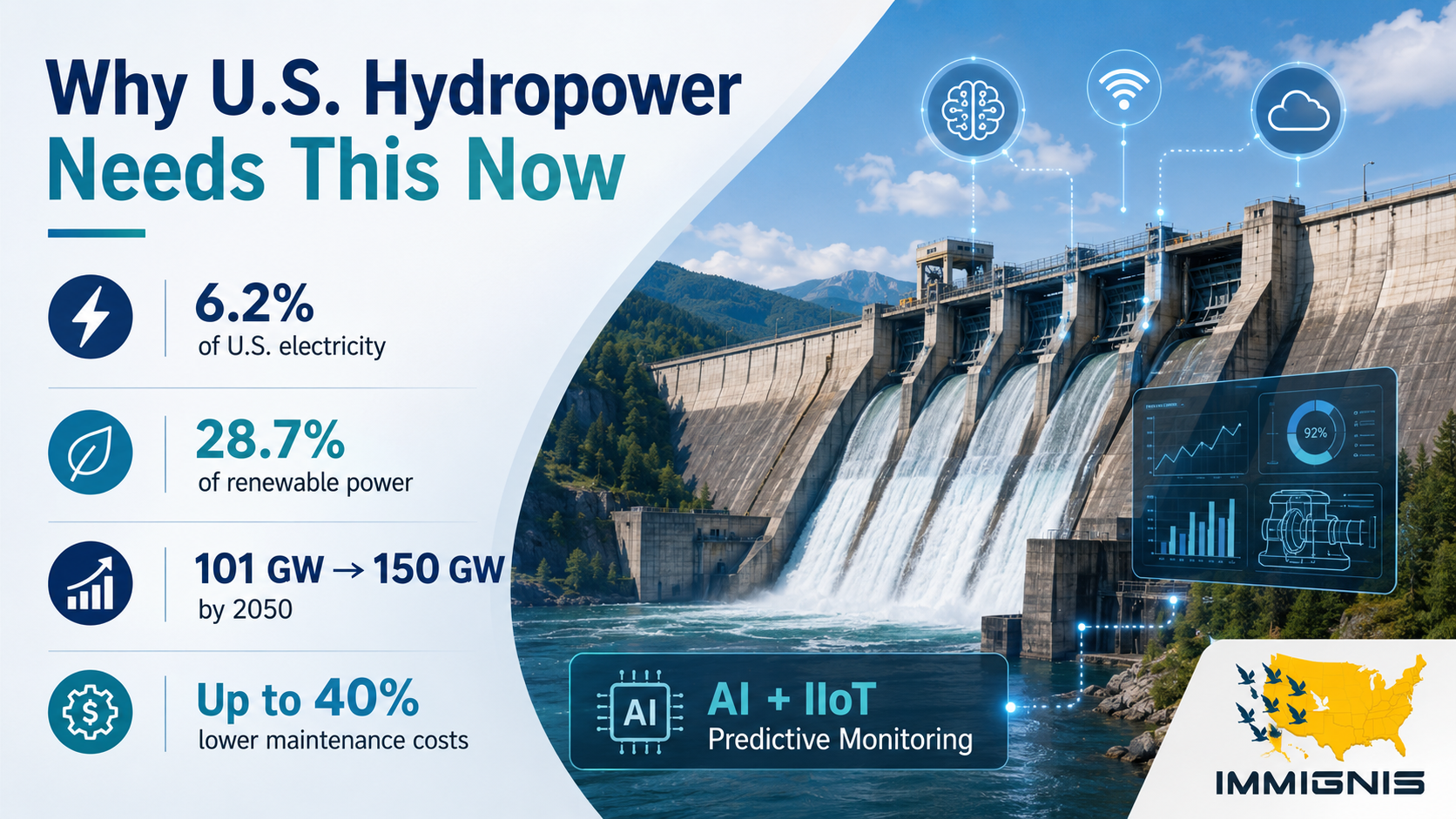
Hydropower accounts for 6.2% of total U.S. electricity generation and 28.7% of all U.S. renewable electricity. The U.S. Department of Energy’s Hydropower Vision analysis projects growth from 101 GW to nearly 150 GW of combined electricity generating and storage capacity by 2050. That growth, combined with the National Energy Emergency declaration of January 2025, makes the reliable operation of existing hydropower infrastructure an urgent national priority.
Predictive maintenance technologies can reduce hydropower maintenance costs by up to 40% according to the U.S. Energy Information Administration. The U.S. Department of Energy has specifically identified advanced monitoring systems as a recognized need in U.S. hydropower operations. Unplanned shutdowns cost not just the direct production loss, but the cost of root-cause discovery, emergency response, and the downstream supply impacts when significant generation capacity goes offline unexpectedly.
His proposed system addresses these costs directly. Not by fixing things faster, but by detecting them earlier before they become the kind of problem that requires a shutdown at all.
What He Has Done at the Largest Plant
The Control and Instrumentation section at a major hydropower project is not a support function. It is the nerve center. Every other section depends on it to understand, modify, or repair any control system. He has served in that role at Pakistan’s largest hydropower project since March 2019, and the list of modifications he has executed during that time is unusually specific and unusually consequential.
The Turbine Speed Monitoring Device modification prevented turbines from moving accidentally during water leakage incidents by generating creep speed signals that lift the turbine above ground before motion occurs – protecting against debris and rock damage.
The 525kV Transformer Coolers Logic modification stopped a condition where any temporary cooler fault would trip the entire 243MW turbine and transmission line unnecessarily. His new logic requires all coolers to fail AND oil temperature to exceed 75°C for 20 minutes before tripping, giving engineers time to intervene and prevent outages.
The Tailrace Tunnel Level Monitoring System was designed during a complete powerhouse shutdown caused by tunnel failure. With mechanical teams unable to communicate with pump operators located 3km inside the tunnel, he designed and deployed a level monitoring and remote control system that enabled the pumping required for full tunnel inspection and rehabilitation. The tunnel was repaired. The plant came back online.
The 62km communication link between the Dam site and Powerhouse site which did not exist when he arrived was established and integrated into the SCADA system at the Powerhouse, enabling coordinated operational control across the entire facility.
Add to these a Generator-Transformer pump rotation logic that reduced wear across all eight pumps, a 525kV transformer signal isolation project that enabled individual fault identification where previously three transformers shared a common output, a Cross-Trip Scheme implemented with the national transmission company, and Power Line Carrier protection relay configuration and the picture is of an engineer who has spent years methodically improving the operational integrity of a facility that cannot afford to go down.
The Control & Instrumentation section is where other sections come when something breaks or needs to change. Every other section relies completely on C&I to address faults and implement modifications. He has served in that role at Pakistan’s largest hydropower project.
The Broader Portfolio| Eb-2 NIW Hydropower Engineer
Before his work at the hydropower project, his career was already marked by the same pattern: identifying a problem that required a custom control solution, designing it, building it, and deploying it.
At a major Pakistani manufacturing company (the country’s largest polyester yarn producer) he served as R&D Engineer and replaced the faulty German electronic cards in an aging spinning plant with PLCs he programmed himself, eliminating production delays caused by waiting for international spare parts. He also redesigned a hot conveying process control system using microcontrollers, replacing expensive PLCs and reducing cost while improving system integrity.
Across other engagements: a data acquisition and logging system for a major container terminal, a PLC-based paint mixing plant for a major paints manufacturer, a cable winder machine with four variable-frequency drives for a major cables manufacturer, a batch process automation for a sugar mill, and a smart energy meter system with remote SMS control. Each project was a new problem and a delivered solution.
He also received government funding from Pakistan’s national technology fund for the Omni-Directional Ballbot – a formal grant awarded by the Ministry of IT & Telecom, reflecting institutional recognition of his R&D capability beyond operational engineering.
The Proposed Monitoring System
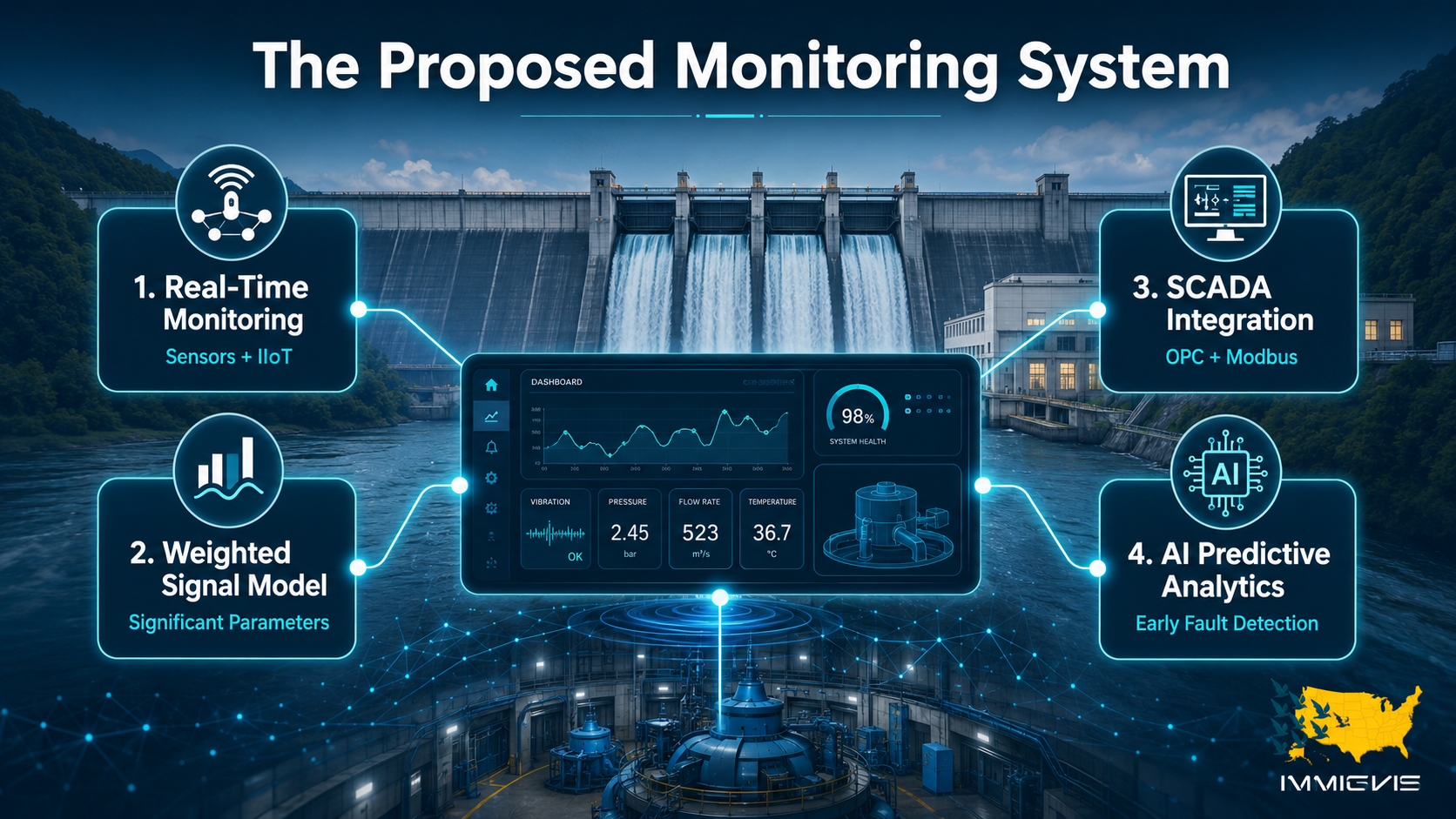
His proposed system for U.S. hydropower plants is built on four integrated technical components that address the gap between current reactive maintenance and the predictive approach the industry needs.
Continuous real-time monitoring using existing sensors in the plant connected through IIoT protocols to a central processing layer. The system establishes baseline ‘normal’ behavior profiles for water flow, turbine speed, temperature, pressure, and vibration — the equivalent of a healthy heartbeat that allows anomalies to be recognized immediately when they deviate.
A significant parameter approach using a single weighted function instead of multiple independent indicators, reducing infrastructure cost and memory requirements while improving the efficiency of monitoring, analysis, and decision-making. Combined with polynomial neural networks for multi-criteria decision-making that can identify uncertainty in system behavior based on parameter significance.
Integration with existing SCADA systems (WinCC, SIMATIC PCS 7) using standard industrial protocols such as OPC and Modbus, ensuring the monitoring layer works alongside existing controls without interfering with plant operation. The system adds predictive capability to existing infrastructure without requiring a replacement of what is already there.
AI-driven predictive analytics using Python-based machine learning frameworks (TensorFlow, PyTorch, Keras, Scikit-learn) to analyze historical data patterns, identify early indicators of equipment degradation, and recommend proactive maintenance actions before failures escalate. Alert mechanisms notify plant personnel through SCADA visualization interfaces and configurable threshold-based triggers.
Credentials and Recognition
He holds an MS in Electrical and Electronic Engineering from a UK university and a BS in Electronic Engineering from a Pakistani engineering university. He has been a Registered Engineer with the Pakistan Engineering Council for 14 years since 2010.
His published research paper on bi-fuel system technology appeared in the International Journal of Scientific & Technology Research (Volume 3, Issue 11, November 2014). A second paper on smart energy meters has been submitted to a peer-reviewed engineering journal. He was invited as a distinguished guest speaker at an international science and engineering conference held in Canada in 2024.
A U.S.-based professor who serves as Graduate Program Director in Data Science at a Maryland university has provided a formal Letter of Intent supporting his proposed endeavor, offering expertise in Artificial Intelligence and Machine Learning to support the system’s predictive analytics component. This U.S. academic connection also reflects that the proposed system has been evaluated by someone with the domain expertise to assess its feasibility.
How the Petition Was Built
This was a direct petition. The career record, project portfolio, credentials, and proposed system technical plan were already in place.
– National importance sourcing: EIA hydropower statistics (6.2% total electricity, 28.7% renewables), DOE Hydropower Vision (101GW to 150GW by 2050), DOE predictive maintenance cost reduction data (up to 40%), National Energy Emergency declaration (January 2025), DOE Wind and Water Power Technologies Office Hydropower Vision analysis, EPA environmental stewardship documentation.
– Well-positioned evidence: Assistant Executive Engineer (Electronics) at Pakistan’s largest hydropower project in the C&I section, 12 documented modifications to the 969MW facility including network redundancy redesign, turbine protection modifications, SCADA integration, and critical tunnel rehabilitation, Ignite National Technology Fund government grant, Pakistan Engineering Council Registered Engineer (14 years), published research paper, international conference speaking invitation (Canada 2024), Letter of Intent from U.S. university data science professor.
I-140 filed as a self-petition without a U.S. employer.
The Outcome
Approved.
A self-petitioned EB-2 NIW for a control and instrumentation engineer who spent years making critical modifications to Pakistan’s largest hydropower project, has delivered over 20 automation systems across multiple industries, holds a government research grant and published research, and proposes to build the predictive monitoring infrastructure that U.S. hydropower plants need to shift from reactive to condition-based maintenance.
The U.S. has about 2,200 conventional hydropower plants. Most of them were built decades ago. None of them have the kind of real-time IIoT predictive monitoring system he is proposing to build. The opportunity to reduce maintenance costs by 40% while improving reliability across 28.7% of U.S. renewable generation is exactly what the DOE’s Hydropower Vision identifies as the future of the industry.
For Hydropower and Control Systems Engineers
If your career is in hydropower control systems, industrial automation, SCADA, or IIoT for energy infrastructure and you have a documented track record of solving real problems at operational facilities, the NIW is worth a serious assessment. The U.S. DOE has specifically named hydropower monitoring and predictive maintenance as national priorities. A career spent solving exactly those problems at one of the most demanding facilities in your country is a strong answer to the Dhanasar well-positioned test.
Questions Hydropower and Control Engineers Ask Us
Can a control, instrumentation, and automation engineer working in hydropower qualify for an EB-2 NIW?
Yes. Hydropower is explicitly recognized as a national priority by the DOE, and CISA designates the energy sector as critical infrastructure. The proposed endeavor (an IIoT-based predictive monitoring system for U.S. hydropower plants) addresses a specific, documented gap that DOE has identified as essential for expanding U.S. hydropower from 101GW to 150GW by 2050. An engineer with hands-on modifications at a major hydropower facility and a government-funded research grant is well-positioned to advance it.
How does making critical modifications at a major hydropower plant support the well-positioned argument?
Specific, named, documented modifications at a nationally significant facility provide a different class of evidence from general work descriptions. Each modification (network topology redesign, turbine protection logic, tunnel level monitoring) demonstrates a specific capability: the ability to identify a structural vulnerability in a complex industrial control system, design a solution, implement it without disrupting operations, and deliver a measurable improvement. Those are exactly the capabilities the proposed predictive monitoring system requires. The modifications are verifiable through plant records and support the argument that the petitioner can execute what the proposed endeavor describes.
Does a government research grant (Ignite National Technology Fund) help an NIW case?
Yes. A government-funded research grant is independent institutional recognition that the petitioner’s research is worthy of public investment. In the Dhanasar well-positioned analysis, this represents third-party validation of research capability that goes beyond self-reported achievements. Pakistan’s Ignite National Technology Fund is the Ministry of IT & Telecom’s mechanism for funding promising national technology projects; receiving that funding reflects a formal evaluation that the work has merit and potential. For a proposed endeavor that involves AI and machine learning components, the grant provides evidence that the petitioner’s R&D capability has been externally assessed and supported.
Does being invited to speak at an international science and engineering conference help?
It contributes to the well-positioned argument by providing independent recognition that the petitioner’s technical contributions are considered valuable to an international professional community. Peer-reviewed conference speaking invitations are external evaluations of the quality and relevance of the petitioner’s published work. A conference held in Canada (an international venue) demonstrates that the recognition extends beyond the petitioner’s home country.
If your career is in hydropower or industrial control systems and you want to understand whether your background supports an EB-2 NIW, start with a free assessment.