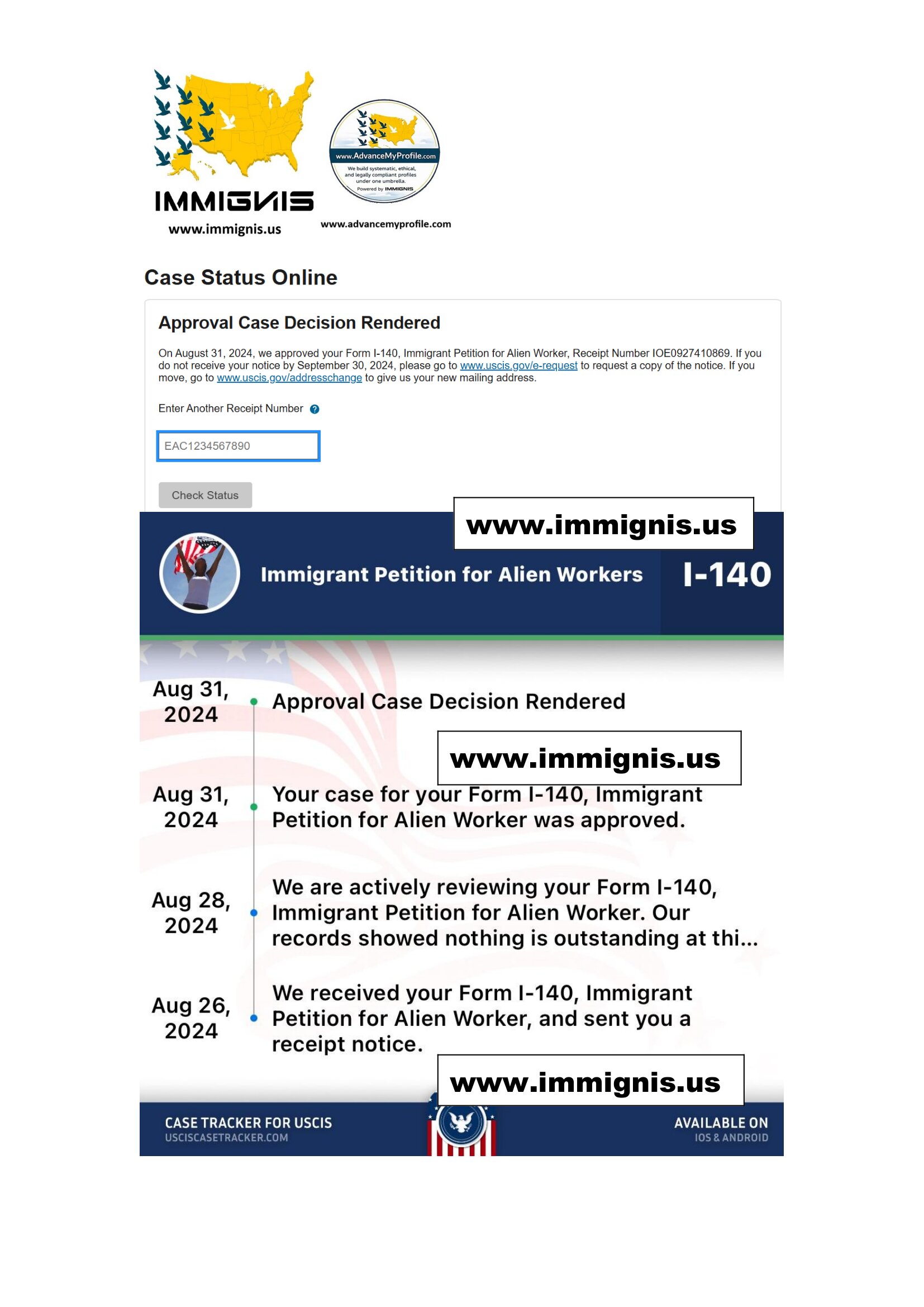
A biomedical engineer who has sold and serviced laboratory automation equipment across Saudi Arabia for 18 years – installing Siemens POCT systems, launching MERS outbreak response infrastructure, and managing $20 million product portfolios – approved for an EB-2 NIW to digitally transform U.S. laboratory operations through Total Lab Automation, Point of Care Technology, and smart sensors.
In short: An EB-2 NIW lab automation engineer holding a Bachelor of Science in Biomedical Engineering, with 18 years of progressive experience in the sales and service of laboratory automation equipment, Point of Care Technology, flow cytometry, PCR, and life sciences instrumentation, was approved for an EB-2 National Interest Waiver as a self-petitioner. Pakistani national, Saudi Arabia-based. He currently serves as Area Manager at a major Saudi commercial group managing a $20 million Siemens Point of Care Testing product range alongside VWR Avantor laboratory supplies. His career includes managing an $11 million MERS-CoV outbreak response project deploying negative pressure isolation infrastructure, establishing a new laboratory division that achieved $4 million in annual sales, and launching POCT and fragment analyzer product lines across all of Saudi Arabia. He has received service-level training from Eppendorf (Germany), ABI Life Technologies (USA), AATI (Iowa, USA), Werfen/ROTEM (Italy), and Sysmex (Dubai). He holds Saudi Engineering Council membership. Proposed endeavor: digitally modernize U.S. laboratory operations by combining Total Lab Automation, robotics, smart sensors, and Point of Care Technology as an independent consultant. Approved under Matter of Dhanasar.
The petitioner’s name and employer names have been withheld for privacy. Career record, projects, training certifications, and outcome are real.
Why Selling AND Servicing Matters
In the laboratory instrumentation and automation industry, most professionals specialize in one direction: they are either field service engineers who repair and maintain equipment, or sales professionals who sell and support adoption. Both roles require deep product knowledge, but they develop different kinds of it. Service engineers understand how machines actually fail – the real-world failure modes that the manual doesn’t mention. Sales professionals understand what organizations need and why they hesitate, making this directly relevant to an EB-2 NIW lab automation engineer.
He has done both, simultaneously, for 18 years. His career has moved through service engineer, sales engineer, product manager, area manager, and regional manager roles across the full lifecycle of laboratory instruments: selecting them, selling them, installing them, training users, servicing them when they fail, and then finding the next generation. This combination is unusual, and it is directly what an EB-2 NIW lab automation engineer proposing to help U.S. healthcare facilities digitalize their lab operations needs.
The Projects That Define the Well-Positioned Argument
His most significant single project as an EB-2 NIW lab automation engineer was the MERS-CoV outbreak response deployment – an $11 million project to install negative pressure isolation rooms for a medical company’s clients during the Middle East Respiratory Syndrome outbreak. Negative pressure isolation rooms create an environment where infected air cannot escape into surrounding spaces. The physics involves specialized HVAC, UV sterilization, and monitoring technology. Managing an $11 million deployment of this infrastructure requires technical understanding of infection control, project management across multiple sites, and vendor coordination across international suppliers. This type of project – pandemic-preparedness infrastructure at commercial scale is relevant to the U.S. laboratory and healthcare readiness context.
He currently manages the Siemens Point of Care Testing product range across Saudi Arabia – a $20 million portfolio including blood gas analyzers and urine analyzers. POCT is the technology the proposed U.S. endeavor is built on: testing performed at or near the patient rather than in a central laboratory. Blood gas analysis, for example, tells ICU physicians within minutes whether a critically ill patient is oxygenating adequately. Urine analysis supports rapid infection diagnosis. Managing the commercialization and installation of this product range across Saudi Arabian healthcare facilities requires both technical depth (the instruments are complex, requiring calibration, quality control, and preventive maintenance) and organizational influence (getting hospitals to adopt and trust a new testing paradigm), strengthening the EB-2 NIW lab automation engineer case.
Earlier in his career, he established a new laboratory division from scratch at a Saudi medical company, growing it to $4 million in annual sales by building a product portfolio around VWR Avantor laboratory supplies and negotiating new principal agreements with international suppliers. Starting a commercial division with zero baseline identifying the market, selecting the product range, hiring and training a team, and delivering a multimillion-dollar revenue target is the commercial equivalent of the independent consulting role his proposed endeavor envisions as an EB-2 NIW lab automation engineer.
A $20M POCT portfolio, an $11M MERS response deployment, and a $4M division built from scratch. This is not a career that requires introduction to the laboratory automation market. It is a career built inside it.
The Equipment Portfolio
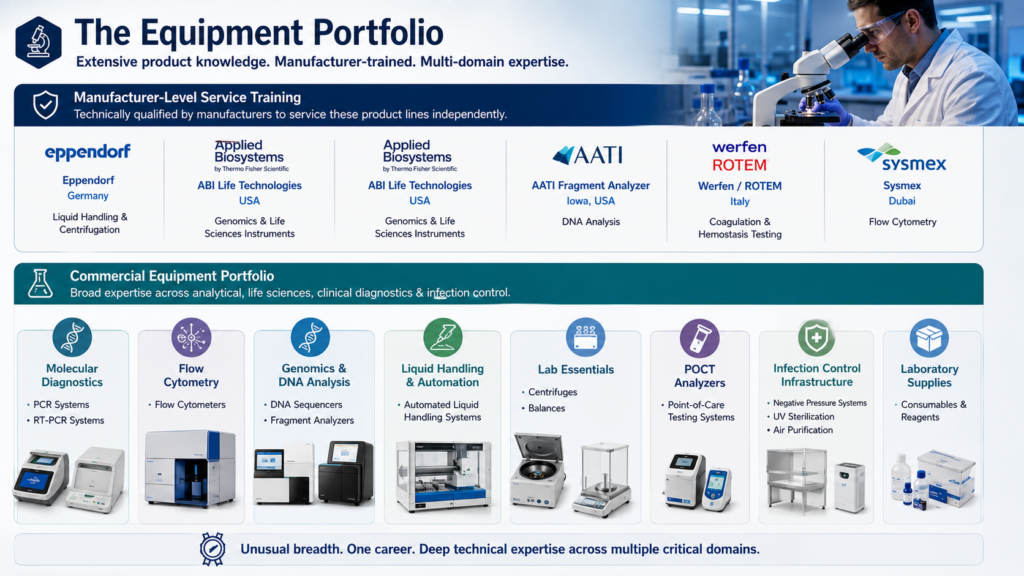
His product knowledge spans the full range of laboratory technology relevant to the proposed U.S. endeavor. Manufacturer-level service training includes Eppendorf (Germany) for liquid handling and centrifugation, ABI Life Technologies (USA, two separate training engagements) for genomics and life sciences instruments, AATI Fragment Analyzer (Iowa, USA) for DNA analysis, Werfen/ROTEM (Italy) for coagulation and hemostasis testing, and Sysmex (Dubai) for flow cytometry. Each training required technical qualification by the manufacturer and authorized him to service those specific product lines independently.
His commercial portfolio includes PCR and RT-PCR systems, flow cytometers, DNA sequencers, fragment analyzers, automated liquid handling systems, centrifuges and balances, POCT analyzers, infection control infrastructure (negative pressure, UV sterilization, air purification), and laboratory supplies across multiple major distributors. This breadth across analytical, life sciences, clinical diagnostics, and infection control is unusual in a single career.
The Four-Component Proposed Endeavor
His proposed U.S. endeavor centers on four integrated technologies, each addressing a specific gap in how U.S. laboratories currently operate for an EB-2 NIW lab automation engineer.
Total Lab Automation (TLA) – systems that automate the full sequence of laboratory processes from sample sorting through testing, analysis, and storage. TLA reduces human error, enables 24/7 operation, and allows laboratories to process significantly higher sample volumes with the same workforce. The U.S. laboratory market, valued at $93 billion and comprising over 319,000 CLIA-certified laboratories, is experiencing documented workforce shortages. TLA directly addresses the gap between test volume demand and available staff.
Robotics and automated liquid handling – replacing the repetitive manual steps of pipetting, sample transfer, and plate preparation with robotic precision. Robotic liquid handling eliminates a major source of variability and cross-contamination in PCR, immunoassay, and genomics workflows. His service training at ABI Life Technologies (genomics/life sciences instrumentation) and AATI (fragment analyzers) is directly relevant to these applications, strengthening the EB-2 NIW lab automation engineer case.
Smart sensors – continuous real-time monitoring of temperature, humidity, equipment performance, and sample integrity conditions. In a laboratory where samples may be degraded by improper storage conditions or where instrument drift may affect result accuracy, smart sensor networks that automatically flag deviations before they become problems are a quality and compliance tool as much as an efficiency tool.
Point of Care Technology (POCT) – the core of his proposed endeavor. POCT moves testing from the central laboratory to the bedside, clinic, ambulance, or patient home. For conditions requiring rapid intervention (sepsis, myocardial infarction, respiratory failure, stroke) the time between sample collection and result can determine outcome. He currently manages a $20 million POCT portfolio. He is not proposing to learn this technology. He is proposing to apply it at national scale as an EB-2 NIW lab automation engineer.
The National Importance Case
The U.S. laboratory market is documented to be under significant structural pressure, making this directly relevant to an EB-2 NIW lab automation engineer. The Health Industry Distributors Association 2023 Laboratory Market Report valued the U.S. laboratory market at $93 billion with over 319,000 CLIA-certified laboratories. The AAMI workforce shortage data confirms that 40% of biomedical engineers and laboratory professionals are aged 55 or above. COVID-19 accelerated demand for decentralized POCT. The FDA has documented medical device shortages including laboratory equipment. The ONC’s 2020-2025 Federal Health IT Strategic Plan explicitly targets improvements in health data exchange, laboratory information systems, and electronic health information access.
His proposed consultancy addresses these documented pressures directly: TLA and robotics reduce the workforce dependency of high-volume laboratories; POCT decentralizes testing to reduce central lab backlog; smart sensors improve quality and reduce costly retesting from compromised samples, strengthening the EB-2 NIW lab automation engineer case.
White House National Science and Technology Council Plan to Advance Data Innovation: Recognizes real-time data collection for epidemiological response as a national priority, directly applicable to TLA and POCT deployments for an EB-2 NIW lab automation engineer.
HHS FY 2022-2026 Strategic Goal: ‘Protect and Strengthen Equitable Access to High Quality and Affordable Healthcare’ – POCT specifically improves access in rural and underserved communities by eliminating the need to travel to central labs.
ARPA-H mission: Supporting the development of high-impact research to drive biomedical and health breakthroughs – laboratory automation and point-of-care diagnostics are core application domains for an EB-2 NIW lab automation engineer.
CDC Global Digital Health Strategy: Improve availability and use of data in health systems – TLA and smart sensors generate the real-time data streams the Strategy envisions.
Critical and Emerging Technologies List 2024: Advanced and Networked Sensing, Advanced Computing – both applicable to smart sensor networks and laboratory AI decision support.
How the Petition Was Built
This was a direct petition. The career record, project portfolio, and manufacturer training certifications were already in place.
– Well-positioned evidence: Area Manager managing $20M Siemens POCT range, $11M MERS-CoV negative pressure isolation room project, $4M division established from scratch (VWR Avantor), AATI Fragment Analyzer national launch across Saudi Arabia, PET-CT installation project, manufacturer service training in Germany/USA (x2)/Italy/Dubai, AATI service training at Iowa USA (2014), Saudi Engineering Council membership, 18 years spanning both sales and service.
– National importance sourcing: HIDA 2023 Laboratory Market Report ($93B, 319,000 CLIA-certified labs), AAMI biomedical workforce shortage data, ONC 2020-2025 Federal Health IT Strategic Plan, HHS FY2022-2026 strategic goals, ARPA-H mission, CDC Global Digital Health Strategy, CET List 2024, NSTC Data Innovation Plan, CDC chronic disease statistics (92% of seniors with at least one chronic condition), FDA medical device shortage documentation.
I-140 filed as a self-petition without a U.S. employer.
The Outcome
Approved.A self-petitioned EB-2 NIW for a biomedical engineer whose 18-year career spans both the service and commercial sides of laboratory automation, including a $20 million POCT portfolio, an $11 million pandemic-response deployment, and manufacturer-level service training on instruments used in U.S. healthcare facilities, proposing to bring that combined expertise to the documented digital transformation gap in U.S. laboratory operations.
The U.S. has 319,000 CLIA-certified laboratories, documented workforce shortages, and a healthcare system under sustained pressure to adopt laboratory automation. An engineer who has sold and serviced these systems for 18 years across a complex market of major hospitals, research institutions, and government facilities has a direct answer to the question of whether he is positioned to advance the proposed endeavor.
For Biomedical Engineers in Lab Automation and Diagnostics
If your career is in laboratory instrumentation, TLA, POCT, flow cytometry, life sciences equipment, or medical device sales and service and you have a documented track record of managing major product portfolios, executing turnkey installations, and holding both commercial and technical responsibility, the NIW is worth a serious assessment. The U.S. laboratory market is large, documented as strained by workforce shortages, and actively seeking automation expertise.The Dhanasar well-positioned analysis rewards the combination of technical depth and commercial execution that a career spanning both sales and service uniquely provides.
Questions Lab Automation and Biomedical Professionals Ask Us
Can a biomedical engineer specializing in lab automation sales and service qualify for an EB-2 NIW?
Yes. The Dhanasar test evaluates the national importance of the proposed endeavor and the petitioner’s positioning to advance it. The U.S. laboratory market ($93 billion, 319,000 CLIA-certified laboratories) is documented to face workforce shortages, automation adoption backlogs, and POCT integration gaps. A proposed endeavor that addresses these gaps through laboratory digitalization, TLA, and POCT consulting has substantial merit and national importance. An engineer with 18 years of commercial and service experience, manufacturer-level training on relevant platforms, and a track record of managing multimillion-dollar laboratory technology portfolios is well-positioned to advance it.
Does having both sales and service experience in biomedical equipment strengthen an NIW case for a proposed consulting endeavor?
Yes. The distinction is meaningful for the well-positioned argument. A purely sales professional understands adoption and market positioning but lacks the technical authority to troubleshoot and optimize deployed systems. A purely service engineer understands the equipment deeply but may lack the commercial and organizational skills to drive adoption at scale. The combination of both, demonstrated across 18 years and multiple employer types, is directly relevant to an independent consulting role that requires both convincing healthcare facilities to adopt new technology and ensuring that adoption succeeds technically after installation.
Does manufacturer service training in the United States (AATI, Iowa) help a non-U.S.-resident NIW case?
It provides a meaningful U.S. connection in the well-positioned argument. Manufacturer training in the United States means the petitioner has been physically evaluated by the American company whose equipment he is certified to service. AATI (Advanced Analytical Technologies Inc.), an Iowa-based manufacturer of fragment analyzers, authorized him as a service engineer after direct assessment. This is the same manufacturer whose equipment is used in U.S. research and clinical laboratories. His certification is directly applicable to U.S. laboratory environments without a technology transition gap.
If your career is in biomedical laboratory equipment and you want to understand whether your background supports an EB-2 NIW, start with a free assessment. Free assessment: immignis