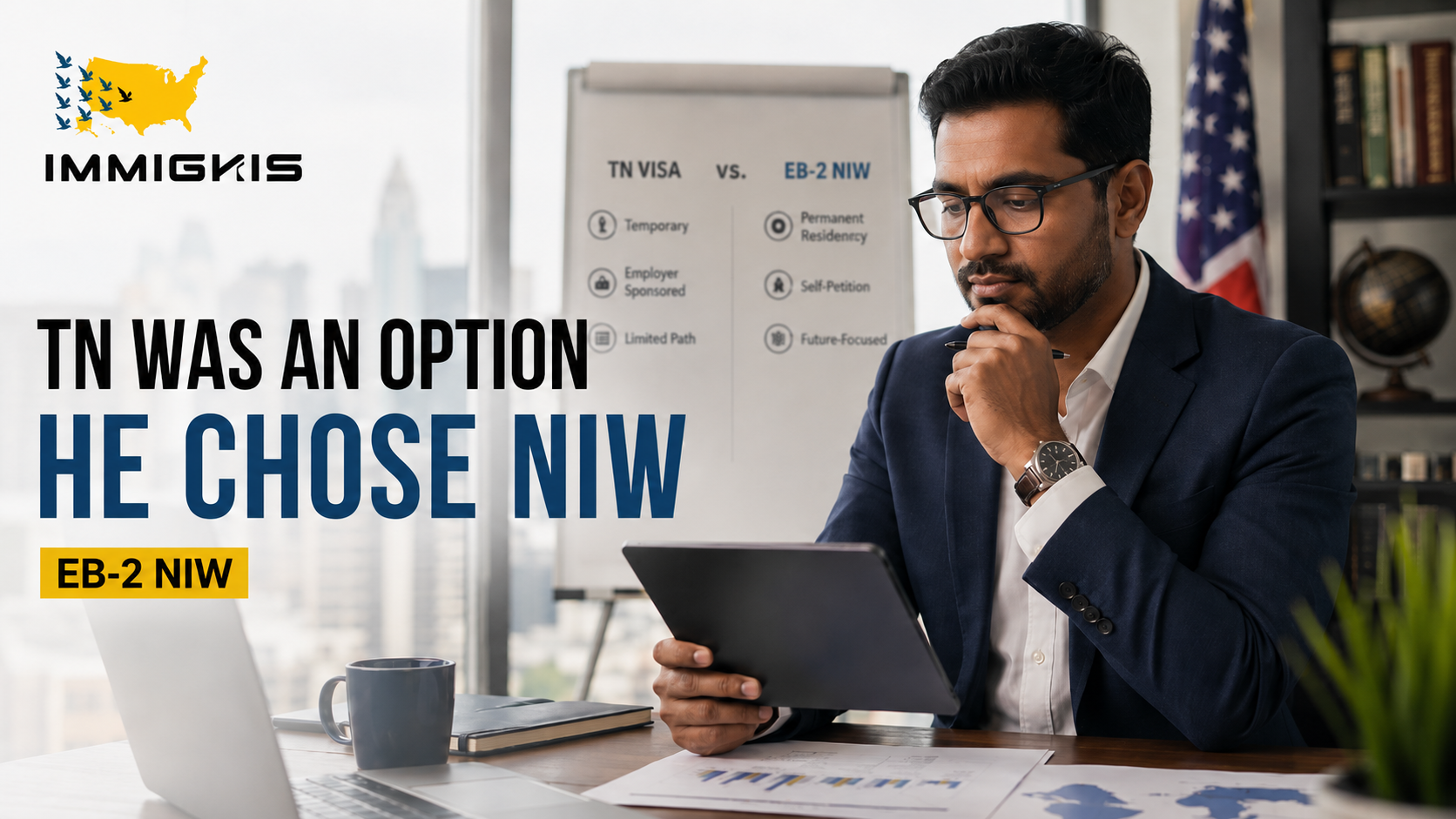
EB-2 NIW medical imaging engineer: A Canadian citizen with 21 years of medical imaging engineering experience, trained every year at U.S. manufacturer facilities, and at the top FSR rank of his profession who could have walked into the U.S. on a work visa, but chose an NIW because employment would have limited what he came to do.
In short: A biomedical engineer holding an MBA and a Bachelor of Biomedical Engineering, with 21 years of
specialized experience in medical imaging equipment (CT, ultrasound, and X-ray), was approved for an EB-2
National Interest Waiver as a self-petitioner. Canadian citizen. He holds the highest Field Service Representative
rank at a leading global medical imaging manufacturer, with all technical training completed at manufacturer
facilities in the United States.
As a Canadian citizen, a TN visa for U.S. work was available and straightforward. He
filed an NIW instead because his proposed endeavor ‘working as an independent consultant bringing specialized
expertise directly to healthcare facilities required the freedom that an employer relationship would not allow’.
Approved under Matter of Dhanasar.
The petitioner’s name and employer details have been withheld for privacy. Career record, credentials, and outcome are real.
The Easy Route He Didn’t Take
Canadian citizens who are biomedical engineers can work in the United States under the TN nonimmigrant visa, a straightforward, relatively quick work authorization available under the NAFTA/USMCA framework. Given the documented shortage of biomedical engineers specializing in medical imaging equipment in the U.S. with 40% of currently employed engineers aged 55 and above, 22% already past 60, and a field that has struggled to attract young talent, an experienced specialist with 21 years in CT, ultrasound, and X-ray was likely well positioned to attract U.S. employer interest.
He chose not to go that route.
The reason is specific and practical. His proposed endeavor is to work as an independent consultant and later through a startup, going directly to healthcare facilities to offer specialized advice on equipment selection, facility planning, cost-effective innovations, and service quality. Employment would limit that. An employer directs the work, controls the client base, and sets the scope. What he wants to do (reaching facilities on his own terms, proposing improvements his employers would not necessarily prioritize, training the next generation of biomedical engineers as part of a broader plan) requires the independence that a regular job does not offer.
He filed an NIW because the NIW is the appropriate instrument for this kind of contribution. Not a job. Not a transfer. A nationally important proposed endeavor, advanced by someone with the demonstrated expertise to do it.
There is a difference between being good enough at your job to find employment and being senior enough in your
field to have something worth contributing independently. At 21 years, at the top FSR rank, he had become the
second kind.
Twenty-One Years of Medical Imaging
His career began in Pakistan in 2000, supporting GE Medical and Toshiba equipment at two medical device distributors. He spent eight years building the foundational expertise, x-ray, ultrasound, progressively more complex imaging systems. In 2008 he migrated to Canada through the Skilled Worker immigration category, a process that involved independent government evaluation of his qualifications and recognition that his skills were worth importing.
In Canada, his career advanced through three significant roles. At a provider of explosive detection CT systems for airports, he maintained specialized computed tomography equipment deployed at multiple airports across North America, receiving training at the U.S. manufacturer facility. At a global medical imaging and technology company, he spent a year supporting x-ray and vascular x-ray systems. Then, since 2014, he has been at a leading global medical imaging manufacturer, the company that makes the CT, ultrasound, and x-ray equipment used in hospitals across North America as a Field Service Representative.
He is now at FSR III level, the highest Field Service Representative rank within the organization. Only executive positions sit above it. His HR department has provided a letter confirming consistent annual salary increases reflecting increasing responsibilities, and his current compensation confirms he is performing above peers. In practical terms: when a 640-slice CT scanner is installed at a major Canadian hospital, he is the person who does it. When a vascular X-ray system goes into a hospital across the country, he travels to commission it.
His technical training tells its own story. Every year, he travels to U.S. manufacturer training facilities in California, Ohio, and South Carolina for courses on the latest imaging systems. Canon CT, Canon ultrasound, Canon X-ray. Before that, Toshiba CT (40-slice, 64-slice, 640-slice, and single-rotation Genesis), Toshiba vascular X-ray, Toshiba angio. Before that, Siemens X-ray and vascular training in Germany and the U.S. Going further back, Toshiba ultrasound training in Japan. His technical education is global and manufacturer-certified at every stage. The U.S. healthcare system runs on the same equipment, under the same service protocols, that he has been servicing and maintaining in Canada for a decade.
What He Proposes to Do and Why It Matters
His proposed endeavor has three practical components.
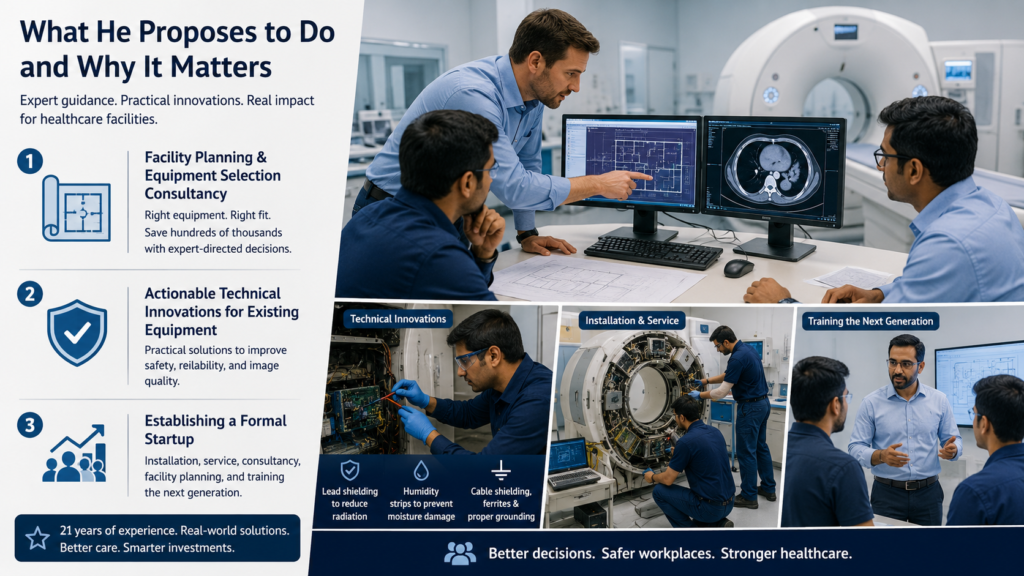
The first is facility planning and equipment selection consultancy. Many healthcare facilities particularly smaller clinics, rural hospitals, and specialty practices like veterinary imaging make equipment decisions without specialized guidance. The result is often either overspecification (paying for a 320-slice CT when a 16-slice would serve their actual patient population) or poor facility design that creates workflow inefficiencies and maintenance complications. He has done this work: recommending a more appropriate scanner for a veterinary hospital, advising a cardiac-focused practice on a smaller flat panel detector suited to their actual case mix rather than the full-size version. That kind of expert-directed decision can save a facility hundreds of thousands of dollars on a single procurement.
The second is specific, actionable technical innovations for existing equipment the kind of adjustments that a manufacturer-employed FSR cannot make because they fall outside the employer’s approved scope. Modified lead shielding in CT control rooms to reduce radiation exposure for staff. Humidity indicator strips in ultrasound keyboards to detect moisture damage before it causes failure under strict disinfection protocols. Mesh-type cable shielding and sintered ferrite materials to reduce image noise in CT environments. Proper grounding to eliminate electromagnetic interference. They are practical interventions that an independent engineer with 21 years in the field can implement at facilities that have no one with this level of expertise advising them.
The third is establishing a formal startup, a model he has already tested in Canada, where he launched a similar company without significant capital investment, relying entirely on expertise. The U.S. version would provide installation, service, consultancy, facility planning, and eventually training for younger biomedical engineers entering the field.
The National Need Behind the Case
The shortage of biomedical engineers specializing in medical imaging equipment in the U.S. is well-documented. The Association for the Advancement of Medical Instrumentation has reported that 40% of currently employed biomedical engineers are 55 or older, with 22% already past 60 and approaching retirement. The profession has struggled to attract young talent. The U.S. Bureau of Labor Statistics projects 10% employment growth for biomedical engineers through 2031 faster than average indicating growing demand against a thinning supply.
The medical imaging equipment market underpins this need. The U.S. medical imaging market was valued at $48.75 billion in 2021 and is projected to reach $84 billion by 2030. CT, ultrasound, and x-ray systems are at the center of diagnosing the conditions that drive the largest burden of disease in the U.S. - cancer (1.9 million new cases annually), cardiovascular disease (a leading cause of death), stroke, chronic respiratory disease. The engineers who keep those machines running, calibrated, and performing accurately are not optional. When they retire and are not replaced, patient care suffers.
How the Petition Was Built |EB-2 NIW medical imaging engineer
This was a direct petition. The 21-year career, the FSR III rank, the manufacturer certifications, the project record, and the Canadian startup proof of concept were already in place. The work was framing it precisely against Dhanasar.
- National importance sourcing: AAMI shortage reports, BLS biomedical engineer employment projections, U.S. medical imaging market data, aging population statistics (Florida demographic data specifically cited given startup location plan), HHS healthcare strategic goals, White House STEMM priorities, ARPA-H, CDC disease burden statistics.
- Well-positioned evidence: FSR III rank (highest FSR level), annual salary progression documented by HR letter, manufacturer certifications across all three imaging modalities (CT, ultrasound, x-ray) at U.S. and international training facilities, completed installations at major hospitals, Canadian startup already operational as a proof of concept.
- Prong 3 argument: explicit acknowledgment that TN visa would have been available and straightforward as a Canadian citizen, and that the NIW is sought specifically because the proposed independent endeavor requires freedom that employment would not allow.
The I-140 was filed as a self-petition without a U.S. employer.
The Outcome
Approved.A self-petitioned EB-2 NIW for a Canadian citizen with 21 years of specialized medical imaging engineering experience, the top FSR rank at a leading global manufacturer, and a proposed endeavor that addresses a documented national shortage through independent expertise rather than employment. The case made a credible argument that the United States benefits more from having him operate independently, reaching any healthcare facility that needs his expertise, than from having him bound to a single employer’s client base and approved scope of work.
The TN visa argument is not a weakness in this kind of NIW case. It is evidence that the person genuinely chose the
harder path because the easier one would not let them do what they actually came to do.
For Senior Medical Imaging Engineers and Biomedical Equipment Specialists
If you work in medical imaging equipment ‘servicing CT, MRI, ultrasound, or X-ray systems’ and you have reached a level of seniority where you have something specific and demonstrable to offer U.S. healthcare facilities that employment alone cannot fully express, the NIW can be the right path. It is particularly strong when: the proposed work genuinely requires independence rather than employment, the national need is documented (the biomedical imaging equipment shortage is well-evidenced), and the career provides concrete proof of capability rather than general competence claims.
Questions Senior Biomedical Engineers Ask Us
If I can qualify for a TN visa or another U.S. work authorization as a Canadian or Mexican citizen, should I still file for an NIW?
It depends on what you intend to do. If your goal is employment with a U.S. employer, a TN or O-1 visa is often faster and simpler. But if your proposed endeavor genuinely requires operating independently advising multiple facilities, implementing innovations that an employer would not sanction, training the next generation without the constraints of a corporate role then the NIW is the appropriate instrument. In this case, the fact that a TN was available and declined actually strengthened the Prong 3 argument by demonstrating that the NIW was chosen for substantive reasons, not as a workaround.
Does 21 years of experience in the same specialized field make a stronger NIW case than a shorter career with broader scope?
Depth in a specialized, nationally important field can be very strong. What matters is whether the career demonstrates the specific expertise needed to advance the proposed endeavor. Twenty-one years specializing in CT, ultrasound, and x-ray service with manufacturer certifications from the companies that build the equipment, documented at the top of a formal internal ranking structure directly supports a proposed endeavor focused on exactly that type of equipment. Breadth matters less than relevance and demonstrability.
Does having a startup already operating in Canada help an EB-2 NIW petition for U.S. work?
It can help specifically with the Dhanasar second prong (well positioned) and third prong (beneficial to waive the job offer). A startup already operating in the same domain demonstrates that the proposed U.S. endeavor is not aspirational but active and tested. It also provides concrete evidence of independent execution capability, which supports the argument that the work requires the independence that NIW provides rather than traditional employment.
What makes FSR III or similar senior technical certifications relevant to an NIW petition?
Formal employer-assigned rank progression particularly when documented through HR letters confirming consistent advancement and salary growth provides independent, institutional evidence that the petitioner’s performance exceeds peers. For the well-positioned prong, this kind of formal recognition carries weight because it is not self-reported: it reflects the employer’s own evaluation that the petitioner has reached the top of the technical ladder within a major organization.
Is the documented shortage of biomedical engineers in the U.S. helpful for an NIW petition in this field?
Yes. The AAMI shortage data, BLS employment projections, and industry reports on the aging and retiring biomedical engineer workforce are all public, citable evidence of national need. The Dhanasar substantial merit and national importance prong is strengthened when an independent source a federal labor statistics agency, a professional body, a government-commissioned study documents that the field faces a genuine and growing shortage. This is different from fields where the national importance argument must be constructed primarily from the petitioner’s own claims.
Choosing the harder path, an NIW over an available TN visa, is itself evidence of genuine independent purpose. See how Immignis builds NIW cases around proposed work that employment can't fully express.