
An EB-2 NIW net-zero success story of a facilities and sustainability professional who managed mission critical operations for a global international financial institution in Washington and was then recruited to the world’s largest dedicated multilateral climate fund approved for an EB-2 NIW to apply that institutional-grade execution discipline to the gap between net zero ambition and building performance across the United States.
In short: A mechanical engineer holding a Master of Science in Mechanical Engineering, an MBA Executive from one of Pakistan’s leading business schools, and a Bachelor of Mechanical Engineering, with progressive experience spanning industrial manufacturing, renewable energy project delivery, and senior facilities leadership at two of the world’s most significant international institutions, was approved for an EB-2 National Interest Waiver as a self petitioner. Pakistani national, South Korea based. He served as Senior Facilities Officer at a global international financial institution in Washington, D.C. (2023 November 2025) and is currently Facilities & Maintenance Officer at the world’s largest dedicated multilateral climate finance fund under the UNFCCC, based in Incheon, South Korea. He has been accepted into a PhD program beginning 2026 focusing on market based decarbonization pathways. Proposed endeavor: advance integrated net-zero energy strategies for U.S. government facilities, commercial buildings, and urban infrastructure through five interdependent operational and governance pillars. Approved under Matter of Dhanasar.
The petitioner’s name and employer names have been withheld for privacy. Carzeer record, credentials, projects, and outcome are real.
The Problem With How Buildings Actually Perform:
U.S. buildings consume approximately 74-75% of all electricity generated in the United States, a core EB-2 NIW net-zero national context. Commercial and residential buildings together account for roughly 40% of total national energy use when generation losses are included. There are approximately 5.9 million commercial buildings in the country, consuming 6.8 quadrillion BTU of energy at a cost of around $141 billion per year. Federal facilities alone used 308.8 trillion BTU of energy and 120.4 billion gallons of water in a single fiscal year.
The EB-2 NIW net-zero commitments are real. The policy frameworks exist. The technology works. And yet industry and DOE research consistently shows that 30 to 50 percent of anticipated efficiency gains from net zero and sustainability initiatives fail to materialize, or erode within a few years of implementation.
The gap is not in the equipment. It is in what happens after installation. Design teams hand systems over to operations teams without clear performance governance. Facility managers inherit targets without accountability structures. Energy drift accumulates gradually (setpoint changes, deferred maintenance, unmanaged system interactions) until the building is operating well below its design intent, and nobody has flagged it because no one was assigned to watch.
His proposed endeavor, framed as an EB-2 NIW net-zero initiative, addresses that gap specifically. Not the technology, not the policy. The execution infrastructure that determines whether net zero ambition becomes net zero reality.
A Global Financial Institution in Washington, Then the World’s Largest Climate Fund:
From 2023 through November 2025, he served as Senior Facilities Officer responsible for operations, sustainability, and Environment, Health, and Safety at a global international financial institution headquartered in Washington, D.C. one of the most scrutinized institutional buildings in the world, supporting the work of economic governance for 190 member countries. Positions there are internationally competitive, selected from a global pool, and demand demonstrated competence in complex, multinational environments where operational decisions carry institutional weight far beyond a typical facilities brief.
His responsibilities included operational oversight of large, mission critical facilities; sustainability program integration; Environment, Health, and Safety governance; coordination with third party service providers; and performance monitoring under rigorous U.S. regulatory compliance requirements. He was involved in indoor environmental quality management, water hygiene and safety programs, emergency preparedness, incident investigation, and capital project coordination. This was not facilities administration. It was institutional operations management in a high accountability, globally visible environment.
In November 2025, he was recruited to his current role as Facilities & Maintenance Officer at the world’s largest dedicated multilateral climate finance fund under the United Nations Framework Convention on Climate Change, based in Incheon, South Korea. This fund operates at the highest levels of international climate governance, supporting mitigation and adaptation initiatives across developing countries, working with governments, development banks, and accredited entities under strict fiduciary, environmental, social, and governance standards. Selection into a professional role there is globally competitive and reflects an advanced capability to operate within mission critical, policy aligned sustainability environments.
His annual base salary at this institution is USD 102,000 documented at 1.5 to 3 times the prevailing average for comparable facilities management roles in South Korea, based on publicly available compensation benchmarks. That differential is an independent, market based confirmation of the standing his consecutive appointments reflect.
Managing the facilities of one of the world’s most significant international financial institutions in Washington, D.C., then being recruited to the world’s largest climate fund, is a consecutive institutional record that speaks directly to the well-positioned argument before any project details are considered.
The Career Behind the Institutional Appointments:
Before his time in Washington and South Korea, he built a track record of solar energy project delivery and sustainable infrastructure management in Pakistan, a background directly relevant to EB-2 NIW net-zero work. At a major real estate development authority, he served as senior engineer responsible for facilities and infrastructure planning, renewable energy integration, and sustainability management. His project portfolio from this period includes three completed solar EPC projects totaling over one megawatt of installed capacity a 465 kW solar carport, a 435 kW rooftop system, and a 235 kW PV installation. He also led a net zero energy transition initiative for a commercial mall and managed the design and implementation of a sewage treatment plant integrated with water reuse objectives.
Before that, he spent six years at a large industrial manufacturing organization, advancing from production planning and control roles to Acting Manager responsible for facilities services, maintenance, and corporate sustainability across complex production environments. This period grounded his understanding of how facilities systems actually fail not through catastrophic breakdowns but through accumulated deferred maintenance, unclear ownership, and the absence of structured performance review, an insight that later strengthened his EB-2 NIW net-zero case.
He holds a Certified Energy Manager credential from the Association of Energy Engineers, a LEED Green Associate from the U.S. Green Building Council, Program Management Professional and Project Management Professional certifications from PMI, a Risk Management Professional designation, ISO 9001 and 14001 Lead Auditor qualifications, NEBOSH and OSHA certifications, and a suite of Harvard Business School courses in finance, quantitative methods, and management communications. Each credential adds a different dimension to the integration of technical, operational, and governance disciplines that his proposed endeavor requires under an EB-2 NIW net-zero framework.
He has also been accepted into a part time PhD program at a leading Japanese research university beginning in 2026. His doctoral research will focus on market based decarbonization pathways for Japan’s electricity sector a systems level research engagement that connects the practice layer expertise in his career to the policy layer questions his proposed work will need to navigate.
Five Pillars for the Execution Gap:
His proposed endeavor is built around five interdependent pillars, each addressing a specific dimension of why net zero building performance fails in practice rather than in principle, a core concern of his EB-2 NIW net-zero proposed endeavor.
The first is an integrated net zero delivery and operations model a lifecycle framework that treats net zero as an ongoing operational objective, not a project milestone. Design intent, procurement, operational governance, and performance accountability are unified from the beginning rather than managed by separate entities after handover. The innovation is execution continuity: the same performance targets that drove design decisions are embedded into daily facilities management with clear ownership and review processes, a defining feature of the EB-2 NIW net-zero approach.
The second is operational energy recovery and waste to value management converting routinely wasted energy (waste heat from HVAC and mechanical systems, underutilized excess renewable generation, losses from misaligned operating schedules) into a managed operational resource. This is not a technology innovation. It is a governance innovation: making energy recovery a defined facilities management responsibility rather than leaving it unaddressed because no one is accountable for it.
The third is continuous performance based governance structured review processes where energy, water, and system efficiency are monitored as operational metrics that drive decisions, not reported annually for compliance. Performance drift is detected early and corrected before it becomes entrenched. Accountability is assigned. Corrective action is escalated through defined pathways. This shifts sustainability from reporting to management.
The fourth is scalable and replicable implementation models converting successful site-level execution into standardized frameworks that can be applied across portfolios without starting from scratch each time. The persistent failure of net zero programs to scale is largely because lessons from successful projects are never codified. His approach treats replicability as a design objective from the start.
The fifth is integrated water energy facilities sustainability management managing water use, energy consumption, and facilities operations as interdependent elements of one operational system. Water pumping, heating, cooling, and treatment processes connect water use directly to energy demand. Managing them separately (as most organizations do) creates unintended tradeoffs. Managing them together creates compound efficiency gains, reinforcing the EB-2 NIW net-zero framework.
What the Federal Policy Says:
The national importance context for this proposed endeavor is well documented for an EB-2 NIW net-zero case.
National Energy Emergency declaration (January 2025): Federal acknowledgment that energy insecurity poses immediate risk to economic stability and national resilience, directing agencies to address infrastructure stress and rising demand.
DOE Buildings Technology Office innovation initiative: Identified that technology alone is insufficient without effective deployment, integration, and sustained operational performance in existing buildings, a central point in the EB-2 NIW net-zero argument.
GSA Federal High Performance Buildings program: Manages a federal portfolio that spent $5.3 billion on energy and $597 million on water in fiscal year 2020 the direct institutional context for improvements in facilities operational performance.
DOE/FEMP Energy Management Information Systems program: Federal guidance on continuous performance monitoring and data-driven operational decision making in federal facilities.
DOE Zero Water Building Strategies and Water Efficiency in Federal Buildings: Programs explicitly addressing water energy integration in institutional facilities.
Clean Energy Victory Bonds proposed legislation: Congressional recognition that scalable, verifiable clean energy implementation financing is a national priority.
Critical and Emerging Technologies List (2024): Advanced energy systems, digital optimization, and integrated infrastructure explicitly designated as national priority domains.
Buildings consume 74-75% of U.S. electricity. Federal facilities spend $5.3 billion annually on energy. And 30-50% of efficiency gains from existing programs are lost to operational drift. This is not an abstract policy problem. It is a documented, measurable, recurring national inefficiency within the EB-2 NIW net-zero framework and it is exactly what this proposed endeavor is designed to reduce.
How the Petition Was Built:
This was a direct petition. The institutional employment history, credentials, and project portfolio were already in place.
National importance sourcing: EIA building energy data (27.6% end use, 74-75% electricity), GSA federal portfolio statistics ($5.3B energy, $597M water), DOE Buildings Technology Office innovation initiative, DOE BTO data and analysis, DOE FEMP energy management guidance, National Energy Emergency declaration, Clean Energy Victory Bonds legislation, DOE energy conservation program updates, DOE water efficiency federal buildings program, Critical and Emerging Technologies List 2024.
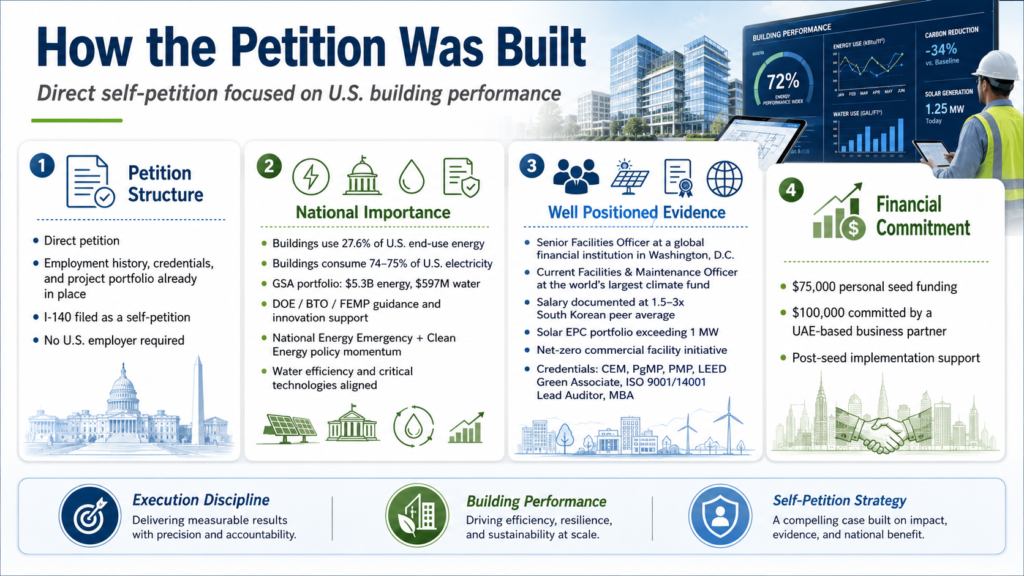
Well positioned evidence: Senior Facilities Officer at a global international financial institution in Washington D.C. (directly in the U.S., managing mission critical institutional facilities), current Facilities & Maintenance Officer at the world’s largest dedicated multilateral climate finance fund (globally competitive selection), salary documented at 1.5-3x South Korean peer average, solar EPC project portfolio totaling over 1 MW, net-zero commercial facility initiative, CEM credential, PgMP and PMP, LEED Green Associate, ISO 9001/14001 Lead Auditor, MBA from one of Pakistan’s leading business schools.
Financial commitment: USD 75,000 personal seed funding plus USD 100,000 committed by a UAE based business partner for post seed implementation.
I-140 filed as a self-petition without a U.S. employer.
The Outcome:
Approved EB-2 NIW net-zero.
A self-petitioned EB-2 NIW for a facilities and sustainability professional who managed the Washington, D.C. facilities of one of the world’s most significant international financial institutions, was then recruited to the world’s largest dedicated climate finance fund, holds a CEM, PgMP, LEED Green Associate, and multiple ISO lead auditor credentials, and proposes to bring operational governance discipline to the documented gap between net zero ambition and building performance in the United States, a core EB-2 NIW net-zero priority.
The buildings sector uses three quarters of U.S. electricity and loses a third to half of its efficiency gains to operational drift. The most credible person to fix that problem is someone who has already managed the facilities of one of the world’s most important international institutions in Washington, D.C., making him strongly positioned for EB-2 NIW net-zero work.
For Facilities, Sustainability, and Net-Zero Professionals:
If your career is in sustainable facilities management, building energy operations, net zero implementation, or green building commissioning and performance and your track record includes delivery in complex institutional environments with documented results the NIW is worth a serious assessment. The proposed endeavor does not need to be a technology invention. An execution and governance methodology that addresses a documented national performance gap in the buildings sector, advanced by someone who has managed mission critical facilities in the United States at the highest institutional level, satisfies the Dhanasar test.
Questions Facilities and Sustainability Professionals Ask Us:
Can a facilities management or sustainable buildings professional qualify for an EB-2 NIW?
Yes. The EB-2 NIW evaluates national importance and positioning, not field prestige or publication count. The U.S. buildings sector consumes 74-75% of national electricity and 40% of total energy, and federal agencies have documented persistent performance gaps caused by fragmented execution and weak operational governance. A proposed endeavor that addresses those execution gaps directly, advanced by a professional who has managed mission critical facilities in the United States at internationally competitive institutions, satisfies both prongs of the Dhanasar test.
Does previous employment at a U.S. based international institution help an NIW case?
It helps substantially, particularly for the well-positioned argument. Having previously worked inside the United States in a senior facilities role at a globally recognized international institution demonstrates direct, in country operational experience managing complex building systems under U.S. regulatory requirements. It also provides concrete evidence that USCIS can evaluate: this is not a future promise about working in U.S. facilities but a documented track record of having already done so, at an institutional level that almost no other facilities professional in the world can claim.
Does holding both a CEM (Certified Energy Manager) and a LEED Green Associate help an NIW case?
Each credential contributes differently. The CEM, issued by the Association of Energy Engineers, validates professional competency in energy efficiency planning, optimization, and renewable integration across large scale facilities directly relevant to net zero building performance. The LEED Green Associate, issued by the U.S. Green Building Council, validates knowledge of green building principles as applied in the United States specifically. Together, they confirm both the technical depth and the U.S. market specific knowledge required to advance the proposed endeavor. Combined with PgMP, PMP, and ISO 9001/14001 Lead Auditor credentials, the certification portfolio addresses every layer of the proposed endeavor’s operational, governance, and quality management dimensions.
Does a salary significantly above the local peer average help the well positioned argument?
Yes. Documented compensation that is materially above comparable local market rates provides an objective, market based confirmation that the employer has assessed the petitioner’s contributions as exceeding peer standards. When supported by publicly available benchmark data showing the differential, it is third party independent evidence of exceptional standing not self reported performance, but a market signal. A salary documented at 1.5 to 3 times the South Korean peer average for facilities managers, in a role selected through global competition, is a meaningful indicator in the Dhanasar well positioned analysis.
How does a PhD acceptance (even one not yet started) help a NIW case?
A formal acceptance into a doctoral program demonstrates institutional recognition of the petitioner’s research capacity and professional standing from an academic institution. For a practitioner whose proposed endeavor involves developing new governance and operational methodologies, it establishes that the work has both a practical and a scholarly dimension. More practically, it shows that the petitioner is engaged in a structured research process that will produce transferable knowledge relevant to the proposed endeavor’s goals in this case, systems level analysis of decarbonization pathways with direct relevance to buildings and infrastructure.
If your career is in facilities management, sustainable buildings, or net zero operations and you want to understand whether your background and proposed work support an EB-2 NIW, start with an honest assessment. See how Immignis builds that connection.