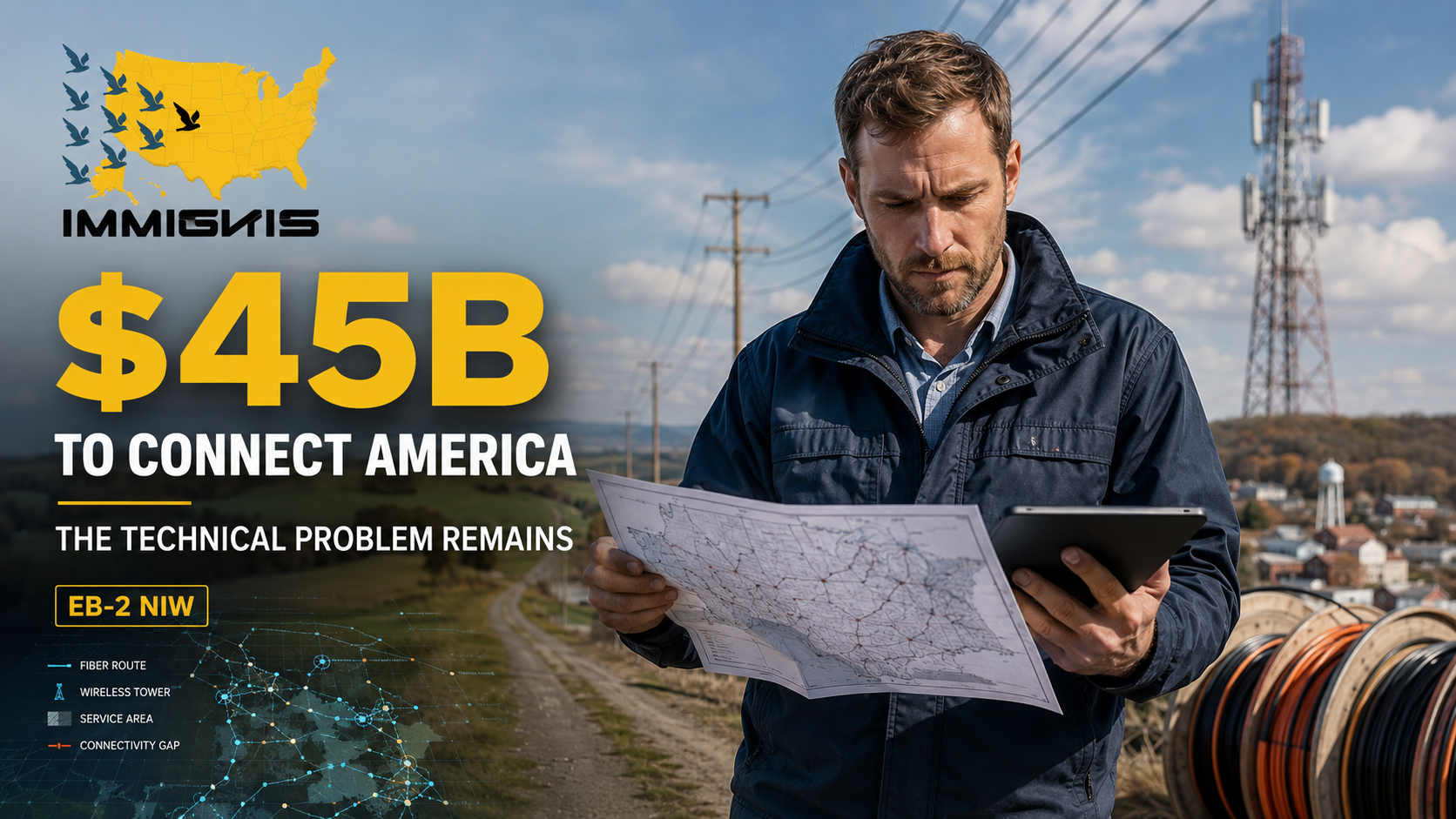
EB-2 NIW open network architecture engineer: A telecommunications engineering specialist working on open network architectures and critical broadband infrastructure – the technology at the center of the U.S. government’s most ambitious connectivity program – approved for an EB-2 NIW from Norway.
In short: A telecommunications engineering specialist holding a Bachelor of Science in Computer Engineering, with
progressive experience across 5G, OpenRAN, Open BNG, Fiber to the Home, and related telecommunications
infrastructure, was approved for an EB-2 National Interest Waiver as a self-petitioner. Norwegian citizen. Proposed
endeavor: advance open network architectures and critical broadband infrastructure in the United States, reducing
foreign technology dependency, accelerating domestic innovation, and supporting the U.S. government’s
documented goal of universal high-speed connectivity. Approved under Matter of Dhanasar.
The Money Is There. The Architecture Isn’t.
The U.S. government has committed $45 billion to connect every American to reliable, affordable high-speed internet through the Broadband Equity, Access, and Deployment (BEAD) program. As of 2020, 14.5 million Americans still lacked basic broadband access. For rural communities, the gap is sharper. For Indigenous communities, it is wider still.
Most people think the barrier is money. The money is now there. The harder problem is the architecture of the networks being built.
Traditional telecom networks are built on closed, single-vendor systems. A carrier picks a manufacturer ‘Ericsson, Nokia, Huawei’ and that vendor controls the hardware and software end to end. The carrier can’t easily swap components, can’t introduce competitive pricing, and can’t integrate new technologies without that vendor’s cooperation. In an industry where the largest foreign vendors are increasingly subject to national security scrutiny, that dependency is not just a business problem. It is a strategic vulnerability.
OpenRAN changes the equation. It disaggregates the radio access network into components that can come from different vendors and still work together. It lets carriers build 5G infrastructure with more competition, more flexibility, and less exposure to foreign supply chain risk. The NTIA launched a $1.5 billion Innovation Fund specifically to develop open and interoperable networks. The DoD and NTIA ran a joint $7 million 5G Challenge to accelerate OpenRAN adoption. NIST joined the O-RAN Alliance. The FCC is pursuing a strategy that explicitly names open infrastructure as a priority.
His proposed endeavor is to advance exactly that work for the United States.
What Open Network Architecture Actually Means
Most people who use a mobile network have no idea what is happening between their phone and the internet. The radio access network ‘the RAN’ is the part that picks up your signal from the air. In a traditional network, everything in the RAN is from one vendor: the antennas, the processing hardware, the software. That vendor writes the rules.
OpenRAN breaks that apart. Different hardware can come from different manufacturers. The software runs on standard commercial servers. An operator in rural Montana can pick the antenna maker that works best for mountainous terrain, the processing vendor with the lowest cost, and the software provider with the best performance without being locked into one company’s ecosystem. Open BNG does the same for the broadband gateway, the connection point between a home fiber network and the wider internet.
This matters for national security because it means the U.S. is not dependent on any single foreign vendor for the physical infrastructure of its communications network. It matters for the connectivity gap because open systems are cheaper to build and easier to scale into rural areas where the economics of a closed, single-vendor deployment don’t work.
Funding the digital divide is step one. Building the right architecture to close it durably without creating new foreign
dependencies is step two. That’s the work.
The Career Behind the Case
His 17-year career gave the petition its practical strength.
He was not presented as a general IT worker. He was presented as a telecommunications infrastructure specialist who had worked inside the systems that carry modern communications: 5G networks, broadband access infrastructure, routing and transport layers, service-provider platforms, SD-WAN environments, OpenRAN, Open BNG, and Fiber to the Home.
That distinction mattered.
The U.S. broadband challenge is not solved by policy funding alone. It requires engineers who understand how networks are planned, integrated, tested, deployed, and kept reliable after launch. His background showed that he understood those realities from direct professional experience.
He held a Bachelor of Science in Computer Engineering and had developed specialized expertise across telecommunications architecture, IP networking, routing, switching, broadband systems, 5G, SD-WAN, OpenRAN, Open BNG, cybersecurity-aware infrastructure, and critical communications networks.
His hands-on platform experience covered Cisco, Juniper, Nokia, Ericsson, Huawei, and other major telecommunications vendors, along with the emerging open-architecture standards that are reshaping how modern networks are designed and deployed.
Across his career, he worked on large-scale network modernization, broadband expansion, core network integration, service-provider infrastructure, and multi-vendor telecommunications environments. His experience included designing and supporting service-provider networks, implementing routing and transport solutions, improving broadband-access architecture, and contributing to systems that support high-speed connectivity for residential, enterprise, and public-sector users.
His project background was especially important because the petition did not treat his proposed endeavor as a future idea disconnected from his past work. It showed that he had already spent years working in the technical space where the United States is now making major public investment.
His key professional work included:
– Supporting broadband and fiber-access infrastructure used to expand high-speed connectivity for residential and business customers.
– Working on 5G and mobile-network architecture involving routing, transport, integration, and network-performance support.
– Contributing to multi-vendor network environments where interoperability, scalability, and system reliability were central to project success.
– Applying OpenRAN, Open BNG, SD-WAN, and service-provider networking knowledge to improve how telecom infrastructure can be deployed and managed.
– Working with major telecom platforms and vendors, giving him practical exposure to both traditional closed systems and emerging open-network models.
– Supporting telecom systems where uptime, performance, routing accuracy, and secure connectivity were essential to operational success.
His professional standing was further supported by memberships and affiliations with recognized technical and engineering organizations, including ISC2 and IAENG. These credentials strengthened the presentation of his profile as a specialist working in a field directly connected to U.S. national infrastructure priorities.
For USCIS, that was the key.
The case did not simply say that open network architecture was important. It showed that this particular petitioner had spent years working in the exact technical space where that national priority must be implemented.
The Two-Part Proposed Endeavor |EB-2 NIW open network architecture engineer
His proposed endeavor has two components that work together.
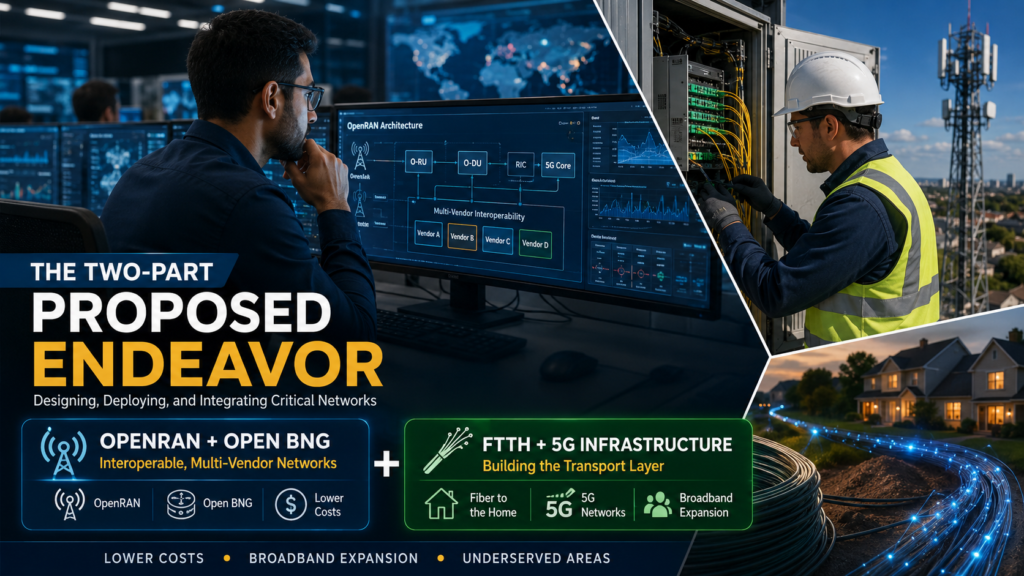
The first is developing and deploying open network architectures specifically OpenRAN and Open BNG. The work involves designing interoperable, multi-vendor network frameworks that reduce U.S. telecommunications dependence on foreign systems, lower infrastructure costs, and make it easier for operators to deploy 5G and broadband networks in underserved areas. OpenRAN is still early in its adoption curve – only 35 active deployments globally as of 2023, with the market expected to reach $3 billion by 2024 and 10% of total RAN deployments by 2025. There is significant ground to cover, and the U.S. government has put substantial money and policy attention behind making it happen.
The second is building critical infrastructure – Fiber to the Home, 5G networks, and the transport layer that connects them. FTTH delivers broadband directly to homes at speeds and reliability that wireless alone cannot match. 5G provides the mobility layer. Together, they are the foundation of the connected infrastructure the BEAD program is designed to fund. The engineering work of designing, deploying, and integrating these systems at scale is where his expertise sits.
Why the National Importance Argument Was Strong
The case did not need to stretch to establish national importance. The U.S. government had done that work explicitly, across multiple branches and agencies.
– $45 billion in BEAD program funding for broadband expansion, with OpenRAN and open architectures specifically named in the underlying policy rationale.
– $1.5 billion NTIA Open Wireless Supply Chain Innovation Fund, explicitly targeting the development and adoption of OpenRAN and interoperable network technology.
– The NTIA and DoD 2023 5G Challenge a $7 million prize competition to accelerate open, interoperable, secure 5G ecosystems stating that “a competitive wireless ecosystem is vital for our domestic and economic security.”
– The White House 2024 Critical and Emerging Technologies List, which includes integrated communication and networking technologies as a designated national priority.
– NIST’s formal membership in the O-RAN Alliance, promoting open wireless standards for 5G and next-generation networks.
– CISA’s designation of the Communications Sector as one of 16 critical infrastructure sectors.
When multiple federal agencies, a bipartisan infrastructure law, and multiple executive orders all point to the same technology as a national priority, the Dhanasar national importance prong is met by the public record. The petition organized that record and connected it to the proposed endeavor precisely.
How the Petition Was Built
The I-140 was filed as a self-petition without a U.S. employer. Immignis prepared the full case: proposed endeavor framing, Dhanasar mapping, national importance sourcing, and supporting documentation.
– National importance sourcing: BEAD program, NTIA Innovation Fund, NTIA/DoD 5G Challenge, White House spectrum strategy, FCC 5G FAST Plan, FCC Rural Broadband Accountability Plan, CISA critical infrastructure designation, Congressional broadband bills, White House “Internet for All” initiative, Critical and Emerging Technologies List updates for 2022 and 2024.
– Proposed endeavor: two-pillar structure covering open network architecture development and critical broadband infrastructure deployment, both tied directly to named federal programs and documented national gaps.
The Outcome
Approved.
A self-petitioned EB-2 NIW from Norway, in a field the U.S. government had explicitly identified as a national priority, with a proposed endeavor that mapped directly to documented federal programs and a 17-year career building the exact systems the country needs more of.
The U.S. has made the investment. What it needs now are people who know how to build the open, interoperable networks that make the investment work.
For Telecommunications Engineers Working on 5G and Open Architectures
If you work in 5G, OpenRAN, broadband infrastructure, or related telecommunications engineering and your work touches the areas the U.S. government has designated as national priorities in connectivity, security, and open standards, the NIW is worth looking at seriously. The BEAD program, the NTIA Innovation Fund, the DoD 5G Challenge, and the Critical and Emerging Technologies List have collectively created one of the strongest publicly documented national importance cases in telecommunications in years. A proposed endeavor that connects to that documented need, backed by real engineering experience, can make a compelling case.
Questions Telecom Engineers Ask Us
Can a telecommunications engineer working on 5G or OpenRAN qualify for an EB-2 NIW?
Yes. The U.S. government has explicitly identified open wireless architecture, 5G deployment, and broadband infrastructure as national priorities, backed by billions of dollars in federal programs. A proposed endeavor that addresses documented gaps in these areas with an engineering background that demonstrates real capability to advance it – can meet the Dhanasar test. The national importance argument is easier to establish here than in most fields because the government has done the work of saying so publicly.
Does the BEAD program or other federal broadband programs help an NIW case?
Significantly. The BEAD program ($42.45 billion), the NTIA Open Wireless Supply Chain Innovation Fund ($1.5 billion), the DoD and NTIA 5G Challenge, and the White House spectrum strategy all constitute documented federal recognition that open network architecture and broadband infrastructure are national priorities. Citing these directly, and connecting the proposed endeavor to their stated goals, is a strong approach for the national importance prong.
What makes OpenRAN specifically relevant to a U.S. national interest argument?
OpenRAN directly addresses two documented U.S. priorities at once: reducing dependence on foreign vendors (particularly Chinese manufacturers like Huawei and ZTE) for critical telecommunications infrastructure, and lowering the cost and complexity of deploying broadband in rural and underserved areas. The U.S. government has funded, challenged, and legislated in support of OpenRAN adoption specifically. A proposed endeavor focused on OpenRAN development and deployment sits at the intersection of national security and the digital equity agenda.
Does being based in Norway or another European country affect an EB-2 NIW petition?
No. The Dhanasar test evaluates the proposed endeavor and the petitioner’s qualifications – not current country of residence. The I-140 can be filed from outside the U.S. Once approved, the petitioner proceeds through consular processing. European telecom engineering experience is often directly applicable to U.S. infrastructure work, as the underlying standards and vendor ecosystems substantially overlap.
What does the well-positioned argument look like for a telecom engineer?
It draws on hands-on experience with the specific technologies being proposed, evidence of successful project delivery at relevant scale, platform expertise across major vendors, professional certifications, and any formal recognition of above-peer performance. For OpenRAN specifically, experience with multi-vendor network design, systems integration, and open-standards deployment is directly relevant. The closer the past work is to the specific proposed endeavor, the stronger the argument.
The U.S. has committed $45 billion to broadband, what it needs now are engineers who can build the open, interoperable architecture that makes the investment work. See how Immignis builds NIW cases around exactly that expertise.