A Solution Architect and Open RAN Subject Matter Expert working today inside one of the most ambitious wireless infrastructure deployments in U.S. history approved for an EB-2 NIW to extend that operational expertise into a nationally scalable AI-driven automation framework.
In short: An EB-2 NIW Open RAN engineer holding a Bachelor of Engineering in Electronics and Communication, with approximately 20 years of progressive experience in wireless networks across RF engineering, LTE optimization, Open RAN integration, and AI-driven network automation, was approved for an EB-2 National Interest Waiver as a self-petitioner. Indian national, based in Texas. He currently serves as Solution Architect and Open RAN Subject Matter Expert at a major U.S. cloud-native Open RAN wireless carrier, leading Level 3 outage resolution and multi-vendor incident management for a nationwide production network. He previously led Open RAN integration and AI/ML validation for major global Telecom Infra Project (TIP) initiatives at a major U.S. technology company’s research laboratory. Proposed endeavor: design and execute an AI-driven Open RAN automation and 6G-ready deployment ecosystem to improve reliability, interoperability, and long term evolution readiness across U.S. wireless infrastructure. Approved under Matter of Dhanasar.
The petitioner’s name and employer details have been withheld for privacy. Career record, projects, publications, and outcome are real.
The Network That Changed Everything Had to Keep Running:
When U.S. wireless carriers have deployed 5G networks in the past, they have done it the traditional way: closed, proprietary systems from a single vendor where every component (antennas, software, baseband processing) is designed to work only with the same manufacturer’s equipment. One vendor owns the network. If something breaks, you call that vendor. This context is directly relevant to an EB-2 NIW Open RAN engineer.
One major U.S. carrier made a different bet. It decided to build America’s first nationwide, fully cloud native 5G network using Open RAN principles, where components from different vendors are designed to work together. Mavenir for one function. Fujitsu for another. Cisco. Samsung. All coordinated through open interfaces, software-defined control, and cloud infrastructure.
That bet is technically extraordinary. It is also operationally demanding. When something breaks in a multi vendor open network, there is no single vendor to call. The problem could be in any layer, any interface, any vendor’s software. Isolating it requires someone who understands how all the pieces interact and can get the right vendor to the right place fast enough to restore service, strengthening the EB-2 NIW Open RAN engineer case.
He is that person. When a Severity-1 outage hits this nationwide network, his team handles the Level 3 escalation. He designed the Methods of Procedure that now govern how high impact incidents are identified, escalated, and resolved. His proposed endeavor is to build the AI systems that prevent those outages before they start as an EB-2 NIW Open RAN engineer.
Twenty Years to This Moment:
His career started as an RF engineer in India in 2006, building the technical foundation for an EB-2 NIW Open RAN engineer. It progressed through senior network engineering, LTE optimization at major global operators, and RAN specialist work at one of the world’s largest telecom equipment manufacturers. During his time there, he worked directly on AT&T and T Mobile networks in the United States driving test campaigns, optimizing VoLTE performance, improving call setup success rates and mobility KPIs. He also supported a major international LTE launch in Turkey, traveling onsite to accelerate readiness before commercial deployment.
That was his first exposure to the U.S. market. He was brought in based on performance, strengthening the EB-2 NIW Open RAN engineer case.
His next major assignment was at a major U.S. technology company’s global Telecom Infra Project research laboratory in Menlo Park, California. TIP is the industry consortium that drives Open RAN ecosystem development through funded, multi-vendor, production-oriented validation initiatives. He served as a Solution Architect there from late 2021 through early 2023, leading integration and validation work across three flagship programs.
Evenstar: the development and certification of Open RAN compliant radio units, validating interoperability across control, user, management, and synchronization planes. ROMA: orchestration and management automation for disaggregated Open RAN networks, including SMO and RIC integration use cases. RIA: RAN Intelligence and Automation – testing and validating AI/ML-based xApps and rApps for optimization, anomaly detection, and automated control in Open RAN environments. These initiatives directly support his positioning as an EB-2 NIW Open RAN engineer.
These are not internal project names. They are publicly referenced ecosystem initiatives used as design blueprints by operators and vendors across the global Open RAN community. Being a lead contributor to all three at a major technology company’s research lab is a specific, verifiable, and significant credential for an EB-2 NIW Open RAN engineer.
He was then selected for the role at the cloud native Open RAN carrier in Texas. Again, deputed based on merit recognized as having exactly the right combination of operational experience and architectural depth for the hardest job in the most ambitious Open RAN deployment in the country.
Deputation from India to the United States based on technical performance is how organizations signal that they cannot find the expertise they need domestically. That signal is directly relevant to the Dhanasar well positioned analysis for an EB-2 NIW Open RAN engineer.
Why the Demand Exceeds the Supply:
The NTIA’s Public Wireless Supply Chain Innovation Fund is a $1.5 billion statutory investment specifically to advance Open RAN, competition, and supply chain resilience, making this directly relevant to an EB-2 NIW Open RAN engineer. In Round 3, focused on integration automation solutions, NTIA received more than 90 applications requesting nearly $3 billion – against $450 million available. That is a demand-supply gap of more than six to one.
The gap exists because the problem is hard. Open RAN enables multi-vendor networks, which is exactly what U.S. policy wants: reduced dependence on any single supplier, increased competition, stronger supply chain resilience. But multi-vendor networks are operationally complex in ways that single vendor networks are not. When multiple vendors’ components must work together, interoperability must be continuously validated, software upgrades must be tested before they reach production, and fault diagnosis requires someone who can reason across all the vendor layers simultaneously, strengthening the EB-2 NIW Open RAN engineer case.
Without automation, that complexity is a barrier. With automation that is well designed, field tested, and explainable, the complexity becomes manageable. That is the gap his proposed endeavor is built to close.
A 2026 Verizon outage generated over 1.5 million outage reports and lasted more than ten hours, prompting FCC investigation and public safety warnings about 911 availability. A 2024 outage produced more than 70,000 reports within hours. These are not edge cases. They are the national security consequence of wireless network fragility. NERC identifies natural-gas compression and wireless networks as critical to electric grid stability. FCC rulemaking in June 2025 proposed new requirements for NG911 reliability. The White House issued a National Security Presidential Memorandum in December 2025 specifically on winning the 6G race naming secure, open, and resilient by design architecture as the objective for an EB-2 NIW Open RAN engineer.
The Four-Pillar Proposed Endeavor:
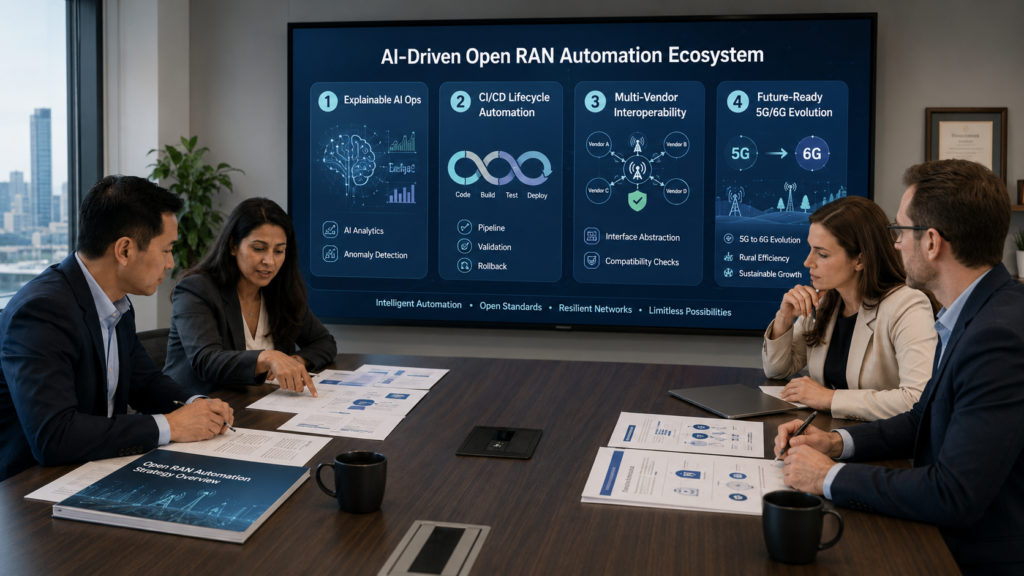
His proposed endeavor as an EB-2 NIW Open RAN engineer is an AI-driven Open RAN automation ecosystem built around four integrated pillars. Each addresses a different dimension of the operational problem.
The first is explainable AI-driven RAN operations and assurance. Multi vendor networks generate large volumes of performance data, fault signals, and change history that must be correlated quickly during incidents. The proposed system will ingest those signals, identify anomalous patterns, rank likely causes with supporting evidence, and recommend corrective actions – in a form engineers can validate before acting. The emphasis on explainability is not optional. Critical communications infrastructure requires accountability. A black box AI recommendation that nobody can justify is not useful during a Sev-1 event. His design produces evidence backed recommendations that engineers can audit.
The second is CI/CD enabled lifecycle automation. In software engineering, CI/CD is standard practice every change goes through automated testing before it touches a live system. In wireless network operations, it is inconsistently applied. He will design pipelines that treat network configuration changes, software upgrades, and feature introductions as version-controlled artifacts that must pass automated validation before deployment. The goal is controlled speed: changes that can be made safely, quickly, and with predefined rollback paths when something goes wrong, strengthening the EB-2 NIW Open RAN engineer case.
The third is production-grade multi-vendor interoperability governance. Open RAN components are certified for interoperability in lab environments. But production networks change continuously vendors ship updates, features are enabled, configurations drift. One time lab certification does not guarantee that next quarter’s software release will still work with all the other vendors in the stack. His governance model embeds continuous interoperability validation into the deployment and upgrade workflow, so the question is not ‘did these components work together in the lab six months ago’ but ‘are they working together right now, after this update’.
The fourth is future ready and economically sustainable network evolution. 6G is coming. Networks need to evolve toward it without destabilizing the 5G services running on the same infrastructure. His approach treats future readiness as an operational property designing automation and governance frameworks so new capabilities can be introduced incrementally, with continuous validation and defined rollback, rather than through disruptive rip and replace upgrade cycles. The same automation driven efficiency reduces the operational burden for rural and underserved deployments where staffing resources are limited for an EB-2 NIW Open RAN engineer.
Already Contributing to U.S. Network Operations:
His proposed endeavor is not a pivot. It is a scaling of work he is already doing inside the U.S. wireless ecosystem.
At the cloud native Open RAN carrier, his troubleshooting workflows and Methods of Procedure are embedded in the operational framework of a nationwide U.S. network. His collaborative RCA sessions with Mavenir, Fujitsu, Cisco, and Samsung have influenced software patches and feature stabilization in commercial products. His work does not stay inside one employer’s internal documentation it improves the stability of vendor products deployed across the industry.
At the TIP research lab, the test plans, automation pipelines, and validation frameworks he developed for Evenstar, ROMA, and RIA are referenced by operators and vendors across the global Open RAN ecosystem. Projects at that level of industry visibility function as reference models. His contributions to those models are documented and attributable.
He published a peer-reviewed article on AIpowered Open RAN in March 2025 on DevX, a technology platform with a global professional readership. He was invited to speak as a keynote at the Future of Workflow Automation for Businesses Virtual Summit (USA Edition) external recognition that his methodologies have relevance beyond the telecom sector.
Letters of Interest from his current employer and from the TIP laboratory document institutional confidence in his technical judgment.
How the Petition Was Built:
This was a direct petition. The career record, the project contributions, the publications, and the employer recognitions were already in place.
National importance sourcing: White House National Security Presidential Memorandum on Winning the 6G Race (December 2025), Open RAN Outreach Act (H.R. 2037), NTIA Public Wireless Supply Chain Innovation Fund ($1.5B), NTIA Round 3 demand gap (90+ applications, $3B requested vs $450M available), NTIA BEAD program ($42.45B), Critical and Emerging Technologies List 2024, FCC TAC 6G Working Group Report (August 2025), FCC NG911 reliability rulemaking, Rural Broadband Protection Act of 2025, carrier outage data (Verizon January 2026, AT&T February 2024), FBI ransomware data, Dell’Oro RAN market concentration data.
Well positioned evidence: Solution Architect / Open RAN SME in live nationwide U.S. network, Level 3 Sev-1 outage resolution authority, Methods of Procedure adopted within production operations, TIP Lab contributions to Evenstar/ROMA/RIA (globally referenced initiatives), CI/CD automation pipelines for Open RAN validation, IEEE membership, published article (DevX, March 2025), keynote speaking engagement (USA), Letters of Interest from current employer and prior TIP Lab, $200,000 personal seed funding committed.
Proposed endeavor: four pillar AI-driven automation ecosystem, each tied to a documented U.S. wireless infrastructure gap, each grounded in work the petitioner is already executing in production or at industry ecosystem scale.
I-140 filed as a self petition without a U.S. employer sponsorship requirement.
The Outcome:
Approved.
A self petitioned EB-2 NIW for an Open RAN engineer with 20 years of wireless experience, currently operating at the core of the most ambitious cloud native 5G deployment in the United States, with publicly verifiable TIP Lab contributions, a published article, a keynote speaking record, and a proposed endeavor directly responsive to the federal government’s documented Open RAN automation and 6G leadership priorities.
The NTIA received nearly $3 billion in applications against $450 million available. The demand for deployable Open RAN automation expertise is not theoretical. It is quantified and it is six times the available supply. He is already doing the work.
For Open RAN and Wireless Automation Specialists:
If your career is in Open RAN, vRAN, 5G operations, or wireless network automation – and you have been working on production networks, contributing to ecosystem initiatives, or developing deployable automation frameworks – the NIW is worth a serious assessment. The White House, Congress, NTIA, and FCC have collectively built one of the clearest documented national importance cases for Open RAN expertise of any field in the series. And if you are already working inside the U.S. wireless ecosystem, your well-positioned argument starts from a much stronger baseline than it would from outside the country.
Questions Open RAN and Wireless Professionals Ask Us:
Can an Open RAN operations specialist or wireless network automation engineer qualify for an EB-2 NIW?
Yes. Open RAN is explicitly named in federal legislation (the Open RAN Outreach Act), federal funding programs (the $1.5B NTIA Public Wireless Supply Chain Innovation Fund), the White House National Security Presidential Memorandum on 6G, and the Critical and Emerging Technologies List. A proposed endeavor focused on AI-driven automation, multi-vendor interoperability governance, and lifecycle management for Open RAN addresses these documented national priorities directly. An engineer with production-grade NOC leadership in a nationwide Open RAN network and published contributions to major TIP ecosystem initiatives is well-positioned to advance it.
How does working inside a live U.S. Open RAN network strengthen the NIW well-positioned argument?
It provides operational-grade evidence that no credential list can replicate. Resolving Severity-1 outages in a nationwide, multi-vendor, cloud native production network requires the specific combination of multi vendor troubleshooting depth, live escalation management, and decision-making under pressure that the proposed endeavor requires. Methods of Procedure that have been formally adopted by a major carrier’s NOC team are evidence of operational influence that extends beyond personal performance into institutional practice. This kind of evidence answers the well positioned question concretely: the petitioner has already been trusted with the exact class of problem the proposed endeavor is designed to solve.
Do contributions to global Open RAN ecosystem initiatives like TIP projects help an NIW case?
Yes, substantially. Contributions to Evenstar, ROMA, and RIA at a major technology company’s TIP research laboratory are publicly documented, ecosystem level technical contributions that are referenced by operators and vendors internationally. They demonstrate that the petitioner’s work has influenced practices beyond any single employer, which directly supports the Dhanasar well positioned prong. The difference between internal work and ecosystem level contributions is the difference between demonstrating competence and demonstrating influence.
How does the NTIA’s Open RAN demand gap (nearly $3B requested vs $450M available) support a national importance argument?
A six-to-one demand-to-supply gap in federal funding applications is among the most direct possible forms of documented national need. It reflects the assessment of more than 90 organizations – each of which identified Open RAN automation as a priority worth investing significant effort to pursue that the capability does not yet exist at the scale the country needs. Citing this gap in a national importance argument is not inferring need from general statistics; it is pointing to a federal agency’s own documentation that the specific problem the proposed endeavor addresses is undersupplied relative to demand. If you work in Open RAN, wireless network automation, or 5G/6G engineering and want to understand whether your background supports an EB-2 NIW, start with an honest Free assessment: immignis