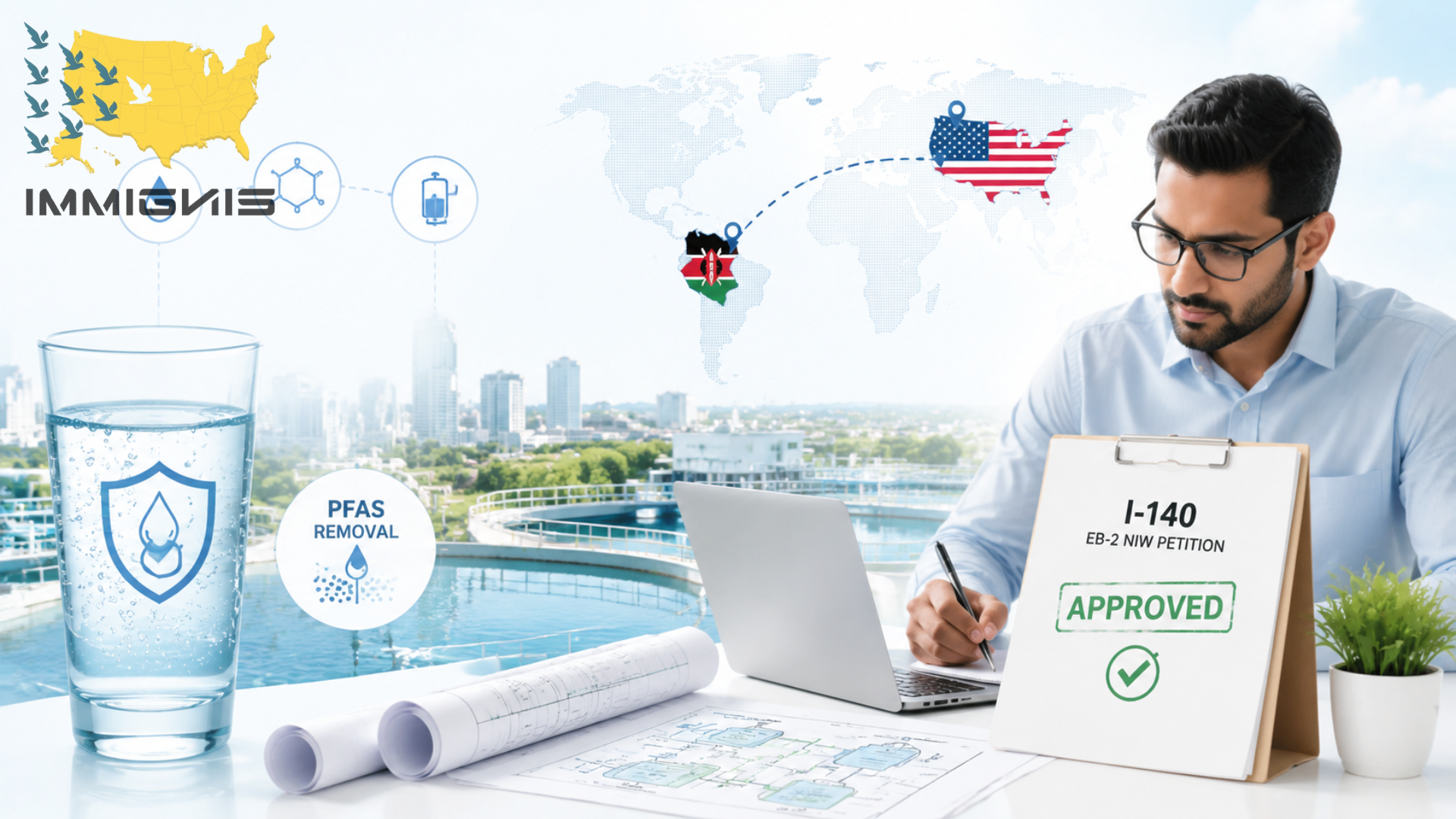
A senior environmental engineer believed he was trapped in the India EB-2 backlog. A careful birth-country review changed the timeline; profile building made the case approvable.
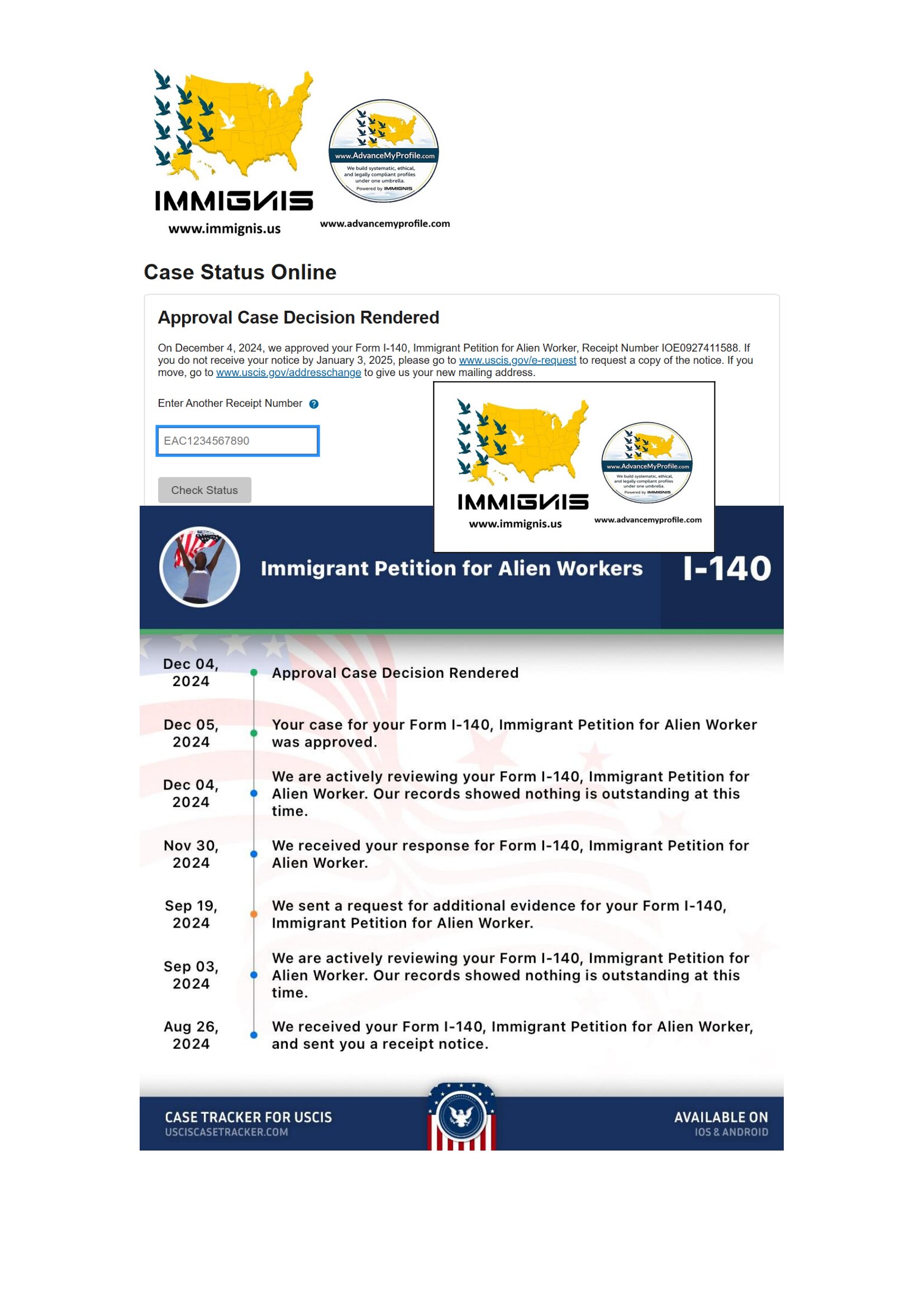
In short: An EB-2 NIW PFAS engineer, an Indian national born in Kenya, had spent about nine years in the United States building a serious environmental-engineering career focused on PFAS removal from municipal water systems. He assumed his green-card path would be delayed by the India EB-2 backlog. We identified that employment-based chargeability could be based on Kenya, not his passport nationality, and then built a PFAS-focused EB-2 NIW record strong enough for concurrent I-140 and I-485 filing. The I-140 was approved without an RFE, and the I-485 was later approved after USCIS processing.
Privacy note: The client’s name, employer, exact project identifiers, patent details, and personal immigration numbers have been suppressed. This public version focuses on the strategy, field, and evidence structure.
The success result: approval first, strategy behind it second
The result was direct: the EB-2 NIW I-140 was approved without a Request for Evidence for an EB-2 NIW PFAS engineer, and the adjustment-of-status application was later approved. That outcome was possible because two strategies worked together. First, the immigration review identified Kenya chargeability and opened the door to concurrent filing. Second, the profile-building work turned a private PFAS engineering record into a public, verifiable national-interest case.
This story is important because the timing advantage alone would not have been enough. Country of birth helped with visa availability; it did not prove national importance. The petition still needed to show why PFAS removal from municipal drinking-water systems matters to the United States and why this EB-2 NIW PFAS engineer was well positioned to advance that work.
The national problem: forever chemicals in public water systems
PFAS are persistent chemicals that create long-term water-quality, public-health, and municipal-compliance problems, a national issue directly relevant to an EB-2 NIW PFAS engineer. For public water utilities, the challenge is not only detecting contamination. Communities need treatment systems that can remove PFAS at scale, fit existing infrastructure, and remain affordable enough for municipal deployment.
The client’s work sat directly inside that problem. He had experience evaluating treatment technologies, comparing adsorption materials, supporting municipal-scale design, and helping public-water systems move from regulatory concern to engineering implementation. That made PFAS treatment a much stronger NIW direction than a general environmental-engineering profile for an EB-2 NIW PFAS engineer.
The weak starting point: a strong engineer who thought his timeline was blocked
At intake, the client had real technical work and a U.S.-based engineering career as an EB-2 NIW PFAS engineer, but he believed his nationality placed him in the same long queue faced by many Indian professionals in the EB-2 category. He had spent years assuming permanent residence would remain distant unless an employer-sponsored route moved slowly through the backlog.
Our first review found the turning point: he was an Indian national, but he was born in Kenya. Employment-based immigrant-visa chargeability generally follows country of birth, subject to the applicable rules and case facts. That meant the EB-2 NIW PFAS engineer case could potentially be charged to Kenya, where the priority date was current at the time of strategy and filing.
The proposed endeavor we built around
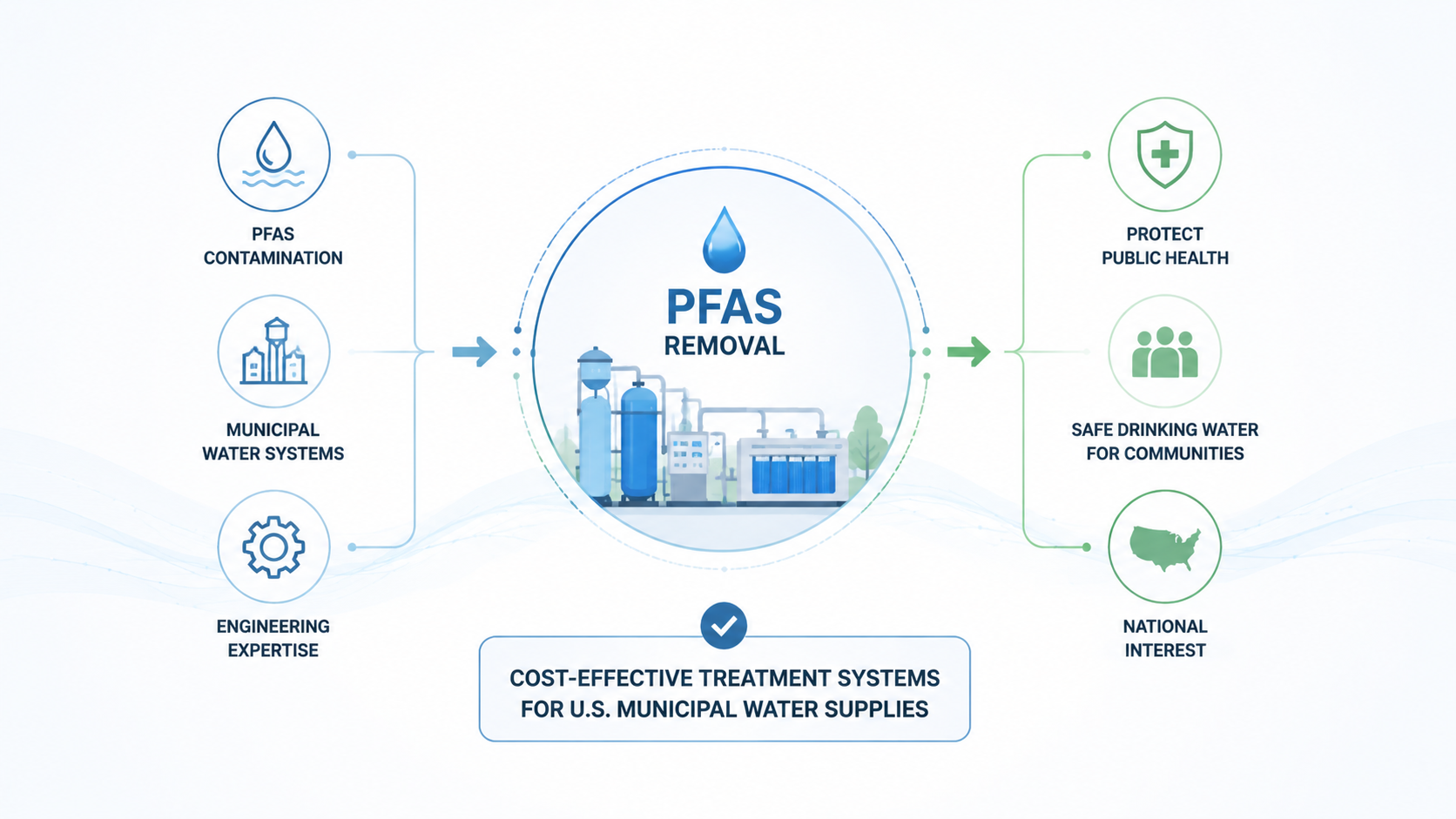
A vague proposed endeavor such as “I will work in environmental engineering” would not have carried the EB-2 NIW PFAS engineer case. The endeavor had to connect his exact PFAS treatment expertise to a U.S. national problem. We used the following direction as the strategic center:
“To develop and scale cost-effective treatment systems for removing per- and polyfluoroalkyl substances (PFAS) from U.S. municipal water supplies as an EB-2 NIW PFAS engineer - protecting public health by eliminating persistent, bioaccumulative contamination from the water millions of Americans depend on daily.”
This wording did four things. It named the contaminant, identified the affected infrastructure, described the engineering solution, and explained the public-health consequence. It also kept the field-endeavor nexus tight: PFAS treatment engineering was not background information; it was the mechanism of the national benefit.
What Immignis and AdvanceMyProfile built
The profile-building work was not added as decoration. Each step was designed to create evidence that a USCIS officer could verify and connect to the Dhanasar framework.
1. A public professional identity focused on PFAS treatment
We rebuilt the public-facing identity around PFAS removal for municipal water systems. His professional website, LinkedIn profile, researcher profile, and publication summaries were aligned to one narrow point: practical, cost-sensitive PFAS treatment engineering for public-water infrastructure.
2. A publication record tied to the same endeavor
With domain support, we helped structure a first-author publication plan in environmental engineering and water-science journals. The topics stayed close to his real work: adsorption materials, treatment-system design, municipal implementation barriers, and cost-sensitive filtration. Four papers were published in legitimate venues, giving the petition field-facing evidence beyond employment letters.
3. Earned media and expert commentary
Because the client did not want a profile based on paid placements, the visibility strategy focused on earned commentary and coverage. His comments addressed practical PFAS questions: treatment costs, adsorption performance, municipal feasibility, and compliance planning. This helped present him as a working expert in a public-health infrastructure problem, not only as an employee inside one firm.
4. A practitioner white paper and stakeholder outreach
PFAS compliance is a policy-facing and infrastructure-facing issue, so a white paper was appropriate. We helped prepare a practitioner-focused paper on cost-effective PFAS treatment options for municipal water systems and shared it with water-quality associations, environmental engineering networks, municipal utility contacts, and public-sector stakeholders. This showed a pathway from technical work to broader field use.
5. Conference activity and professional recognition
We prepared a conference paper for a recognized environmental-engineering gathering. The client presented his work and was later invited to participate in a technical PFAS treatment session at a water-quality forum. We also pursued credible professional recognition where the requirements supported his standing, avoiding basic pay-to-join labels that add little value.
6. Patent evidence showing originality
A patent application was filed for a novel combination of adsorption materials and treatment design developed from his research and engineering work. The filing documented original technical contribution and supported the argument that his work involved more than routine engineering execution. The patent did not need to be granted before filing to have evidentiary value, provided the filing was genuine, relevant, and properly documented.
7. Independent letters tied to municipal water impact
The letter strategy focused on independence and specificity. Letters came from voices who could explain why his PFAS treatment expertise mattered to municipal water systems, public-health protection, and practical compliance. The strongest letters did not simply praise his talent; they connected his methods to a shortage of scalable, affordable PFAS treatment solutions.
How the evidence supported Dhanasar
The final petition was organized as an evidence architecture, not a document pile. Each item had a job under the NIW framework.
- Substantial merit and national importance: PFAS removal was tied to public health, drinking-water safety, municipal infrastructure, and regulatory compliance.
- Well positioned: publications, conference activity, patent filing, technical work, expert commentary, and independent letters showed that he had the technical record to advance the endeavor.
- Waiver benefit: concurrent filing and the national need for PFAS treatment expertise supported the argument that requiring a labor certification would not serve the broader public interest.
Why concurrent filing changed the practical outcome
Once Kenya chargeability was identified and the priority date was current, the I-140 and I-485 could be filed together, subject to eligibility and USCIS processing. That changed the timeline from a distant backlog assumption to an active adjustment-of-status process. For an H-1B professional, this also created a path toward employment authorization and travel flexibility during the process, subject to the normal USCIS rules and approvals.
This point is central to the story: the birth-country rule changed the timeline, but profile building made the case capable of approval. Without the PFAS-focused record, concurrent filing would only have placed a weak case into USCIS faster. The goal was not speed alone. The goal was an approvable record filed at the right time.
Filing, approval, and what changed afterward
The petition and adjustment package were prepared and filed together. USCIS approved the I-140 without an RFE. The I-485 later completed processing and was approved. The client became a permanent resident after years of believing that the India EB-2 backlog would keep permanent residence out of practical reach.
The professional impact also continued. With stronger public recognition, PFAS-focused publications, stakeholder outreach, and a clearer technical identity, he moved into a stronger technical leadership role connected to municipal water-treatment implementation. His compensation improved, and his profile made it easier to present himself as a specialist in PFAS solutions for public-water systems.
What this case teaches Indian nationals born outside India
- Do not assume passport nationality controls the employment-based timeline. Country of birth can change chargeability analysis.
- Concurrent filing is valuable only when the priority date is current and the petition is strong enough to stand on its own.
- A timing advantage does not replace profile evidence. USCIS still evaluates the proposed endeavor, the national importance, and whether the petitioner is well positioned.
- A strong NIW topic must connect a national problem to the petitioner’s actual expertise. PFAS treatment worked because it joined engineering, drinking-water safety, municipal compliance, and public health.
- Ethical profile building does not create a false profile. It documents real expertise through publications, white papers, commentary, stakeholder outreach, technical recognition, patent activity, and independent letters.
For professionals considering this path
This case is a reminder that immigration strategy and professional evidence strategy must be reviewed together. A person may have a hidden timing advantage and still need a stronger record. Another person may have a strong record but no current visa-number pathway. The correct strategy starts with both questions: what immigration route is legally available, and what evidence is needed to make the professional case credible?
If you are an Indian national born outside India, or if you work in PFAS treatment, water infrastructure, environmental engineering, or public-health engineering, the right first step is an honest assessment of your birth-country chargeability, visa availability, proposed endeavor, and evidence gaps.
Free assessment: Submit your profile for review through Immignis