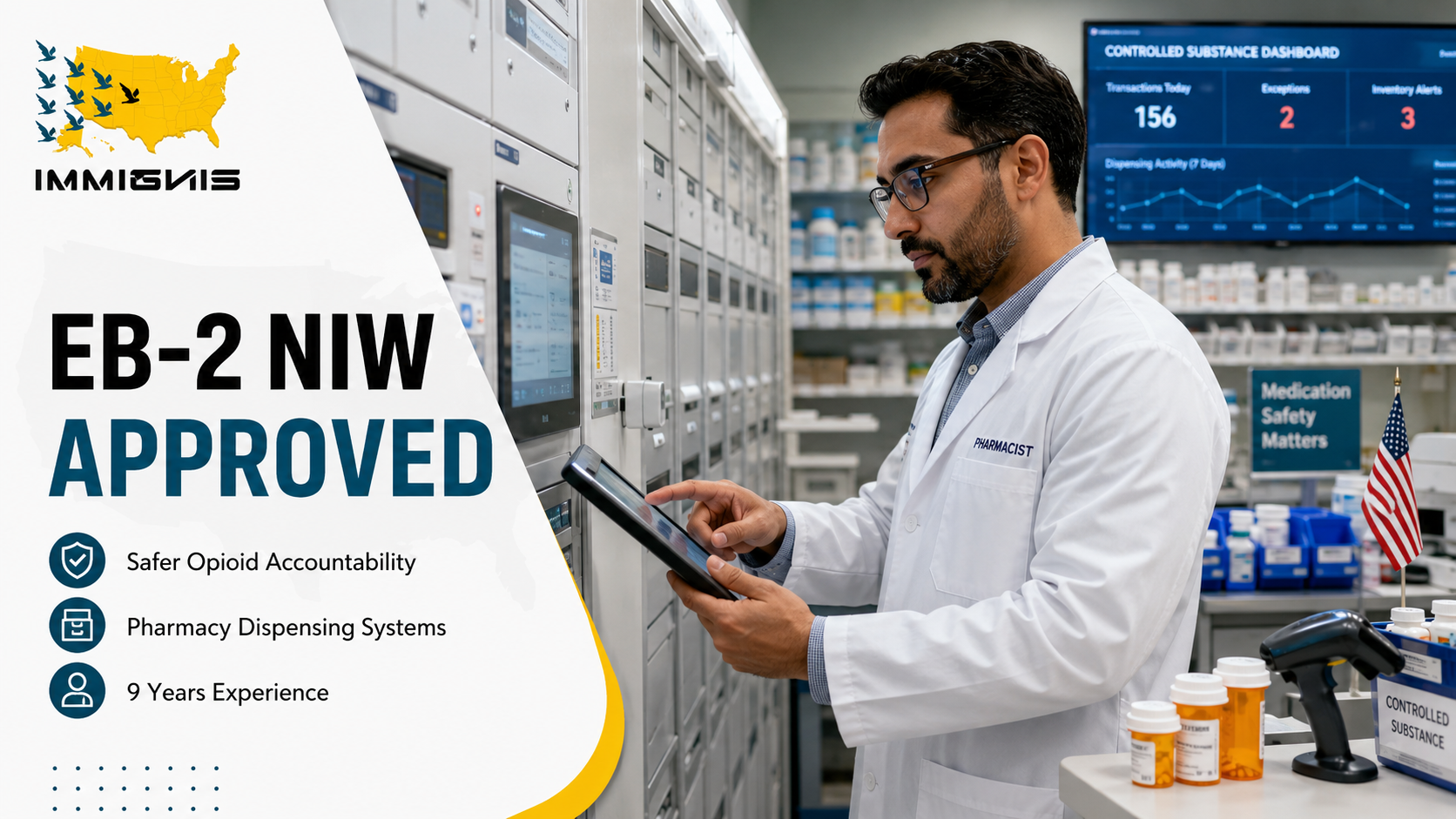
EB-2 NIW Pharmacy Automation Engineer: A Canadian biomedical engineer with more than 15 years of healthcare-automation experience, including nine years deploying and optimizing pharmacy dispensing systems, was approved for an EB-2 NIW to advance AI-powered, blockchain-secured opioid dispensing infrastructure for U.S. hospitals, pharmacies, and long-term care facilities.
| Case Snapshot | Approved EB-2 NIW self-petition |
| Professional Profile | Canadian citizen and biomedical engineer with more than 15 years of healthcare-automation, medical-device deployment, and pharmacy-systems experience. |
| Core Experience | Nine years as a senior field service engineer working with automated medication dispensing systems, biometric access controls, barcode medication administration, audit trails, diversion analytics, and staff training. |
| Proposed Endeavor | Develop and implement a secure opioid dispensing ecosystem for U.S. healthcare facilities, integrating blockchain audit trails, AI anomaly detection, federated learning, IoT smart cabinets, EHR-linked clinical decision support, secure mobile access, and compliance training. |
| National Importance | Anchored in the U.S. opioid epidemic, controlled-substance accountability, healthcare-facility diversion prevention, rural and long-term-care medication safety, and federal public-health priorities. |
| Well-Positioned Evidence | Hands-on deployment history, pharmacy automation expertise, clinical device integration experience, SOP and training development, preventive maintenance leadership, and direct knowledge of how dispensing systems work in real healthcare environments. |
| Outcome | Approved under Matter of Dhanasar. |
Privacy note: The petitioner’s name, employer names, university name, LinkedIn profile, and personal contact details have been withheld. The professional facts, proposed endeavor, and approval outcome are presented in anonymized form.
130 Deaths a Day, and a Dispensing System at the Center of the Problem
The approval was built around a direct public-health problem: the United States continues to face a severe opioid crisis, and healthcare facilities need stronger systems to control, monitor, and audit access to controlled substances.
The petition did not present the petitioner as a general biomedical engineer trying to enter healthcare technology. It presented him as someone who had spent years inside the exact infrastructure where controlled substances are stored, dispensed, recorded, reconciled, and audited.
That distinction mattered. Automated dispensing cabinets, medication-management platforms, barcode administration workflows, biometric access controls, and diversion analytics are not abstract technologies to him. They are the systems he has deployed, configured, maintained, trained users on, and optimized in real clinical environments.
The Career Behind the Approval
The petitioner’s career spans healthcare technology from the field level to the systems-integration level. He began in biomedical and clinical equipment support, working with analytical instruments, laboratory systems, endoscopy systems, laparoscopy platforms, and clinical-device training programs. This early experience gave him practical knowledge of how medical devices move from installation into daily clinical use.
The most important part of the profile was his nine-plus years with a global pharmacy automation and medication-management company. In that role, he worked directly with automated dispensing systems used by healthcare facilities to manage medication access, inventory control, user authorization, and controlled-substance accountability.
His responsibilities included configuring biometric and role-based access controls, integrating barcode medication administration workflows, supporting diversion analytics, building chain-of-custody processes, conducting preventive maintenance, improving uptime, training pharmacy and biomedical engineering teams, and preparing standard operating procedures. This work connected his background directly to the proposed U.S. endeavor.
The Proposed Endeavor for EB-2 NIW Pharmacy Automation Engineer: A Secure Opioid Dispensing Ecosystem
The approved proposed endeavor was structured as a next-generation opioid dispensing accountability system for U.S. hospitals, pharmacies, and long-term care facilities. It was not framed as a single device or a general software product. It was framed as an integrated infrastructure model for controlled-substance security, auditability, and safer medication access.
1. Blockchain-Enabled Audit Trails
The first component uses a private, permissioned blockchain architecture to record opioid transactions from stocking to dispensing, administration, wasting, reconciliation, and audit review. The purpose is to make controlled-substance records more tamper-resistant and easier to trace across authorized users and workflow steps.
2. AI Anomaly Detection and Behavioral Biometrics
The second component applies AI models to detect unusual dispensing behavior, such as abnormal access times, repeated withdrawals, unexpected medication quantities, or unusual user patterns. Behavioral biometrics add another layer by helping identify account compromise or misuse beyond static passwords and badge access.
3. Federated Learning Across Institutions
The third component allows participating healthcare facilities to learn from shared diversion-risk patterns without exchanging raw patient or employee data. Each institution keeps its own data locally while contributing model updates that improve the collective detection system.
4. IoT Smart Cabinets and Edge Computing
The fourth component focuses on smart dispensing cabinets with local processing capability. This allows essential access-control and audit functions to continue even when a network connection is unstable or temporarily unavailable, an important consideration for rural hospitals and long-term care facilities.
5. Clinical Decision Support and Compliance Training
The remaining components connect dispensing activity to EHR-linked clinical decision support, cloud-based compliance dashboards, secure mobile access for authorized emergency use, and automated staff training modules that link certification status to medication-access privileges.
Why the National Importance Argument Worked
The petition connected the proposed endeavor to a national public-health crisis rather than presenting it as a narrow equipment-service business. Opioid misuse, diversion, overdose deaths, controlled-substance accountability, rural access to safe medication systems, and institutional compliance formed the core of the national-importance argument.
The case also explained why the problem is not limited to prescribing decisions. A healthcare facility can have appropriate prescribing policies and still face diversion risk if the dispensing system has weak authentication, poor auditability, delayed anomaly detection, or fragmented reconciliation workflows.
This gave USCIS a practical link between the petitioner’s day-to-day experience and a larger national problem. The petition showed that safer opioid infrastructure depends on people who understand both the technology and the clinical environment in which it operates.
How the Dhanasar Prongs Were Presented
Prong One: Substantial Merit and National Importance
Substantial merit was shown through the technical value of secure medication dispensing, controlled-substance tracking, AI-enabled risk detection, privacy-preserving institutional learning, and clinical compliance support. National importance was shown through the scale of the opioid epidemic, the federal public-health response, the role of healthcare facilities in controlled-substance management, and the public benefit of preventing diversion before harm occurs.
Prong Two: Well-Positioned to Advance the Endeavor
The well-positioned argument was rebuilt around specific, documented experience. The petitioner had years of direct work on pharmacy automation systems, not merely general interest in healthcare technology. He had installed and configured dispensing infrastructure, supported biometric and barcode workflows, trained users, authored operating procedures, maintained uptime, and worked with the exact operational controls the proposed endeavor aimed to improve.
His broader biomedical engineering background strengthened the case because it showed familiarity with clinical device deployment, hospital staff training, equipment lifecycle support, and the interface between engineering systems and patient-care environments.
Prong Three: Benefit of Waiving the Job Offer and Labor Certification Requirement
The waiver argument focused on cross-institutional scope. The proposed work was not limited to one hospital, one pharmacy, one vendor, or one employer. It required a system that could be adapted across hospitals, pharmacies, long-term care facilities, rural providers, and compliance environments. A single employer role would narrow the proposed impact, while the NIW would allow the petitioner to advance a broader public-health technology model.
The petition also argued that the endeavor would support, rather than displace, U.S. workers by creating implementation needs for pharmacy teams, biomedical engineering departments, compliance professionals, cybersecurity specialists, software integrators, and healthcare training personnel.
The Outcome
Approved.
USCIS approved the EB-2 National Interest Waiver self-petition for a Canadian biomedical engineer whose healthcare automation and pharmacy dispensing systems experience directly supported a proposed U.S. endeavor focused on secure opioid dispensing infrastructure.
The approval shows that healthcare technology cases can succeed when the petitioner’s work is tied to a concrete public-health problem, when the proposed solution is technically specific, and when the evidence shows direct experience with the systems the petitioner proposes to improve.
What Makes This Success Story Different
This case is different from general biomedical engineering or medical-device stories because it is centered on controlled-substance accountability. The national-importance anchor was not device innovation in the abstract. It was the opioid epidemic and the need for safer, more auditable dispensing systems inside real healthcare facilities.
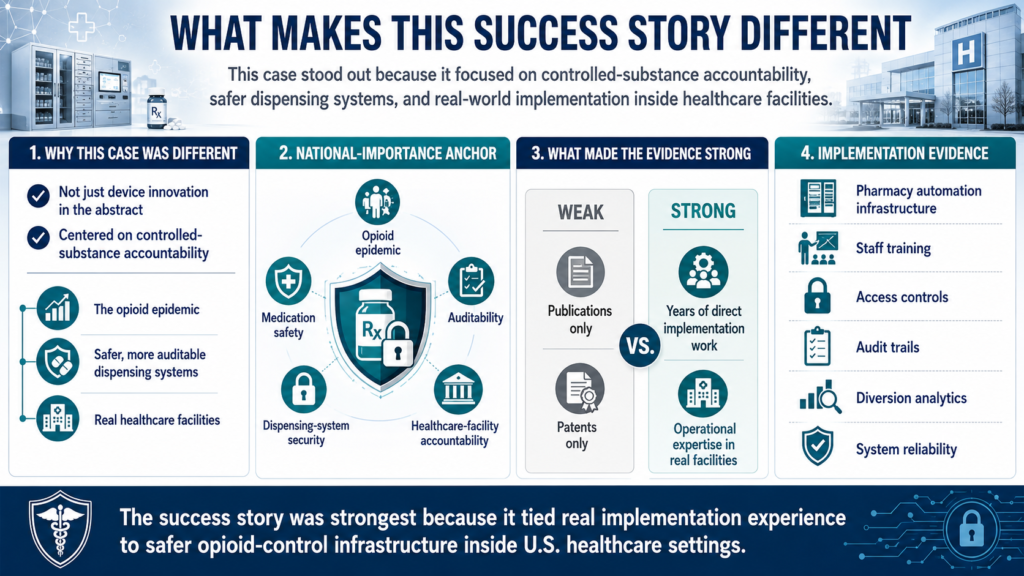
It is also different because the petitioner’s strongest evidence came from implementation. He was not relying on publications or patents as the main proof of positioning. He relied on years of direct work with pharmacy automation infrastructure, staff training, access controls, audit trails, diversion analytics, and system reliability.
Questions Healthcare Automation Professionals Ask Us
Can a pharmacy automation engineer qualify for an EB-2 NIW?
Yes, when the proposed endeavor connects the engineer’s experience to a nationally important healthcare problem. In this case, the petitioner’s direct work with automated dispensing systems, controlled-substance workflows, biometric access, barcode medication administration, and diversion analytics made the connection clear.
Why did the opioid focus strengthen the case?
The opioid epidemic gave the petition a clear public-health foundation. The proposed work was not merely improving hospital operations; it was aimed at reducing diversion risk, improving accountability, supporting compliance, and strengthening medication safety in environments where opioids are stored and dispensed.
Does a petitioner need patents or publications for this type of case?
Not always. Publications and patents can help, but they are not the only way to prove the well-positioned prong. For implementation-heavy healthcare technology cases, documented field experience, major deployments, training work, SOP development, system-integration responsibility, and direct technical knowledge can be strong evidence when tied to the proposed endeavor.
How is this different from a normal pharmacy automation job?
A normal job would usually support one employer’s products or service territory. This proposed endeavor was framed at a broader level: developing a secure opioid dispensing ecosystem that could be adapted across multiple healthcare settings and aligned with national public-health and compliance needs.
What lesson does this case offer future NIW applicants?
The strongest NIW cases do not only describe a problem. They show why this petitioner has already worked inside the systems where that problem occurs. Here, the petitioner’s pharmacy automation background made the proposed endeavor credible because he understood the real operational environment behind opioid dispensing and diversion prevention.
For Biomedical Engineering, Pharmacy Automation, and Healthcare Technology Professionals
If your work involves medication management, clinical automation, hospital technology, controlled-substance systems, biomedical equipment deployment, healthcare cybersecurity, or compliance infrastructure, an EB-2 NIW may be worth assessing when your proposed work addresses a documented U.S. public-health or healthcare-system need.