An approved success story for EB-2 NIW plant scientist built from plant physiology, processing tomato research, field implementation, structured validation experience, and a U.S.-focused agricultural water-resilience strategy.
Case Snapshot
| Client profile | Hungarian PhD-level plant scientist with agricultural industry and structured software-validation experience |
| Field | Plant-responsive irrigation for water-limited high-value vegetable production, including processing tomato |
| Core U.S. need | Water scarcity, declining irrigated acreage, drought pressure, and stable production of processing vegetables in regions such as California |
| Proposed endeavor | Develop, validate, and implement plant-responsive irrigation methods using stomatal conductance, canopy temperature, and crop-performance metrics |
| Evidence foundation | PhD summa cum laude, peer-reviewed publications, 209 Google Scholar citations, independent citation reach across countries and continents, and Q1 journal citations |
| Implementation strength | Field trials, plant-protection consulting, GEP/GLP documentation, grower-facing support, machinery-sector experience, and industrial software testing |
| Main strategy | Show that this was not routine crop advice, but a research-to-implementation model for water-use efficiency, crop quality, and production resilience |
| Outcome | EB-2 NIW I-140 approved |
EB-2 NIW plant scientist Approval result : A Technical Irrigation Record Became a National-Interest Story
This case ended with EB-2 National Interest Waiver approval for a Hungarian plant scientist whose strongest evidence came from a precise combination of plant physiology, irrigation research, crop-quality analysis, field implementation, and structured validation. The approved record did not present him as a general academic researcher. It presented him as a specialist positioned to advance plant-responsive irrigation methods for water-limited agricultural production in the United States.
The petition framed the client as an advanced-degree professional whose work focused on plant-physiological indicators, especially stomatal conductance and canopy temperature, for irrigation decision-making in processing tomato and other high-value vegetable systems. The approval showed that this technical record could support a national-interest case when the evidence was organized around a clear U.S. agricultural water-resilience problem.
The success did not come from making broad claims about agriculture. It came from showing how the client’s research and implementation experience could support better irrigation decisions in regions where water limits affect production, processing quality, rural economies, and food-supply stability.
The National Problem: Water-Limited Agriculture Needs Better Field Decisions
The U.S. problem identified in the petition was concrete. Irrigated agriculture depends on limited freshwater resources, especially in western production regions. California remains central to specialty-crop and processing-tomato production, yet water pressure, drought, groundwater limits, and reduced irrigated acreage continue to affect planting decisions and crop reliability.
The proposed endeavor addressed the decision layer inside that problem. Growers may already use irrigation systems, weather information, soil-moisture data, and experience. The gap is that those tools may not fully show how the plant itself is responding. A crop-responsive approach can help determine when irrigation can safely be reduced, when water stress threatens yield or Brix, and when continued irrigation is necessary to preserve marketable quality.
That gave the case a strong national-interest foundation. The work was not framed as ordinary crop advice. It was framed as a practical method for improving water-use efficiency, crop resilience, and processing-quality stability in water-limited agricultural systems.
The Proposed Endeavor
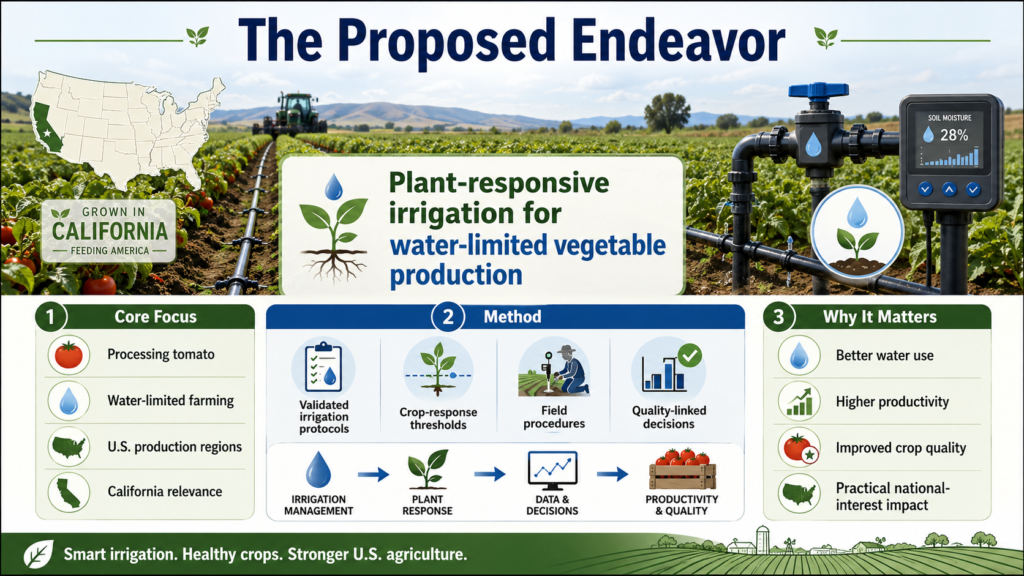
To develop, validate, and implement plant-responsive irrigation methods for water-limited production of high-value processing vegetables in the United States, including processing tomato, with particular relevance to major production regions such as California where water availability critically influences agricultural productivity.
The endeavor was effective because it stayed precise. It did not promise to solve drought. It focused on validated irrigation protocols, crop-response thresholds, field procedures, and quality-linked decision-making. That made the national-interest argument easier to follow and harder to dismiss as ordinary farm consulting.
What Made the Profile Strong
- Academic depth: a PhD summa cum laude in crop and horticulture sciences, with prior research on water supply, stomatal conductance, yield, and processing tomato quality.
- Citation record: doctoral and related work cited 209 times across 40 countries and six continents, including citations in high-quality journals such as Agricultural Water Management and Computers and Electronics in Agriculture.
- Practical field capability: experience in agricultural trials, biological plant protection, grower-facing consulting, crop-protection implementation, and technical-commercial agricultural support.
- Validation mindset: structured software-testing and quality-assurance experience in an industrial automation environment, useful for repeatable protocol testing, documentation, and performance comparison.
- Professional standing: statutory plant-protection licensure, membership in the Hungarian Academy of Sciences public body, and appointments to PhD dissertation defense committees.
How the Evidence Architecture Was Built
The success of the case came from combining two sides of the client’s profile. On one side was plant science: stomatal conductance, canopy temperature, regulated deficit irrigation, yield stability, soluble solids, and processing quality. On the other side was implementation discipline: field trials, grower-facing work, plant-protection practice, and validation methods from industrial software testing.
The petition organized those facts into five connected pillars. First, plant-responsive assessment would measure crop signals. Second, deficit-irrigation protocols would define when reduced water could be tolerated. Third, research findings would be translated into grower-usable procedures. Fourth, structured validation would make the procedures testable and repeatable. Fifth, crop-quality metrics would ensure that water savings did not come at the cost of processing value.
This mattered because a U.S. irrigation case cannot depend only on scientific vocabulary. USCIS needs to understand what the petitioner will do, who can use it, and why the result extends beyond one employer or one farm. The evidence architecture made that connection visible.
How the Case Supported Dhanasar
Substantial merit
The petition tied the endeavor to agricultural science, irrigation management, environmental sustainability, and resource-efficient food production. The expected outputs were measurable through yield, yield stability, Brix, water-use efficiency, and fruit quality.
National importance
The petition connected the work to U.S. irrigation dependence, western drought conditions, declining irrigated acreage, California processing-tomato pressure, groundwater sustainability, and federal programs focused on water efficiency, conservation, precision agriculture, and climate-smart agricultural practices.
Well positioned
The record relied on the client’s advanced credentials, publication and citation record, plant-protection license, research appointments, industry trial experience, and validation background. The strongest point was the combined proof that he could develop scientifically grounded methods and translate them into practical field procedures.
Balancing / waiver benefit
The petition explained why the endeavor had value beyond a narrow employer-specific role. Plant-responsive irrigation methods can support growers, processors, agricultural advisors, research institutions, and water-limited production regions where better decisions can improve resilience and resource efficiency.
Filing and Approval
The final petition was assembled as an evidence architecture. The proposed endeavor explained the agricultural water-resilience problem. The scientific record showed the client’s technical foundation. The citation record showed independent engagement with his research. The field-trial, consulting, plant-protection, and validation evidence showed practical capacity to advance the work. The Dhanasar analysis connected each exhibit to the national-interest standard.
USCIS approved the EB-2 NIW I-140. The approval confirmed that a plant-science and irrigation case can succeed when the national problem, technical mechanism, and evidence record are aligned clearly. The case was strongest because it did not overstate the work. It showed a practical, research-based pathway for improving irrigation decisions in water-limited high-value vegetable production.
What the Client Gained Beyond Approval
The approval was the immigration result, but the profile-building process also gave the client a clearer professional identity. His work could now be explained as a focused contribution to agricultural water resilience, not simply as a plant-science background or a collection of academic publications.
That clarity made the profile stronger for professional conversations with agricultural technology companies, irrigation advisors, crop researchers, processing-vegetable stakeholders, and water-efficiency organizations. The same evidence that supported the petition also made his expertise easier for the market to understand.
What This Success Story Teaches
- A strong NIW story can come from practical plant science when the national problem is specific and the technical mechanism is clear.
- Citation numbers matter more when they are connected to a focused endeavor rather than presented as isolated academic achievement.
- Field implementation experience can strengthen a research case because USCIS must see capacity to advance the work, not only past scholarship.
- Structured validation experience can be valuable when the endeavor depends on repeatable procedures, documented testing, and adoption-ready methods.
- For agriculture cases, national importance should be tied to water, food-supply resilience, production stability, rural economies, and realistic replication potential.
- Ethical profile building documents real expertise. It does not manufacture a false profile or invent evidence the record cannot support.
If you are a plant scientist, agronomist, crop researcher, irrigation specialist, or agricultural technologist, your profile may be stronger than it first appears. The key is not only what you studied. The key is whether your work can be organized into a U.S. national-interest story with a clear problem, a specific technical mechanism, measurable outputs, and credible evidence that you are positioned to advance it.
Ready to build your EB-2 NIW case? Explore how Immignis helps engineers and professionals win their National Interest Waiver.