
Case Snapshot | EB-2 NIW power generation executive
| Client profile | Senior power-generation and gas-services executive; registered professional engineer; advanced-degree professional. |
| Country background | Pakistan-born petitioner residing in the United Arab Emirates. |
| Field | Gas turbine systems, combined-cycle power generation, lifecycle asset management, grid reliability, digital performance optimization, and power-sector modernization. |
| Professional record | More than 20 years of power-sector experience, including senior GE, GE Power, FieldCore, and GE Vernova leadership across South Asia and the Middle East. |
| Proposed endeavor | A grid-constrained reliability scaling system that converts existing U.S. gas-turbine fleets into rapidly deployable, firm-capacity reliability platforms. |
| Primary U.S. problem addressed | Electricity-demand growth from data centers, AI workloads, cloud computing, semiconductor facilities, and advanced manufacturing is moving faster than conventional grid expansion. |
| Evidence theme | Engineering credibility, executive execution record, fleet-level reliability model, gas-turbine modernization, predictive availability management, and Dhanasar-aligned national-importance framing. |
| Outcome | EB-2 NIW I-140 approved. |
The Approval Result
This case ended with an EB-2 National Interest Waiver I-140 approval for a senior power-generation and gas-services executive whose strongest record was not a narrow job description, but a long history of helping gas-turbine fleets deliver reliable capacity in demanding power markets.
The success came from converting a broad executive and engineering career into a precise national-interest story. The petition did not rely only on major employers, project value, or senior titles. It showed how the petitioner’s experience with gas-turbine modernization, long-term service agreements, outage execution, lifecycle asset planning, and digital performance management could be applied to a current U.S. grid-reliability need.
The approval confirmed that a senior infrastructure professional can present a strong NIW case when the proposed endeavor identifies a specific technical mechanism, a measurable national problem, and a credible execution record.
The National Problem: Power Demand Is Moving Faster Than Grid Expansion
The proposed endeavor was organized around a current U.S. reliability problem. Data centers, artificial-intelligence workloads, cloud platforms, semiconductor facilities, and advanced manufacturing projects require large amounts of dependable electricity, often in regions where transmission capacity, interconnection timelines, and generation availability are already under pressure.
The case did not argue that new generation and transmission are unnecessary. It made a practical point: while long-cycle infrastructure expansion continues, the United States can recover near-term reliability value from existing gas-turbine and combined-cycle assets that are already built, permitted, interconnected, and operating within regional power systems.
This framing kept the case grounded. It connected the petitioner’s prior work to the specific reliability question facing the United States: how existing dispatchable fleets can be modernized, coordinated, and managed so that AI-driven and industrial electricity demand does not outpace firm-capacity availability.
The Proposed Endeavor |EB-2 NIW power generation executive
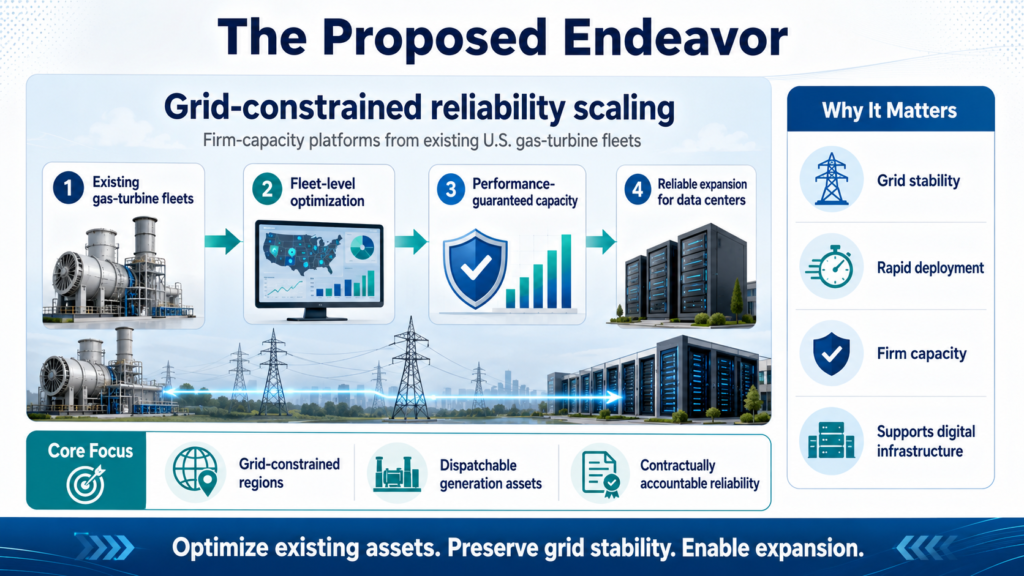
To design and deploy a grid-constrained reliability scaling system that converts existing U.S. gas-turbine fleets into rapidly deployable, firm-capacity reliability platforms, allowing data centers and other digital infrastructure to expand in grid-constrained regions while preserving electric-grid stability.
The endeavor treated reliability as a measurable and contractually accountable outcome. It focused on optimizing and coordinating existing dispatchable generation assets at the fleet level so that under-optimized gas-turbine fleets could become performance-guaranteed capacity resources while long-term grid expansion proceeds.
Why the Endeavor Was Strong
The case identified the right assets. The model began by identifying grid-constrained regions and then prioritizing existing gas-turbine fleets, including classes such as 9E, 9F, 6FA, 9HA, and similar assets that are already interconnected and capable of supporting regional reliability.
The case connected modernization to firm capacity. Output-boost upgrades, heat-rate improvement, advanced gas path upgrades, compressor upgrades, controls modernization, and availability improvements were presented as reliability tools, not isolated plant-level capital projects.
The case used lifecycle engineering as reliability evidence. Rotor life extension, component refurbishment, inspection strategy, outage coordination, and lifecycle planning were shown as methods for keeping grid-critical units available, reducing forced-outage risk, and preserving dependable capacity.
The case made digital performance management part of the reliability model. Predictive analytics, asset-performance management, digital-twin methods, and condition-based availability planning were positioned as operating-intelligence tools that help match maintenance and outage planning with peak reliability needs.
The case made the model scalable. Fleet-level execution protocols and availability-based reliability models shifted the story away from one plant or one employer and toward a repeatable system for multiple grid-constrained regions.
What Immignis and AdvanceMyProfile Built
The profile-building work converted a long technical and executive career into an evidence architecture that USCIS could follow. The record had to show how the petitioner’s prior power-sector work translated into a forward-looking U.S. endeavor with national importance.
Education and professional standing supported the technical nature of the profile, including mechanical engineering, energy and environmental engineering, project management, executive business administration, and professional engineering registration.
Senior leadership roles across GE, GE Power, FieldCore, and GE Vernova showed execution capacity in gas-power services, fleet reliability, customer programs, and regional power-sector operations.
Direct experience with gas-turbine modernization, output improvement, heat-rate optimization, compressor upgrades, advanced gas path initiatives, rotor-life and lifecycle programs, and long-term service agreements showed a record aligned with the exact mechanism of the proposed endeavor.
Digital performance contracts, predictivity tools, outage planning, decarbonization studies, and reliability-centered maintenance strategy supported the argument that the petitioner could connect physical asset modernization with measurable availability outcomes.
The final evidence architecture was built around a five-pillar model: region selection, engineering modernization, life extension, predictive availability management, and fleet-level reliability execution.
How the Evidence Supported Dhanasar
Prong One - substantial merit and national importance: The national-importance argument centered on grid reliability, energy security, digital-infrastructure readiness, economic competitiveness, emissions performance, and the need for near-term firm capacity. The petition tied the endeavor to data-center and AI electricity demand, resource-adequacy concerns, capacity scarcity, interconnection delays, and the continuing importance of existing natural-gas generation in the U.S. power system.
Prong Two - well positioned to advance the endeavor: The petition connected the petitioner’s education, professional engineering registration, GE and GE Vernova leadership, FieldCore experience, gas-turbine modernization work, long-term service agreement execution, digital predictivity exposure, and regional power-services management to the exact work required by the proposed endeavor.
Prong Three - benefit of waiving the labor-certification requirement: The case emphasized that the proposed endeavor required cross-regional deployment, fleet-level coordination, independent stakeholder engagement, and rapid execution across multiple assets and entities. That framing helped explain why the work should not be limited to a single employer-sponsored job role.
Filing and Approval
The final petition was filed as a structured national-interest case, not as a senior-executive resume package. The proposed endeavor explained the U.S. grid-reliability problem. The professional record showed the petitioner’s direct experience with the asset classes, service models, and execution systems needed to address that problem. The Dhanasar analysis connected each evidence category to a specific legal purpose.
USCIS approved the EB-2 NIW I-140. The approval showed the value of presenting a power-sector executive through a specific technical endeavor: existing gas-turbine fleets, modernized and managed at the fleet level, can provide near-term firm-capacity reliability while long-term grid expansion continues.
What the Client Gained Beyond Approval
The approval was the immigration result, but the profile-building process also clarified the petitioner’s professional identity for U.S.-facing opportunities. His record could now be explained as a grid-reliability and gas-turbine modernization platform, not only as a history of senior roles in major power companies.
That clarity strengthened the way his experience could be presented to utilities, energy developers, data-center stakeholders, industrial power users, and infrastructure partners that need practical solutions for speed-to-power, resource adequacy, availability management, and fleet-level execution.
What This Case Teaches
- A senior executive profile still needs a specific technical endeavor. Leadership alone is not enough; the petition must identify the mechanism of national impact.
- Energy reliability can be nationally important when the case connects specific assets, regional constraints, demand growth, and measurable capacity outcomes.
- Existing infrastructure can be a powerful NIW theme when the strategy shows how it can be modernized, optimized, and coordinated at scale.
- Federal policy alignment should support the argument, not replace it. The petition still needs a petitioner-specific execution story.
- A strong NIW profile converts professional history into a forward-looking national-interest plan.
If your work sits inside energy, power generation, grid reliability, data-center infrastructure, industrial systems, or critical infrastructure modernization, your NIW strategy should begin with one question: what national system becomes more reliable, efficient, or resilient because of your specific expertise?
Decades of gas-turbine fleet experience can solve a national grid reliability problem, see how Immignis turns executive power-sector careers into approved EB-2 NIW cases.