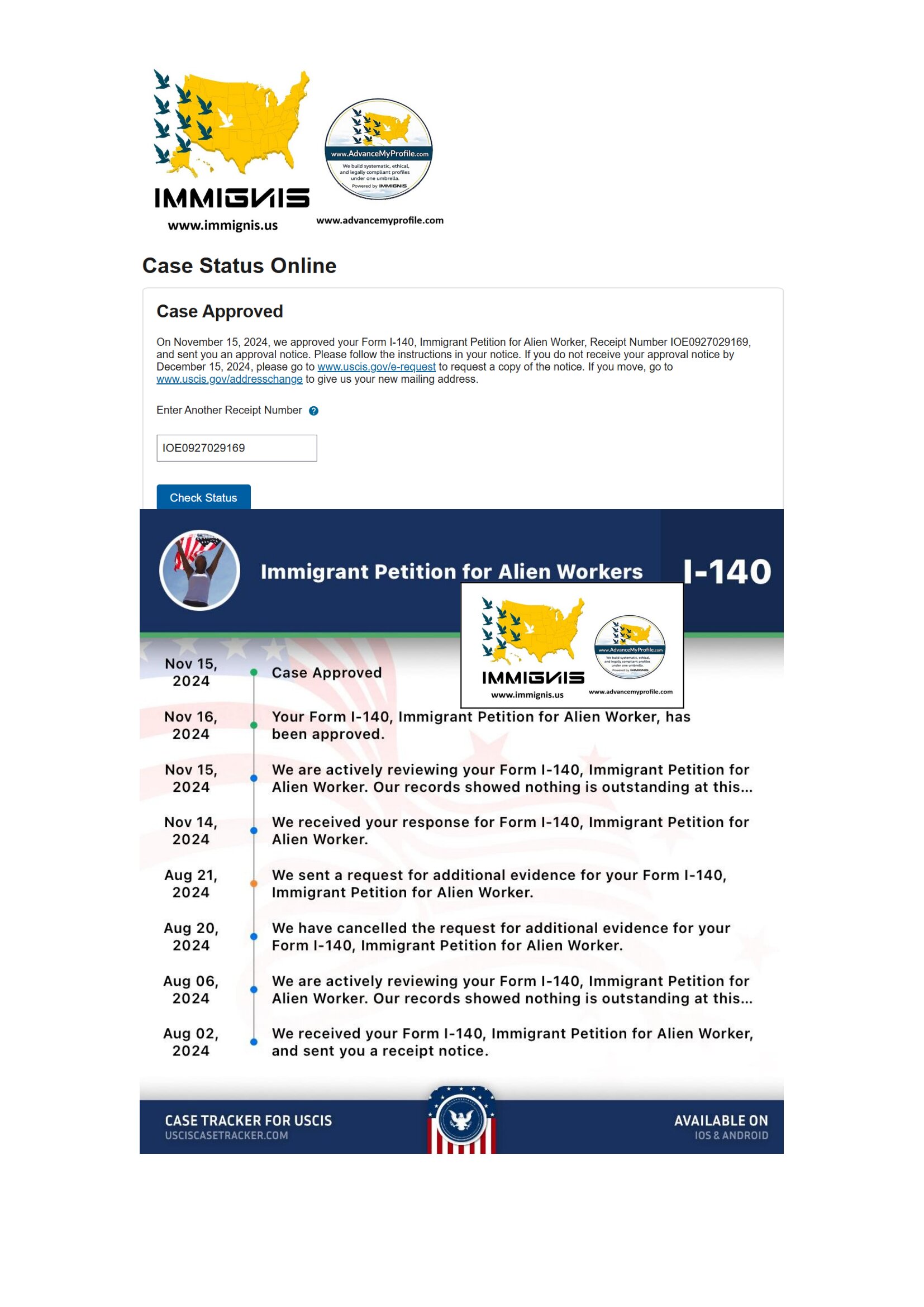
A senior precision-agriculture scientist had already tried the EB-2 NIW route with a careful attorney filing. USCIS issued an RFE, the response was filed, and the case was still denied. The problem was not that he lacked expertise. The problem was that the proposed endeavor did not connect tightly enough to the technical work he actually did for an EB-2 NIW precision agriculture case. After approximately ten months of profile rebuilding through AdvanceMyProfile.com and Immignis, the EB-2 NIW precision agriculture case was refiled and approved without an RFE.
Approval result: EB-2 NIW I-140 approved on refile without an RFE after the proposed endeavor was corrected and the evidence was rebuilt around sensor-integrated precision irrigation and predictive soil-data modeling.
Approval Summary
| Category | Details |
| Nationality | Egyptian |
| Work Base | Saudi Arabia – precision-agriculture research and industry |
| Profession | Precision-agriculture scientist focused on sensor-based irrigation and crop-resilience data systems |
| Career Stage | Approximately 10 years as a senior researcher and engineer |
| Pathway | EB-2 National Interest Waiver |
| When He Came to Us | Attorney-filed NIW petition, RFE answered, and petition still denied |
| Engagement | Approximately 10 months of profile rebuilding and refile preparation |
| Outcome | Refiled EB-2 NIW I-140 approved without an RFE |
The National Problem: Farming With Less Water
The United States cannot treat agricultural water efficiency as a side issue. Drought-prone farming regions face rising pressure to protect yields while using less water. Precision irrigation, crop-resilience analytics, and predictive soil-data modeling are practical tools for domestic food security, especially in areas where climate-driven water scarcity affects production planning, making this a strong EB-2 NIW precision agriculture case.
This client had spent close to a decade working on that exact problem in Saudi Arabia. His work used real-time soil, climate, and crop data to decide when water was needed, where it was needed, and how much should be applied. The work was field-tested and connected to large-scale farms, but the earlier NIW filing did not present that technical value in a way that USCIS could clearly evaluate for an EB-2 NIW precision agriculture petition.
The Client’s Starting Point: Strong Expertise, Weak Field-Endeavor Connection
He came to us after a respected immigration attorney had prepared the earlier filing, responded to an RFE, and still received a denial in an EB-2 NIW precision agriculture case. That distinction mattered. This was not a careless filing by an unqualified applicant. It was a case where the foundation of the proposed endeavor was too broad for the evidence.
The earlier record discussed agricultural technology, food security, water conservation, and climate adaptation. Those topics were important, but they sat too far above the petitioner’s actual technical mechanism. USCIS did not need another broad explanation of why food security matters. It needed to see how this specific scientist’s skills in sensor-integrated irrigation, sensor fusion, soil-moisture modeling, predictive crop-resilience analytics, and field deployment would create the national benefit claimed in the EB-2 NIW precision agriculture petition.
The Strategic Correction: Making the Endeavor the Engine of the Case
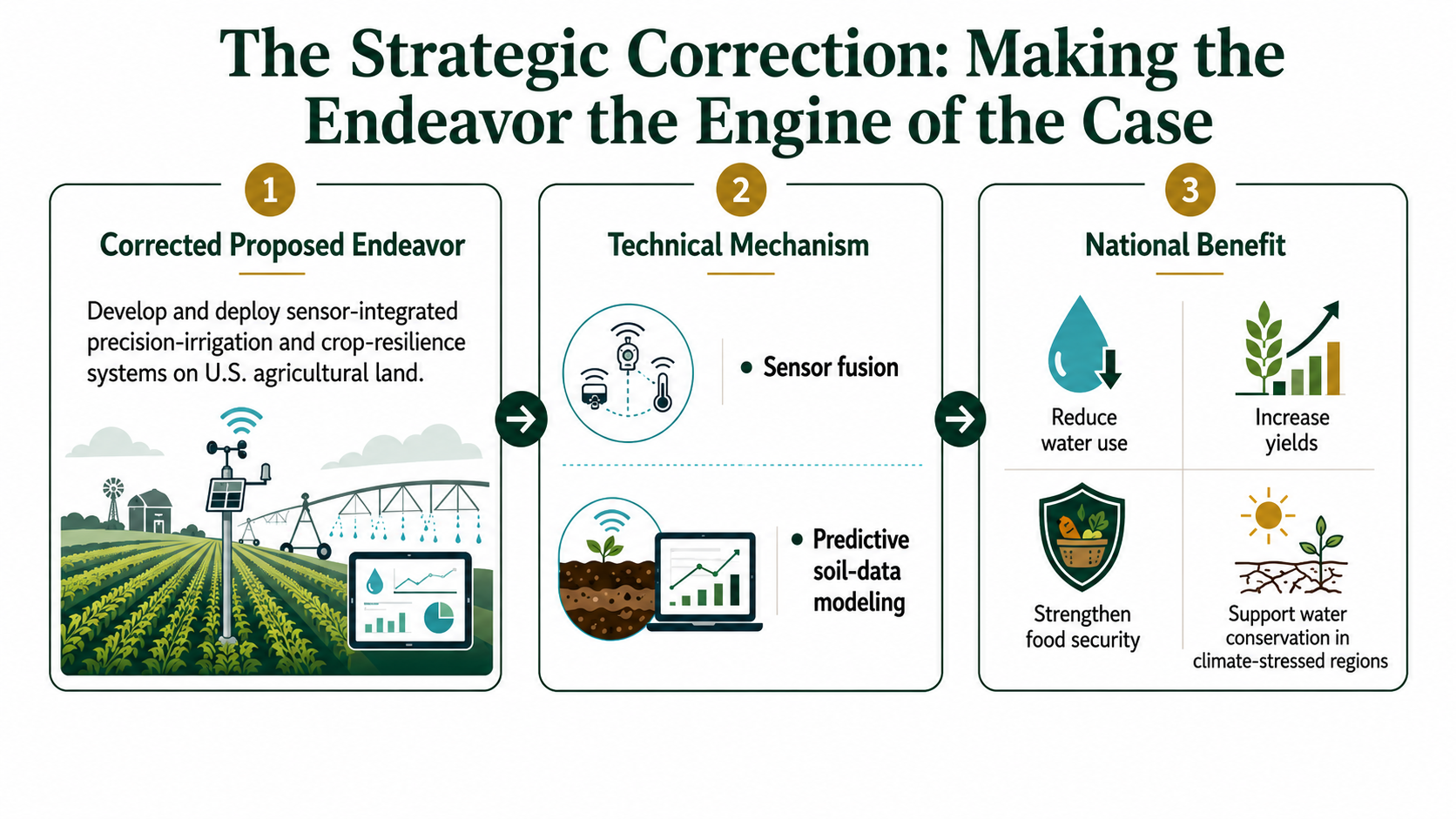
Corrected proposed endeavor: To develop and deploy sensor-integrated precision-irrigation and crop-resilience systems that reduce water consumption and increase yields on U.S. agricultural land – strengthening domestic food security and water conservation by applying sensor-fusion and predictive soil-data modeling in regions facing climate-driven water scarcity.
This corrected endeavor changed the case because it made the field-endeavor nexus explicit. It did not replace the client’s real work with a generic social goal. It made his technical capability the mechanism of the national benefit. From that point forward, every exhibit had to prove the same thing: he had already developed, applied, published, shared, and been recognized for the exact technical capability the endeavor required.
What AdvanceMyProfile and Immignis Built
1. A public identity around a narrow technical niche
We narrowed his public positioning from general agricultural technology to sensor-based precision irrigation and crop-resilience analytics. His professional website, LinkedIn profile, and research presence were aligned so that an officer, expert reviewer, or potential collaborator could understand his field in minutes.
2. A focused publication and citation record
Working with a domain PhD, we planned four first-author papers in agricultural engineering, water-use efficiency, and crop-resilience analytics. The topics followed a natural progression: soil-sensor field data, irrigation decision modeling, crop-resilience forecasting, and deployment in water-stressed regions. As the papers were published, independent citations began to appear from researchers and agronomists with no connection to him.
3. Public evidence for applied work
Precision-agriculture projects often remain hidden in internal reports or field deployments. We converted the client’s applied work into public evidence by securing coverage and expert commentary in agricultural and environmental-science outlets. The goal was not publicity for its own sake; it was to show that his methods had value outside one employer or one farm system.
4. A practical white paper and targeted stakeholder outreach
We prepared a practical white paper on sensor-integrated irrigation for water-stressed agricultural systems and shared it with relevant recipients, including agricultural engineering networks, water-resource and irrigation professional groups, extension-oriented contacts, and precision-agriculture stakeholders. This created a credible trail showing that his methods could be evaluated by institutions and industry actors with real relevance to U.S.-facing agricultural adoption.
5. Conference activity and selective professional recognition
A conference paper was prepared for a recognized agricultural-engineering gathering. After presentation, the work supported his inclusion in a technical working group focused on water-efficient agriculture. We also prepared a Senior Member application for a major agricultural engineering professional body, using evidence of genuine professional standing rather than a basic pay-to-join membership.
6. Patent and software evidence
The client’s field work supported a patent filing for a novel combination of soil-sensor hardware and predictive irrigation algorithm. The patent process moved quickly enough that an approved patent could be included with the evidence package. We also documented software copyright for the data-analysis platform used to process soil and climate inputs in real time. Together, those records showed both technical originality and a usable analytical system.
7. Independent letters that answered the real USCIS concern
The prior case had relied too heavily on general praise. The refile needed letters that explained the field-endeavor nexus. We sourced arms-length letters from a U.S.-based irrigation researcher who had cited his sensor-fusion methodology, a water-resource engineer familiar with predictive soil-data modeling, a U.S. agricultural extension contact who had reviewed or piloted one of his methods, and a senior agronomist who could explain the national importance in practical agricultural terms.
How the Evidence Supported Dhanasar
Prong 1: Substantial merit and national importance
The corrected endeavor tied the client’s work to domestic food security, drought resilience, water conservation, and crop-yield stability. The petition no longer asked USCIS to accept a broad claim that agriculture matters. It showed how sensor-integrated irrigation and predictive soil-data modeling could address a specific agricultural infrastructure problem.
Prong 2: Well positioned to advance the endeavor
The record showed field-tested experience, first-author publications, independent citations, public technical commentary, conference activity, working-group participation, Senior Member recognition, an approved patent, software copyright, and independent expert letters. These items made the client’s expertise visible beyond his employer.
Prong 3: Why the waiver benefited the United States
The waiver argument was built around the fact that this work required independent deployment across farms, research partners, irrigation networks, and agricultural stakeholders. A single job offer would not capture the broader value of translating water-efficient irrigation methods into U.S. agricultural settings facing climate-driven scarcity.
The Filing and Approval
We drafted the cover letter, completed the forms, assembled the exhibits, and refiled the petition. This time, the petition did not receive an RFE. After USCIS processing, the EB-2 NIW I-140 was approved.
The approval did not happen because the client became a different professional. He had always been a serious precision-agriculture scientist. The difference was that the refile finally presented the correct professional story with the right evidence attached to it.
What the Client Gained Beyond Approval
The immigration approval was only one result in this EB-2 NIW precision agriculture case. His publications continued to gain citations. His white paper opened conversations with agricultural and water-resource stakeholders. His approved patent strengthened his innovation record. His software platform became easier to present to research partners and farm-technology collaborators.
He later moved into a stronger role connected to drought-resilient farming and precision-agriculture implementation. His compensation improved, and his title reflected a move from project-level technical contribution toward a more visible leadership function in EB-2 NIW precision agriculture.
Lessons for Other Professionals
- The field-endeavor nexus must be explicit. USCIS should not be asked to guess how the petitioner’s skills create the national benefit.
- A strong attorney filing can still fail if the proposed endeavor is too broad or detached from the petitioner’s exact technical value.
- Applied professionals need evidence that travels beyond their employer, such as publications, citations, conference activity, white papers, stakeholder outreach, patents, software records, and independent letters.
- Patent evidence should be used accurately. A genuine, relevant patent does not have to be a U.S. patent to help prove originality.
- White papers are strongest when shared with relevant professional bodies, research networks, extension contacts, standards groups, or major industry stakeholders.
- Ethical profile building does not invent expertise. It organizes, strengthens, documents, and presents professional value that already exists.
For Professionals Considering EB-2 NIW After a Denial
If your prior NIW petition was denied, or if your proposed endeavor sounds important but does not clearly connect to your exact expertise, start with an honest assessment before refiling. Stronger language cannot fix the wrong foundation. The right first step is to diagnose the record, correct the endeavor, and build evidence that proves the connection.
Free assessment: immignis