
How a Qatar-based mechanical integrity and corrosion specialist converted advanced NDT, dynamic RBI, corrosion risk mapping, Fitness-for-Service modeling, and digital-twin expertise into an EB-2 NIW Predictive Asset Integrity U.S.-focused national-interest case for safer oil, gas, and petrochemical infrastructure.
| Client profile | Pakistani mechanical integrity, inspection engineering, and asset reliability specialist based in Qatar. |
| Professional foundation | More than 20 years of experience. |
| Core field | Non-destructive testing, corrosion management, risk-based inspection, Fitness-for-Service analysis, inspection software, and asset integrity management. |
| Proposed endeavor | Enhance the safety and efficiency of U.S. oil, gas, and petrochemical infrastructure through predictive inspection, corrosion-risk mapping, RBI, FFS modeling, and digital-twin-based integrity decision support. |
| Outcome | EB-2 NIW I-140 approved. |
The Approval Result
This case ended with EB-2 NIW Predictive Asset Integrity approval for a Pakistani mechanical integrity and corrosion specialist whose record was strongest when organized around one urgent infrastructure problem: aging U.S. oil, gas, refinery, storage, pipeline, and petrochemical assets need smarter failure-prevention systems before corrosion, wall thinning, cracking, or thermal fatigue become shutdowns, leaks, fires, environmental incidents, or public-safety emergencies.
The client did not need to be presented as a general inspection engineer. His strongest case came from a EB-2 NIW Predictive Asset Integrity model built around advanced NDT, dynamic risk-based inspection, corrosion risk mapping, Fitness-for-Service analysis, and digital twins. The approval showed that field engineering and reliability work can support a strong NIW record when the proposed endeavor is specific, evidence-backed, and connected to U.S. energy infrastructure resilience.
The approval ultimately validated the EB-2 NIW Predictive Asset Integrity approach: that inspection, corrosion, and reliability expertise becomes most impactful when framed as a scalable system for preventing failures and protecting national energy infrastructure.
EB-2 NIW Predictive Asset Integrity: The National Problem of Aging Energy Infrastructure and Preventable Industrial Failures
The United States depends on safe, reliable energy and petrochemical infrastructure. Refinery inspection units, pipelines, storage tanks, and pressure equipment often remain in service for decades. Industrial equipment rarely fails without warning. Corrosion, material loss, cracking, thermal cycling, and mechanical degradation usually develop over time. The challenge is that many operators still rely on periodic or fragmented inspection practices that may not identify early risk signals with enough precision. EB-2 NIW Predictive Asset Integrity
The national-interest argument was built around that operational gap. EB-2 NIW Predictive Asset Integrity Better inspection intelligence can reduce unplanned shutdowns, extend asset life, guide repair and replacement decisions, improve emergency preparedness, and reduce the risk of leaks or failures near communities and critical supply chains. The case therefore connected asset integrity to energy security, infrastructure resilience, environmental protection, and safer operation of aging industrial systems. EB-2 NIW Predictive Asset Integrity
The Proposed Endeavor
The proposed endeavor was to enhance the safety and efficiency of the U.S. oil, gas, and petrochemical industries by developing and implementing advanced inspection and maintenance strategies. The work focused on modern non-destructive testing, corrosion management systems, risk-based inspection, Fitness-for-Service analysis, and digital-twin-based integrity decision support.
The value of the endeavor was its shift from reactive maintenance to predictive risk management. Instead of waiting for scheduled shutdowns or visible deterioration, the proposed model would use condition data, inspection histories, engineering judgment, and digital integrity tools to identify high-risk assets earlier and guide better run, repair, replace, and life-extension decisions.
What Made the Profile Strong
- Field-tested technical depth: more than two decades in refinery, fertilizer, oil and gas, and petrochemical inspection environments.
- Clear national-interest bridge: the endeavor was tied to safety, energy reliability, corrosion risk, infrastructure resilience, emergency preparedness, and industrial modernization.
- Implementation-ready methods: the petition showed how NDT, RBI, corrosion mapping, FFS, and digital twins could work together as one decision-support framework.
- Independent execution model: the story showed how a specialist consultant could deploy methods across multiple facilities rather than being limited to one employer.
- Credible record of prior success: QatarEnergy, Engro Fertilizers, and MOL Pakistan experience supported the client’s ability to execute integrity programs in demanding industrial environments.
The Technical Pillars Behind the Case
| Predictive NDT framework | Combining ultrasonic testing, phased-array ultrasonics, acoustic emission monitoring, and digital radiography into a unified inspection intelligence model. |
| Dynamic RBI | Using condition inputs, inspection histories, sensor data, and degradation patterns to update inspection priorities and focus resources on the highest-risk assets. |
| Corrosion risk mapping | Using GIS-based corrosion maps and lifecycle integrity models to identify high-risk zones and forecast material loss in tanks, pipelines, and pressure systems. |
| Customized FFS modeling | Using localized degradation data, thermal profiles, and asset-specific operating conditions to guide run, repair, or replace decisions. |
| Digital twin integration | Bringing inspection, corrosion, FFS, RBI, and operating data into virtual asset models for scenario simulation and better asset-life decisions. |
How the Evidence Supported Dhanasar
Prong 1: Substantial Merit and National Importance
The petition linked the endeavor to energy security, aging infrastructure, corrosion-related failures, operational continuity, environmental risk reduction, and industrial safety. This avoided a narrow employment-based presentation and placed the client’s work within national infrastructure and public-safety concerns.
Prong 2: Well Positioned to Advance the Endeavor
The profile relied on a strong professional record: QatarEnergy refinery inspection work, Engro Fertilizers inspection-management software, corrosion mapping, relative-life estimation, shutdown and turnaround inspection planning, NDT practice, RBI understanding, FFS-oriented judgment, and inspection-related technical credentials. These details showed that the client had already executed comparable work in complex industrial environments.
Prong 3: Benefit of Waiving Labor Certification
The petition framed the work as consulting-based, multi-site, and infrastructure-focused. The value was not that one employer needed an inspection engineer. The value was that U.S. industrial operators could benefit from specialized integrity frameworks deployable across many facilities and sectors.
Filing and Approval
The final petition was filed as an evidence architecture. The proposed endeavor explained the national infrastructure problem. The professional record showed long-term execution in high-risk energy and petrochemical environments. The technical pillars demonstrated a practical model for predictive asset integrity. The Dhanasar analysis connected the evidence to national importance, well-positioned capacity, and the public benefit of a waiver.
USCIS approved the EB-2 NIW I-140. The approval confirmed that inspection, corrosion, and reliability professionals can build persuasive national-interest cases when the work is presented as a scalable infrastructure-safety contribution rather than a routine maintenance role.
What the Client Gained Beyond Approval
The approval was the immigration result, but the profile-building process also clarified the client’s professional identity. His work could now be explained as predictive asset integrity for safer energy and petrochemical infrastructure, not simply as refinery inspection experience. That clarity made the profile stronger for professional conversations with operators, engineering firms, industrial owners, reliability teams, and infrastructure stakeholders.
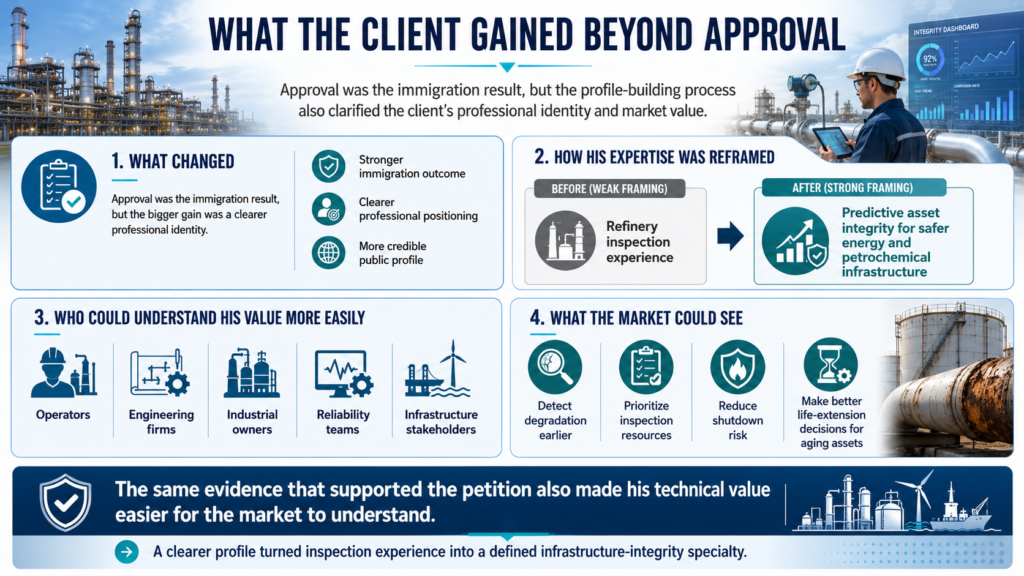
The same evidence that supported the petition also made his technical value easier for the market to understand: he could help facilities detect degradation earlier, prioritize inspection resources, reduce shutdown risk, and make better life-extension decisions for aging assets.
What This Case Teaches
- Industrial and field-engineering professionals can have strong NIW potential when their work addresses national infrastructure, safety, reliability, or energy concerns.
- Technical experience becomes stronger when it is organized into a future-facing proposed endeavor with clear implementation pillars.
- Inspection, maintenance, and reliability work should not be described as routine employment when the professional is proposing scalable methods that can benefit many facilities.
- Advanced NDT, dynamic RBI, corrosion mapping, FFS modeling, and digital twins can create a strong national-interest theory when tied to aging industrial assets and risk prevention.
- Ethical profile building documents real expertise. It does not manufacture a false profile or invent evidence the record cannot support.