EB-2 NIW public health data scientist Approval: He built an approved National Interest Waiver case around proactive coverage-risk detection, machine-learning-assisted survey operations, and inclusive U.S. public-health data systems.
| Nationality / residence | Ghanaian national residing in the United States on F-1 status |
| Field | Survey and data science, epidemiology, population studies, and public-health data systems |
| Career stage | Early-career but highly specialized public-health data scientist with U.S. and international applied experience |
| Pathway | Original EB-2 NIW self-petition as an advanced degree professional |
| Proposed endeavor | Integrated proactive-coverage methodology for inclusive U.S. population and public-health data systems |
| Core problem | Hard-to-count and vulnerable populations can be missed during data collection, weakening public-health evidence and resource allocation |
| Profile-building focus | Methodology framing, applied public-health evidence, conference activity, field engagement, and Dhanasar evidence architecture |
| Outcome | EB-2 NIW I-140 approved |
The Approval Result | EB-2 NIW public health data scientist
This case ended with an EB-2 National Interest Waiver approval for a Ghanaian public-health data scientist whose record was strongest when it was organized around one precise national problem: the United States relies on population and public-health data to allocate resources, evaluate health needs, and identify underserved communities, but hard-to-count and vulnerable populations can be underrepresented in the datasets that guide those decisions.
The client did not need to be presented as a celebrity researcher, a founder, or a patent-heavy inventor. His strongest case came from the methodology he was positioned to advance: proactive coverage-risk detection during active data collection, supported by survey methodology, machine-learning-assisted prediction, adaptive data-collection operations, and epidemiological reasoning.
The approval showed that an early-career professional can still build a strong NIW record when the proposed endeavor is specific, the evidence is organized, and the national-interest problem is clear.
The National Problem: Incomplete Data Can Produce Unfair Decisions
The central issue was not data science in the abstract. It was the practical consequence of incomplete representation. Public-health agencies, healthcare programs, disability-service systems, universities, and federal statistical agencies rely on survey and population data to decide who needs support, where resources should be directed, and whether programs are working.
When low-income households, rural residents, people with disabilities, language-minority groups, children, or other hard-to-count populations are missed, the final dataset may look complete while still hiding the needs of the very groups public systems are meant to serve.
That gave the case a strong national-interest foundation. The proposed work was tied to census coverage, public-health surveys, disability-service data, healthcare resource planning, Health Professional Shortage Area targeting, and public-health data modernization. The petition therefore moved away from a narrow academic exercise and toward a national evidence-infrastructure problem.
The Proposed Endeavor
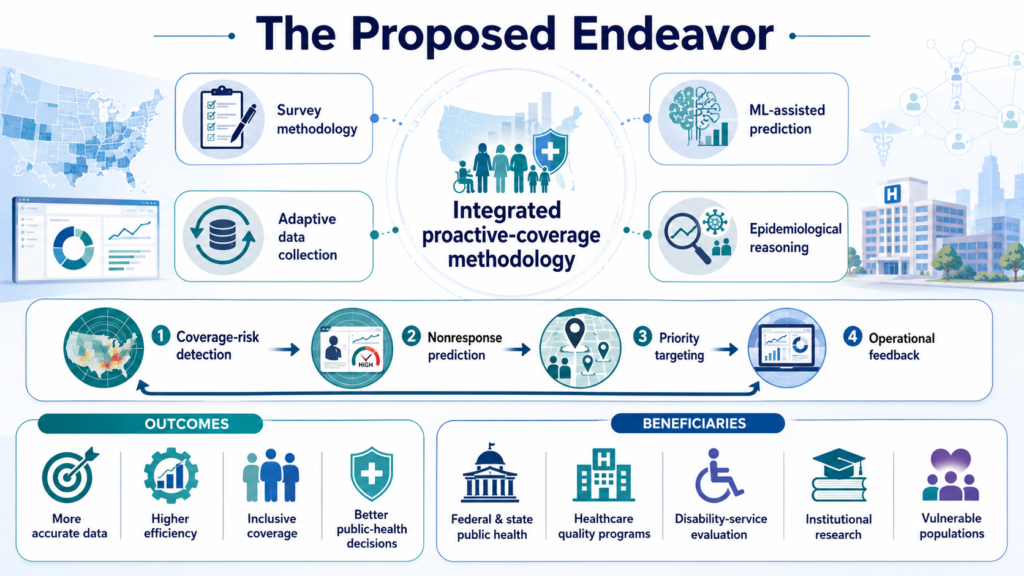
To design, develop, validate, and implement an integrated proactive-coverage methodology that combines advanced survey methodology, machine-learning-assisted prediction, adaptive data-collection operations, and epidemiological reasoning to improve the accuracy, efficiency, and inclusiveness of population and public-health data systems in the United States.
The strength of this endeavor was its specificity. It did not say only that the client would improve public-health data. It identified a concrete method: proactive coverage-risk detection, nonresponse prediction, epidemiology-informed prioritization, and adaptive operational feedback during active data collection. It also identified the beneficiaries: federal and state public-health systems, healthcare quality programs, disability-service evaluation systems, institutional research offices, and vulnerable populations whose needs may otherwise be undercounted.
What Immignis and AdvanceMyProfile Built
1. A focused identity around survey methodology, machine learning, and public-health data equity
The public and petition-facing profile was organized around a clear professional identity: a public-health data scientist working at the intersection of survey methodology, machine learning, epidemiology, and population measurement. This identity matched the client’s education, including graduate training in survey and data science, population studies, and epidemiology.
2. A four-pillar methodology USCIS could understand
- Proactive coverage-risk detection during active data collection, so underrepresentation can be identified before a survey closes.
- Machine-learning-assisted nonresponse and undercoverage prediction, so outreach resources can be targeted more efficiently.
- Epidemiology-informed prioritization of vulnerable populations, so missing data are evaluated by public-health significance instead of response counts alone.
- Adaptive data-quality feedback loops, so emerging coverage risks lead to operational action during the collection process.
This structure made the petition easy to follow. Each pillar had a technical purpose, a practical implementation role, and a national-interest connection. The methodology was presented as an enhancement to existing survey and public-health workflows, not as an unrealistic replacement for federal or state data infrastructure.
3. Applied experience that made the plan credible
The record showed that the client was already working in environments where the proposed methodology could be refined and applied. His experience included public-health data work involving individuals with intellectual and developmental disabilities, institutional survey and data-quality work, exposure to international statistical practice, and applied research involving machine-learning-based nonresponse prediction.
4. Professional recognition and field engagement
The petition highlighted field engagement that supported the well-positioned prong, including accepted research for a major survey-research conference, abstract-review activity, graduate research judging, and memberships in professional bodies connected to statistics, survey research, public health, population studies, and applied statistical practice.
How the Evidence Supported Dhanasar
| Dhanasar element | Evidence used | Strategic value |
| Substantial merit | Survey methodology, public-health data science, machine learning, epidemiology, and measurable data-quality outcomes. | Showed that the work was scientific, technical, operationally measurable, and directly relevant to public-health systems. |
| National importance | Census undercoverage, public-health survey nonresponse, disability-data needs, data modernization, and healthcare-resource targeting. | Moved the argument from a personal career plan to a national data-quality and resource-allocation problem. |
| Well positioned | Graduate education, public-health data work, survey-methodology experience, conference activity, review activity, and applied research. | Showed that the client had the interdisciplinary preparation required to execute the proposed methodology. |
| Balancing | U.S.-based education and applied work in public-health data environments, plus the need for flexible work across agencies and institutions. | Supported the argument that a waiver of the job-offer requirement would serve the national interest more effectively than a narrow employer-specific pathway. |
Filing and Approval
The final petition was filed as an evidence architecture, not as a general resume package. The proposed endeavor explained the national data-quality problem. The education record showed the technical foundation. The applied public-health and survey work showed practical experience. Conference and review activity showed field engagement. The Dhanasar analysis connected each item to the legal standard.
USCIS approved the EB-2 NIW I-140. The approval confirmed that a methodology-based public-health data case can succeed when the petition shows why the work matters nationally and why the petitioner is positioned to advance it.
What the Client Gained Beyond Approval
The approval was the immigration result, but the profile-building process also gave the client a clearer professional identity. His work could now be explained as a focused contribution to inclusive public-health data systems, not as a general data-science background.
That clarity made the profile stronger for professional conversations with public-health agencies, research institutions, healthcare analytics groups, survey organizations, and data-modernization stakeholders. The same evidence that supported the petition also made his expertise easier for the market to understand.
What This Case Teaches
- A strong NIW can be built around methodology, not only around patents, products, or high citation counts.
- Public-health data quality can be nationally important when the record shows how undercoverage affects resource allocation, health-disparity analysis, and service planning.
- Machine learning should be presented responsibly as a decision-support tool inside established workflows, not as a vague AI claim.
- For early-career professionals, applied U.S. experience, conference recognition, and a focused technical identity can help show that the endeavor is already underway.
- Ethical profile building documents real expertise. It does not manufacture a false profile or invent evidence the record cannot support.
If your work sits at the intersection of data science, public health, survey research, epidemiology, healthcare analytics, or population measurement, your NIW strategy should begin with one question: what national decision system becomes more accurate, fair, or effective because of your specific methodology?
Start with a free, honest assessment. If the record is not ready, the right strategy is to build the missing evidence before filing.