EB-2 NIW quantum computing researcher: A quantum-computing researcher working from Singapore used his existing O-1A record as a platform, built a focused NIW strategy around fault-tolerant quantum systems, answered a national-importance RFE, and secured EB-2 NIW approval while preserving a future EB-1A pathway.
| Nationality / chargeability context | Chinese; mainland China backlog planning was part of the strategy |
| Professional field | Quantum-computing researcher focused on fault tolerance and error-correction algorithms |
| Work location | Singapore, with U.S. academic collaboration through an O-1A platform |
| Career stage | Approximately 9 years; senior researcher |
| Immigration pathway | EB-2 National Interest Waiver, with EB-1A preserved as a later option |
| Initial position | Strong O-1A record, strong publications, but no permanent strategy and national-importance risk |
| Profile-building engagement | Approximately 10 months |
| Outcome | RFE on national importance answered; EB-2 NIW approved |
The approval result
This case ended with EB-2 NIW approval after USCIS issued a Request for Evidence on national importance. The approval mattered because the client was not beginning from zero. He already had an O-1A approval and a respected research record, but those facts alone did not automatically satisfy the National Interest Waiver standard.
The profile-building work converted temporary recognition into a permanent-pathway record. It preserved the value of his O-1A achievement, narrowed the proposed endeavor, strengthened the U.S.-interest argument, and answered the RFE with evidence that connected his specific quantum-error-correction work to U.S. technological leadership.
The national problem: quantum leadership depends on fault tolerance
Quantum computing is often discussed as a future technology, but the practical barrier is immediate and technical: quantum systems are unstable. Without fault tolerance and error correction, quantum devices remain too fragile for the long computations needed in cryptography, advanced simulation, secure communications, materials discovery, and strategic computing applications.
That is why the proposed endeavor could not be written as a broad statement about “advancing quantum computing.” The stronger national-interest theory had to focus on the specific bottleneck the client worked on: error-correction algorithms and implementation methods that move quantum systems closer to reliable operation.
The client’s starting point
The client was a Chinese quantum-computing researcher working in Singapore. He had approximately nine years of experience, a strong publication record, citations from research groups in multiple countries, conference activity, and an O-1A approval through a U.S. academic affiliation as a visiting researcher.
His weakness was not lack of achievement. His weakness was strategic translation. O-1A evidence proves extraordinary ability for a temporary professional purpose. NIW evidence must prove that the proposed endeavor has substantial merit and national importance, that the petitioner is well positioned to advance it, and that the United States benefits from waiving the job-offer and labor-certification requirement.
Because he was born in mainland China, we also had to be realistic about timing. EB-2 NIW approval could secure a priority date and a permanent immigration foundation, but it would not necessarily create immediate green-card availability. The O-1A therefore became a bridge: it provided stability while the permanent-pathway record was built.
The proposed endeavor |EB-2 NIW quantum computing researcher
| To advance fault-tolerant quantum computing through the development of error-correction algorithms and physical implementation methods that bring practical quantum systems closer to reliable operation, supporting United States leadership in quantum computing, a designated critical and emerging technology with direct implications for national security, cryptography, and long-term computational advantage. |
This wording did three important things. It identified the technical barrier, named the client’s method, and tied the work to U.S. interests in critical and emerging technology, national security, cryptography readiness, and long-term computational capability.
What AdvanceMyProfile and Immignis built
1. A narrow public identity
We reorganized his public record around fault-tolerant quantum computing and quantum error correction. His website, LinkedIn, researcher profiles, publication summaries, and media positioning were aligned to one professional identity. The goal was consistency: the petition, public record, expert letters, and RFE response all needed to point to the same specialist niche.
2. Publication and citation alignment
His existing research record was already credible, but it had to be organized under the Dhanasar framework. We helped develop additional first-author outputs in the same narrow area. The purpose was not to increase volume. The purpose was to show continuing contribution to the reliability gap that limits practical quantum systems.
3. White paper and policy-facing positioning
We prepared a technical white paper explaining why error correction is the bridge between noisy experimental devices and reliable quantum systems. It was shared with appropriate quantum-research, standards-facing, and technology-policy audiences. This helped translate the research from laboratory contribution into national-interest relevance.
4. Media and expert commentary
Media work stayed technical and credible. We positioned his commentary around quantum reliability, noisy intermediate-scale devices, error correction, cryptography readiness, and the practical requirements for fault-tolerant systems. The aim was not broad publicity; it was field-relevant visibility that supported the same endeavor.
5. Conference activity and working-group recognition
A conference paper was prepared for a leading quantum-computing forum. His presentation helped lead to a technical working-group invitation on fault-tolerant quantum architectures. That mattered because it showed participation in the professional conversations where future technical direction was being shaped.
6. Selective membership and independent letters
We pursued a Senior Member grade through a recognized professional body where peer review and achievement were part of the standard. The independent letters came from U.S.-connected quantum researchers, academic experts, a conference program-committee member, and a technology-policy expert. Each letter addressed the nexus between his methods and the U.S. national interest.
How the evidence supported Dhanasar
| Substantial merit | Quantum error correction and fault tolerance were presented as technical barriers to practical quantum systems, with implications for strategic computing, cryptography, secure communications, and U.S. technology leadership. |
| National importance | The petition connected the client’s specific work to U.S. leadership in quantum computing as a critical and emerging technology, rather than relying on a generic statement that quantum research is important. |
| Well positioned | Publications, citations, O-1A recognition, conference activity, working-group participation, Senior Member recognition, white paper outreach, media commentary, and independent letters showed that he could advance the proposed endeavor. |
| Waiver benefit | The record showed that the United States would benefit from his continued work without requiring a single employer to control the pathway, especially because his research had cross-institutional and U.S.-collaboration relevance. |
The RFE and the response
USCIS issued an RFE focused on national importance. The officer did not reject the client’s credentials or dismiss quantum computing as valuable. The concern was that the record needed a clearer bridge between his specific work in error correction and a U.S. national interest, instead of a general benefit to the global scientific field.
The response was built around primary-source national-interest evidence and supplemental expert explanation. We clarified that fault tolerance is the technical bridge between unstable experimental devices and reliable quantum systems. We added letters from U.S.-connected experts who explained why his methods mattered to quantum readiness, cryptography, national security, and long-term computational advantage.
The RFE response strengthened the case because it answered the exact concern. It did not simply repeat that quantum computing is important. It explained why this petitioner’s specific work in error correction mattered to the national-interest objective stated in the proposed endeavor.
The approval and what changed afterward
After the RFE response, USCIS approved the EB-2 NIW petition. Because the client remained subject to the China EB-2 backlog, the approval did not create immediate permanent residence. It did secure an approved I-140, a priority date, and a permanent immigration foundation while he continued his research from the stability of his O-1A platform.
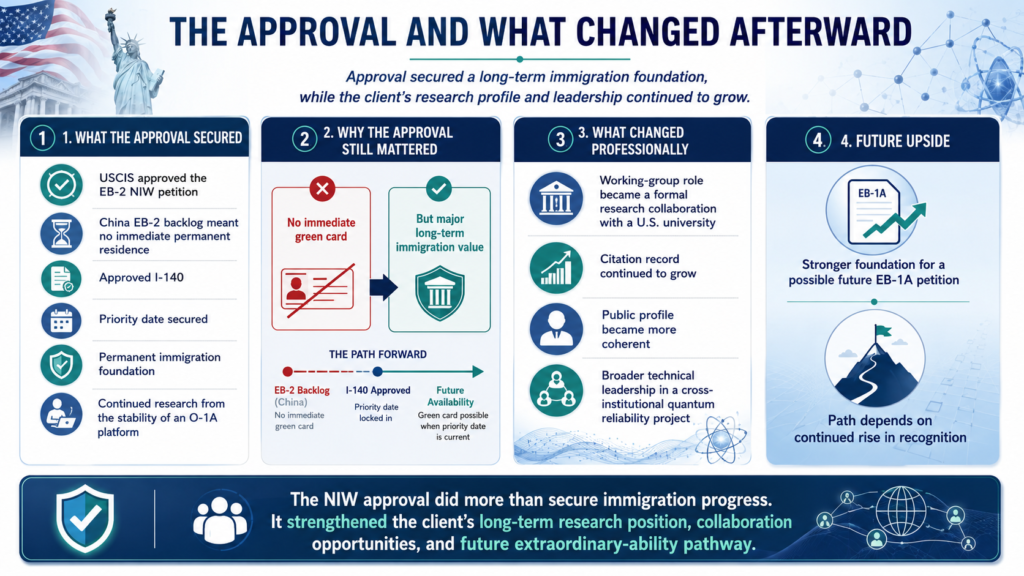
The professional impact continued beyond the approval. His working-group role developed into a formal research collaboration with a U.S. university. His citation record continued to grow. His public profile became more coherent, and he moved into broader technical leadership on a cross-institutional quantum reliability project. That growth also improved the foundation for a possible future EB-1A petition if his recognition continues to rise.
What this case teaches
- An O-1A approval is a bridge, not the end of the strategy. It can provide stability while a permanent immigration record is built carefully.
- NIW and EB-1A are sequencing decisions. The strongest pathway is the one the evidence can support at the time of filing.
- For mainland China-born applicants, backlog planning must be honest. NIW approval can secure a priority date even when adjustment is not immediately available.
- Scientific importance alone is not enough. The petition must explain why the specific work matters to a U.S. national interest.
- White papers, standards-facing outreach, conference roles, and independent letters help only when they fit the field and support the same proposed endeavor.
- A strong RFE response does not defend weak wording. It clarifies the theory and supplies evidence that answers the officer’s exact concern.
For O-1A holders and quantum researchers
This case shows how temporary recognition can be converted into a permanent immigration foundation when the professional record is organized around a precise national-interest endeavor. The O-1A showed that the client had already been recognized. The NIW approval showed that his work could also be framed as nationally important under Dhanasar.
For researchers in quantum computing, AI, cybersecurity, semiconductors, advanced energy, biotechnology, and similar critical-technology fields, the lesson is clear: do not rely on the field’s importance alone. Build the case around the exact technical problem you solve, the evidence that proves you can solve it, and the U.S. interest that makes the work matter beyond one laboratory or employer.
Strong credentials alone aren’t enough, your work needs to be framed as a U.S. national interest. See how Immignis converts O-1A recognition into permanent NIW pathways.