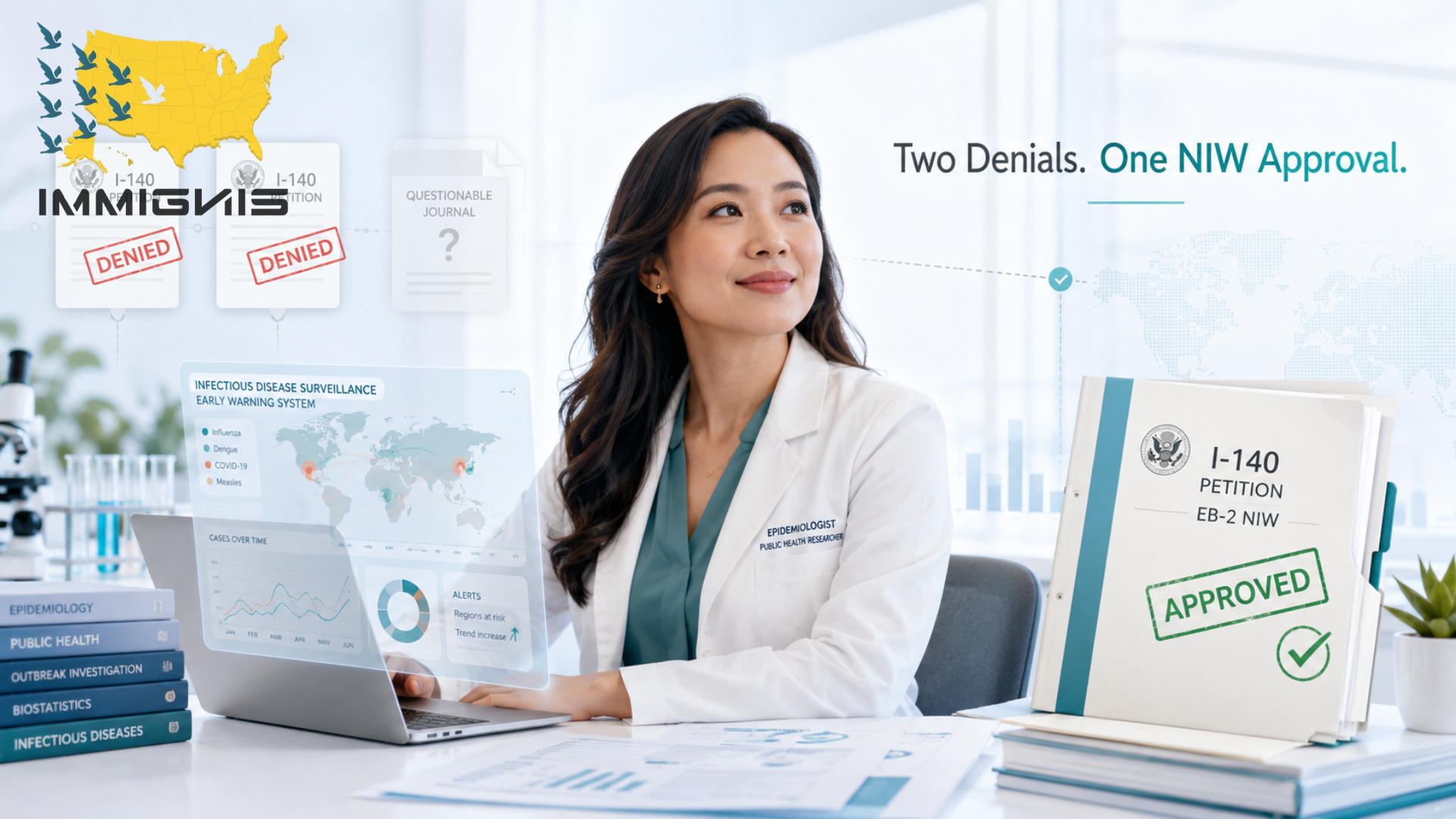
How a Filipino epidemiologist rebuilt a damaged record into an approved NIW petition (EB-2 NIW refile after denial) without a Request for Evidence
| Nationality / chargeability | Filipino; charged to the Philippines |
| Professional field | Epidemiology, infectious-disease surveillance, outbreak early warning, and pandemic preparedness |
| Starting point | Two prior NIW denials, including one filing damaged by a predatory-journal publication |
| Profile-building period | Approximately 11 months |
| Profile rebuilt through | Legitimate publications, independent citations, authored book, white paper, media commentary, conference and panel activity, selective membership, and expert letters |
| Final outcome | Third EB-2 NIW filing approved without an RFE |
The Approval Result Came After the File Was Rebuilt
This case ended with an EB-2 National Interest Waiver I-140 approval without a Request for Evidence. That result was significant because the client had already been denied twice before she came to Immignis and AdvanceMyProfile.com. The third filing in this EB-2 NIW refile after denial, was not a cosmetic rewrite of the earlier petitions. It was a full credibility rebuild.This EB-2 NIW refile after denial represented a complete shift in strategy rather than a revision of documents.
The client was a Filipino epidemiologist working at a national public-health institution in the Philippines. Her work involved infectious-disease surveillance, outbreak investigation, field reporting, genomic surveillance, and public-health preparedness. Her expertise was real. The problem was that the earlier filings did not present that expertise in a way USCIS could trust and evaluate under Dhanasar.
The second filing had created an additional problem: a publication from a predatory journal had entered the record. In an immigration case, that type of evidence is not harmless. It can cause an officer to question the reliability of the entire submission. Our first task was therefore not drafting. It was damage control, evidence triage, and a clean rebuild around legitimate proof.
The National Problem: Outbreak Signals Must Be Detected Before They Become Crises
Epidemiology is not only a research field. It is part of national security, healthcare readiness, and public trust. The COVID-19 pandemic showed how quickly delayed surveillance can become a national emergency. Strong outbreak early-warning systems can help public-health authorities identify unusual disease patterns, allocate resources earlier, support genomic monitoring, and reduce the time between signal detection and response.
The approved proposed endeavor in this EB-2 NIW refile after denial was built around that national problem: to develop and deploy data-driven infectious-disease surveillance and early-warning systems that strengthen the United States capacity to detect outbreak signals before they become public-health crises, advancing pandemic preparedness, biosurveillance infrastructure, and health-security resilience. This EB-2 NIW refile after denial framing changed the case entirely by shifting the petition away from a general statement that she was an experienced public-health employee and toward a specific national-interest objective connected to U.S. pandemic preparedness and biosurveillance capacity.
This framing changed the case. It moved the petition away from a general statement that she was an experienced public-health employee and toward a specific national-interest objective connected to U.S. pandemic preparedness and biosurveillance capacity.
Why the First Two Filings Failed
The first filing treated her experience as a list of duties. It showed that she had worked in public health, but it did not build a specific national-interest theory. The record relied on employment letters, academic credentials, and field assignments without showing how her work could extend beyond one institution or one country.
The second filing tried to create public evidence quickly and included a journal publication that lacked credible peer review and reliable academic standing. That created a credibility issue. USCIS is increasingly attentive to journal quality, predatory publishing, citation reliability, and whether claimed recognition is earned or purchased. A weak publication can damage more than the publication section. It can make the whole petition look less trustworthy in an EB-2 NIW refile after denial context.
We therefore did not rush a third filing. We audited the record, separated usable evidence from risky evidence, and built a new strategy around verifiable public-health expertise.
What Immignis and AdvanceMyProfile Built
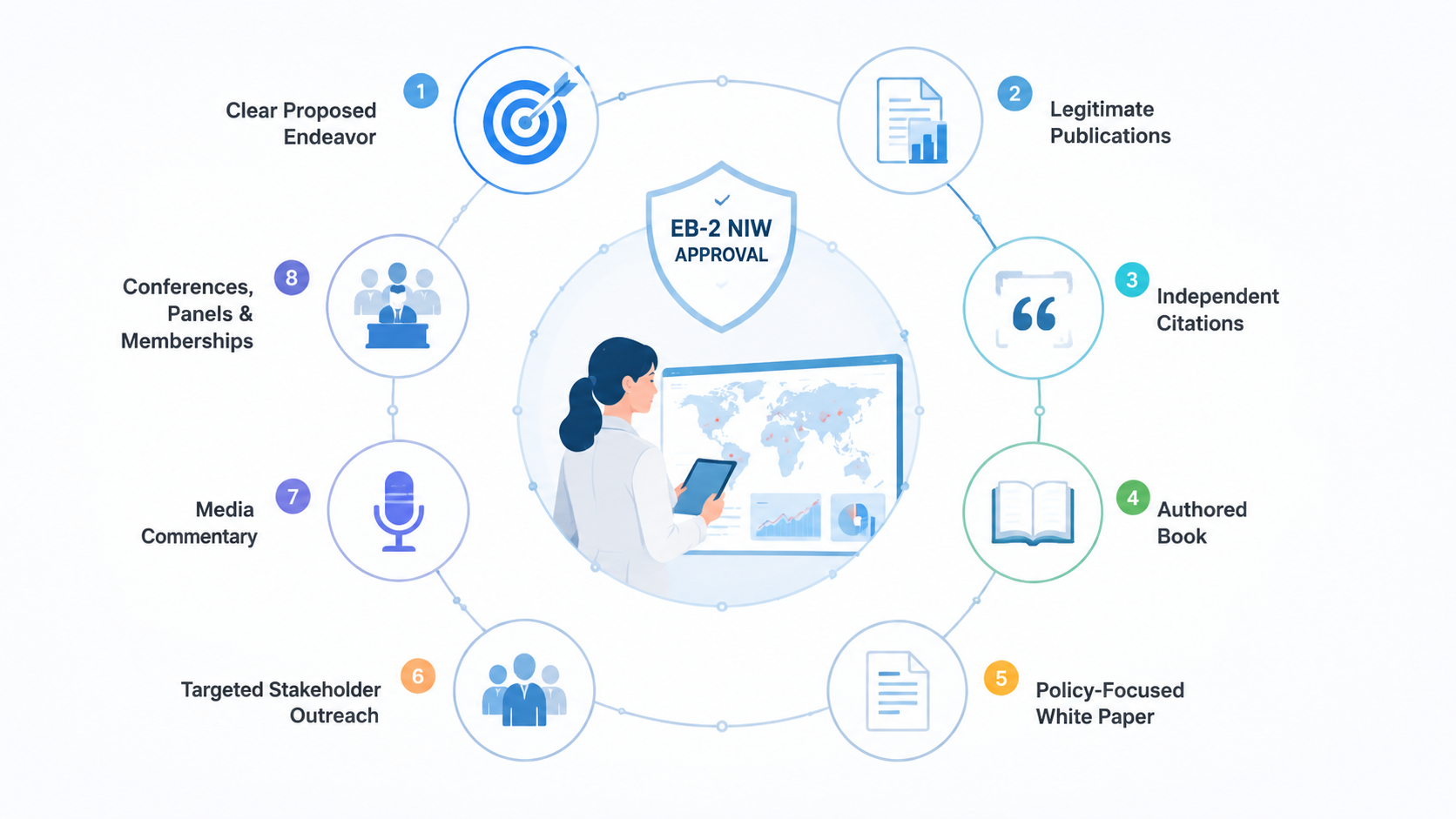
The profile-building strategy had one rule: every piece of evidence had to survive skeptical review. That meant no shortcuts, no artificial identity, no broad public-health slogans, and no reliance on questionable publications. The rebuilt record had to show the same story from multiple independent directions.
1. A precise proposed endeavor: The case was centered on data-driven infectious-disease surveillance, outbreak early warning, biosurveillance infrastructure, and health-security resilience. This gave the petition a clear national-interest direction in the context of an EB-2 NIW refile after denial.
2. Legitimate publication rebuilding: With domain support, the client developed a focused first-author publication record in infectious-disease surveillance, outbreak detection, genomic surveillance, and early-warning methods. The work was placed in credible journals with real review processes.
3. Independent citation growth: The publications began receiving citations from researchers with no connection to the client. This helped show that the field was engaging with her methods and ideas in an EB-2 NIW refile after denial context.
4. An authored professional book: Her field experience was organized into a practical book on rapid field-epidemiology response. The book showed breadth, teaching value, and professional depth beyond individual papers.
5. Policy-facing white paper: Because public-health surveillance directly affects national preparedness, we helped prepare a serious white paper explaining how data-driven outbreak signals can support earlier intervention and better resource allocation.
6. Targeted stakeholder outreach: Her work was circulated to public-health researchers, surveillance-system professionals, and institutional stakeholders whose work genuinely overlapped with hers.
7. Public-health media commentary: Expert-commentary opportunities connected her name to outbreak investigation, genomic surveillance, and pandemic early-warning systems in credible health and science outlets.
8. Conference and panel participation: A relevant conference paper and later panel invitation placed her work into professional discussion spaces and supported field-facing recognition.
9. Selective senior membership: She was elected to a senior membership grade in a recognized public-health professional body, based on documented professional standing rather than a basic pay-to-join membership.
10. Independent expert letters: Letters came from credible and arms-length voices, including public-health researchers, a journal editor, field epidemiology practitioners, and a senior U.S.-connected public-health voice. The letters addressed national importance and her ability to advance the work.
How the Rebuilt Evidence Supported Dhanasar
For Prong 1, the proposed endeavor connected the client’s work to a clear U.S. need: infectious-disease early warning, pandemic preparedness, biosurveillance, and health-security resilience. The white paper, publications, book, and public commentary helped show that the work had value beyond ordinary employment.
For Prong 2, the rebuilt record showed that she was well positioned to advance the endeavor. The evidence did not rely only on job descriptions. It included legitimate publications, independent citations, conference activity, panel participation, senior membership, an authored book, and letters from people able to speak to the field-level value of her work.
For Prong 3, the petition explained why waiving the job-offer and labor-certification requirement served the national interest. Her proposed work involved public-health surveillance capacity, cross-institutional outbreak preparedness, and methods that could support broader health-security systems. A single employer-based role would not capture that wider public-health purpose.
The Third Filing: Transparent, Organized, and Strong Enough to Win
The final petition did not pretend the earlier problems had never happened. It handled them professionally. The prior predatory-journal issue was not used as evidence. The new record directed the officer to credible, independently verifiable material that replaced the weakness with substance.
The cover letter was drafted as an evidence architecture, not a pile of documents. The proposed endeavor, publications, citations, book, policy paper, media coverage, conference record, panel participation, selective membership, and independent letters all pointed to the same conclusion: this was a public-health professional with a credible, nationally important surveillance endeavor and a rebuilt record strong enough to support approval.
The third EB-2 NIW petition was filed under standard processing and approved without a Request for Evidence.
What She Gained Beyond the Green Card Petition Approval
The approval was the immigration result. The professional result went further. She moved from a damaged record and two prior denials to a visible public-health profile supported by legitimate journals, independent citations, a practical book, policy-facing work, public commentary, conference activity, selective membership, and expert validation in an EB-2 NIW refile after denial case.
After approval, her work gained stronger international positioning. She began discussions with U.S. academic medical centers and public-health institutions whose surveillance and outbreak-response work aligned with her expertise. Her book continued to be used and cited, and her profile moved from local institutional recognition toward broader professional visibility.
That is the value of ethical profile building. It does not invent a professional identity. It documents the expertise that already exists and presents it in a form that immigration officers, institutions, and professional peers can evaluate.
Why This Success Story Matters for Denied Applicants
Two denials are not always the end of an NIW case. They are a diagnosis. Some cases should not be refiled. Some need only targeted correction. Some, like this one, require a full credibility rebuild before another petition is safe.
This case also shows why cheap or rushed profile-building can be dangerous. A predatory journal can create damage that follows the applicant into later filings. The correct answer is not to hide the problem. The correct answer is to audit the damage, stop relying on weak evidence, and build a legitimate record strong enough to outweigh it.
The client did not become a different person. She had always been a serious epidemiologist. What changed was the record: her expertise became visible, organized, and independently verifiable.
Lessons for Professionals
- A denial is often a judgment on the evidence record, not on the person’s real ability.
- A predatory publication can damage credibility and must be handled directly.
- A stronger refile begins with an audit, not another rushed petition.
- A proposed endeavor must be specific, field-aligned, and nationally important.
- Legitimate journals, independent citations, books, white papers, selective memberships, media commentary, and expert letters must all support the same story.
- Ethical profile building documents genuine expertise; it does not manufacture a false profile.