
An EB-2 NIW refinery engineer who serves as the centralized technical authority for 19 naphtha processing facilities at the world’s largest energy company with a pending U.S. patent, TÜV certified functional safety credentials, a peer-reviewed paper presented in Nashville, and 24 years of documented, quantified refinery results approved for an EB-2 NIW to apply that expertise to the U.S. refining sector at a moment of declared national energy emergency.
In short: A chemical engineer holding a Master of Science in Process Safety and Loss Prevention and a Bachelor of
Science in Chemical Engineering, with over 24 years of progressive experience in refinery and petrochemical operations,
process safety governance, and naphtha processing optimization, was approved for an EB-2 National Interest Waiver as
a self-petitioner. Saudi Arabia-based. He currently serves as Specialist for Naphtha Block (NHT, CCR, and Aromatics)
within the Global Manufacturing Excellence organization of a world leading integrated energy and chemicals enterprise,
providing centralized technical oversight for 19 facilities.
He is a TÜV-certified Functional Safety Engineer (CFSE-Process) and TÜV-certified PHA-HAZOP Leader, a named inventor on a pending U.S. patent application for heat-exchanger decoking, and co-author of a peer-reviewed technical paper presented at a major U.S. industry conference. His documented achievements include USD 40 million per year in gasoline optimization savings, approximately 10% fired heater energy reduction, and approximately 18,308 metric tons of annual CO₂ reduction. Proposed endeavor: modernize U.S. refinery and petrochemical plant operations through safety anchored optimization, energy-intensive asset performance restoration, and predictive monitoring. Approved under Matter of Dhanasar.
The petitioner’s name and employer names have been withheld for privacy. Career record, certifications, published work, patent, quantified results, and outcome are real.
Forty Million Dollars from Molecules
Gasoline is not a single chemical. It is a blend of dozens of hydrocarbon compounds, and the quality, octane level, and value of the final blend depend on exactly which molecules are present and in what ratios. A refinery that manages that composition well produces higher value output from the same crude oil input. A refinery that does not leaves margin on the table every day, making this directly relevant to an EB-2 NIW refinery engineer case.
He led a gasoline pool optimization initiative at a world class refinery that improved the molecular composition of the blended output without requiring any new equipment or capital investment. The result: approximately USD 40 million per year in sustained economic benefit formally recognized by his employer, completed within six months of idea generation through full implementation. This is not the kind of improvement that happens by accident. It requires deep understanding of the catalytic processes that produce each component, the ability to identify the constraints limiting blend quality, and the process engineering judgment to change operating conditions in a way that improves the output while remaining safe and stable as an EB-2 NIW refinery engineer.
That combination (deep process chemistry knowledge, applied to optimization, within a safety governed framework) is what he has spent 24 years building. And it is what the 132 aging U.S. refineries that form the backbone of American fuel supply do not have enough of in the EB-2 NIW refinery engineer context.
Why the U.S. Refining Sector Needs This Now
In January 2025, the White House declared a National Energy Emergency, a context directly relevant to an EB-2 NIW refinery engineer case. Approximately 60% of U.S. refineries are more than 40 years old. National refining capacity has remained largely unchanged. The U.S. Chemical Safety Board documented 25 accidental chemical release events across 14 states between 2020 and 2025, resulting in 7 fatalities, 23 serious injuries, and approximately USD 1 billion in property damage. A subsequent CSB report identified 30 serious chemical incidents in the same period causing approximately USD 1.8 billion in property damage. The 2022 naphtha fire at a major Ohio refinery was the most severe fatal incident at a BP-operated U.S. facility since the 2005 Texas City disaster.
Refinery flaring accounts for 42% of refinery methane emissions. East Coast refinery utilization fell to 54.8% in early 2025, the lowest since July 2020, during a maintenance heavy period. OSHA has repeatedly identified systemic process safety compliance gaps in petroleum refinery enforcement reviews, strengthening the EB-2 NIW refinery engineer national importance argument.
These are not isolated incidents or statistical anomalies. They are a documented pattern of aging infrastructure, reactive maintenance, fragmented decision-making, and a persistent gap between formal safety requirements and the day-to-day reality of how optimization decisions get made in the field.
His proposed endeavor addresses precisely that gap as an EB-2 NIW refinery engineer.
The Career That Qualifies Him
He began his career in 2001 as a shift engineer at a major Pakistani petroleum refining company, operating naphtha hydrotreating, platforming, and Continuous Catalyst Regeneration units on UOP technology. Eight years of that work built his operational foundation: the experience of running these systems in real time, troubleshooting them under pressure, understanding how they degrade, and learning what discipline looks like at the unit level.
He then moved to Oman, where he spent the next 11 years at a major aromatics and reforming complex, advancing from operations team leader through senior engineer and acting team leader for process optimization. In that role he led the technical execution of the USD 40 million gasoline optimization, the fired heater ceramic coating project, multiple catalyst lifecycle initiatives, the first-ever regeneration of a Shell ATA-21 transalkylation catalyst, advanced process control implementation, the digital management of change program, and a fuel gas integration project between refinery and petrochemical complexes. He also performed HAZOP, SIL, and LOPA analyses as part of process safety reviews.
He was then promoted to Manager Process Safety Governance & Assurance at the same group - a role that took him from the optimization bench to enterprise-level process safety governance. He developed and institutionalized PSM compliance frameworks across multiple assets, conducted audits, and embedded HAZOP, SIL, and lifecycle risk management principles into operating facilities as structural practice rather than compliance documentation.
Since July 2022, he has served as the Specialist for Naphtha Block (NHT, CCR, and Aromatics) within the Global Manufacturing Excellence organization of one of the world’s largest integrated energy and chemicals enterprises, providing centralized technical advisory support for 19 refining and petrochemical facilities across the company and its joint venture portfolio. His responsibilities include performance benchmarking, catalyst lifecycle evaluation, troubleshooting of complex operational issues, process safety studies, and value-creation initiatives. Being chosen for a centralized role that advises 19 world class facilities simultaneously is one of the clearest possible institutional statements about the standing of his technical judgment.
The combination of field operations, optimization leadership, enterprise safety governance, and centralized multi facility
advisory authority is not a standard career trajectory. It is the specific combination of experience the proposed endeavor
requires, and it is the combination that most U.S. refinery engineers do not have.
The Credentials That Back It Up
His safety credentials are among the most demanding in the field for an EB-2 NIW refinery engineer. The Certified Functional Safety Engineer (CFSE-Process) designation from TÜV SÜD validates advanced expertise in Safety Instrumented Systems, SIL determination, and compliance with IEC 61508 and IEC 61511 - globally recognized as one of the highest professional credentials in industrial process safety. The Certified PHA-HAZOP Leader from TÜV NORD / TÜV Middle East authorizes independent leadership of HAZOP studies in high-hazard industrial environments. Together, these credentials validate what his career history demonstrates: he is not someone who participates in safety reviews. He leads them.
He holds a Master of Science in Process Safety and Loss Prevention (completed 2025) alongside his Bachelor of Science in Chemical Engineering from a leading Pakistani engineering university. The master’s degree, in a discipline directly relevant to his EB-2 NIW refinery engineer proposed endeavor, completes a formal academic grounding that runs in parallel with his practical career.
His pending U.S. patent application for heat exchanger decoking introducing a method that uses an existing catalyst regeneration system to clean heat exchangers with improved control and reduced disruption is the clearest possible statement that his expertise produces innovations, not just operational execution. The patent targets a recurring industry problem: fired heaters and heat exchangers degrade over time through fouling and coking, reducing heat transfer efficiency, increasing fuel consumption, and eventually triggering shutdowns. Traditional decoking methods are energy-intensive and disruptive. His method offers an alternative pathway using existing refinery infrastructure. It was filed with the USPTO in May 2024.
He co-authored a peer-reviewed technical paper presented at CORROSION 2019 the NACE International Annual Conference held in Nashville, Tennessee the world’s leading conference on materials performance and industrial asset integrity. The paper examined the technical and economic benefits of ceramic coatings on fired heater tubes, demonstrating measurable tube life extension, efficiency improvement, and cost-benefit outcomes. Presenting at a major U.S. industry conference in his field, with co-authors from across the international refinery community, is direct evidence that his expertise is recognized internationally and supports the EB-2 NIW refinery engineer profile.
The Three-Pillar Proposed Endeavor
His proposed work in U.S. refineries and petrochemical plants is organized around three integrated pillars for an EB-2 NIW refinery engineer. The key insight is that optimization, equipment performance, and safety are not separate activities treating them as separate is what creates the execution gap that leads to incidents and avoidable losses.
The first pillar is safety anchored optimization governance. In most U.S. refineries, process optimization and process safety are managed by different teams with different priorities. When an optimization change is made without structured hazard review, it can narrow safety margins or introduce latent failure pathways that nobody identified. His approach embeds HAZOP, LOPA, SIL based evaluation, and disciplined Management of Change into the optimization process itself, so performance improvements are governed as controlled operational changes rather than informal tuning. The CSB incident reports show repeatedly that failures preceded by “gradual” changes and “informal” adjustments. This pillar directly addresses that for an EB-2 NIW refinery engineer.
The second pillar is performance optimization of fired heaters and heat exchangers the most energy-intensive and failure sensitive assets in a refinery. His prior work achieved approximately 10% fired heater energy reduction and 18,308 metric tons of annual CO₂ reduction through structured ceramic coating technology and combustion optimization. His pending U.S. patent adds a novel heat exchanger decoking method that can restore thermal efficiency with reduced disruption. Together, these approaches reduce avoidable fuel consumption, lower emissions from unstable operations, and extend asset life in equipment that makes up a disproportionate share of both energy cost and downtime risk.
The third pillar is predictive performance and risk monitoring converting the data refineries already collect into early warnings of degradation, abnormal behavior, and emerging risk. Many U.S. refineries collect large volumes of operating data through historians, DCS systems, and laboratory analysis. Most of that data is reviewed reactively, after an alarm fires or a problem appears. His framework uses those same data sources proactively: tracking energy efficiency trends, catalyst condition indicators, equipment performance metrics, and alarm patterns to identify deviations before they escalate into shutdowns or safety-critical events, strengthening the EB-2 NIW refinery engineer proposed endeavor.
The Federal Policy Alignment Is Direct and Recent
The national importance case for this proposed endeavor is anchored in a set of 2025-2026 federal actions that are unusually direct for an EB-2 NIW refinery engineer.
Critical and Emerging Technologies List (2024): Names advanced industrial technology and process optimization as national priority domains.
The petition cites six federal statutes, executive orders, and agency programs across two pages, strengthening the EB-2 NIW refinery engineer national-importance argument.
White House National Energy Emergency Declaration (January 2025): Formally names domestic refining and petrochemical infrastructure reliability as a national security concern.
Unleashing American Energy EO (January 2025): Directs expansion of domestic energy production, modernization of refining infrastructure, and improvement of operational efficiency across the refining and petrochemical sector.
Regulatory Relief for American Chemical Manufacturing Security Presidential Proclamation (July 2025): Identifies domestic refinery and petrochemical output as strategically essential for supply-chain security and national defense readiness.
DOE Energy Earthshots Initiative (2025): Targets industrial heat systems and energy intensity as priority modernization domains - exactly where fired heater and heat exchanger optimization produces its effects for an EB-2 NIW refinery engineer.
CSB Incident Reports Vol. 2 (March 2025) and Vol. 3 (2025): Document ongoing serious chemical incidents across U.S. facilities with fatalities, injuries, and USD 1-1.8 billion in property damage - the public safety case for strengthened process safety governance.
EPA Greenhouse Gas Reporting Program and refinery methane data: Confirm that operational instability and inefficiency are the primary drivers of refinery methane and flaring emissions.
How the Petition Was Built
This was a direct petition. The career record, quantified achievements, credentials, patent filing, and published research were already in place.
- Well-positioned evidence: 24 years progressive refinery and petrochemical experience from field operations through enterprise safety governance; centralized advisory authority for 19 world-class facilities; USD 40M/year gasoline optimization; 10% fired heater energy reduction; 18,308 mt/year CO₂ reduction; USD 12.5M proactive savings recognition; pending U.S. patent (filed May 2024); peer-reviewed paper at NACE CORROSION 2019 Nashville; TÜV CFSE-Process and HAZOP Leader certifications; first-time Shell ATA21 catalyst regeneration; multiple turnarounds, commissioning assignments, and process safety reviews; IChemE Affiliate Member.
- National importance sourcing: National Energy Emergency declaration, Unleashing American Energy EO, Chemical Manufacturing Security Presidential Proclamation, DOE Energy Earthshots, CSB Incident Reports Vol. 2 & 3, EPA GHGRP refinery data, EIA refinery capacity data, Reuters refinery disruption reporting, OSHA refinery PSM enforcement publications, peer-reviewed scholarly work in Computers & Chemical Engineering (Galeazzi et al., 2024), Industrial & Engineering Chemistry Research (Sansana et al., 2024), Digital Chemical Engineering (Braniff et al., 2025), AIChE Journal (Arunthavanathan et al., 2024), and Nature (Sherwin et al., 2024).
I-140 filed as a self-petition without a U.S. employer.
The Outcome
Approved.
A self-petitioned EB-2 NIW for a chemical engineer who serves as centralized technical authority for 19 world class refining and petrochemical facilities, has delivered USD 40 million per year from a single optimization, holds a pending U.S. patent and TÜV functional safety credentials, has presented peer-reviewed work in the United States, and proposes to apply 24 years of documented, quantified refinery expertise to the documented modernization needs of the U.S. refining sector.
The NACE CORROSION 2019 conference was held in Nashville, Tennessee. He co-authored a paper there. The CSB 2022
report on the BP Husky naphtha fire was filed in Ohio. These are the same industry, the same equipment, the same safety
problems. He is not proposing to come to the United States to learn. He is proposing to apply what he already knows.
For Refinery and Petrochemical Process Engineers
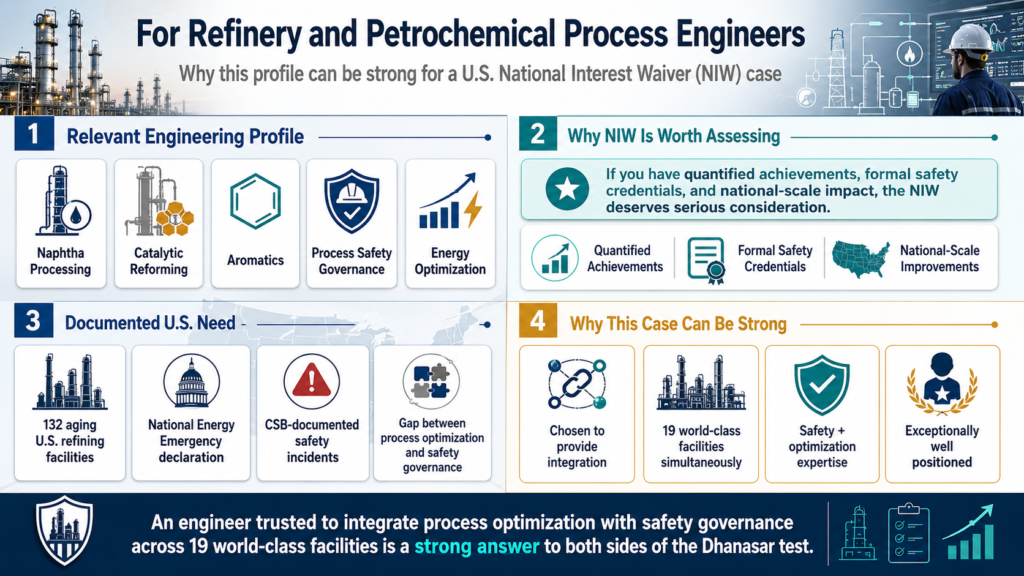
If your career is in refinery or petrochemical process engineering particularly in naphtha processing, catalytic reforming, aromatics, process safety governance, or energy optimization and you have quantified achievements, formal safety credentials, and a track record of delivering national-scale improvements, the NIW is worth a serious assessment. The U.S. refining sector has 132 aging facilities, a National Energy Emergency declaration, ongoing CSB-documented safety incidents, and documented gaps in the integration of process optimization with safety governance. An engineer who has been chosen to provide that integration to 19 world class facilities simultaneously is exceptionally well positioned to advance the proposed endeavor.
Questions Refinery and Petrochemical Engineers Ask Us
Can a refinery or petrochemical process engineer qualify for an EB-2 NIW?
Yes. The refining and petrochemical sector is CISA-designated critical infrastructure. The National Energy Emergency declaration (January 2025), Unleashing American Energy EO, and multiple federal programs explicitly name refinery reliability, energy efficiency, and process safety governance as national priorities. A proposed endeavor that improves these factors in aging U.S. refinery infrastructure satisfies the national importance prong. A chemical engineer with 24 years of progressive experience, TÜV functional safety certifications, documented quantified improvements, and a pending U.S. patent is well positioned to advance it.
What is the significance of TÜV-certified Functional Safety Engineer credentials in an NIW case?
The TÜV CFSE-Process credential is globally regarded as one of the highest professional certifications in industrial process safety engineering. It validates competency in Safety Instrumented Systems, SIL determination, and compliance with IEC 61508 and IEC 61511. For a proposed endeavor that integrates process optimization with formal safety governance specifically the HAZOP/LOPA/SIL-based validation of optimization changes in high-hazard refining environments, this credential provides independent, globally recognized confirmation that the petitioner can execute the safety-anchored component at the standard those methods require. Combined with a TÜV Certified PHA-HAZOP Leader designation, it establishes formal authority to lead the type of hazard analysis work the proposed endeavor includes.
How does a pending U.S. patent help an NIW case?
A pending U.S. patent is evidence of original technical contribution that has passed the threshold of patent examination. It demonstrates that the petitioner identified a novel, non-obvious, and practically applicable solution to an industrial problem (in this case, a more efficient and controlled method of decoking heat exchangers using existing catalyst regeneration infrastructure). For the well-positioned prong, a U.S. patent application reflects innovation capacity and direct alignment with U.S. industrial modernization. For the national importance prong, it demonstrates that the petitioner is advancing the field, not merely applying routine practices - which is one of the considerations USCIS weighs in evaluating whether an endeavor has merit beyond normal professional activity.
How does presenting a peer-reviewed paper at a U.S. conference help a non-U.S.-resident NIW case?
It provides direct evidence that the petitioner’s expertise has been recognized by and shared with the U.S. professional community in the petitioner’s specific field. NACE CORROSION (now AMPP) is the world’s leading conference on materials performance and industrial asset integrity, drawing international participation from oil and gas, petrochemical, and energy infrastructure professionals. Presenting peer-reviewed work there demonstrates that the petitioner’s contributions have met the evaluation standards of the industry’s premier U.S.-hosted professional forum, that the work was considered relevant and novel enough to merit presentation, and that peers in the U.S. refining and petrochemical community have encountered and evaluated his technical contributions.
If your career is in refinery or petrochemical process engineering and you want to understand whether your background and proposed work support an EB-2 NIW, start with a free assessment.
Free assessment: immignis