
EB-2 NIW RF wireless engineer: An RF and wireless network engineer with 17+ years of experience spanning Pakistan, Australia, and Saudi Arabia received a Request for Evidence that evaluated his case under the wrong category and called him the wrong profession. The RFE response corrected the record. The petition was approved.
In short: An RF and wireless engineering specialist holding a Post Graduate Diploma in Applied Data Science from an Australian university and a Bachelor of Electronics Engineering, with 17+ years of progressive experience in cellular network design, 5G deployment, and mobile technology strategy, was approved for an EB-2 National Interest Waiver as a self petitioner. Australian citizen.
The petition received an RFE that contained fundamental evaluation errors, including assessment under the wrong EB-2 classification and misidentification of the petitioner’s profession. The RFE response corrected those corrected those errors and reargued the case. The petition was approved under Matter of Dhanasar.
The petitioner’s name and employer details have been withheld for privacy. Career record, RFE content, and outcome are real.
The Letter That Got the Job Title Wrong
When the Request for Evidence arrived, it was not simply a challenge to the national importance argument or the proposed endeavor. It contained two more fundamental problems.
First: the evaluation had been conducted under the wrong classification. EB-2 NIW petitions can be filed under either the Advanced Degree or Exceptional Ability category. He had applied under Advanced Degree – clearly stated on page one of his petition. The RFE evaluated the case under Exceptional Ability, applying an entirely different set of criteria to a petition that had not claimed that category.
Second: the RFE referred to his work experience – nearly 18 years in RF and wireless engineering – as the experience of a PILOT.
He is not a pilot. He designs and deploys wireless networks. The RFE response corrected both errors, laid out the proper legal framework for the Advanced Degree classification, and rebuilt the Prong 2 argument from the ground up against the correct standard.
The case was approved.
An RFE is not a denial. Even an RFE with factual errors in it is not a denial. What matters is the response and whether it addresses the specific problems precisely.
Who He Actually Is
He is a Radio Frequency engineer specializing in wireless network design, 5G deployment, and mobile technology strategy. His career started in Pakistan, moved through Australia, and has been based in Saudi Arabia for nearly a decade. Three different regulatory environments. Multiple network generations. Several of the world’s largest telecom operators.
Early in his career, working for a major telecommunications technology company, he was deployed on a WiMax fixed wireless broadband network project for a Gulf telecom’s subsidiary in Pakistan, and on a CDMA2000 network for a national operator. That was 2G and 3G territory. He moved to Australia where he holds citizenship and spent several years doing LTE radio design and optimization for a major Australian mobile operator, working at three different firms across network modernization, frequency re-farming, and site commissioning.
Then Saudi Arabia. First as a Principal Consultant for a UK-based telecom consultancy, assigned to a major regional telecommunications group covering operations in three countries. His scope there included developing the RAN Evolution Strategy, leading a Network Modernization Programme, and the project that stands out, the successful launch of a 5G-NR network reaching 35% population coverage using Ericsson equipment. He also designed the Universal Service Fund rural broadband network for 266 remote and countryside locations, engineered to guarantee 10 Mbps per user in areas where no commercial operator had built.
He then moved into a senior strategy role at the same group, taking responsibility for the Mobile Domain Technology Strategy across three wireless operators. His scope covered technology roadmaps, vendor engagement, market scanning, capital and operating budget planning, and identifying use cases for new technologies. At that level, the job is no longer deploying networks. It is deciding which technologies the organization will build next, and why.
The White Paper and the Recognition
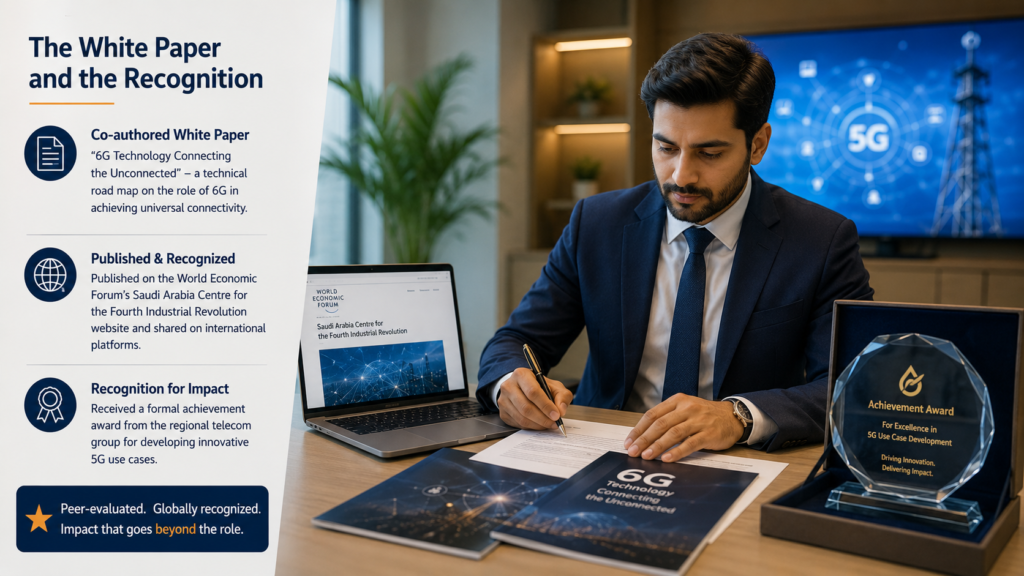
He co-authored a white paper titled “6G Technology Connecting the Unconnected” – a technical road map on the role of 6G in achieving universal connectivity. The paper was published on the World Economic Forum’s Saudi Arabia Centre for the Fourth Industrial Revolution website and circulated on other international platforms. He also received a formal achievement award from the regional telecom group for his work developing 5G use cases.
These are not entries on a certification list. A white paper published through the WEF is peer-evaluated and internationally circulated. An employer award for 5G use case development is institutional recognition that specific work exceeded what the role required. Both contribute to the well-positioned argument in a way that general job descriptions cannot.
The Proposed Endeavor |EB-2 NIW RF wireless engineer
His proposed endeavor covered four interconnected areas: building OpenRAN platform architecture, expanding rural broadband connectivity, deploying IoT networks, and implementing 5G. Each draws on something he had already done professionally.
He designed a rural USF broadband network for 266 remote Saudi locations, a direct analogue for the rural connectivity problem the U.S. BEAD program exists to solve. He launched a 5G network. He developed an OpenRAN technology strategy and roadmap. He built a cellular IoT strategy and supported a commercial IoT network launch using existing LTE infrastructure. He also developed a 5G use case involving drone-based wildfire response — drones using 5G connectivity for live video streaming and machine-learning-based analytics for real-time fire monitoring. That specific use case demonstrates how RF engineering connects to applications far beyond the network itself.
The long-term dimension of the proposed endeavor was 6G. His white paper on the WEF platform was written precisely as an input to U.S. policy conversations about where wireless technology needs to go after 5G. The NTIA, NSF, and DoD have all named 6G as a national priority. His contribution to that conversation was already on record, in a publicly accessible document, before the petition was filed.
What the RFE Response Changed
The RFE response had to do two things at once: correct the procedural errors and respond to the substantive challenges as if under the correct framework.
On the classification error, the response cited USCIS’s own Chapter 5, which clearly states that the Advanced Degree category applies to a beneficiary with a U.S. bachelor’s degree or a foreign equivalent plus five years of progressive post-degree experience. With two recognized bachelor’s degrees and 18 years of relevant experience, the classification under Advanced Degree was straightforward. The response made this explicit and asked USCIS to re-examine the case under the correct standard.
On the substantive challenges, the response reargued the national importance and well-positioned prongs against the correct framework. The same federal programs (BEAD, NTIA Innovation Fund, the DoD 5G Challenge, the Critical and Emerging Technologies List) that supported national importance in the original petition remained relevant. The well-positioned argument was rebuilt around his actual career as an RF engineer: the 5G launch, the USF rural network, the WEF white paper, the mobile strategy role, the three-country scope.
Notably, USCIS had already acknowledged in the RFE that substantial merit was established. The challenge was national importance and the well-positioned argument. Once those were addressed under the correct classification, the case cleared.
The Outcome
Approved.An RF and wireless engineering specialist, Australian citizen, working in Saudi Arabia, with no U.S. employer. A 17+ year career that ran from 2G and 3G deployment in Pakistan through LTE commissioning in Australia to 5G network launch and mobile technology strategy in Saudi Arabia. An RFE that got both the category and the profession wrong. A response that corrected both and still made the case. Approved.
A wrong category evaluation and a mistaken job title in the same RFE is unusual. It is also correctable. An error in the
review process does not change the underlying strength of the case and in this instance, the case held.
For RF and Wireless Engineers
If you work in radio frequency engineering, cellular network design, 5G deployment, or wireless technology strategy and your career includes any of the domains the U.S. government has named as national priorities (OpenRAN, rural broadband, 5G, IoT), the NIW can be worth considering seriously. The U.S. has committed $45+ billion to broadband infrastructure, $1.5 billion to OpenRAN development, and $7 million to a DoD-NTIA 5G challenge. Wireless engineering expertise is what turns those commitments into deployed networks.
Questions RF and Telecom Engineers Ask Us
What happens if USCIS makes an error in the RFE – wrong category, wrong profession?
Errors in RFE evaluations do happen and they are correctable. The response needs to identify each error clearly, cite the relevant USCIS policy or regulation that establishes the correct standard, and then address the substantive questions under the correct framework. In this case, USCIS had evaluated an Advanced Degree petition under the Exceptional Ability criteria and misidentified the petitioner’s profession. The response cited USCIS’s own Chapter 5 guidance on the Advanced Degree standard and rebuilt the well-positioned argument accordingly. The case was approved.
Can an RF engineer or wireless network specialist qualify for an EB-2 NIW?
Yes. RF engineering is listed under Communication and Networking Technologies in the U.S. Critical and Emerging Technologies List. Designing and deploying OpenRAN, 5G, rural broadband, and IoT networks addresses areas the U.S. government has explicitly funded and prioritized. An engineer who has launched 5G networks, designed rural USF broadband infrastructure, and developed OpenRAN strategies has a concrete track record directly relevant to those documented national needs.
How does a white paper published through an international forum help an NIW case?
A white paper published through an internationally recognized body such as the World Economic Forum demonstrates that the petitioner’s work has been submitted to an external platform, evaluated, and found worth distributing to a policy and industry audience. In the Dhanasar well-positioned analysis, contributions that extend beyond a single employer, particularly those that engage with national or international policy conversations, support the argument that the petitioner is positioned to advance work of national importance. A published co-authored white paper on 6G connectivity from a WEF platform is that kind of contribution.
Does experience launching 5G in a foreign country count toward a U.S. NIW case?
It can count significantly. The technical skills involved in designing and deploying a 5G-NR network (spectrum selection, architecture decisions, coverage simulation, vendor evaluation, rollout management) are the same skills the U.S. needs to deploy 5G infrastructure. The regulatory environment differs but the engineering expertise transfers directly. A petitioner who led a 5G launch to 35% population coverage has demonstrated execution at a scale that most professionals have not reached.
My original petition had a year-of-experience discrepancy. Is that a problem?
Minor internal inconsistencies in a petition can sometimes trigger USCIS scrutiny, but they are addressable in an RFE response. The response should clarify the correct figure, explain any discrepancy, and ensure the career timeline in the supporting evidence is clear and consistent. The underlying experience does not change; what matters is that the response presents it accurately and coherently.
Even an RFE with factual errors isn’t a denial, it’s a chance to correct the record. See how Immignis builds RFE responses that fix mistakes and still win NIW approval.