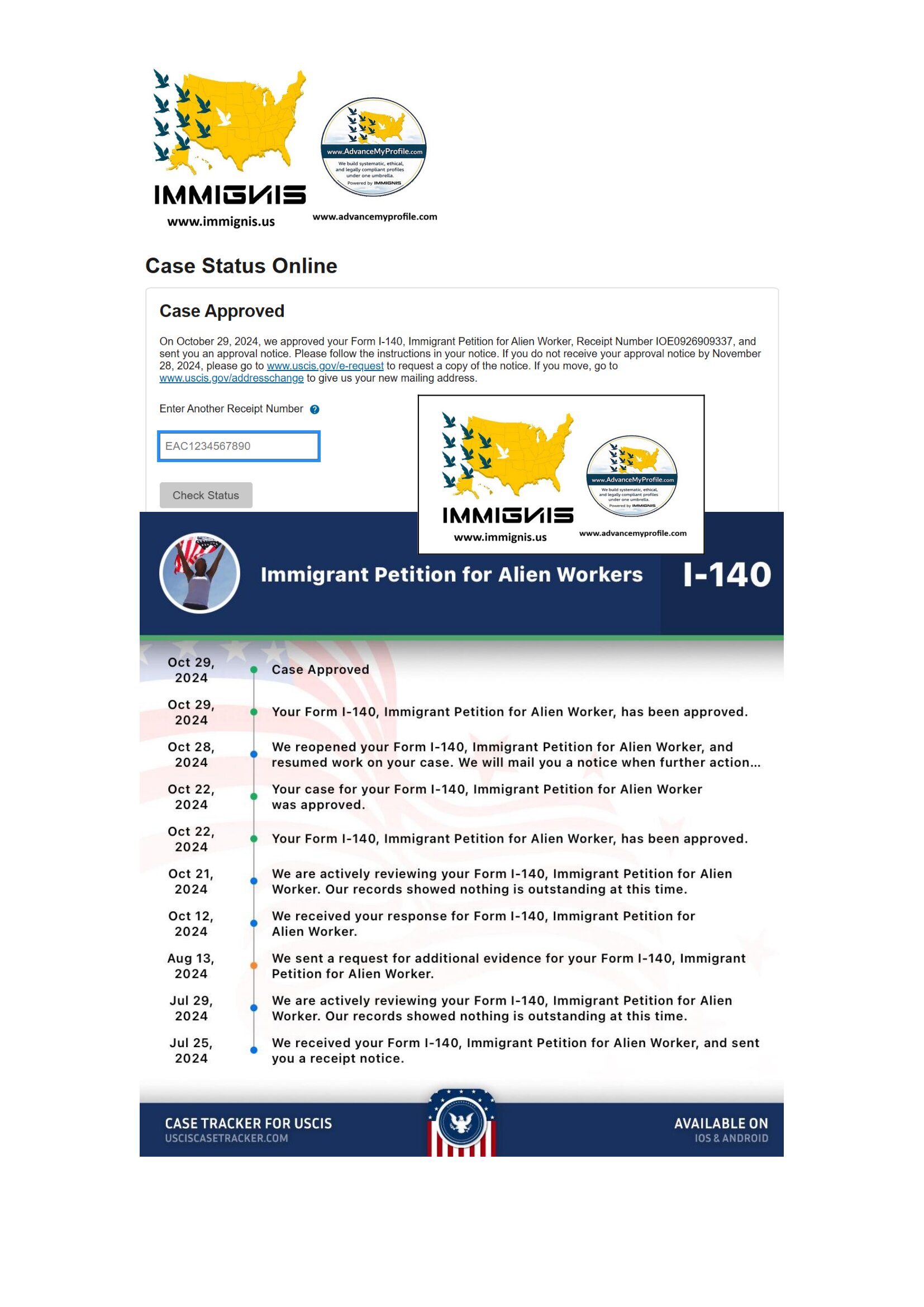
A behavioral-health researcher came to AdvanceMyProfile.com after her prior firm stopped responding during an active USCIS RFE. This EB-2 NIW RFE approval case was repaired under deadline pressure by replacing weak, insider-heavy support with independent expert letters, professional visibility, a policy-facing white paper, and a sharper RFE response. USCIS approved the EB-2 NIW after the response.
| Nationality | Colombian |
| Working in | Spain, behavioral-health research institute |
| Profession | Researcher focused on evidence-based digital behavioral-health interventions |
| Career stage | Approximately 9 years; senior researcher |
| Pathway | EB-2 National Interest Waiver |
| Starting point | Active RFE, prior firm unresponsive, deadline approaching |
| Engagement | Approximately 7 months, including mid-process repair and RFE response |
| Outcome | RFE answered, record strengthened, and EB-2 NIW approved |
In short: this case was not won by rewriting the same filing in stronger language. It was won by identifying the exact
weakness in the RFE, building independent proof quickly, and showing USCIS that the petitioner’s digital mental-health
work had already moved beyond her close professional circle.
The Approval Story: A Case Rescued During an Active RFE
By the time she contacted us, the petition was already in danger. USCIS had issued a Request for Evidence, the deadline was moving closer, and the prior firm had become unresponsive. She did not need a general consultation. She needed a complete rescue plan for an EB-2 NIW RFE approval: review the original filing, understand the RFE, repair the evidence, and prepare a response before the window closed.
The underlying professional record was strong. She had nearly a decade of work in evidence-based digital interventions for depression, anxiety, and post-traumatic stress. Her work addressed a clear U.S. problem: millions of people face barriers to behavioral healthcare because of clinician shortages, cost, stigma, geography, language access, disability, and lack of nearby in-person services.
The approval came after the RFE response because the response did what the first filing had not done well enough. It showed independent recognition, external use of her methods, relevant professional visibility, and a stronger connection between her work and the U.S. behavioral-health access crisis, strengthening the EB-2 NIW RFE approval case.
The National Problem: Mental Health Need Exceeds In-Person Capacity
The United States has a serious behavioral-health access problem. In many communities, patients wait weeks or months for care, and rural, low-income, immigrant, disabled, and trauma-affected populations often face the sharpest barriers. Digital behavioral-health interventions cannot replace every form of care, but properly designed and evidence-based tools can expand access, support continuity, and help clinicians reach patients who would otherwise remain untreated, strengthening the EB-2 NIW RFE approval case.
That was the national-interest direction of the case. The petitioner was not presented as a general mental-health researcher. She was presented as a researcher developing evidence-based, scalable, technology-mediated behavioral-health interventions that could help underserved populations access care through digital delivery models, which supported the EB-2 NIW RFE approval strategy.
The Weakness USCIS Identified
The prior filing had explained her research, but it relied too heavily on people close to her: former mentors, collaborators, and co-authors. Those letters were sincere, but they did not carry the same evidentiary weight as independent evaluations from people who used, cited, reviewed, or applied the work without a personal reason to support her, which became central to the EB-2 NIW RFE approval strategy.
USCIS was not asking whether she was liked or respected by people who already knew her. The officer wanted proof that her work had reached beyond her immediate circle. That became the central repair point for the EB-2 NIW RFE approval case.
The Corrected Proposed Endeavor
“To develop and deploy evidence-based digital behavioral-health interventions that expand access to mental health care for underserved populations across the U.S. health system - addressing the national behavioral-health crisis by scaling accessible, technology-mediated therapeutic solutions where clinician shortages and cost barriers limit in-person care.”
This wording kept the case grounded. It identified the population, the delivery mechanism, the public-health gap, and the national benefit. It also matched her real experience: clinical research, digital intervention design, behavioral-health access, and scalable therapeutic protocols.
What AdvanceMyProfile Built Under Pressure
We worked on two tracks at the same time. First, we prepared the legal and evidentiary response to the RFE. Second, we repaired the profile record fast enough to include new, independent proof before the deadline.
The repair did not involve inventing a new identity for the client. It involved finding the external evidence that already existed or could credibly be created from her real work: researchers who had cited her methods, clinicians who had used similar protocols, journal reviewers who had evaluated her work, and policy-facing audiences that understood the behavioral-health access gap.
Independent Letters Replaced Warm Letters
The strongest new evidence for the EB-2 NIW RFE approval came from arms-length evaluators. We sourced letters from a U.S. university researcher who had cited her digital-intervention methodology, a clinical psychologist whose telehealth platform used techniques drawn from her published protocols, a behavioral-health journal reviewer who had evaluated one of her papers, and a health-policy researcher who had cited her work in a digital mental-health access report.
Those letters did not read like character references. They answered the immigration issue directly: her work had professional value beyond her own institution, and others had engaged with it because of its substance, strengthening the EB-2 NIW RFE approval case.
Podcast, Expert Commentary, and Policy-Facing Evidence
We also strengthened the public record around her expertise. An internationally distributed behavioral-health and clinical-psychology podcast had previously invited her, but she had not followed up because she did not realize its evidentiary value. We arranged the appearance and prepared her to discuss her research in a way clinicians, public-health readers, and policy audiences could understand.
Expert commentary was secured in behavioral-health and healthcare-technology publications. A concise white paper on evidence-based digital behavioral-health interventions for underserved populations was prepared and shared with relevant digital health, behavioral-health, nonprofit, and policy stakeholders. Each item supported the same theme: her work belonged in the broader professional conversation on access to mental-health care.
How the RFE Response Was Structured
The response did not bury the issue under a longer cover letter. It answered the officer’s concern directly. The filing showed independent letters, independent use of her methods, expert commentary, the podcast appearance, and the policy-facing white paper. Every exhibit was organized around one point: the petitioner’s work had moved beyond her immediate circle and was being evaluated, used, and discussed by people with no personal stake in her case.
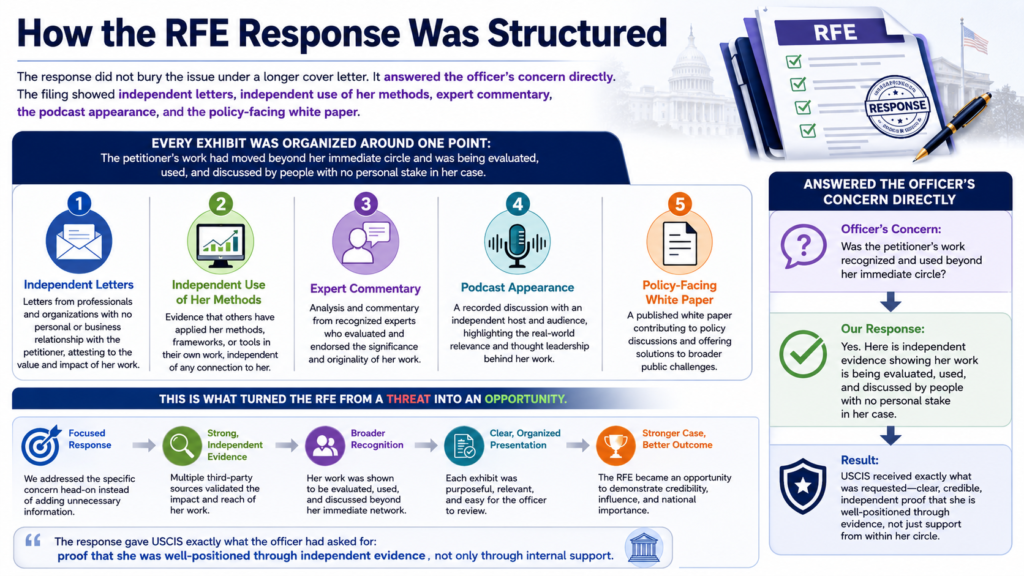
This is what turned the RFE from a threat into an opportunity. The response gave USCIS exactly what the officer had asked for: proof that she was well-positioned through independent evidence, not only through internal support.
The Outcome
USCIS approved the EB-2 National Interest Waiver after the RFE response. The approval confirmed the value of a disciplined mid-process repair: the case did not need a completely new profession or a fabricated profile. It needed independent evidence, stronger public recognition, and a response that matched the officer’s question.
After the approval, her professional visibility continued to grow. The podcast episode circulated among behavioral-health professionals. The independent experts introduced during the RFE process became part of a wider network. Her commentary trail helped position her as a public voice in digital mental health, and she entered stronger conversations with U.S. research and healthcare organizations working on scalable mental-health interventions.
Why This Case Matters
This case shows that an abandoned RFE is not automatically a lost case. The deadline is serious, and some cases cannot be repaired if the record is weak or the response window is too narrow. But when the underlying work is genuine, a focused takeover can still succeed.
It also shows why profile building must be evidence-led. The client did not need artificial awards, random media, or generic letters. She needed independent proof that her work had reached the people and institutions that could evaluate its value.
How the Profile-Building Steps Supported Dhanasar
| Substantial Merit | Digital behavioral-health interventions were tied to mental-health access, clinician shortages, telehealth, underserved populations, and scalable care delivery. |
| National Importance | The case showed the endeavor could affect behavioral-health access beyond one clinic, employer, or research team by building evidence around scalable digital protocols and policy-facing use. |
| Well Positioned | Independent letters, citations, reviewer evidence, podcast recognition, expert commentary, and professional outreach showed that others had engaged with her work outside her close circle. |
| Waiver Rationale | The RFE response showed that requiring a single employer-driven process would not fit a researcher whose work could support a broader national behavioral-health access need. |
Lessons for Professionals Facing an NIW RFE
- Do not answer an RFE by repeating the same evidence in different words. Start with the officer’s exact concern.
- Independent letters often carry more weight than warm letters from mentors, co-authors, or close collaborators.
- A professional podcast can be useful evidence when the audience is relevant and the invitation is based on subject-matter expertise.
- White papers help only when they are directed to credible field, policy, nonprofit, research, or professional stakeholders.
- NIW first and EB-1A later can be the correct sequence when the current record supports NIW but not yet extraordinary ability.
- A case taken over mid-process can still succeed when the underlying work is real and the response window allows disciplined repair.
If your NIW is in RFE stage and the team that filed it has stopped responding, the first step is a fast, honest review. The deadline matters, but so does the quality of the response. A stronger filing begins by identifying exactly what USCIS asked and what independent evidence can still be built or documented before the deadline. Submit your free assessment request. immginis