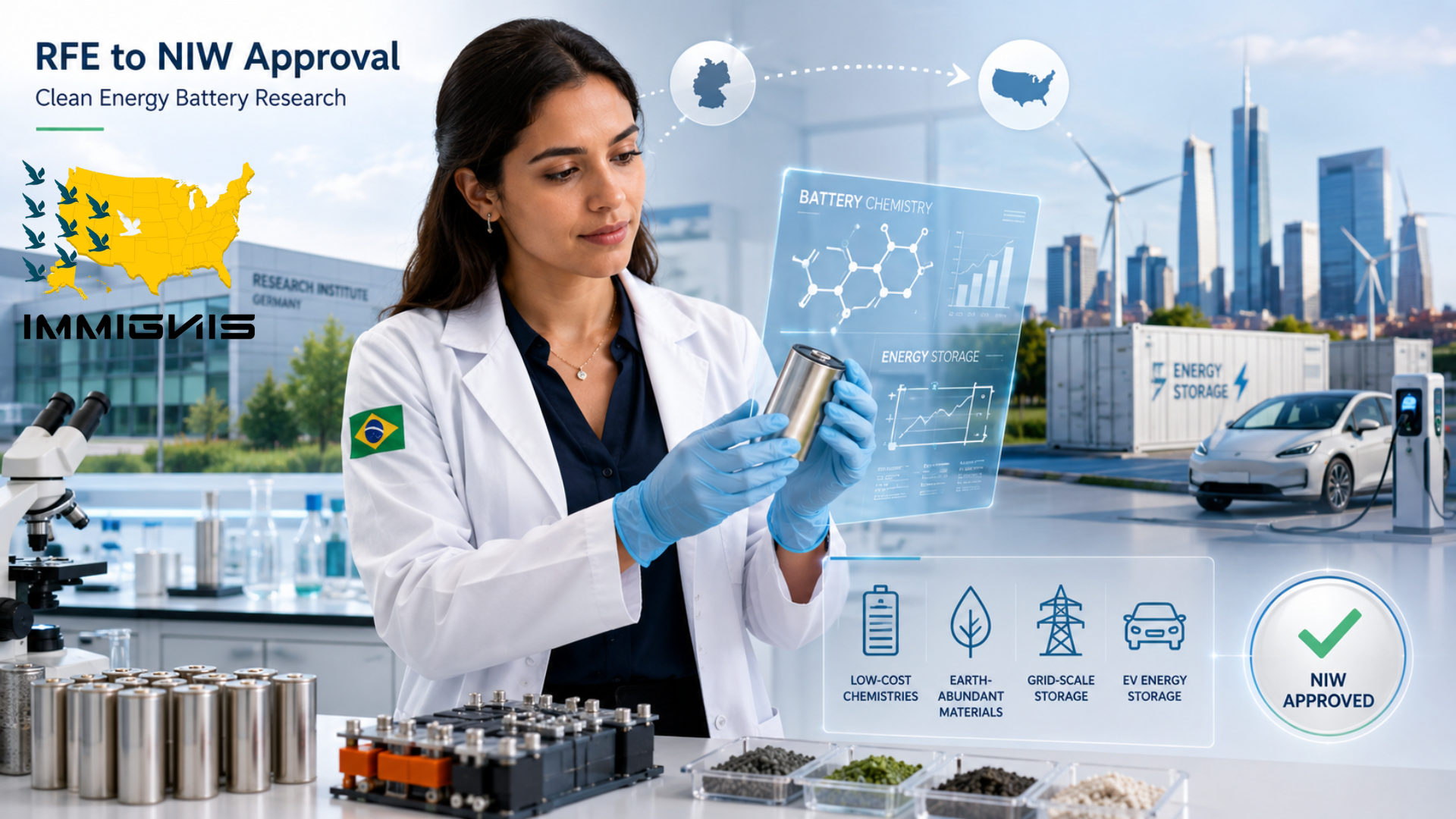
EB-2 NIW RFE well-positioned response: A clean-energy researcher working in Germany received an RFE on whether she was well-positioned to advance her U.S. endeavor. After a focused profile-building strategy and a stronger U.S.-specific record, USCIS approved her EB-2 National Interest Waiver.
| Nationality | Brazilian |
| Work location before approval | Germany, at a European research institute |
| Field | Materials science and low-cost battery chemistries |
| Proposed endeavor | Advance low-cost, earth-abundant battery chemistries for grid-scale and electric-vehicle energy storage in the United States |
| Initial challenge | Strong research background, but limited U.S.-facing recognition and an underdeveloped U.S.-specific plan |
| Profile-building period | Approximately 12 months, including RFE-response strengthening |
| USCIS issue | RFE focused on whether she was well-positioned to advance the endeavor in the United States |
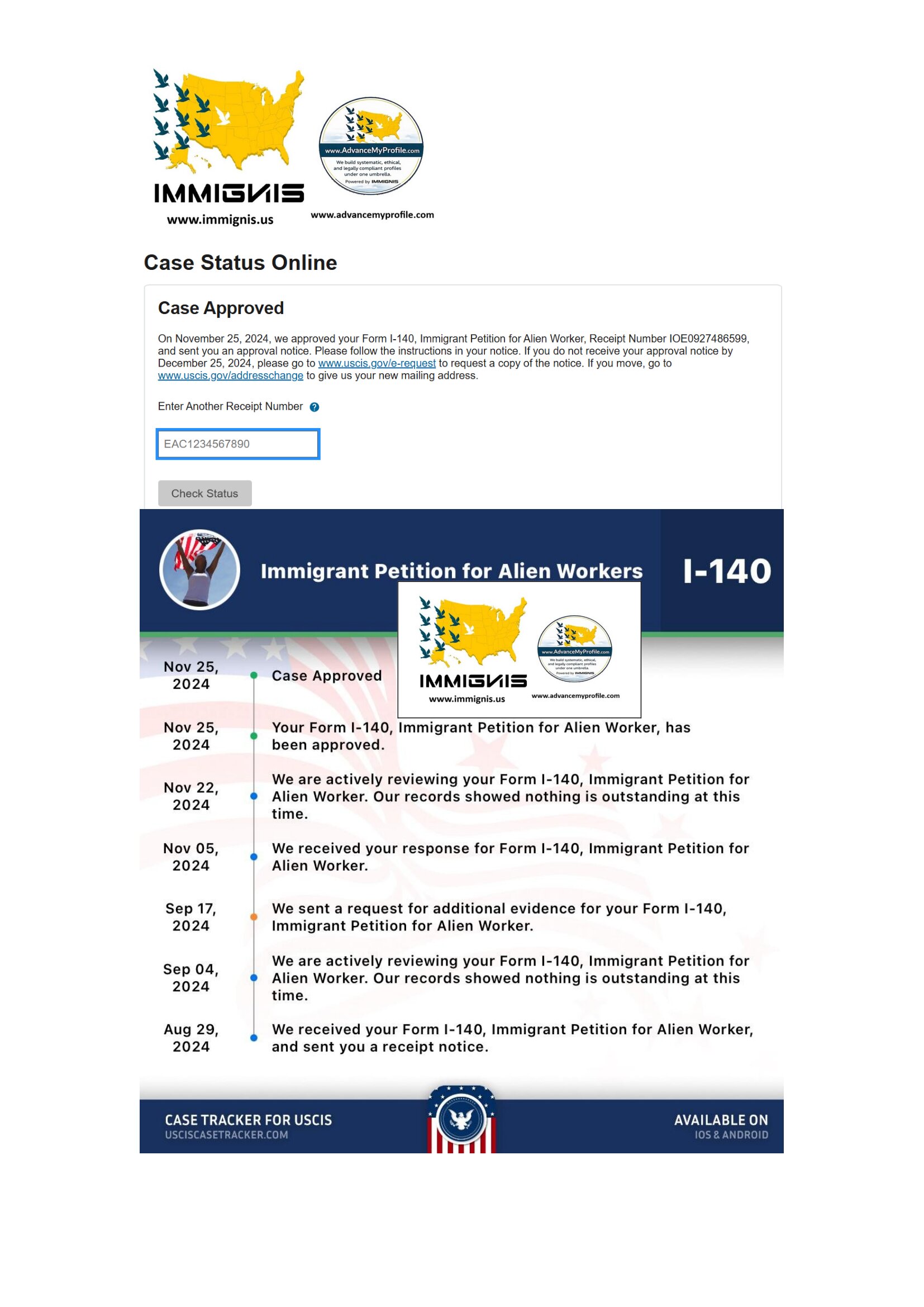
| Outcome | EB-2 NIW approved after RFE response |
Privacy note: This success story is anonymized. Personal identifiers, employer-specific details, and private case information are intentionally excluded.
The approval result: EB-2 NIW RFE Well-Positioned Response
This case did not begin as a weak profile. It began as an under-organized one. The client was already a serious battery researcher working in Germany on low-cost energy-storage chemistries. Her work was relevant to the clean-energy transition, grid reliability, electric-vehicle growth, and the global race to reduce dependence on scarce critical minerals.
The issue was that the record had not yet been shaped for U.S. immigration review. USCIS later issued an RFE asking for stronger proof that she was specifically well-positioned to advance the proposed work in the United States. That question became the center of the response strategy.
After additional profile building, stronger U.S.-specific evidence, supplemental expert support, and a clearer professional plan, USCIS approved the EB-2 National Interest Waiver. The approval followed the evidence because the record finally showed not only what she studied, but why that work mattered to the United States and why she was positioned to continue it here.
The national problem: storage cost, critical minerals, and U.S. clean-energy capacity
The United States cannot expand electric vehicles, renewable power, and resilient grid storage without better battery systems. Lithium-ion technology is important, but the supply chain depends on materials that are expensive, geographically concentrated, and exposed to global supply disruptions. Grid-scale storage also requires chemistries that can be affordable, safe, durable, and deployable at large scale.
Her work sat inside that national problem. She was not working on a general chemistry topic. She was working on low-cost, earth-abundant battery chemistries that could reduce material scarcity and support broader deployment of grid-scale and EV energy storage. That gave the case a strong national-interest foundation, provided the record could be organized properly.
The client’s weak starting point
At intake, the client had a real research record, but it was scattered. Her publications and citations existed, yet they were not clearly tied to one U.S.-facing national-interest direction. Some evidence sat inside research circles. Some public-facing recognition was limited. Her work had not been translated into policy, industry, or U.S. clean-energy relevance in a way that an immigration officer could quickly follow.
This is a common problem for researchers working outside the United States. A strong scientific record abroad does not automatically become a strong NIW record. The petition must still explain how the work connects to U.S. priorities and why the petitioner is specifically positioned to advance it in the United States.
The proposed endeavor that gave the case direction
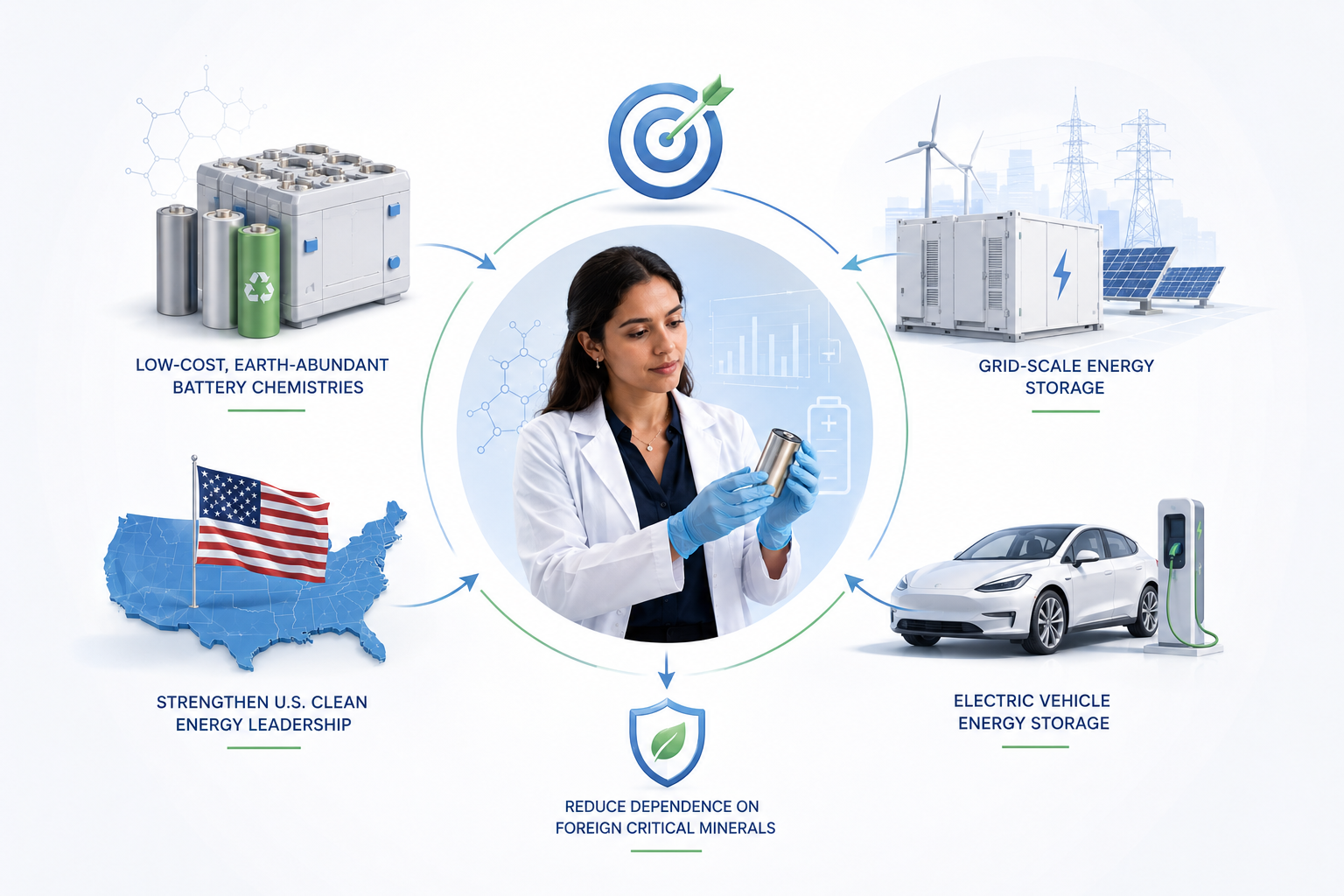
The first strategic step was to define the proposed endeavor with precision. A broad statement such as “I research batteries” would not have carried the national-importance argument. The endeavor needed to connect her actual technical specialty to U.S. clean-energy capacity, domestic battery manufacturing, EV growth, grid resilience, and critical-mineral independence.
“To advance low-cost, earth-abundant battery chemistries that reduce the cost and material scarcity of grid-scale and electric-vehicle energy storage to accelerate the United States’ transition to domestically produced clean energy and reduce dependence on foreign critical minerals.”
That sentence became the organizing center of the case. Every later step had to support the same identity: a Brazilian materials scientist advancing affordable, earth-abundant battery chemistries for U.S. energy-storage needs.
What Immignis and AdvanceMyProfile built
The profile-building work did not create a false identity. It organized and strengthened evidence around expertise that already existed. The work was built in layers:
• A focused clean-energy professional identity around earth-abundant battery chemistries and affordable storage.
• A publication strategy that stayed within the battery-storage niche instead of widening the profile into unrelated topics.
• A citation-growth strategy that allowed the record to mature before filing and during the RFE period.
• Clean-energy and materials-science visibility that translated technical research into practical energy-policy relevance.
• A policy-facing white paper explaining how lower-cost chemistries could reduce supply-chain risk and support grid-scale deployment.
• Targeted outreach to U.S.-relevant researchers, battery-sector contributors, and energy-storage stakeholders.
• Invited talks and senior professional membership to show recognition beyond ordinary participation.
• Independent expert letters addressing not only the science, but the U.S. relevance of the work.
• A detailed U.S. professional plan responding directly to the RFE’s well-positioned concern.
How the profile-building work supported Dhanasar Prong 1
The substantial merit and national importance argument became stronger because the record connected the research to U.S. energy-storage problems. The petition no longer presented battery science as an isolated academic topic. It showed how affordable chemistries could support electric-vehicle adoption, grid-scale storage, critical-mineral independence, domestic clean-energy manufacturing, and energy resilience.
The white paper and public-facing coverage helped bridge the gap between laboratory research and national policy relevance. They made the technical work understandable to readers outside her immediate field while keeping the science tied to a credible national problem.
How the profile-building work supported Dhanasar Prong 2
The RFE focused on whether she was well-positioned to advance the work in the United States. The response therefore had to show U.S.-specific traction, not only general scientific ability. We reorganized evidence of U.S. research engagement, highlighted citations from U.S.-based groups, added a documented conference record, and obtained supplemental letters from U.S.-connected experts.
The updated record showed that her work had already begun to enter conversations relevant to U.S. clean-energy research and storage deployment. The response did not simply claim she was well-positioned. It showed the officer how her work, contacts, recognition, and professional plan connected to the United States.
How the profile-building work supported Dhanasar Prong 3
The balance-of-interests argument became clearer once the record showed that her work was research-driven, national in scope, and not limited to one employer. Her proposed contribution depended on scientific development, research collaboration, industry engagement, and clean-energy deployment pathways. Those are not well captured by a conventional labor-certification process tied to a single job offer.
The strengthened record allowed the petition to argue that the United States would benefit from allowing her to continue this work through the NIW framework because the work served broader energy-storage goals and had value beyond an individual employer’s immediate needs.
The RFE and the response
Seven weeks after filing, USCIS issued an RFE. The officer wanted stronger proof that she was specifically positioned to advance the endeavor in the United States. The RFE was not the end of the case. It gave the response a clear target.
The response focused on three points. First, we documented U.S. engagement through citations, conference activity, and U.S.-connected expert support. Second, we prepared a forward-looking U.S. professional plan explaining where and how her research direction could continue inside the U.S. clean-energy ecosystem. Third, we supplemented the record with updated citations, recognition, and letters that addressed the officer’s question directly.
The final response was stronger because it did not rely on argument alone. It answered the RFE with documents that matched the officer’s concern.
The approval
USCIS approved the EB-2 National Interest Waiver after the RFE response. The approval showed that the case had been successfully moved from a scattered research profile to a structured national-interest record.
The final record presented a clear endeavor, a focused research identity, a growing citation base, independent recognition, U.S.-specific engagement, expert support, and a practical professional plan. Together, these elements answered the core question USCIS raised: why this researcher was specifically positioned to advance this clean-energy work in the United States.
What she gained beyond approval
The approval was the immediate immigration result, but the profile-building process produced value beyond the I-140. She emerged with a clearer expert identity, stronger public-facing research positioning, better organized publications and citations, credible clean-energy visibility, and a professional plan she could use in conversations with U.S. research environments and industry contacts.
That is why ethical profile building matters. It does not manufacture a reputation. It gives structure and visibility to real expertise so that the client can use it for immigration, research collaborations, institutional meetings, and future professional growth.
Lessons for researchers working outside the United States
• A strong research record abroad does not automatically answer the U.S.-specific NIW question.
• The proposed endeavor must be narrow enough to be credible and broad enough to show national importance.
• Publications matter more when they are organized around one field direction and supported by citation growth.
• White papers and policy-facing materials can help when the field naturally connects to public policy, as battery storage does.
• An RFE can be answered successfully when the officer’s concern is understood and the response adds evidence, not only explanation.
• Profile building works best when it documents real expertise rather than creating claims the record cannot support.
If you are a researcher working outside the United States, your strongest evidence may already exist, but it may not yet be organized for U.S. immigration review. A good strategy starts by identifying the national-interest direction, then building a record that proves the connection between your work, U.S. priorities, and your ability to advance the endeavor.
Start with a free, honest assessment. If your profile can be strengthened credibly, we will explain the path. If it cannot, we will tell you directly.