EB-2 NIW robotics inventor: A Mexican robotics and automation engineer had a real invention, a granted U.S. patent, a registered product identity, and factory adoption. The first NIW failed because the record was framed too generally. The refile succeeded after the case was rebuilt around the evidence he actually had: invention, commercialization, adoption, and industry relevance.
Approval summary: After a self-filed NIW denial, the case was rebuilt over approximately 10 months and refiled as a patent-first inventor petition. The refiled EB-2 NIW I-140 was approved without a Request for Evidence. The approval was supported by a revised proposed endeavor, a granted U.S. patent, a registered trademark, independent adoption letters, focused technical publications, trade-sector visibility, industry-facing outreach, conference activity, Senior Member recognition, and a petition narrative that treated him as an applied robotics inventor rather than forcing him into an academic profile.
Privacy note: The client’s name, company names, product identifiers, customer names, and personal details have been removed for public use. The case is presented as an anonymized success story based on the provided profile-building record.
The Problem: A Real Inventor With the Wrong Immigration Architecture
He was not a professor with a long publication record. He was an engineer who built systems that worked on factory floors. For nearly 10 years, he developed collaborative robotic systems for small and mid-size manufacturers that needed automation without the cost, disruption, and rigidity of million-dollar industrial lines.
His strongest evidence was practical and commercial: a granted U.S. patent, a registered trademark, product deployment, and real users who had evaluated or adopted the technology. Yet his self-filed NIW described the case too broadly. It said robotics was important and attached the patent, but it did not show why his specific invention mattered to U.S. manufacturing capacity.
That is why the first petition failed. The problem was not that he lacked substance. The problem was that the substance had not been organized into the Dhanasar framework. The officer was left to infer the national importance, the originality, and the field-level relevance. A successful NIW cannot depend on inference.
The Corrected Endeavor |EB-2 NIW robotics inventor
Proposed endeavor: To develop and deploy affordable collaborative robotic systems that enable small and mid-size U.S. manufacturers to automate precision tasks alongside human workers, accelerating reshoring of advanced manufacturing, reducing dependence on offshore production, and strengthening U.S. industrial capacity in sectors critical to national economic security.
The revised endeavor changed the case. It did not present him as someone generally interested in robotics. It identified a specific mechanism: affordable collaborative robots for smaller manufacturers. It identified the U.S. interest: reshoring, industrial capacity, manufacturing productivity, and reduced offshore dependence. It also preserved the field-endeavor nexus because the endeavor matched the invention he had already built.
What Immignis and AdvanceMyProfile Built
The strategy was not to turn an inventor into a researcher. That would have been artificial. The profile had to be built around invention, commercialization, adoption, and credible industry recognition. Each step was selected because it supported the same approval story.
1. A patent-first evidence strategy
The granted U.S. patent became the center of the originality argument. We placed it early in the record and explained why the patented design mattered for collaborative robotics, accessible automation, and smaller manufacturing environments. A granted patent was stronger than a pending filing because the invention had already passed examination for novelty and non-obviousness.
2. Trademark and commercialization evidence
The registered trademark helped show that the invention had moved beyond concept stage. A trademark does not prove technical novelty, but it can show that an invention became a market-facing product. In this case, that mattered because the petition was not based on a future idea. It was based on a product identity already connected to real manufacturing use.
3. Independent adoption letters in place of academic citations
For an academic researcher, citations may show that others used or built on the work. For an applied inventor, independent adoption can serve a similar evidentiary function. We sourced letters from people who could describe real use, evaluation, productivity improvement, safety value, and the technology gap among smaller manufacturers. These were not generic testimonials. They were market-validation evidence.
4. Targeted technical publications without overbuilding an academic profile
We added a modest but credible publication layer: two focused first-author papers in robotics and manufacturing-technology venues. The purpose was not to create a scholar’s profile overnight. The purpose was to explain the technical method, make the invention understandable to the professional community, and support the well-positioned argument with field-facing documentation.
5. Trade-sector visibility and industry-facing outreach
The media strategy focused on manufacturing and industrial-robotics outlets, not broad publicity. Expert commentary addressed accessible automation, reshoring economics, and human-cobot production environments. We also prepared a concise white paper on affordable collaborative robotics and shared it with relevant manufacturing associations, automation stakeholders, and a regional advanced-manufacturing network.
6. Conference activity and professional recognition
A conference paper was prepared and presented at a manufacturing-technology gathering. That was followed by a panel invitation on accessible automation for domestic manufacturers. He also secured Senior Member grade in a recognized engineering body through peer nomination and review. The membership evidence was used because it reflected professional standing; we did not rely on basic pay-to-join memberships.
How the Profile-Building Supported Dhanasar
The refile was built so every exhibit had a clear legal purpose. The national-importance argument came from the role of affordable automation in U.S. manufacturing capacity, reshoring, productivity, and supply-chain resilience. The well-positioned argument came from the granted patent, trademarked product, deployment history, adoption letters, technical writing, conference activity, and professional recognition. The waiver argument came from the public value of allowing an inventor with a working technology to advance a manufacturing-capacity endeavor without tying the work to one employer.
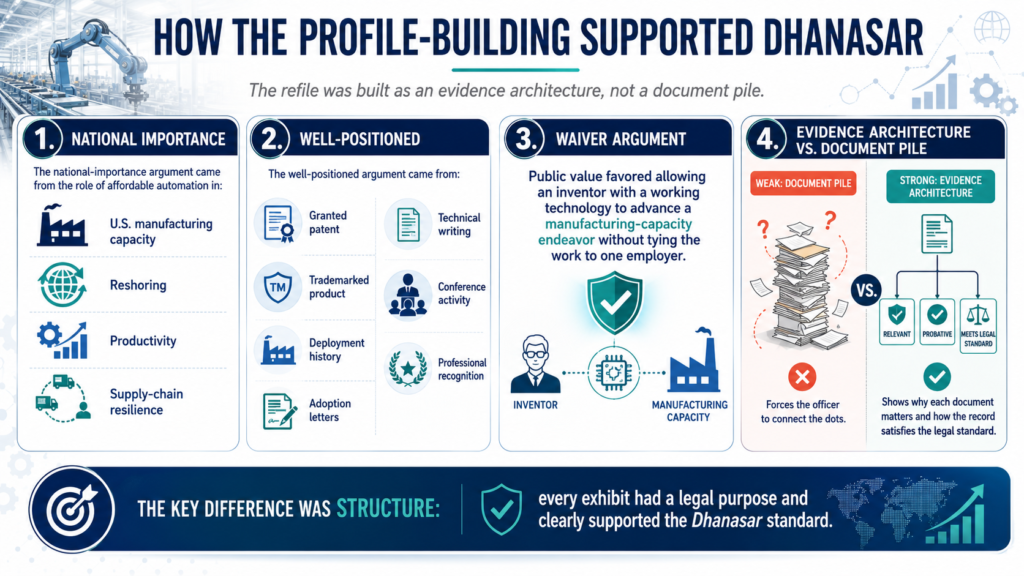
This is the key difference between a document pile and an evidence architecture. A document pile forces the officer to connect the dots. A strong evidence architecture shows why each document matters and how the record satisfies the legal standard.
The Refile and Approval
The petition was refiled with a cover letter written around the inventor profile. It did not apologize for the absence of a heavy academic record. It explained why this record should be read differently: the petitioner was influencing the field through invention, deployment, commercialization, and adoption, not primarily through scholarly citations.
No RFE arrived. The EB-2 NIW I-140 was approved after USCIS processing. The approval confirmed the value of matching the strategy to the client’s real evidence instead of forcing the client into a profile that did not fit him.
What Changed Beyond the Approval
The approval was not the only result. The profile-building process gave him a clearer public inventor identity. His patent became part of the product story. His trademarked system gained stronger commercial recognition. His speaking opportunities increased, and he began being introduced as an inventor and automation strategist, not only as an engineer.
He later moved into a senior engineering and commercialization role with a company scaling collaborative robotics for small and mid-size manufacturers. That career movement showed why ethical profile building can help beyond immigration. The same evidence that helped USCIS understand his value also helped the market understand it.
Lessons for Engineers and Inventors
- NIW is not only for academic researchers. Inventors, applied engineers, and product builders can qualify when their evidence shows original contribution, national importance, and capacity to advance the endeavor.
- A granted patent can be stronger than a paper in an inventor’s case, especially when it is directly connected to the proposed endeavor.
- Commercialization evidence matters. A trademark, product history, and user adoption can show that an invention moved from idea to market.
- Industry-adoption letters must be independent, specific, and tied to real use or evaluation. Generic praise is not enough.
- White papers should be directed to credible field recipients. In this case, manufacturing associations and automation networks made sense.
- A generic endeavor can sink a real profile. The national benefit must be linked to the petitioner’s specific mechanism of impact.
- Ethical profile building does not invent a false identity. It documents and organizes real work so USCIS and the market can understand it.
A granted patent and real factory adoption are powerful evidence, they just need the right immigration architecture. See how Immignis turns inventor profiles into approved EB-2 NIW petitions.