EB-2 NIW special education teacher in Georgia built an approved EB-2 NIW case around AI-assisted IEP execution, adaptive learning, progress monitoring, documentation support, and teacher capacity building.
| Client profile | Special Education Teacher, IRR Math Teacher, and IEP Case Manager in a major Georgia public school system |
| Field | Special education, inclusive education, AI-assisted instructional systems, IEP implementation, adaptive learning, and progress monitoring |
| Career stage | 10+ years across U.S. public schools and Indian special education institutions |
| Original challenge | Show that classroom-level IEP work could become a scalable national-interest endeavor, not only a teaching role |
| Evidence foundation | U.S. school experience, 31 scholarly/professional outputs, Google Scholar citation record, awards, public education work, teacher training, and IEP case-management practice |
| Outcome | EB-2 NIW I-140 approved |
The Approval Result| EB-2 NIW special education teacher
This case ended with an EB-2 National Interest Waiver approval for a special education professional whose record became strongest when it was organized around one operational problem affecting U.S. schools: the gap between written IEP requirements and consistent classroom implementation.
The client did not need to be presented as a general classroom teacher. Her strongest case came from a focused model for AI-assisted IEP execution, adaptive learning, progress monitoring, documentation support, and teacher capacity building. The approval confirmed that a classroom-based professional can support a national-interest case when the proposed endeavor is scalable, evidence-based, and tied to a systemwide education need.
The success was not created by changing who the client was. It came from organizing her real teaching, IEP case-management, research, public education, and AI-assisted special education work into a coherent Dhanasar record that USCIS could evaluate.
The National Problem: IEPs Exist, but Implementation Remains Difficult
The central issue was not whether special education matters. The issue was how to show that the petitioner’s work addressed a recurring operational weakness in U.S. schools. Individualized Education Programs are legally required and educationally essential, yet teachers often face high caseloads, complex documentation duties, fragmented progress data, inconsistent accommodation delivery, and limited time to convert written goals into daily instructional actions.
The petition identified this implementation gap as the national-interest problem. The proposed model was designed to help schools translate IEP goals, accommodations, service requirements, and progress-monitoring data into practical instructional outputs that educators can use in real classrooms.
This framing moved the case beyond ordinary teaching excellence. It connected her work to more consistent IEP implementation, stronger documentation, better progress monitoring, improved teacher capacity, and more reliable support for students with disabilities across classrooms and districts.
The Proposed Endeavor for EB-2 NIW special education teacher
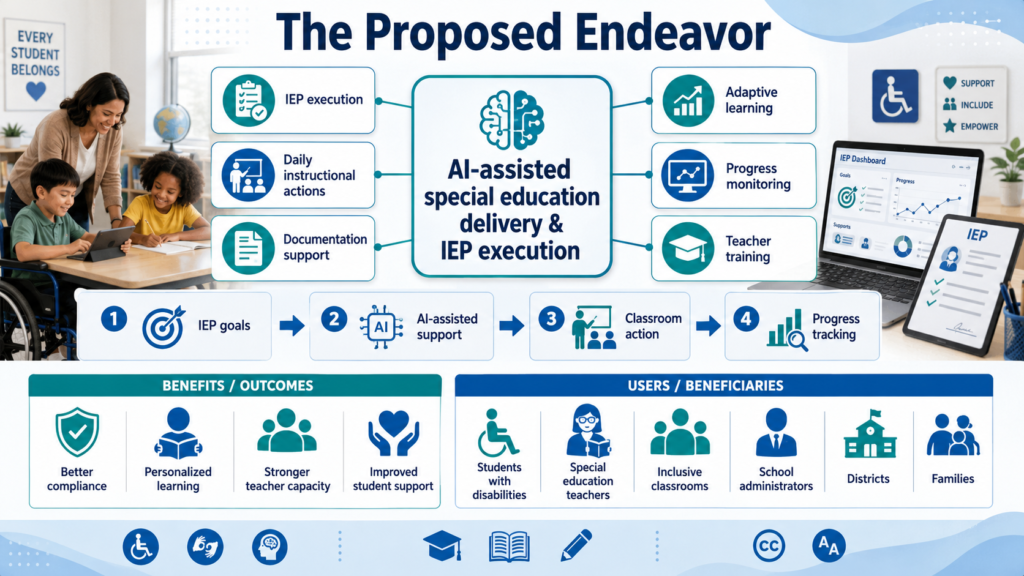
To develop, implement, and scale an AI-assisted special education delivery and IEP execution system that helps U.S. schools convert Individualized Education Program requirements into daily instructional actions, improve compliance-supported documentation, personalize adaptive learning and progress monitoring, and strengthen teacher capacity to support students with disabilities.
This endeavor was stronger than a general education-technology claim because it named the mechanism and the users. The mechanism was AI-assisted IEP execution, adaptive learning, documentation support, progress monitoring, and teacher training. The users were students with disabilities, special education teachers, general education teachers in inclusive classrooms, school administrators, districts, and families.
Why This Became a National-Interest Case, Not Only a Teaching Profile
A teaching record can be strong professionally, but an NIW petition must show broader prospective impact. The case therefore moved the petitioner’s work from an individual classroom frame to a replicable special education delivery framework.
The argument was not that one teacher helps one group of students. The argument was that her model could support a recurring national need: more consistent IEP implementation, reduced administrative burden, stronger progress monitoring, and improved educator capacity in school systems serving students with disabilities.
What Immignis and AdvanceMyProfile Built
We organized the profile around a precise special education delivery identity. The record combined U.S. classroom work, IEP case management, scholarly and professional outputs, public education activity, awards, teacher training, and AI-assisted learning concepts into one practical national-interest story.
The case emphasized current U.S. work as a Special Education Teacher, IRR Math Teacher, and IEP Case Manager; progressive experience across Georgia public schools; earlier special education and IEP-related experience in India; founder and director work connected to learning support; 31 documented scholarly, professional, and public education outputs; reported Google Scholar metrics; recognition evidence; and public-facing educational work through webinars, articles, conference presentations, and teacher guidance materials.
The profile-building strategy did not force the petitioner into an artificial technology-founder identity. It showed that her classroom experience gave the model credibility, while her research and public-facing work gave the record broader professional value.
Four Pillars of the Approved Strategy
AI-assisted IEP-to-instruction execution
This pillar addressed the gap between a written IEP and daily teaching. The proposed system would help educators break IEP goals into measurable skills, suggest lesson modifications, remind teachers of accommodations, and connect student-specific needs to practical classroom actions.
Integrated compliance and progress monitoring
This pillar connected compliance-supported documentation with student progress. The model would help educators identify missing or inconsistent records, track whether accommodations and services align with the IEP, and detect stalled progress earlier than periodic review alone may allow.
Teacher capacity building
This pillar recognized that technology cannot improve special education without trained educators. The petitioner’s workshops, teacher training, inclusive education work, and low-cost teaching materials supported a model that includes implementation guides, professional development, and teacher-facing protocols.
Privacy-conscious and human-supervised design
Because IEPs contain sensitive student information, the petition did not present AI as an autonomous decision-maker. The model was framed as a human-supervised support system that would assist teachers and IEP teams while preserving professional judgment, parent participation, and confidentiality-focused practices.
How the Evidence Supported Dhanasar
| Dhanasar prong | How the evidence supported it |
| Substantial merit and national importance | The endeavor addressed special education delivery, IEP implementation, teacher workload, AI-assisted educational systems, and improved support for students with disabilities in U.S. schools. |
| Well positioned | The petitioner’s U.S. IEP case-management roles, 10+ years of special education experience, research outputs, citation record, awards, public education work, and teacher-training background showed capacity to advance the endeavor. |
| Balancing | The petition argued that waiving the job-offer and labor-certification requirement would benefit the United States because the model was designed for broader replication across classrooms, schools, and districts, rather than one employer-specific teaching assignment. |
Filing and Approval
The final petition was organized as an evidence architecture, not a general teaching resume. The proposed endeavor explained the national special education delivery problem. The client’s U.S. classroom and IEP case-management record showed practical experience. Her research, public education work, awards, and professional outputs showed a broader record connected to the same theme.
USCIS approved the EB-2 NIW I-140. The approval confirmed that a special education professional can build a strong NIW case when the record shows a specific national need, a scalable method, and credible evidence that the petitioner is positioned to advance the work.
What the Client Gained Beyond Approval
The approval was the immigration result, but the profile-building process also gave the client a clearer professional identity. Her work could now be explained as a focused contribution to AI-assisted special education delivery and IEP implementation, not only as classroom teaching experience.
That clarity strengthened professional conversations with schools, education-technology stakeholders, disability-service organizations, and teacher-training audiences. The same evidence that supported the petition also made her expertise easier for the market to understand.
What This Case Teaches
• A classroom-based professional can build a national-interest case when the proposed endeavor is scalable and tied to a systemwide problem.
• In special education, IEP implementation is a stronger focus than general teaching excellence because it connects legal, instructional, documentation, and student-support duties.
• AI should be framed carefully in education cases. The strongest approach is human-supervised, privacy-conscious, and tied to practical educator support.
• Publications, awards, webinars, and public education outputs are most useful when they point to the same professional theme as the proposed endeavor.
• Ethical profile building documents real expertise. It does not manufacture a false profile or invent evidence the record cannot support.
If you are a special education teacher, therapist, school-based professional, education researcher, or edtech professional with a serious idea for improving disability services, IEP implementation, adaptive learning, or teacher capacity, your work may have broader national-interest value when it is organized correctly.
Ready to build your EB-2 NIW case? Explore how Immignis helps engineers and professionals win their National Interest Waiver.