EB-2 NIW structural engineer bridge monitoring: How a Bangladeshi structural engineer turned a thin first filing into a petition-grade EB-2 NIW record for structural health monitoring of aging U.S. bridges and critical infrastructure.
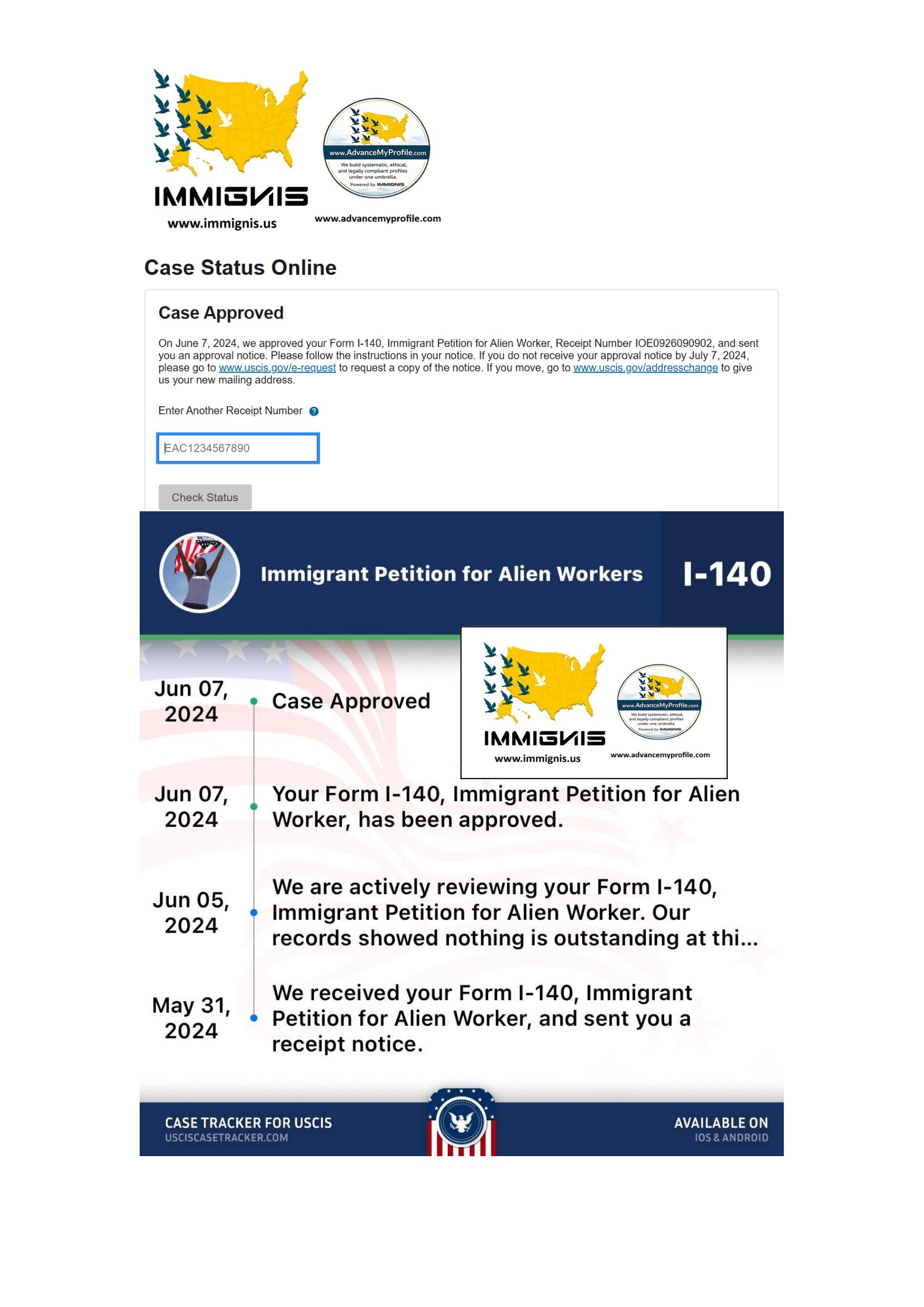
Approval result: EB-2 NIW I-140 approved on refile without a Request for Evidence after approximately 11 months of focused profile and evidence building.
| Nationality | Bangladeshi |
| Profession | Structural engineer focused on structural health monitoring for bridges and aging infrastructure |
| Starting point | Self-filed NIW denied once because the evidence was thin and the endeavor was too generic |
| Profile-building period | Approximately 11 months before the refile |
| Core endeavor | Structural health monitoring systems for aging U.S. bridges and critical infrastructure |
| Outcome | Refiled and approved without RFE |
The Success: A Denied Self-Filing Became an Approved Infrastructure NIW
The first petition accurately described his work, but USCIS still denied it. That is a common problem in National Interest Waiver filings: a professional may describe valuable work correctly while failing to prove why the proposed endeavor has national importance and why the petitioner is specifically positioned to advance it.
On the second filing, the case was rebuilt around a sharper national-interest theory: aging U.S. bridges need predictive monitoring systems that can identify structural risk before failure, emergency repair, or public-safety disruption. The record was no longer a general description of structural engineering. It became a complete evidence architecture around bridge structural health monitoring.
The refile was approved without a Request for Evidence. The approval showed the difference between describing professional experience and documenting a national-interest endeavor with the right supporting evidence.
The National Problem: Aging Bridges Need More Than Periodic Inspection
The United States has a large and aging bridge inventory. Many bridges face years of traffic loading, weather exposure, vibration, corrosion, deferred maintenance, and limited public budgets. Traditional inspection remains important, but inspection alone can leave agencies reacting after visible damage appears.
Structural health monitoring addresses that gap. Sensors, data analytics, and warning protocols can help engineers move from reactive inspection to predictive maintenance. A bridge can be instrumented, monitored, and evaluated continuously so that risk is identified before it becomes a costly emergency or a public-safety crisis.
That is why this field connected naturally to a National Interest Waiver strategy. The client’s work matched a real infrastructure problem: how to use real-time data to protect bridges, prioritize rehabilitation funding, and support the national investment already committed to infrastructure modernization.
The Weak Starting Point: Accurate Work, Thin Immigration Evidence
The denied self-filed petition was not built on false claims. The client was a serious structural engineer and researcher with approximately eleven years of experience. He had worked on monitoring systems, bridge assessment, sensor networks, and infrastructure safety. The weakness was that the petition did not show the officer how those facts satisfied Dhanasar.
The first endeavor sounded like a professional summary. It said, in effect, that he would use structural engineering expertise to improve infrastructure safety. That was true, but too broad. It did not identify the precise U.S. problem, the technical mechanism, or the independent evidence proving that his work reached beyond his immediate professional environment.
The rebuild therefore began with a simple question: what exactly does this engineer do that the United States needs? The answer became the center of the second filing.
The Corrected Proposed Endeavor| EB-2 NIW structural engineer bridge monitoring
| To develop and deploy structural health monitoring systems for aging U.S. bridges and critical infrastructure, providing real-time data on structural integrity to enable predictive maintenance, prevent catastrophic failures, and reduce the emergency-repair burden on national infrastructure investment. |
This revised endeavor worked because it named the national problem, the technical solution, and the public benefit in one coherent direction. It did not present him as a general civil engineer. It presented him as a structural health monitoring specialist whose specific systems could help protect aging bridges and critical infrastructure.
Once the endeavor was corrected, every later evidence item had a clear role. Publications, the manual, the decision tool, expert letters, media commentary, white paper outreach, and professional recognition all pointed to the same conclusion: his exact expertise was the mechanism of the national benefit.
What Immignis and AdvanceMyProfile Built
1. A focused publication record inside the exact niche
Working with domain support, we helped prepare additional first-author papers focused on structural health monitoring for bridges and aging infrastructure. The topics stayed within his real technical field: sensor placement, bridge-response data, predictive maintenance models, and decision frameworks for infrastructure risk. The objective was not to increase paper count. It was to make the record consistent, credible, and aligned with the proposed endeavor.
2. A practitioner’s manual that showed professional authority
The client’s value was not limited to academic modeling. He understood how bridge monitoring systems are specified, installed, interpreted, and explained to owners and decision makers. We helped turn that knowledge into a practitioner’s manual for engineers and infrastructure teams. This created a different type of evidence: not only research output, but professional guidance that others could learn from and use.
3. A copyrighted decision tool documenting original contribution
The client had developed a software-based framework to help engineers choose monitoring strategies for different bridge types and risk conditions. Because this was an analytical framework and software resource, copyright registration was the correct evidence route. We did not present it as a patent. We used it accurately as a dated, verifiable record of an original decision-support tool tied directly to the endeavor.
4. A white paper and targeted infrastructure outreach
Because bridge monitoring sits at the intersection of engineering practice, public safety, and infrastructure policy, a white paper was appropriate. We prepared a focused paper on how real-time bridge monitoring can reduce emergency repairs, improve rehabilitation prioritization, and support safer management of aging infrastructure. It was shared with relevant engineering groups, transportation research networks, asset-management stakeholders, and public-sector-facing forums.
5. Independent letters that answered the prior denial
The first filing lacked enough independent evidence. For the refile, we sourced arms-length letters from infrastructure engineers and researchers who could explain the national value of his specific methods. The strongest letters did not praise him generally. They explained why predictive monitoring, sensor-based structural data, and decision tools matter for U.S. bridge safety and infrastructure investment.
6. Expert commentary, conference activity, and selective membership
We supported expert-commentary placements in infrastructure and construction-technology outlets, with topics focused on predictive maintenance, bridge-sensor adoption, and the gap between periodic inspection and real-time monitoring. We also built conference and selective professional-membership evidence so the record showed peer-facing visibility, not only self-description.
How the Profile-Building Work Supported Dhanasar
| Dhanasar issue | Evidence built | Why it mattered |
| Substantial merit and national importance | Corrected SHM endeavor, infrastructure white paper, public-safety framing | Showed the work addressed aging bridges, predictive maintenance, and national infrastructure investment. |
| Well-positioned to advance the endeavor | Focused publications, practitioner manual, copyrighted decision tool, letters, conference activity | Showed he had already created knowledge, tools, and guidance directly tied to the proposed work. |
| Waiver of job offer and labor certification | Evidence architecture showing reusable methods and broader infrastructure relevance | Showed the value was not limited to one employer or one private project. |
The Refile and Approval
The second filing was not a polished copy of the first. It was a rebuilt record. The cover letter identified why the first filing had failed and then walked the officer through the new evidence: the corrected endeavor, focused publications, practitioner’s manual, copyrighted decision tool, stakeholder-facing white paper, independent letters, expert commentary, conference activity, and professional recognition.
USCIS approved the refiled EB-2 NIW I-140 without a Request for Evidence. Because the petitioner was outside the United States, the next stage was consular processing after I-140 approval. The story is therefore honest about timing: the I-140 approval was a major success, while the immigrant-visa process would still continue through the appropriate post-approval steps.
What the Client Gained Beyond Approval
The profile-building work also changed how his expertise could be presented professionally. His practitioner’s manual and decision tool gave him credibility beyond a traditional resume. His public-facing profile made it easier for infrastructure consulting firms, transportation-engineering teams, and bridge-monitoring stakeholders to understand his specialty.
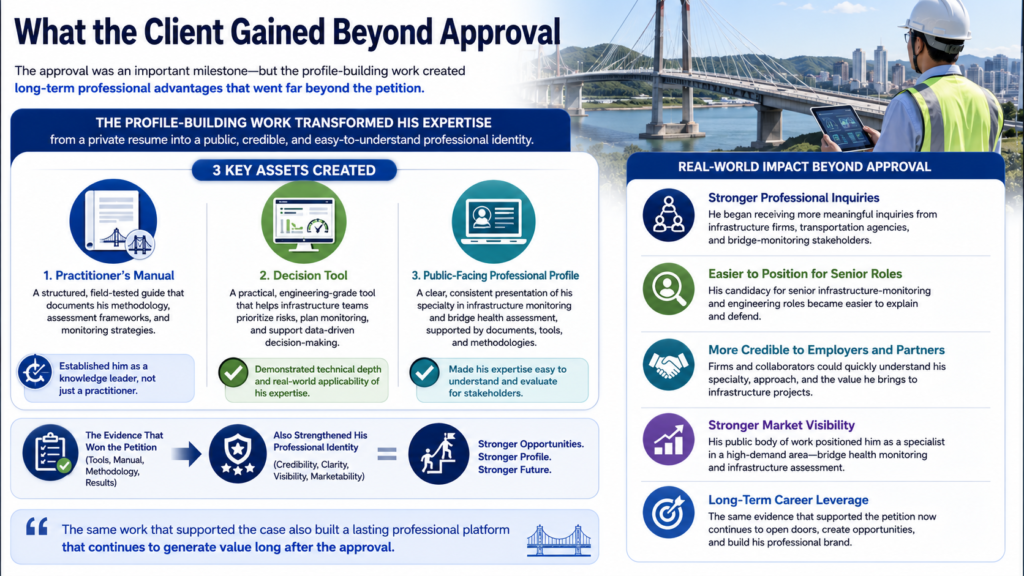
He began receiving stronger professional inquiries from infrastructure and transportation-engineering circles. His candidacy for senior infrastructure-monitoring roles became easier to explain because his expertise now existed in public, documentable form. The same evidence that supported the petition also strengthened his professional identity.
Lessons for Engineers Considering EB-2 NIW
- An accurate description of work is not the same as proof of national importance.
- A denied petition should be rebuilt, not merely rewritten.
- For practicing engineers, a manual can be powerful when it teaches real field knowledge.
- A copyrighted decision tool can document original contribution when a patent is not the right form of evidence.
- White papers help only when shared with relevant professional and public-sector-facing audiences.
- Independent expert letters should explain the connection between the technical work and the national benefit.
Your NIW was denied because the evidence was thin, not because your work lacks national value. See how Immignis rebuilds denied petitions into approved ones.