EB-2 NIW supply chain data scientist: A denied NIW was rebuilt around pharmaceutical and semiconductor supply-chain resilience, AI-driven disruption prediction, and U.S. public-health and technology-security needs.
| Case Snapshot | Details |
| Nationality / Location | Indonesian national working in Singapore |
| Profession | Senior data scientist in AI-driven predictive analytics for pharmaceutical and semiconductor supply chains |
| Starting point | One prior denial because the first petition framed the work as client optimization and did not establish national importance |
| Engagement | Approx. 10 months of profile rebuilding and refile preparation |
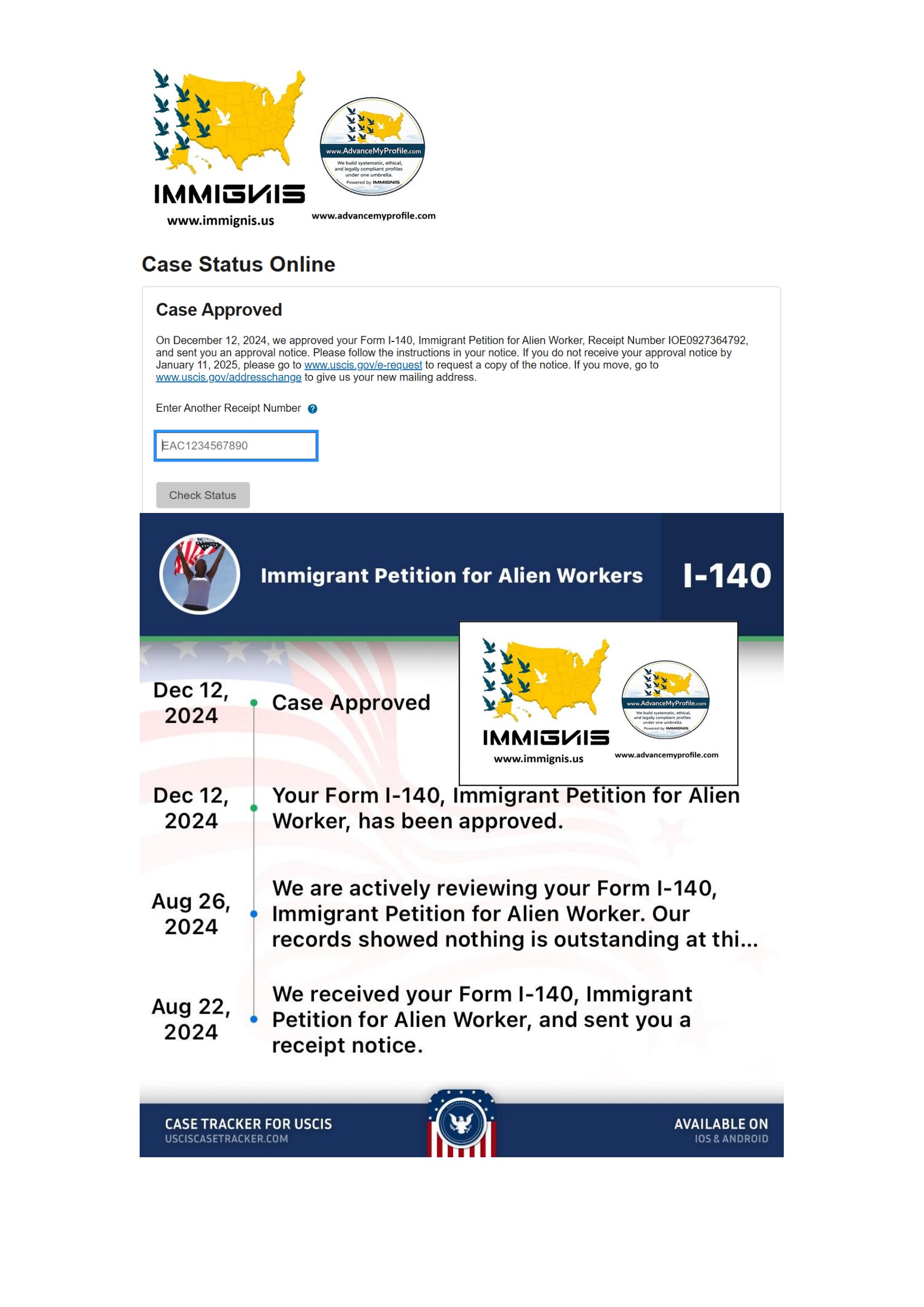
| Outcome | Refiled and approved without a Request for Evidence |
| Core strategy | Reframe the endeavor from private supply-chain efficiency to national public-health, semiconductor, economic-security, and defense-capability resilience |
The approval result | EB-2 NIW supply chain data scientist
This case ended with an EB-2 NIW approval after a denied first filing. The petitioner did not become a different professional between the first filing and the refile. The difference was that the second record finally showed the national value of the work he had already been doing.
The first petition described predictive supply-chain analytics as a tool for clients to reduce costs, improve planning, and manage logistics risk. Those points were true, but they sounded commercial. The rebuilt filing showed that the same AI-driven methods could help identify national vulnerabilities in pharmaceutical and semiconductor supply chains before disruption affected hospitals, technology manufacturers, defense-related systems, and the broader U.S. economy.
The national problem
The case was rebuilt around two sectors where supply-chain disruption has consequences beyond one company: pharmaceuticals and semiconductors. Drug shortages can affect public-health continuity, hospitals, patients, emergency preparedness, and access to critical medicines. Semiconductor disruptions affect advanced manufacturing, transportation, communications, defense systems, and the technology economy.
This distinction changed the case. USCIS did not need another explanation that efficient logistics are useful. The record had to show why this petitioner’s specific predictive analytics capability could support U.S. public-health security, economic security, and technology resilience.
The client’s weak starting point
The petitioner was a senior data scientist working in Singapore. His machine-learning systems identified early warning signals across complex supplier networks: supplier concentration, shipping-lane stress, lead-time anomalies, material-category risk, and disruption probability for critical inputs.
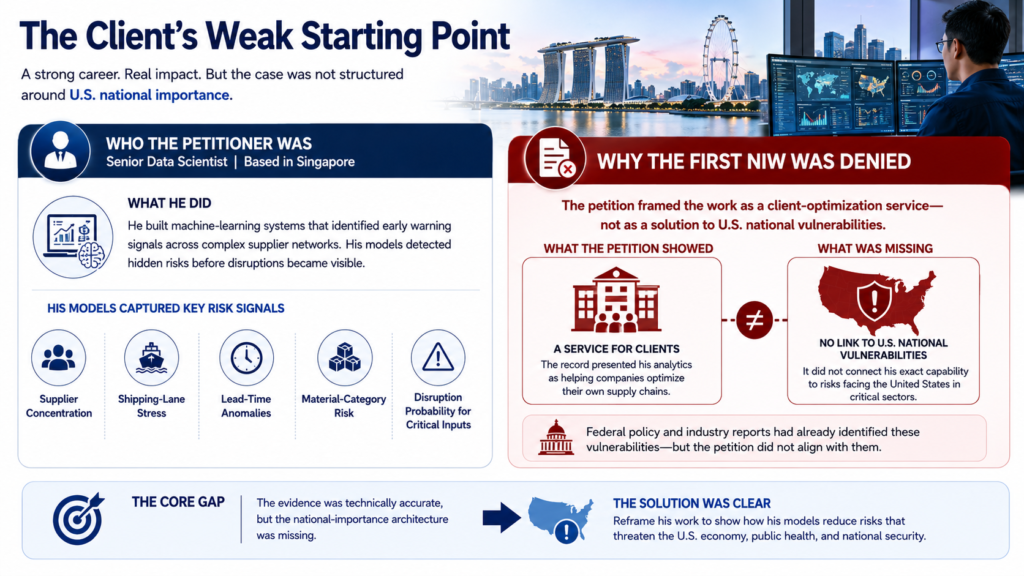
His first NIW was denied because the petition treated that work as a client-optimization service. It did not connect his exact analytics capability to U.S. national vulnerabilities in sectors that federal policy and industry experience had already identified as sensitive. The record was technically accurate, but the national-importance architecture was missing.
The proposed endeavor
To develop and deploy AI-driven predictive analytics systems for pharmaceutical and semiconductor supply chain resilience – enabling U.S. companies and policymakers to anticipate disruptions, identify concentration risks, and strengthen the domestic supply chains that underpin national public health security and economic and defence capability.
This endeavor kept the work specific. It did not claim that every supply-chain dashboard is nationally important. It focused on AI-driven disruption prediction in pharmaceutical and semiconductor supply chains, where failure can affect public health, economic stability, and defense capability.
What AdvanceMyProfile and Immignis built
1. A corrected national-interest frame
The refile separated business usefulness from national importance. Cost reduction and planning efficiency remained part of the background, but they no longer carried the case. The central argument became predictive resilience capacity for sectors where disruption affects the United States at a national level.
2. Focused publications in the correct niche
The publication record was strengthened through papers in operations research, supply-chain management, and applied data science. The topics stayed close to the endeavor: predictive disruption risk, multi-tier supplier mapping, concentration-risk scoring, and resilience modeling for pharmaceutical inputs and semiconductor components.
3. Public identity aligned with the endeavor
His digital profile was reorganized around AI-driven supply-chain resilience, not general analytics consulting. The professional website, LinkedIn profile, and research profile all presented the same specialty, so the public record matched the proposed endeavor.
4. Patent and trademark evidence for applied data science
A patent application documented an original predictive algorithm combining multi-tier supplier mapping with real-time market and logistics signals to estimate disruption probability for critical inputs. Trademark evidence supported the branded analytics platform and showed movement from concept to deployable product.
5. White paper and stakeholder outreach
A policy-facing white paper explained concentration-risk detection, early-warning indicators, and how analytics could reduce exposure before disruption escalated. It was shared with supply-chain and operations-research networks, logistics-resilience forums, semiconductor stakeholders, pharmaceutical supply-chain professionals, and policy-facing research groups.
6. Expert visibility, senior membership, and independent letters
Expert commentary focused on drug shortages, supplier concentration, semiconductor sourcing risk, and the limits of traditional enterprise planning tools. Senior membership in a recognized operations and supply-chain professional body added selective recognition. Independent letters came from a supply-chain resilience professor, a pharmaceutical supply-chain executive, and a technology-policy researcher who addressed the semiconductor and pharmaceutical national-interest frame directly.
How the evidence supported Dhanasar
| Dhanasar point | Evidence strategy |
| Substantial merit and national importance | The endeavor was tied to pharmaceutical continuity, semiconductor resilience, economic security, public-health security, and defense capability. |
| Well positioned | Focused publications, IP evidence, branded platform evidence, white paper outreach, expert commentary, senior membership, and independent letters showed that he could advance the work. |
| On balance | The filing showed why requiring a traditional employer-sponsored labor certification would not fit a cross-sector resilience endeavor involving public and private supply-chain vulnerabilities. |
The refile and approval
The refile was assembled as a new case, not as a longer version of the denied petition. The cover letter acknowledged the prior denial, identified the deficiency, and showed how the new evidence addressed it. Every exhibit pointed to one conclusion: this was not client optimization. It was predictive resilience capacity for sectors the United States had already identified as nationally important.
After USCIS processing, the refiled petition was approved without a Request for Evidence. Because the petitioner was outside the United States, the case then moved toward consular processing, with timing subject to the National Visa Center and later immigrant-visa steps.
What changed beyond the approval
After approval, the petitioner entered the consular-processing stage in Singapore while continuing his work. The approved I-140 gave him a stronger immigration foundation and a clearer professional platform. He began discussions with a U.S. supply-chain analytics company whose pharmaceutical and semiconductor work overlapped with his methodology.
His branded platform gained stronger visibility among resilience-focused organizations, and his role expanded from senior data scientist toward technical leadership in sector-specific supply-chain risk strategy. The professional shift came from the same change that won the case: his work was no longer presented as private optimization. It was presented as a way to identify vulnerabilities in supply chains that support public health, advanced technology, and defense capability.
Lessons for professionals
- Supply-chain expertise becomes nationally important when it addresses documented national vulnerabilities, not only private efficiency.
- The same work can fail or win depending on framing. The first petition described business value; the refile showed national-security and public-health value.
- Federal policy context can make the national-interest argument concrete when the proposed endeavor fits the policy concern.
- Patent and trademark evidence can support applied data-science profiles when the IP is genuine, relevant, and tied to the work described in the endeavor.
- White papers help only when they are directed to relevant professional, industry, standards, research, or policy-facing audiences.
- A refile should answer the reason for the prior denial, not simply repeat the same record with more pages.
If you work in supply-chain analytics, logistics technology, semiconductor resilience, pharmaceutical operations, or another data-intensive field, the question is not only whether your work is useful. The stronger question is whether your specific expertise addresses a documented national vulnerability and whether the record can prove that connection.
Your supply chain work may already address a U.S. national vulnerability, it just needs the right framing. See how Immignis rebuilds denied NIW petitions into approved national-interest cases.