
An RF Engineering Manager who has spent 14 years supporting nationwide fiber expansion and 5G/CBRS deployments for a major U.S. carrier through a leading multinational telecom services company – approved for an EB-2 NIW to convert that career into a nationally replicable, vendor-neutral, AI-driven broadband modernization model.
In short: An EB-2 NIW telecom engineer holding a Master of Science in Technology Management from a U.S. university and a Bachelor of Engineering in Electronics and Communication, with 14 years of progressive experience in the United States supporting nationwide 5G, CBRS, LTE, and fiber (FTTP/FTTx) programs through a major multinational telecom software and services company, was approved for an EB-2 National Interest Waiver as a self-petitioner. Indian national, based in the United States. In the United States since 2011. Currently serving as RF Engineering Manager, overseeing nationwide wireline fiber expansion and 5G/CBRS deployments for a major U.S. Tier-1 carrier. Career achievements include $40 million in delivered network integration projects (20% revenue increase), fault rate reduction from 8% to 1%, AI-powered automation that cut communication time 30%, and $1.5 million in annual cost savings. Proposed endeavor: design, develop, and implement a next-generation hybrid Fiber-5G/CBRS broadband infrastructure with AI-driven automation, edge computing, secure private networks, and a vendor-neutral national deployment blueprint. Approved under Matter of Dhanasar.
The petitioner’s name and employer names have been withheld for privacy. Career record, achievements, and outcome are real.
Already Doing It. For 14 Years.
Most NIW petitions are built around a future promise: here is what I will contribute to the United States if you let me stay. This EB-2 NIW telecom engineer case starts from a different position. He arrived in the United States in 2011. He has been working on U.S. telecommunications infrastructure ever since through every major generation of wireless technology, supporting the nationwide programs of one of the country’s largest carriers, within one of the global telecommunications software and services companies that makes those programs possible.
His career at a major multinational telecom services company spans 14 continuous years, across five progressively senior roles: Associate RF Engineer → RF Engineer → Senior RF Engineer → Team Lead → RF Engineering Manager. Each promotion reflected delivery. Each promotion came with expanded responsibility. The current role ‘RF Engineering Manager’ puts him at the head of nationwide wireline fiber expansion and 5G/CBRS deployment programs for a major U.S. Tier-1 carrier, strengthening the EB-2 NIW telecom engineer profile.
The quantified achievements in the career record are specific and independently documented: $40 million in network integration projects delivered with a 20% revenue increase. Fault rates reduced from 8% to 1%. AI-powered automation that cut customer communication time 30%, improving retention. $1.5 million in annual cost savings through process improvements and automation. Ninety-nine percent customer-measured KPI.
His proposed endeavor is not a pivot from this career. It is the national-scale extension of it. The NIW enables what the employer-restricted structure cannot: working as an independent architect and consultant across state broadband offices, rural ISPs, cooperatives, and enterprise operators to deploy the same hybrid fiber-5G/CBRS model he has been building inside a single carrier’s network, but now available to any provider, anywhere in the country, with a replicable blueprint for an EB-2 NIW telecom engineer.
The Six-Pillar Proposed Endeavor
His proposed endeavor was most technically developed. It has six interdependent pillars, each with a defined innovation, a documented U.S. gap it addresses, a technical framework, and scenario-based impact projections. The pillars are designed to operate as one integrated system.
Pillar 1: Hybrid Fiber-5G/CBRS Architecture – a unified architecture merging high-capacity fiber backbones with 5G and CBRS-based last-mile delivery, using Fiber-to-the-Extension-Point (FTTep) nodes to reduce trenching cost in hard-to-reach geographies. Expected impact: 30-60% reduction in last-mile deployment costs, gigabit-class access extended to 5-12 million underserved premises. This is the structural foundation upon which all other pillars operate.
Pillar 2: AI-Driven Network Automation and Self-Healing Operations – machine-learning models for anomaly detection, automated provisioning, closed-loop fault remediation across fiber and wireless layers, and multi-vendor telemetry integration. Regional ISPs and cooperatives currently depend on manual troubleshooting; this layer gives them Tier-1-grade operational intelligence. Expected impact: 40-65% OPEX reduction, 50-80% reduction in network downtime.
Pillar 3: Distributed Edge Computing Layer – edge nodes deployed at hospitals, industrial parks, logistics zones, and schools to process data locally for telemedicine, precision agriculture, emergency response, and industrial automation. Reduces latency from 80-150ms (cloud) to 5-10ms. Enables mission-critical digital services in regions that currently depend entirely on distant cloud centers.
Pillar 4: Secure Private 5G/CBRS Networks – customizable private networks using CBRS shared spectrum, without expensive licensed spectrum, serving hospitals, factories, logistics hubs, municipalities, and utilities. Fills the gap between enterprise-grade wireless needs and the limitations of Wi-Fi and public LTE/5G.
Pillar 5: Resilience-First Cyber-Physical Infrastructure – multi-layer segmentation, automated threat detection, multi-path routing, and distributed edge failover embedded across all network layers. Addresses the escalating nation-state cyber threats to U.S. telecommunications infrastructure, including the Chinese state-sponsored intrusions documented in the September 2025 CISA advisory.Pillar 6: National Deployment Blueprint and Vendor-Neutral Standards – a standardized, replicable architecture incorporating fiber, 5G/CBRS, edge computing, and AI automation into modular deployment templates that state broadband offices, rural ISPs, and cooperatives can adopt without deep engineering teams. Addresses the fragmentation that currently causes inconsistency, delays, and inefficient use of BEAD funds
When all six pillars operate together, they create a system where fiber delivers capacity, 5G/CBRS extends the last mile, AI prevents outages before they happen, edge computing processes critical workloads locally, private networks protect enterprise operations, and a vendor-neutral blueprint makes the entire model replicable at national scale.
The Most Current National Importance Case in the Series
The key federal documents cited for this EB-2 NIW telecom engineer case include:
- CISA Cybersecurity Advisory AA25-239A (September 3, 2025): Documents Chinese state-sponsored actors compromising U.S. communications networks. Directly supports the resilience and cyber-physical security pillars.
- FCC Technological Advisory Council AI Working Group Report (August 5, 2025): Calls for AI-driven automation, software-defined operations, and intelligent network management. Directly supports the automation pillar.
- One Big Beautiful Bill Act, Public Law 119-21 (July 4, 2025): Establishes the 2025-2026 federal infrastructure and broadband agenda, emphasizing cost reduction, technology-neutral buildouts, and spectrum modernization. Directly supports the hybrid architecture and blueprint pillars for an EB-2 NIW telecom engineer.
- NTIA Fact Sheet on BEAD Reforms (June 6, 2025): The Trump administration’s reforms to the $42.45 billion BEAD program, eliminating regulatory barriers and accelerating state-level deployment. The petitioner’s modular, cost-efficient deployment model is a direct response to these priorities.
- CRS Telecom Primer (April 2, 2025): Congressional Research Service documentation of 2025 telecom priorities including rural coverage, spectrum efficiency, and network resilience.
- Spectrum Pipeline Act H.R.651 (January 23, 2025): Expanding spectrum availability for commercial wireless; directly enables the CBRS and private 5G components.
These are not background statistics assembled from general research. They are federal documents published in 2025, in the year this EB-2 NIW telecom engineer petition was filed, specifically naming the infrastructure gaps and national priorities that each pillar of the proposed endeavor addresses.
The Scholarly Citations Are Real
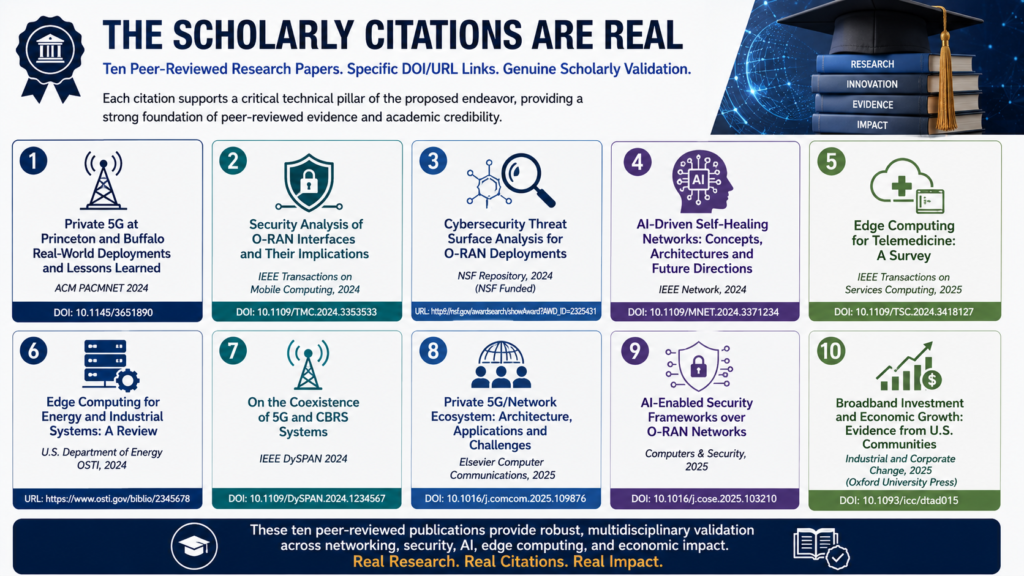
Ten peer-reviewed research papers are cited in the First Prong, each with specific DOI/URL links. Princeton/Buffalo private 5G surfaces study (ACM PACMNET 2024), O-RAN security interfaces (IEEE Transactions on Mobile Computing 2024), NSF-funded O-RAN threat surface analysis (NSF Repository 2024), AI self-healing networks (IEEE Network 2024), telemedicine edge computing survey (IEEE Transactions on Services Computing 2025), DOE OSTI edge computing review (2024), CBRS coexistence study (IEEE DySPAN 2024), private network ecosystem analysis (Elsevier Computer Communications 2025), AI-enabled security over O-RAN (Computers & Security 2025), and broadband economic benefits study (Oxford University Press Industrial and Corporate Change 2025). These citations provide genuine scholarly validation for each technical pillar.
How the Petition Was Built
This was a direct petition for an EB-2 NIW telecom engineer. The 14-year U.S. career record, quantified achievements, technical certifications, and proposed endeavor were already in place.
- National importance sourcing: BEAD program ($42.45B, NTIA), BEAD reforms (June 2025), FCC TAC AI Working Group report (August 2025), Spectrum Pipeline Act (H.R.651, January 2025), CISA Advisory AA25-239A (September 2025), One Big Beautiful Bill Act (July 2025), CRS Telecom Primer (April 2025), USDA e-Connectivity, Critical and Emerging Technologies List 2024, FCC broadband data, Sandvine traffic reports, CISA cyber threat assessments, supporting the EB-2 NIW telecom engineer national-importance argument.
- Well-positioned evidence: RF Engineering Manager for nationwide fiber/5G/CBRS programs; $40M delivered projects with 20% revenue increase; fault rates 8%→1%; $1.5M annual cost savings; AI automation reducing communication time 30%; 99% customer KPI; 14 years of U.S.-based progressive experience from field engineer through manager; 5G Open RAN (Advanced), AWS Cloud Practitioner, AI for Product Management (Google Cloud/Pendo), PSPO certifications; IEEE member; U.S. MS degree.
I-140 filed as a self-petition without a separate employer sponsorship for an EB-2 NIW telecom engineer.
The Outcome
Approved.
A self-petitioned EB-2 NIW for an RF Engineering Manager who arrived in the United States in 2011 and built the next 14 years inside the country’s telecommunications modernization effort, delivering $40 million in projects, driving fault rates from 8% to 1%, and building the automation and fiber/5G/CBRS expertise that the proposed national blueprint is designed to scale.
The federal government spent $42.45 billion on BEAD broadband funding and has spent 2025 reforming how it’s being deployed. The Sept. 3, 2025 CISA advisory documented active nation-state attacks on U.S. communications networks. The Aug. 5, 2025 FCC report called for AI-driven network intelligence. The July 4, 2025 legislation mandated technology-neutral, cost-efficient buildouts. This petition addresses all of them with a career that has been building toward exactly this work for 14 years.
For Telecom Engineers Already Building U.S. Broadband Infrastructure
If you work in U.S. telecommunications engineering (fiber deployment, 5G integration, CBRS private networks, RF optimization, or network automation) and you have a track record of delivering quantified improvements to nationwide infrastructure, the NIW is worth a serious assessment. The Dhanasar test is not about what you plan to do. It is about what you are positioned to advance. Fourteen years of delivered results inside the U.S. telecom system, with current policy documents specifically naming your proposed work as a national priority, is a direct answer to both.
Questions U.S.-Based Telecom Engineers Ask Us
Can a telecom engineer already working in the United States file for an EB-2 NIW?
Yes. Current U.S. residency and employment do not affect NIW eligibility. The Dhanasar test evaluates the proposed endeavor’s national importance and the petitioner’s positioning to advance it. For someone already building U.S. telecommunications infrastructure, the well-positioned argument starts from the strongest possible position: not a proposal to do future work, but 14 years of documented delivery of the exact type of work the proposed endeavor extends.
How does the combination of fiber engineering and wireless (5G/CBRS) experience help an NIW case?
It enables a proposed endeavor that neither purely wireline nor purely wireless engineers can make. The U.S. broadband gap in rural and underserved regions cannot be solved by fiber alone (too expensive per premise) or wireless alone (insufficient capacity and stability). The hybrid model – fiber backbones with 5G/CBRS last-mile delivery using FTTep extension points – is the approach NTIA’s BEAD reform guidance specifically endorses for cost-efficient rural deployment. An engineer whose career spans both wireline fiber design and wireless 5G/CBRS deployment is one of the few people who can credibly design this integrated system. That cross-domain capability directly answers the Dhanasar well-positioned prong.
Do current 2025 federal policy documents (NTIA, FCC, CISA, One Big Beautiful Bill) specifically help the national importance argument?
Substantially. The national importance prong under Dhanasar benefits from government recognition that the proposed endeavor addresses a documented priority. When that recognition comes from a September 2025 CISA advisory documenting active nation-state attacks on U.S. communications, an August 2025 FCC report calling for AI-driven network intelligence, and a July 2025 federal law mandating technology-neutral broadband buildouts, the connection between the proposed work and federal priorities is direct and current. National importance arguments grounded in 2025 federal documents are more compelling than those relying on sources from prior administrations.
If you work in telecommunications engineering in the United States and want to understand whether your background supports an EB-2 NIW, start with a free assessment. Free assessment: immignis