EB-2 NIW telecommunications engineer: A British telecommunications engineer converted international DAS, RF design, airport, rail, smart-city, and public-safety network experience into an approved EB-2 NIW petition focused on rural connectivity, resilient communications, and next-generation U.S. wireless infrastructure.
Case Snapshot
| Client profile | British telecommunications engineer, senior design engineer, project manager, and founder/director of a Telecom Consultancy Ltd. |
| Field | Advanced wireless communications, Distributed Antenna Systems (DAS), RF design, 5G/IoT infrastructure, public-safety networks, and smart-city connectivity. |
| Professional foundation | Advanced degree in information and communication engineering; 14+ years of telecom experience; leadership of an 11-person telecom consultancy team; major UK and international infrastructure projects. |
| Proposed endeavor | Develop and deploy wireless communication solutions that support public safety, smart-city initiatives, rural broadband, next-generation telecommunications infrastructure, and U.S. technological competitiveness. |
| Profile-building focus | U.S. national-interest framing around rural connectivity, resilient emergency communications, critical infrastructure security, spectrum modernization, smart-city deployment, and 5G/6G readiness. |
| Outcome | EB-2 NIW I-140 approved. |
The Approval Result |EB-2 NIW telecommunications engineer
This case ended with EB-2 National Interest Waiver approval for a British telecommunications engineer whose international project record was strongest when it was organized around one U.S. infrastructure problem: the need for secure, resilient, high-capacity wireless systems that support public safety, rural connectivity, smart cities, transportation hubs, healthcare facilities, and next-generation digital infrastructure.
The client did not need to be presented as a general telecom consultant. His strongest case came from the way his work connected design, testing, commissioning, RF optimization, DAS deployment, small-cell systems, and complex-site delivery into a practical national-interest model for U.S. wireless infrastructure readiness.
The approval showed that a field-implementation professional can build a strong NIW record when the proposed endeavor is specific, the evidence is organized, and the national infrastructure need is clear.
The National Problem: Connectivity Is Now Critical Infrastructure
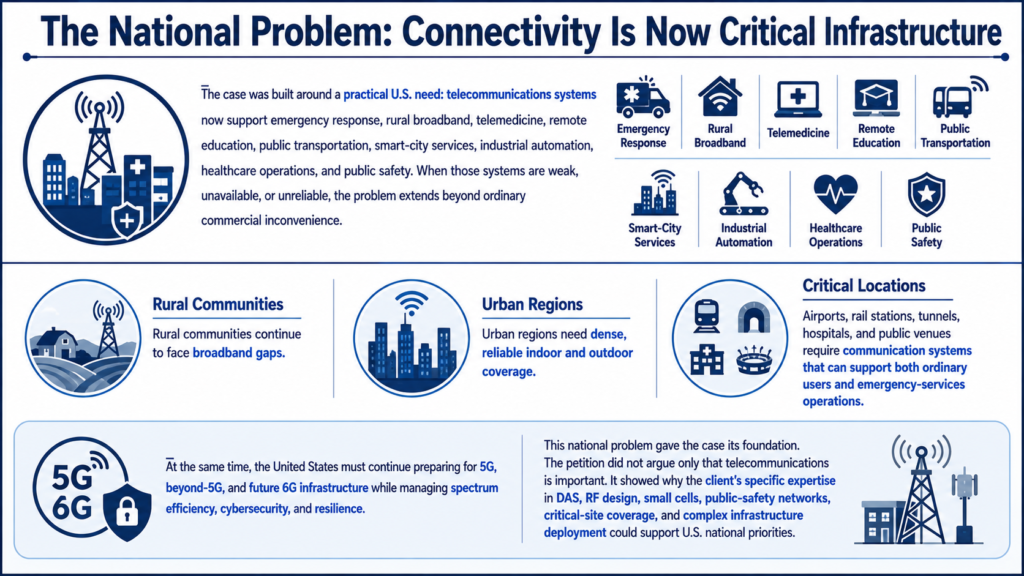
The case was built around a practical U.S. need: telecommunications systems now support emergency response, rural broadband, telemedicine, remote education, public transportation, smart-city services, industrial automation, healthcare operations, and public safety. When those systems are weak, unavailable, or unreliable, the problem extends beyond ordinary commercial inconvenience.
Rural communities continue to face broadband gaps. Urban regions need dense, reliable indoor and outdoor coverage. Airports, rail stations, tunnels, hospitals, and public venues require communication systems that can support both ordinary users and emergency-services operations. At the same time, the United States must continue preparing for 5G, beyond-5G, and future 6G infrastructure while managing spectrum efficiency, cybersecurity, and resilience.
This national problem gave the case its foundation. The petition did not argue only that telecommunications is important. It showed why the client’s specific expertise in DAS, RF design, small cells, public-safety networks, critical-site coverage, and complex infrastructure deployment could support U.S. national priorities.
The Proposed Endeavor
The proposed endeavor was framed as the development and deployment of advanced wireless communication solutions that advance public safety, smart-city initiatives, rural connectivity, and next-generation telecommunications infrastructure in the United States.
The endeavor included RF design, Distributed Antenna Systems, small-cell networks, 5G and beyond-5G infrastructure, IoT-enabled systems, disaster-resilient networks, hybrid terrestrial-satellite connectivity, energy-efficient telecommunications, and secure spectrum-aware network planning.
This wording was important because it converted a broad telecom background into a focused U.S. infrastructure contribution. It identified the technical mechanisms, the deployment environments, and the public-interest value of the work.
What Immignis and AdvanceMyProfile Built
We organized the profile around a national-interest narrative connecting the client’s telecommunications work to U.S. broadband expansion, public-safety communications, smart cities, spectrum policy, cybersecurity, and next-generation infrastructure.
We structured the technical model around DAS, small cells, RF optimization, hybrid terrestrial-satellite networks, IoT systems, digital twins, blockchain-enabled spectrum allocation, and energy-efficient telecom infrastructure, while keeping the story understandable for an immigration officer.
We positioned the client as a field implementation specialist, not only as a theoretical telecommunications researcher. This distinction mattered because his value came from turning complex communication requirements into functioning networks in difficult environments.
We connected his business and leadership record to a U.S. deployment plan, showing how 3A Telecom Consultancy Ltd could be adapted to the U.S. market through neutral hosts, system integrators, telecom operators, transportation networks, and critical-infrastructure clients.
We arranged the evidence under the Dhanasar framework so that each item supported substantial merit, national importance, well-positioned capacity, and the benefit of independent deployment activity in the United States.
Core Implementation Areas
- Public-safety networks: Strengthen first-responder communications through reliable RF design, DAS, hybrid systems, and low-latency connectivity.
- Rural connectivity: Use hybrid terrestrial 5G and Low Earth Orbit satellite architectures to expand broadband access in underserved regions.
- Smart-city infrastructure: Support traffic management, public services, urban safety, environmental monitoring, and connected IoT systems.
- Next-generation wireless systems: Prepare infrastructure for 5G, beyond-5G, 6G, terahertz backhaul, reconfigurable intelligent surfaces, and secure communications.
- Critical infrastructure resilience: Design systems that maintain communication continuity in transport hubs, tunnels, hospitals, public venues, airports, and emergency environments.
How the Evidence Supported Dhanasar
| Dhanasar element | Evidence used | Strategic value |
| Substantial merit and national importance | Rural broadband expansion, public-safety communications, smart cities, 5G/6G leadership, critical infrastructure resilience, spectrum modernization, and secure next-generation networks. | Moved the case from ordinary telecom service delivery to a national infrastructure and public-safety problem. |
| Well positioned to advance the endeavor | Advanced degree, 14+ years of experience, IEEE membership, leadership of 3A Telecom Consultancy Ltd, 200+ microcell designs, 120+ small-cell designs, DAS, RF design, coverage testing, commissioning, CAD drawings, and project management. | Showed that the client had already executed the kind of complex wireless infrastructure work required by the endeavor. |
| Benefit of waiving job offer and labor certification | Independent consulting model, neutral-host partnerships, system-integrator work, public-safety environments, transport infrastructure, smart-city projects, rural broadband, healthcare, and industrial settings. | Explained why the work should not be confined to one employer-specific role and why flexible cross-sector deployment would serve the United States. |
Selected Project Evidence Converted Into a Success-Story Narrative
| Project evidence | NIW relevance |
| London Underground Public Cellular Network | Prepared iBwave designs and MNO design packs for cellular coverage in one of the most challenging underground public-transport environments. |
| London Heathrow Terminal 2 Eastern Campus | Designed cellular, PMR, and emergency-services networks, showing ability to integrate multiple communication layers in a high-security, high-traffic airport setting. |
| Emergency services and airport networks | Led or supported emergency-services network designs across airports and transport hubs, reinforcing the public-safety foundation of the proposed U.S. work. |
| London Bridge Rail Station and Birmingham tunnel networks | Designed critical communication systems for rail and tunnel infrastructure, directly relevant to U.S. transportation and urban-resilience projects. |
| Smart Metering Project for the UK Department of Energy and Climate Change | Contributed to energy-efficiency infrastructure, supporting the sustainability and energy-management dimension of the proposed endeavor. |
| Nationwide 2G/3G/4G benchmarking | Conducted network performance benchmarking for regulatory and operator environments, supporting the case theory around spectrum quality, standards, and infrastructure performance. |
| Bloomberg HQ and high-density venues | Delivered indoor and urban connectivity solutions in demanding environments, relevant to U.S. hospitals, corporate campuses, stadiums, public venues, and smart-city settings. |
What Changed Through Profile Building
The story became stronger because the evidence was no longer presented as a list of telecom jobs. It became a coherent national-interest record. The client was positioned as a specialist capable of designing, testing, commissioning, and scaling communication systems in environments where reliability, safety, spectrum efficiency, interoperability, and public impact matter.
This made the proposed U.S. endeavor credible, specific, and connected to national priorities. The profile showed both technical depth and practical execution: the ability to turn wireless-infrastructure requirements into working systems in complex real-world environments.
What the Client Gained Beyond Approval
The approval was the immigration result, but the profile-building process also gave the client a stronger professional identity. His record could now be explained as a U.S.-relevant telecommunications infrastructure profile rather than a collection of international consulting projects.
That clearer identity supports future conversations with neutral-host providers, telecom operators, public-safety stakeholders, transportation authorities, healthcare facilities, smart-city programs, rural broadband initiatives, and critical-infrastructure clients.
What This Case Teaches
- Field implementation professionals can have strong NIW profiles when their work is translated into national outcomes.
- A telecom engineer who designs DAS, RF systems, small cells, airport networks, tunnel communications, public-safety systems, and smart-city connectivity should not be presented only as a technical employee.
- The strongest profile shows how the same expertise can solve U.S. infrastructure problems at scale.
Ethical profile building documents real expertise. It does not manufacture a false record. It identifies credible experience, organizes it around a specific proposed endeavor, and explains how the professional can support future U.S. impact.
For telecommunications engineers, RF specialists, DAS designers, smart-city professionals, and critical-infrastructure technologists, EB-2 NIW success depends on more than years of experience. The petition must show why the work matters nationally, how the professional is positioned to advance it, and why independent execution would benefit the United States.
Start with a free, honest assessment. If the record is not ready, the right strategy is to build the missing evidence before filing. Immignis.us