
EB-2 NIW wireless communications researcher: A PhD electrical engineer and Associate Professor whose MS thesis supervisor is a globally top-cited wireless communications researcher, and whose work in intelligent reflecting surfaces and 6G technologies is supported by the IEEE Fellow who literally wrote the foundational research in that field - approved for an EB-2 NIW to advance next-generation wireless communications research in the United States.
In short: An electrical engineer holding a Doctor of Philosophy in Electrical Engineering and a Master of Science in Personal and Mobile Radio Communications from a UK research university (scholarship recipient), with 17 years of progressive academic experience in wireless communications research and teaching, was approved for an EB-2 National Interest Waiver as a self-petitioner. Pakistani national. He has served as Lecturer, Assistant Professor, and currently Associate Professor at a leading Pakistani technical university.
His research focuses on intelligent reflecting surfaces, cognitive radio and spectrum sharing, physical layer security, cooperative communications, NOMA, full-duplex transmission, and the integration of machine learning and AI into communication systems. He has 21 peer-reviewed journal and conference publications in top IEEE venues, serves as a peer reviewer for 8 top-tier IEEE journals, and supervises PhD and MS students on IRS and cognitive radio topics.
His academic network includes his MS thesis supervisor (an IEEE Fellow and Web of Science globally highly cited researcher who also served as his PhD external examiner, with active collaborations at Princeton University) and an IEEE Fellow at a major European research university who is among the world’s leading authorities on intelligent reflecting surfaces. Proposed endeavor: research and develop advanced 6G technologies and beyond, with a focus on IRS, cognitive radio, physical layer security, THz communications, and AI integration. Approved under Matter of Dhanasar.
The petitioner’s name and employer names have been withheld for privacy. Publication record, referees, and outcome are real.
The Academic Lineage That Defines the Well-Positioned Argument
In academic research, your supervisor’s standing in the field is part of your own intellectual biography. It reflects who evaluated your work, who shaped your research methodology, and whose standards you were expected to meet. For the NIW well-positioned argument, it also reflects whose expert judgment has independently concluded that your work is worth supporting.
His MS thesis supervisor at a UK research university is an IEEE Fellow and Web of Science globally highly cited researcher who is one of the most cited researchers in wireless communications globally. This same researcher served as an external examiner of his PhD thesis - meaning an internationally recognized authority evaluated his doctoral work independently and found it satisfactory. This supervisor maintains active research collaborations at Princeton University. His willingness to support this NIW petition reflects a sustained academic relationship built on direct evaluation of the petitioner’s research quality at both the MS and PhD levels.
One of the other petition supporters is an IEEE Fellow at a major European engineering university who is among the world’s most recognized researchers on intelligent reflecting surfaces (IRS) and reconfigurable intelligent surfaces (RIS) - the technologies at the center of the petitioner’s proposed endeavor. IRS/RIS has emerged as one of the defining technologies for 6G networks. The petitioner’s own publications include multiple IRS-focused papers in IEEE Transactions on Vehicular Technology, IEEE Access, and other venues. Being supported by one of the field’s leading global authorities for work directly in that domain is a specific, substantiated form of expert recognition.
The well-positioned argument for a researcher is ultimately about expert recognition: have people who understand this field evaluated your work and found it valuable? Having your MS thesis supervised by a globally top-cited researcher, having that same researcher evaluate your PhD, and having the world’s leading authority in your specific sub-field support your petition together answer that question clearly.
Seventeen Years, One Institution, From Lecturer to Associate Professor
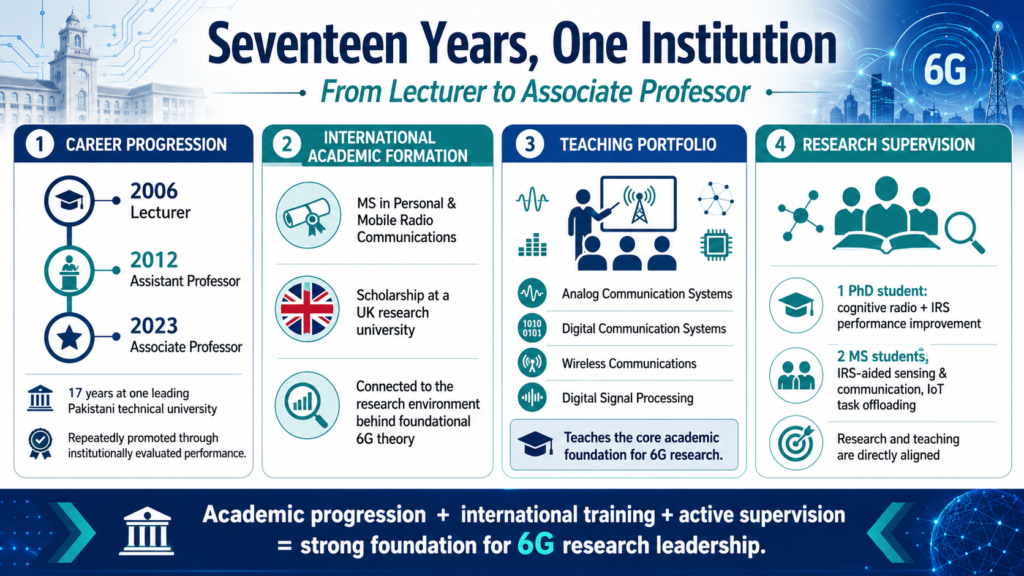
He joined a leading Pakistani technical university as a Lecturer in 2006, shortly after completing his undergraduate degree in electrical engineering. He advanced to Assistant Professor in 2012 following the completion of his PhD, and to Associate Professor in 2023. Seventeen years at the same institution across three progressively senior positions reflects a faculty member whose institution has repeatedly evaluated and confirmed his performance at each level.
His academic trajectory took him to a UK research university, where he received a scholarship for his MS in Personal and Mobile Radio Communications - the program in which he worked under his MS thesis supervisor who would later evaluate his PhD. This overseas academic formation is directly relevant to the proposed U.S. endeavor: it connects him to the UK research environment from which several of the foundational 6G theoretical papers have emerged.
He currently teaches Analog Communication Systems, Digital Communication Systems, Principles of Communication Systems, Wireless Communications, and Digital Signal Processing - the full spectrum of courses that form the academic foundation for 6G research. He supervises one PhD student on cognitive radio and IRS performance improvement, and two MS students on IRS-aided integrated sensing and communication and IoT task offloading algorithms. His research and teaching are aligned: the technologies he teaches are the technologies he researches, and the students he supervises are working on exactly the domains his proposed U.S. endeavor covers.
The Publication Record |EB-2 NIW wireless communications researcher
His 21 peer-reviewed publications span the full range of his proposed endeavor’s technical components. The most impactful venues in the portfolio - IEEE Transactions on Vehicular Technology, IEEE Transactions on Industrial Informatics, IEEE Transactions on Intelligent Transportation Systems, IEEE Transactions on Cognitive Communications and Networking, IEEE Journal of Biomedical and Health Informatics, and IEEE Communications Letters - are among the most selective journals in the electrical engineering and wireless communications field. Publication in these venues requires passing peer review by domain experts who evaluate both technical correctness and contribution significance.
The publications directly support the proposed endeavor's technical components. His IRS-assisted physical layer security work validates his expertise in the security dimension of 6G networks. His papers on IRS-assisted THz communications and IRS channel estimation cover the spectrum and channel management challenges central to next-generation systems. His cooperative spectrum-sharing and cognitive radio publications cover the spectrum access efficiency that is a declared priority in U.S. 6G strategy. His ML and AI integration work (federated learning security, IoT task scheduling) reflects the AI-in-communications dimension that NIST, the FCC, and NSF have all identified as a priority research area.
He also serves as a peer reviewer for eight top-tier journals: IEEE Transactions on Vehicular Technology, IEEE Transactions on Communications, IEEE Transactions on Information Forensics & Security, IEEE Communications Letters, IEEE Signal Processing Letters, IEEE Access, KSII Transactions on Internet and Information Systems, and Physical Communications. Peer review responsibility for these journals reflects the editorial community’s judgment that he has the domain expertise to evaluate submitted research, a form of recognition independent of his own publication record.
Why 6G Research Is a U.S. National Security Priority
The White House issued a National Security Presidential Memorandum on 6G in December 2025, formally declaring that U.S. leadership in 6G is a national security priority. This declaration is not aspirational - it follows documented concern that the United States does not currently hold the wireless communications leadership it held in previous technology generations, and that China, South Korea, and European nations have established significant research and commercial positions in next-generation wireless development.
The Critical and Emerging Technologies List (2022, updated 2024) explicitly identifies next-generation wireless networks (including 5G, 6G, and beyond) as a national priority domain. The NIST NextG Wireless R&D Gap Analysis (December 2023) identified specific research gaps in exactly the areas the petitioner’s proposed endeavor addresses: physical layer security, AI-integrated networks, spectrum access efficiency, and intelligent surface technologies. The Department of Defense’s Innovate Beyond 5G program and the NTIA’s $1.5 billion Public Wireless Supply Chain Innovation Fund both target the open and interoperable network ecosystem that the petitioner’s research supports.
The FCC was mandated to establish a 6G Task Force. The Next G Alliance, operating under the Alliance for Telecommunications Industry Solutions, coordinates the full wireless technology lifecycle from research to commercialization. The United States explicitly targets reducing dependence on foreign nations and companies for wireless infrastructure - a goal that requires domestic researchers developing the algorithms, protocols, and signal processing techniques that define what 6G will be.
The Five-Pillar Technical Proposed Endeavor
His proposed research and development work in 6G technologies covers five interconnected technical domains, each with documented research gaps and national relevance.
- Intelligent Reflecting Surfaces (IRS) and Reconfigurable Intelligent Surfaces (RIS): Nearly-passive surface elements that can be electronically configured to redirect wireless signals, dramatically improving coverage in areas blocked by buildings and terrain. His papers on IRS-assisted THz communications, IRS physical layer security, and IRS channel estimation represent active contributions to this field. The IRS authority who supports his petition has co-authored foundational work in this area.
- Cognitive Radio and Spectrum Sharing: Dynamic spectrum access technology that enables intelligent reuse of spectrum across different users and systems, addressing the spectrum scarcity that 6G and IIoT deployments will intensify. His PhD thesis and multiple papers address this directly.
- Physical Layer Security: Techniques including wiretap coding and secret key generation that secure wireless communications at the signal level, providing security for 6G networks that carry sensitive government, healthcare, and financial data. With virtually every aspect of society digitally connected, this is one of the highest-priority security research areas identified by CISA and the NSF.
- Full-Duplex Transmission: Simultaneous transmission and reception on the same frequency channel, effectively doubling spectral efficiency. His IEEE Transactions on Vehicular Technology paper on full-duplex relay selection in cooperative cognitive radio networks addresses a key enabling technology for 6G throughput targets of up to 1 Tbps.
- AI and Machine Learning Integration: The application of deep learning, federated learning, and other ML techniques to 6G network design, planning, optimization, and security. His publications on federated learning for IoMT security and AI-driven task offloading reflect active contributions to this dimension.
How the Petition Was Built
This was a direct petition. The academic record, publication history, supervisor relationships, and expert supporter network were already in place.
- Well-positioned evidence: PhD in Electrical Engineering, MS in Personal and Mobile Radio Communications (UK research university, scholarship), Associate Professor progression from Lecturer over 17 years, 21 peer-reviewed publications in top IEEE venues, 8 journal peer review responsibilities, PhD and MS student supervision on IRS/cognitive radio topics, MS thesis supervisor who is IEEE Fellow and globally top-cited researcher (also served as PhD external examiner), IRS research authority IEEE Fellow supporter, three additional U.S. and internationally prominent academic and industry supporters.
- National importance sourcing: White House NSPD on 6G (December 2025), Critical and Emerging Technologies List (2022, 2024), NIST NextG Wireless R&D Gap Analysis (December 2023), DoD Innovate Beyond 5G program, NTIA $1.5B Public Wireless Supply Chain Innovation Fund, FCC 6G Task Force, Next G Alliance, FCC TAC AI Working Group Report (August 2025), NSF 6G research centers, national spectrum strategy documents.
I-140 filed as a self-petition without a U.S. employer.
The Outcome
Approved.
A self-petitioned EB-2 NIW for a PhD electrical engineer and Associate Professor whose 17-year academic career at a leading Pakistani technical university has produced 21 peer-reviewed publications in top IEEE venues across IRS, cognitive radio, physical layer security, and 6G technologies, supported by his MS thesis supervisor and PhD external examiner who is among the world’s most cited wireless communications researchers, and by one of the global authorities on the intelligent reflecting surface technology at the center of his proposed endeavor.
The United States declared 6G leadership a national security priority in December 2025. The algorithms and signal processing techniques being published now in IEEE Transactions will define what 6G can achieve. His publications are part of that ongoing body of work.
For Academic Researchers in Wireless Communications
If your research is in wireless communications, signal processing, or related 6G technology areas and you have a publication record in top IEEE venues, a strong academic supervisor network, and active contributions to the research domains the U.S. government has explicitly prioritized, the NIW is worth a serious assessment. The Dhanasar test is satisfied when the proposed work has national importance and you are positioned to advance it. A strong academic supervisor lineage, peer review responsibilities, student supervision in the proposed domain, and support from recognized field authorities together answer the well-positioned question directly.
Questions Academic Wireless Communications Researchers Ask Us
Can a wireless communications researcher whose PhD is from a home-country institution qualify for an EB-2 NIW?
Yes. The Dhanasar test does not require an internationally prestigious doctoral institution; it requires that the proposed endeavor has national importance and that the petitioner is well positioned to advance it. Well-positioned evidence for a researcher can be constructed from publication record, expert recognition, peer review responsibilities, supervisor relationships, student supervision, and research network. A 17-year academic career from Lecturer to Associate Professor at the same institution, 21 publications in top IEEE venues, and expert supporters including IEEE Fellows who are among the world’s most cited researchers in the specific field provide strong well-positioned evidence regardless of where the doctoral degree was conferred.
How does having your MS thesis supervisor serve as your PhD external examiner strengthen the NIW case?
The combination means a single internationally recognized expert has independently evaluated the petitioner’s research quality at two separate milestones: the master’s thesis and the doctoral thesis. A PhD external examiner is an arms-length assessor who has no incentive to approve work that does not meet the standard. When the MS thesis supervisor and PhD external examiner is the same person, it reflects both a sustained academic relationship and a repeated independent endorsement of research quality across different career stages. For the NIW well-positioned argument, this provides two distinct instances of expert validation from a single highly credentialed source.
Does being supported by the leading global authority in your specific research sub-field help a NIW case?
It is one of the most direct forms of expert recognition available. Under Dhanasar, the well-positioned prong asks whether the petitioner is positioned to advance the proposed endeavor. When an IEEE Fellow and Web of Science globally highly cited researcher who specializes in the specific technology at the center of the proposed work (intelligent reflecting surfaces) formally supports the petition, it is an expert field judgment that the petitioner’s contributions are credible and valuable in that specific domain. This form of domain-specific expert recognition is distinct from general institutional support and directly addresses the question USCIS is asking.
Does peer review responsibility for top-tier IEEE journals help a NIW case for a researcher?
Yes, as a secondary form of expert recognition. Journals like IEEE Transactions on Vehicular Technology and IEEE Transactions on Communications invite peer reviewers only from researchers whom the editorial community considers to have sufficient domain expertise to evaluate submitted work. Serving as a peer reviewer for 8 top-tier journals in the field reflects an external community judgment that the petitioner’s knowledge is at the level needed to evaluate original research contributions - which is a meaningful threshold. It is particularly useful as corroborating evidence alongside publication record, citation count, and expert supporters.
When the world's leading authority in your exact research field puts their name behind your case, that's evidence USCIS can't easily dismiss. See how Immignis builds NIW cases around expert recognition.