
How a narrow quantum-computing specialty became a coherent record of original contributions, peer recognition, and sustained acclaim
Key facts at a glance
| Outcome | EB-1A approval for a Chinese quantum computing researcher working in a U.S.-based university laboratory. |
| Approval date | Approved on February 5, 2025. |
| Field niche | Fault-tolerant quantum error-correction algorithms, with a focus on reducing logical error risk and making quantum computation more reliable as systems scale. |
| Starting problem | The research record was strong, but the case needed a sharper explanation of sustained acclaim, individual contribution, and recognition in one narrow quantum-computing specialty. |
| Profile developed by Advance My Profile | The record was strengthened through focused high-quality papers, citation strategy, invited talks, peer review, conference committee work, a technical white paper, selective membership evidence, media commentary, and independent expert letters. |
| Evidence presented under EB-1A criteria | Scholarly articles, original contributions, published material, judging the work of others, and memberships. |
| Approval hook | The petition showed sustained recognition within fault-tolerant quantum error correction rather than relying on a broad claim that quantum computing is important. |
USCIS approved his Form I-140 on February 5, 2025.
The approval belonged to a Chinese quantum computing researcher working in a U.S.-based university laboratory. His field was fault-tolerant quantum error-correction algorithms, a specialty that sits near the center of one of quantum computing’s hardest problems: how to keep fragile quantum information useful long enough for a real computation to finish.
The case did not succeed by saying that quantum computing is exciting, well funded, or strategically important. Those points may explain why the field matters, but EB-1A still asks a more personal question: what has this researcher contributed, and why does the field recognize him?
That distinction shaped the whole petition.
A quantum system can produce errors because qubits are sensitive to noise, imperfect control, measurement disturbance, and the limits of hardware. Error correction tries to protect information by encoding it across many physical qubits so that the system can detect and correct errors without destroying the computation itself. Fault tolerance asks whether the correction process can continue even when the operations used to correct errors are also imperfect.
His research belonged in that difficult space. The petition had to make the science understandable without flattening it into a slogan.
The stronger story was not quantum computing. It was reliability.
At the start, his professional materials described quantum algorithms, research papers, academic collaborations, and laboratory work. They showed ability, but they did not immediately show the narrow authority that would carry an EB-1A petition through final merits.
Quantum computing is a broad field. A person can work on hardware, algorithms, cryptography, optimization, simulation, control systems, quantum networking, or error correction. A broad title can make a strong researcher look less distinctive because USCIS is left to guess which professional problem defines the person’s acclaim.
Advance My Profile, powered by Immignis, reviewed the record with legal strategists and technical reviewers and narrowed the profile to fault-tolerant quantum error-correction algorithms. That framing gave the evidence a center.
The recurring question became simple enough to understand and serious enough to matter: how can quantum information be protected from error as quantum systems become larger and more complex?
Once that question was clear, the petition could connect his papers, citations, peer review, talks, committee work, white paper, membership evidence, media commentary, and independent letters to the same professional identity.
Why strong research still needed a stronger EB-1A narrative
Researchers often assume that a good publication record speaks for itself. Sometimes it does. Often, for EB-1A, it does not.
A publication list can show that a scientist produced research. It may not show whether the work was original in a legally meaningful way, whether the field relied on it, whether other specialists recognized the researcher, or whether the full record rises to sustained acclaim. The same is true for citations. Citations help, but they need context: who cited the work, why the work was cited, and whether the citations reflect influence in the defined field.
The starting weakness in this case was not a lack of intelligence or a lack of serious research. It was that the evidence had to be arranged around the right professional claim. Without a clear narrative, the record risked looking like a collection of technical achievements rather than proof of extraordinary ability in a specific field.
The petition therefore avoided a common mistake. It did not ask USCIS to admire quantum computing as a topic. It asked USCIS to examine a narrower record of recognized work in fault-tolerant quantum error correction.
What USCIS needed to see in a quantum error-correction EB-1A case
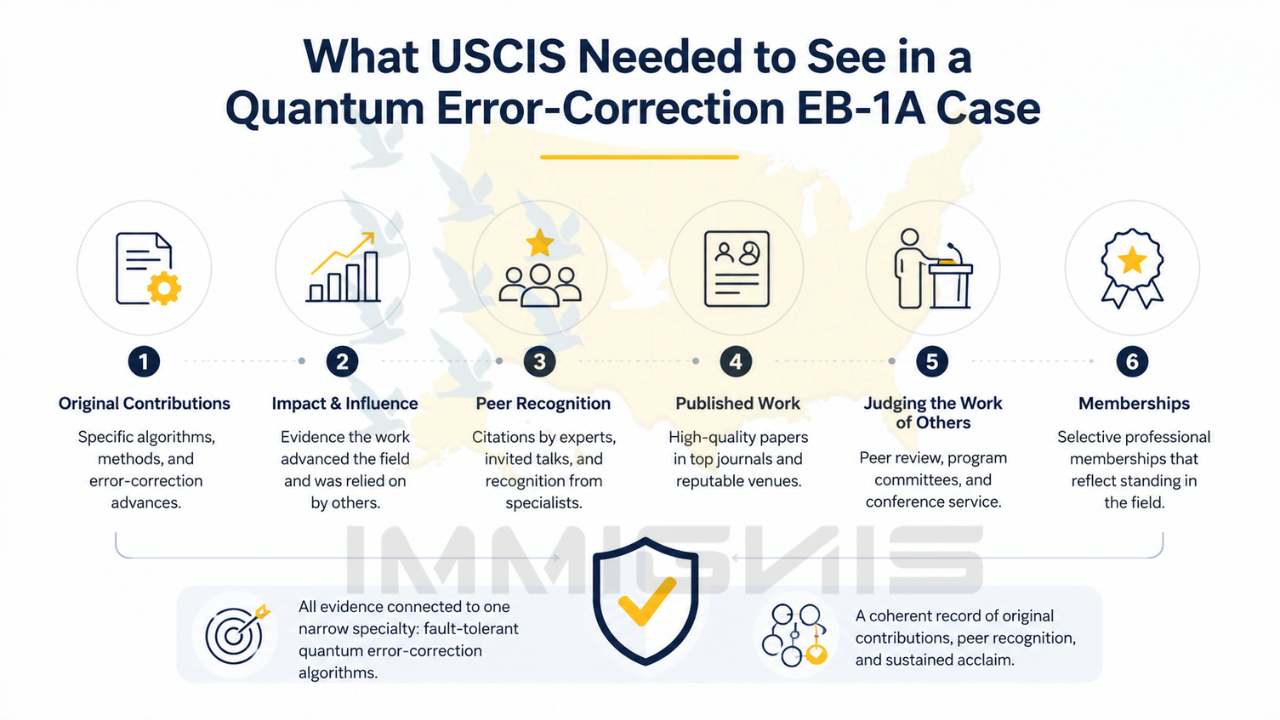
For original contributions, the petition had to identify his specific algorithmic work, research methods, error-correction concepts, or analytical contributions and explain why they had significance in the field. A general statement that quantum error correction is important would not establish his personal contribution.
For scholarly articles, the record needed more than a list of papers. It needed to show a focused body of authorship in quantum error correction, fault tolerance, logical error behavior, decoding methods, or related reliability questions.
For published material, the petition needed independent coverage about him, his work, or his expertise. Media commentary could help only where it showed that outside sources treated him as someone qualified to explain a specialized topic.
For judging, peer review and conference committee work had to be documented carefully. Reviewing papers, evaluating submissions, or serving in a technical selection role can support judging when the evidence shows that the person actually evaluated the work of others. A simple committee title or conference attendance would not be enough.
For memberships, the petition needed selective admission or advancement standards tied to achievement and expert assessment. Open enrollment or ordinary paid membership was kept separate from the EB-1A argument.
At final merits, USCIS could still examine whether the evidence as a whole described a researcher with sustained acclaim. The petition therefore had to make the field, contribution, and recognition consistent from beginning to end.
The research record was rebuilt around one technical problem
The petition organized the evidence around the problem that made his work recognizable: making quantum computation less vulnerable to error as systems scale.
That required translating technical materials into a sequence USCIS could follow. What error model was being addressed? Which part of the correction process did the algorithm improve or analyze? How did the method relate to logical error rates, decoding, resource overhead, thresholds, or the conditions under which a computation could remain reliable?
The record did not claim that one researcher had solved quantum computing. It did not claim that his algorithms alone made universal fault-tolerant computation available. Those would have been unsupported and unnecessary statements.
Instead, the petition focused on attributable contributions: the methods he developed, the problems they addressed, the scholarly record that carried the work, and the evidence that other specialists recognized its relevance.
The papers had to show a field identity, not just productivity
His papers were an important part of the case, but they were not treated as a paper-count exercise. The petition grouped them by their relationship to fault-tolerant quantum error correction.
One evidence stream concerned algorithmic approaches to reducing or managing error. Another addressed the analysis of reliability when operations, measurements, or decoding assumptions are imperfect. A third showed how his work fit into the broader effort to make quantum computation more scalable and useful.
The record also used citation growth with care. Citation evidence was not presented as a raw number detached from context. It helped show that other researchers were engaging with the work, using it as part of related studies, or recognizing its relevance within the defined specialty.
That helped turn a publication record into something more useful for EB-1A: a documented pattern of authorship, influence, and recognition in one technical area.
The citation strategy explained influence without overstating it
Citation evidence can be powerful in a research case, but it can also be mishandled. A petition that simply lists citation totals may leave USCIS uncertain about what those numbers prove.
In this case, the citation strategy connected cited works to the researcher’s narrow specialty. The record identified which papers were cited, what subjects the citing papers addressed, and how those citations related to error correction, fault tolerance, or quantum reliability.
Where the citation pattern showed developing recognition, the petition explained that development. Where the evidence did not support a sweeping claim, the petition did not make one.
That restraint mattered. Sustained acclaim is not shown by exaggerating citation data. It is shown by explaining what the data fairly demonstrates when placed beside publications, peer review, speaking, committee work, media commentary, membership evidence, and independent expert letters.
The technical white paper made the specialty easier to understand
The technical white paper gave the record a public-facing document that connected fault-tolerant quantum error correction to the wider challenge of reliable quantum computation.
It explained why quantum systems cannot be evaluated only by whether they perform a small demonstration successfully. The harder question is whether errors can be detected, corrected, and controlled as the number of qubits and operations increases.
The paper discussed error-correction logic, fault-tolerant design principles, resource overhead, algorithmic assumptions, and the practical difficulty of moving from promising experiments to reliable computation. It avoided unsupported claims about when large-scale quantum computers would arrive or which architecture would dominate.
For the EB-1A record, the white paper served two purposes. It showed that he could explain his specialty outside a narrow paper abstract, and it gave independent experts and public audiences a clearer way to understand the importance of his research question.
Invited talks showed recognition beyond the publication list
Invited talks helped show that his expertise was being requested by other scientific or technical communities. The strongest speaking evidence did not simply prove that he attended conferences. It showed that organizers invited him to explain fault-tolerant error correction, quantum reliability, or algorithmic approaches to error management.
The talks also helped make the record less one-dimensional. A researcher who publishes but is never asked to review, speak, explain, or evaluate may still have a strong academic record, but EB-1A often benefits from evidence that the field engages with the person in multiple ways.
His invited presentations connected the written research to live professional recognition. They also allowed the petition to show how his work was discussed by people who understood the difficulty of the problem.
Peer review and committee work were documented as judging evidence
The judging criterion required careful handling. In academic and technical fields, peer review can be valuable EB-1A evidence because it shows that journals, conferences, or professional venues trusted the petitioner to evaluate the work of other specialists.
The petition documented peer-review assignments involving quantum computing, quantum information science, error correction, algorithms, or related computational and physics subjects. It also documented conference committee work where the role involved reviewing, scoring, selecting, or otherwise evaluating technical submissions.
That distinction was important. Committee participation can mean many things. It may involve organization, visibility, or professional service. It supports judging only when the record shows that the petitioner actually evaluated others’ work.
The reviewed work required real expertise. He assessed technical claims, mathematical reasoning, algorithmic assumptions, experimental or simulation design, comparison baselines, and whether conclusions followed from the evidence.
Media commentary translated quantum computing without turning it into hype
Quantum computing attracts broad public attention, but publicity can easily become imprecise. The media evidence in this case was useful because it connected him to explanation, not exaggeration.
His commentary helped readers understand why quantum error correction is central to reliable quantum computation, why noise and error rates remain difficult, and why a useful quantum computer requires more than adding qubits.
The petition did not present general media interest in quantum computing as if it were published material about him. It focused on coverage that discussed him, quoted him, or relied on his expertise. That approach made the evidence cleaner and more credible.
Selective membership evidence was separated from ordinary affiliation
Professional membership can be helpful in an EB-1A case, but only when the membership standard matters. A general professional society, open student membership, or paid affiliation usually does not carry the same evidentiary value as a selective grade based on achievement and expert review.
The petition therefore documented the actual membership requirements used in the case. It explained the admission or advancement standard, the role of professional achievement, and the evaluation process where applicable.
This prevented the record from treating every affiliation as equal. It also helped USCIS see which membership evidence belonged in the EB-1A analysis and which background affiliations were merely contextual.
Independent letters explained the work at final merits
Independent expert letters helped connect the scientific record to the EB-1A legal standard. The most useful letters did not simply praise him. They identified the problem in fault-tolerant error correction, described his contribution, and explained why other researchers would care about that work.
The letters were especially important because quantum computing can be difficult for non-specialists to evaluate. A letter that says a researcher is brilliant is not as useful as one that explains the technical contribution, its context, and how it fits within the field’s effort to make quantum computation reliable.
The stronger letters also avoided unsupported certainty. Fault-tolerant quantum computing remains an active research area. The case did not need to pretend otherwise. It needed to show that the petitioner had become a recognized specialist in an important part of that work.
How the EB-1A evidence came together
The approved petition worked because the evidence described the same researcher from several directions.
- Scholarly articles showed a focused body of research in fault-tolerant quantum error correction and related quantum reliability questions.
- Original contributions were supported through algorithmic work, technical methods, cited research, and expert explanations of significance within the defined field.
- Published material and media commentary showed that independent sources recognized him or relied on his expertise to explain quantum computing and error correction.
- Judging evidence came from peer review and documented committee work involving evaluation of other specialists’ research or technical submissions.
- Membership evidence focused on selective standards tied to achievement and expert assessment rather than ordinary open enrollment.
Together, these categories created a record that was stronger than the original list of papers. The case showed authorship, influence, independent recognition, professional trust, and a coherent field identity.
Why this approval matters for other quantum researchers
This approval is useful for researchers whose work is strong but difficult to explain outside a specialized field. The lesson is not that every quantum researcher with publications qualifies for EB-1A. The lesson is that a specialized scientific record must be organized around contribution, recognition, and field identity.
Quantum researchers often work in teams, publish dense technical papers, and build reputations inside communities that outsiders rarely see. EB-1A requires that reputation to be documented. It asks for evidence that can show not only what the researcher wrote, but how the field responded.
The Chinese quantum computing researcher received approval after his record was framed around one narrow professional specialty and supported with multiple forms of recognition. That is the part other researchers should study.
A broad field can create prestige. A narrow field can create proof.
What researchers can learn from this case
If you work in quantum computing, artificial intelligence, theoretical physics, computational science, advanced engineering, or another technical field, your strongest EB-1A evidence may not be obvious from your resume.
The evidence may be spread across papers, citations, review requests, conference roles, invited talks, technical explanations, selective memberships, and independent expert recognition. The petition must show why those materials point to the same professional conclusion.
Advance My Profile and Immignis help researchers identify a defensible authority niche, organize evidence around actual contributions, build credible recognition, and prepare EB-1A records that can be explained without exaggeration.
For a quantum computing researcher, the question is not simply whether the field is important. The question is whether the record shows that the researcher has become recognized for a specific contribution within that field.
Frequently asked questions
Can a quantum computing researcher qualify for EB-1A?
Yes, a quantum computing researcher may qualify for EB-1A if the record shows sustained acclaim and recognized achievements in the field. Strong evidence may include scholarly articles, citations, original contributions, peer review, invited talks, selective memberships, published material, and independent expert letters.
Are publications enough for an EB-1A research case?
Publications can support the scholarly-articles criterion, but they are usually not enough by themselves. USCIS may also examine the quality of the work, evidence of influence, independent recognition, judging activity, original contributions, and the full record at final merits.
Can peer review count as judging in EB-1A?
Peer review can support judging when the evidence shows that the petitioner evaluated the work of other specialists. The record should document the venue, subject matter, review activity, and why the work required expertise.
Does conference committee work help an EB-1A case?
It can help, but only if the role is documented accurately. Committee work that involves reviewing or selecting technical submissions may support judging. General organizing, attendance, or honorary listing should not be overstated.
How should quantum researchers define their EB-1A field?
The field should be narrow enough to show a recognizable specialty but not so narrow that it appears invented for the petition. In this case, fault-tolerant quantum error-correction algorithms gave the record a clear and defensible professional center.
Start with the problem your work helps the field solve
The approved case of this Chinese quantum computing researcher shows how a highly technical research record can become a stronger EB-1A petition when the evidence is organized around a clear specialty and supported by independent recognition.
For many researchers, the strongest question is not how many papers they have. It is whether the record shows that other specialists recognize the value of their contribution.