Key facts at a glance
| Outcome | EB-1A approval for a Tunisian smart textiles medtech engineer working at an Italy-based wearable R&D lab. |
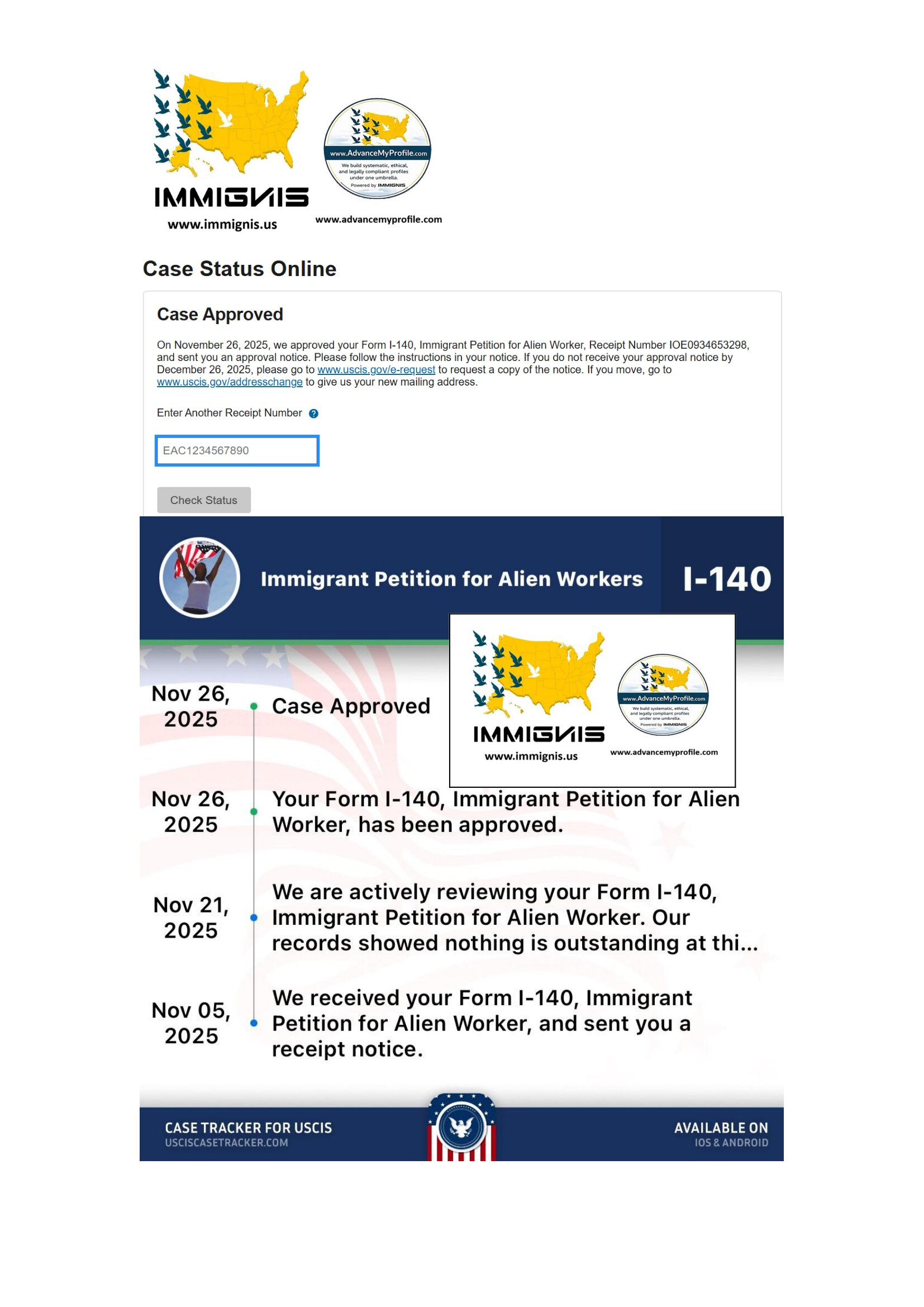
| Approval date | Approved on November 26, 2025. |
| Field niche | Smart textiles for cardiac and rehabilitation monitoring, with a focus on textile electronics, signal quality, sensor integration, prototype validation, and practical use in health-monitoring environments. |
| Starting problem | The work crossed fashion, electronics, and medical-device development. Before profile building, the evidence did not clearly show one EB-1A-ready medical technology specialty. |
| Profile-building path | Advance My Profile, powered by Immignis, focused the record on medical smart textiles and developed publications, prototype-validation evidence, patent filing evidence, medtech media coverage, conference presentation records, peer review, selective membership evidence, and independent letters from wearable-device experts. |
| Evidence presented under EB-1A criteria | Scholarly articles, original contributions, published material, judging, and memberships. Patent evidence supported attribution and the original-contribution argument. |
| Approval hook | USCIS approved the EB-1A petition after the record showed that textile electronics were not merely product design, but part of a health-monitoring contribution with significance beyond one laboratory. |
Approval first: a case that had to be narrowed before it could become strong
On November 26, 2025, USCIS approved the Form I-140 petition of a Tunisian smart textiles engineer working in an Italy-based wearable research and development lab.
At first glance, the case looked attractive but difficult. He had worked on wearable systems, textile electronics, sensor integration, and prototypes that could support cardiac and rehabilitation monitoring. The work was sophisticated. The problem was that it did not yet read like one extraordinary ability case.
Part of the record sounded like fashion technology. Part of it sounded like electrical engineering. Part of it sounded like medical-device development. Another part was hidden inside prototype testing and laboratory files. Each piece had value, but USCIS does not approve a career because it contains many interesting pieces. The petition needed to show a defined field, a recognizable contribution, and evidence that other professionals had begun to rely on or recognize his work.
The strategy was not to exaggerate the science. It was to focus it. The case became about smart textiles for cardiac and rehabilitation monitoring: fabric-based sensing systems designed to collect useful physiological or movement-related information while remaining wearable, repeatable, and suitable for practical health-monitoring contexts.
The central problem was not innovation. It was identity.
Many engineers in emerging fields face the same problem. Their work sits between disciplines, so their immigration record looks scattered even when the actual career is coherent.
A smart textile can be discussed as material design, wearable electronics, signal processing, sports technology, medical monitoring, rehabilitation support, or consumer product development. For EB-1A, that breadth can become a weakness if the petition does not identify the professional question the person is known for answering.
This engineer was not presented as a general wearable-technology professional. The record was narrowed to the medical side of smart textiles: how fabric-integrated sensors could produce usable signals for cardiac and rehabilitation monitoring, and how textile construction, sensor placement, durability, comfort, and signal integrity affected whether a prototype could move toward meaningful health use.
That shift mattered. It moved the case away from a general product-development story and toward a medical technology contribution that independent experts could evaluate.
Why smart textiles can be difficult to explain in an EB-1A petition
Traditional medical devices often have clearer documentation. There may be a device class, a clinical indication, regulatory materials, a formal validation pathway, and a company role that is easy to describe.
Smart textiles can be less tidy. The technology may begin with conductive yarns, embedded electrodes, printed circuits, stretchable sensors, washable components, or fabric structures designed to remain comfortable on the body. The engineering question is not only whether a sensor works on a bench. It is whether the signal remains usable when the textile bends, stretches, moves, touches skin, absorbs moisture, or is worn repeatedly.
For cardiac monitoring, the record may need to address signal quality, electrode contact, motion artifact, data reliability, and whether the textile form can support the monitoring purpose. For rehabilitation monitoring, the questions may involve range of motion, repeatability, sensor placement, patient movement, and whether the data can help track functional activity without making unrealistic clinical claims.
The EB-1A petition did not claim that one textile prototype could diagnose disease or replace a physician. It focused on engineering contributions that helped move smart textiles closer to reliable medical monitoring.
What USCIS needed to see in this smart textiles medtech case
For original contributions, the petition had to identify the engineer’s own technical work and explain why it mattered beyond routine laboratory development. A prototype alone was not enough. The evidence needed to show what problem the prototype addressed, what method or design concept could be traced to him, and why wearable-device experts considered the work significant.
Scholarly articles had to support the same medical smart-textile niche. Publications about materials, wearable sensors, textile electronics, cardiac monitoring, rehabilitation monitoring, or validation methods could help, but only if they were organized into one coherent authority record.
Published material required independent coverage about him or his expertise. A company product mention would not automatically satisfy that criterion unless the coverage discussed him or his work in the way USCIS requires.
Judging required evidence that he actually evaluated the work of others, such as peer-review assignments or technical review activity in wearable technology, biomedical engineering, textile electronics, or allied fields.
Membership evidence had to show selective admission or elevation based on professional achievement. Open enrollment or ordinary paid membership was kept separate.
Patent evidence helped connect him to specific technical concepts. It was not treated as a separate EB-1A criterion. Instead, it strengthened the attribution and original-contribution record when the filing materials supported that connection.
The record was rebuilt around the path from fabric to medical signal
Advance My Profile, powered by Immignis, reviewed the record with legal strategists and wearable-device domain specialists. The team did not try to present every project as equally important. It reorganized the evidence around a practical technical sequence.
What did the fabric need to measure? Where was the sensor placed? How did the textile behave during movement? What happened to the signal when the garment stretched, shifted, or was worn during repeated activity? Which design choice improved reliability, comfort, or usability? How did the validation evidence support the medical monitoring purpose?
This sequence allowed the petition to explain the work without exposing confidential laboratory data or overstating clinical results. It also gave independent experts a way to discuss the contribution with precision.
Instead of saying that the client worked in smart textiles, the record showed how his technical decisions affected the reliability of fabric-based monitoring systems.
The publications gave a scattered R&D record a public scientific language
The publication strategy was built around medical smart textiles rather than general wearable innovation. Focused articles discussed textile-based sensing, signal reliability, sensor placement, prototype validation, and the demands of cardiac and rehabilitation monitoring.
One line of authorship addressed the challenge of collecting usable physiological information from a textile surface. Another examined how movement and garment behavior can affect monitoring reliability. A third connected textile electronics to rehabilitation use, where data must reflect actual motion rather than an artifact created by the fabric, sensor, or measurement environment.
This mattered because USCIS could see a pattern. The articles did not appear as disconnected academic outputs. They supported the same field niche that appeared in the original-contribution evidence, peer review, media coverage, membership evidence, and expert letters.
Prototype validation made the work more than an idea
The strongest technical evidence came from the prototype-validation record. Smart textiles can sound impressive in concept, but EB-1A evidence needs more than a concept. The petition documented non-confidential validation materials showing how the engineer’s work addressed practical barriers in wearable monitoring.
The file used available evidence about prototype behavior, test conditions, signal quality, repeatability, design changes, and the relationship between the textile form and monitoring purpose. It did not invent patient outcomes, diagnostic accuracy, commercial adoption, or regulatory status that the record could not prove.
This restraint strengthened the petition. In medical technology, overclaiming can damage credibility. The case presented what could be documented: a serious engineering contribution to fabric-based medical monitoring systems, supported by technical records and independent explanation.
Patent evidence helped trace the technical concept to the engineer
The patent filing evidence was handled carefully. Where the filing identified him in connection with a smart textile, sensor integration, monitoring, or related technical concept, the petition used that evidence to support attribution.
A patent filing by itself does not prove major significance in the EB-1A sense. The significance came from the full record: the technical problem, the prototype evidence, the focused publications, the medical monitoring context, and independent letters explaining why the work mattered to wearable-device development.
That approach helped USCIS see the patent evidence as part of a broader contribution rather than a standalone label.
Medtech media helped separate medical smart textiles from consumer wearables
Independent media coverage and expert commentary were important because the public often thinks of wearables as watches, fitness bands, or consumer gadgets. This case needed to show a more specific professional identity.
The media record focused on medical smart textiles: how fabric can become part of a monitoring system, why comfort and wearability matter, and why textile behavior can affect data quality. It also explained the difference between a fashionable wearable and a sensor system designed for cardiac or rehabilitation monitoring.
The coverage did not need to claim that the engineer had solved every problem in wearable medicine. Its value was that it made his niche visible outside the lab and connected his name to a field-specific conversation.
Conference presentation and peer review showed professional trust
A conference presentation gave the engineer a public technical setting. He could explain the design and validation problems that appear when electronics move from rigid devices into fabric systems worn on the body.
The presentation addressed issues that wearable-device professionals understand well: signal degradation, motion artifact, skin contact, sensor placement, washability, textile durability, and the need to connect prototype performance to the monitoring use case.
Peer review strengthened the judging record. The evidence showed that journals or technical venues trusted him to evaluate other specialists’ work in smart textiles, biomedical wearables, textile electronics, rehabilitation technology, or related areas. That work required him to assess methods, evidence, claims, and whether conclusions followed from the data.
Selective membership and expert letters completed the authority record
Membership evidence was not treated casually. The petition documented the admission or elevation requirements and showed how the standard was tied to professional achievement, expertise, or expert assessment. That distinction matters because ordinary membership usually does not carry EB-1A weight.
Independent letters from wearable-device experts helped connect the evidence. The best letters did not merely praise him. They explained the problem he worked on, the method linked to him, why fabric-based monitoring is technically difficult, and how his work contributed to the field.
Those letters also helped bridge the gap between laboratory development and field significance. They gave USCIS expert context without asking the officer to infer technical importance from a prototype list or publication titles alone.
How the evidence worked together
This case was strongest when the evidence stopped competing with itself. Fashion technology, electronics, medtech, and rehabilitation were not presented as separate careers. They were organized around one question: how can textile electronics produce usable information for health monitoring?
The publications gave the work a public research record. Prototype validation showed practical engineering development. Patent evidence linked technical concepts to the engineer. Media coverage and conference activity made the niche visible. Peer review and membership evidence showed professional trust. Independent letters explained why the contribution mattered beyond one laboratory.
That combination addressed both parts of the EB-1A analysis. The petition presented evidence under the regulatory criteria and also gave USCIS a final-merits story: a smart textiles medtech engineer whose work, recognition, and technical contribution pointed to the same narrow specialty.
The approval
USCIS approved the Form I-140 petition on November 26, 2025.
The approval did not depend on treating every wearable project as extraordinary. It depended on a disciplined record that showed how his technical work in textile electronics supported medical monitoring and how the field had begun to recognize that expertise.
For professionals in emerging fields, that is often the decisive lesson. A strong EB-1A case is not built by adding more labels. It is built by proving a field, a contribution, and recognition that belong to the same person.
Lessons for wearable, textile, and medtech professionals
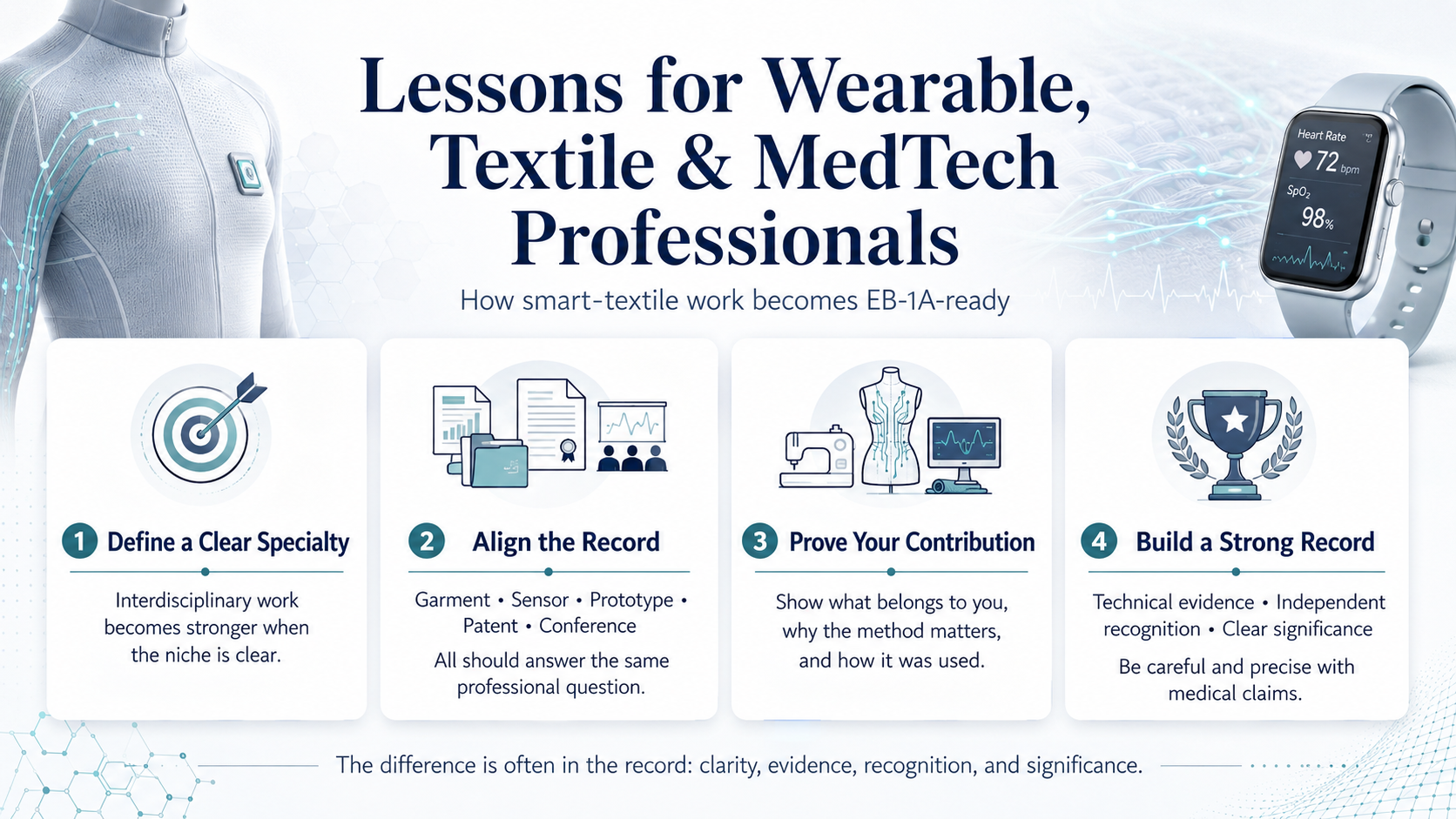
Smart textile professionals often assume their work is too interdisciplinary for EB-1A. In reality, interdisciplinary work can be powerful when the petition identifies a clear specialty and supports it with evidence that USCIS can evaluate.
The key is discipline. A smart garment, a sensor, a prototype, a patent filing, and a conference presentation do not automatically form an EB-1A case. They become stronger when they answer the same professional question.
If your strongest work sits inside a lab, startup, product team, or prototype record, the petition must show what belongs to you, why the method matters, and how the field has recognized or used your expertise. That evidence should be public where possible, independently supported where necessary, and careful about medical claims.
For smart textiles and wearable medtech, the difference between product development and extraordinary ability often lies in the record: the clarity of the niche, the quality of the technical evidence, the independence of recognition, and the way the petition explains significance.
Frequently asked questions
Can smart textiles support an EB-1A case?
Yes, if the evidence shows more than product development. The petition should identify the applicant’s own technical contribution, explain why it matters in the field, and support that claim with publications, validation evidence, independent recognition, judging, memberships, or expert letters.
Is a patent filing enough to prove an original contribution?
No. A patent filing can help trace a concept to the applicant, but major significance usually requires additional evidence such as technical use, adoption, independent expert analysis, publications, or other proof that the contribution matters beyond the applicant’s employer or lab.
Can prototype validation help an EB-1A petition?
Yes. Prototype validation can be valuable when it documents the technical problem, the applicant’s role, the method used, and the significance of the results. The evidence should avoid unsupported clinical, commercial, or regulatory claims.
What makes a smart textile case different from a general wearable-technology case?
A smart textile case often needs to explain how fabric structure, sensor integration, body movement, comfort, durability, and signal quality affect the monitoring purpose. A general wearable label may be too broad unless the petition identifies a specific technical field.
Can work done outside the United States qualify for EB-1A?
Yes. EB-1A is not limited to work performed in the United States. The petition still must show that the applicant has sustained national or international acclaim and that the evidence meets the EB-1A criteria and final-merits standard.
Build an EB-1A record around the medical technology your work actually changed
If you work in smart textiles, wearable medical devices, rehabilitation technology, biomedical sensors, textile electronics, or digital health hardware, your strongest evidence may not be obvious from a resume or project list.
Advance My Profile, powered by Immignis, helps professionals identify a defensible EB-1A niche, document original contributions, develop credible public recognition, and prepare a record that can be verified and defended professionally.