How a niche research record became evidence of original contributions, independent recognition, and field-level expertise in satellite and grid protection
Key facts at a glance
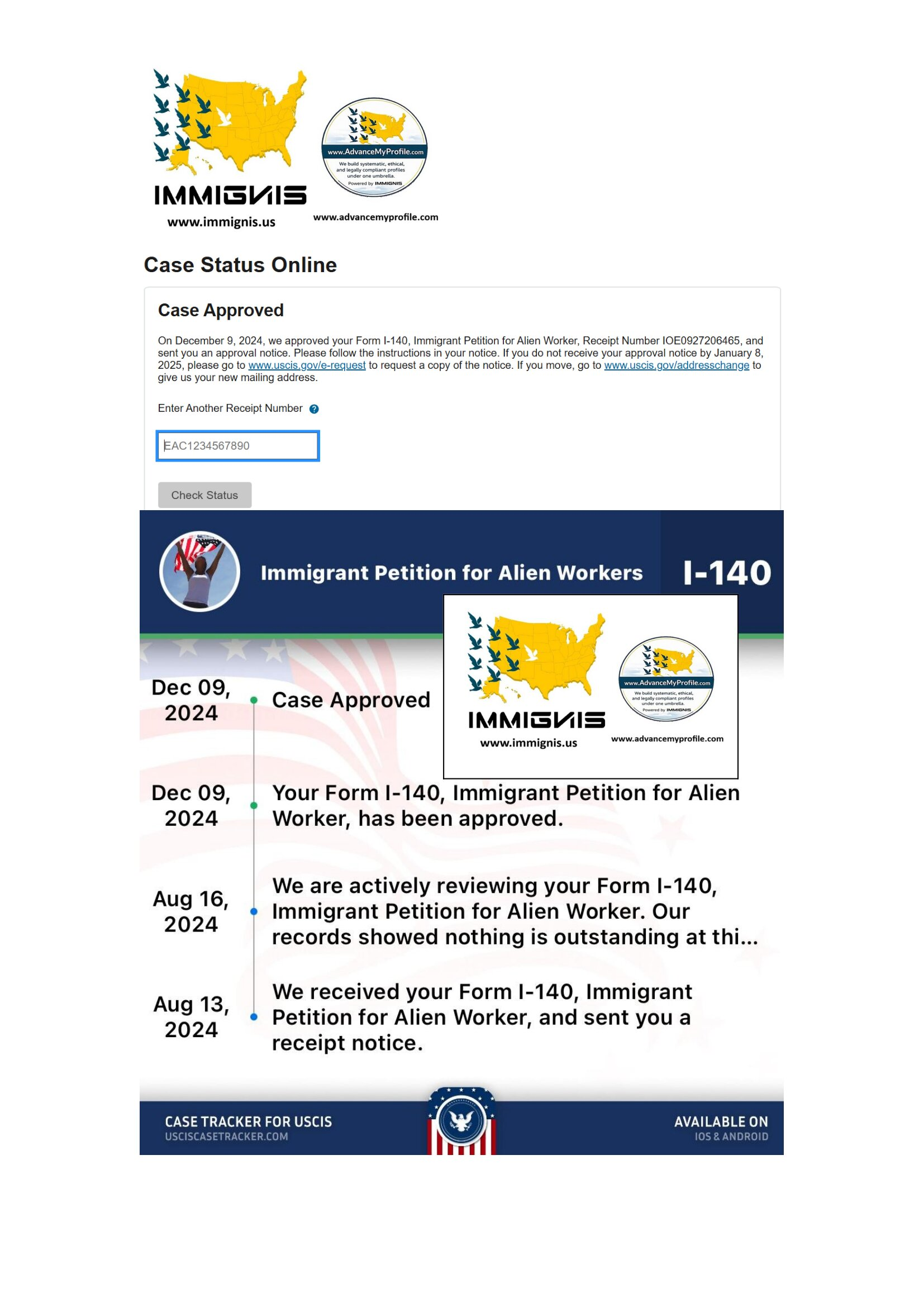
| Outcome | EB-1A approval for an Indian space weather data scientist working at a U.S. based research institute. |
| Approval date | Approved on December 9, 2024. |
| Field niche | Solar-storm forecasting for satellite and grid protection, with a focus on data driven prediction, warning thresholds, and risk interpretation for infrastructure stakeholders. |
| Starting problem | The work was scientifically strong but highly specialized. The record needed to explain why a niche forecasting profile showed sustained acclaim, practical significance, and individual authority. |
| Profile developed by Advance My Profile | The record was strengthened through focused publications, open forecast-tool documentation, a policy brief for satellite and grid stakeholders, media quotes during solar events, invited talks, peer review, and independent expert letters. |
| Evidence presented under EB-1A criteria | Scholarly articles, original contributions, published material, judging the work of others, and leading or critical role. |
| Approval hook | The petition connected solar-storm forecasting to satellite operations, power-grid risk awareness, and critical-infrastructure protection without overstating what any forecast model can guarantee. |
USCIS approved his Form I-140 on December 9, 2024.
The approval belonged to an Indian space weather data scientist working at a U.S.-based research institute. His field was not a common one for a casual reader. He studied solar storms, forecast signals, and the data patterns that can help satellite and grid stakeholders understand risk before a disruption becomes visible in ordinary operations.
That was also the challenge in the EB-1A case. The science mattered, but the record could not rely on the assumption that everyone already understood why space weather forecasting is important.
A solar event may begin far from Earth. The practical question is closer to home: what should satellite operators, communications systems, navigation users, and power-grid planners know early enough to prepare?
His petition had to make that question clear. It also had to show that the scientist was not merely one contributor in a narrow research area, but a recognized specialist whose forecasting work, data tools, peer evaluation, public explanations, and institutional role supported an EB-1A approval.
The field was niche. The risk was not.
Many EB-1A researchers have the opposite problem from artists, business leaders, or media professionals. They may have papers, technical vocabulary, and a real scientific record, but the story still feels distant from practical use.
That was the weakness here. Space weather can sound like a specialized academic subject: solar wind, geomagnetic disturbances, charged particles, satellite exposure, and model uncertainty. The file needed to explain the discipline in terms USCIS could evaluate: what problem did his work address, what did he contribute, who relied on his judgment, and how did others in the field recognize it?
The strongest version of the case did not say, “solar storms are important, so this scientist is extraordinary.” It did something more precise. It showed how his data science work helped turn complex solar observations into forecasting information that could be used by researchers and infrastructure-facing professionals.
That difference mattered. EB-1A is not approved because a field is useful. It is approved when the petitioner shows sustained acclaim and recognized achievements in that field.
Why strong research still needed profile building
His starting record contained meaningful scientific work, but it had several familiar gaps. Publications showed productivity. They did not, by themselves, explain sustained acclaim. Research-institute employment showed a serious environment. It did not automatically prove that he held a leading or critical role. A forecasting subject connected to public safety and infrastructure helped explain significance, but it could not replace evidence of the scientist’s own contribution.
Advance My Profile, powered by Immignis, reviewed the record with legal strategists and domain-aware reviewers. The goal was to organize the evidence around a clear authority niche: solar-storm forecasting for satellite and grid protection.
The case then moved from a broad research profile to a more disciplined question: how did this scientist use data, forecasting models, and risk interpretation to improve how solar-storm information could be understood before infrastructure stakeholders faced consequences?
Once the niche became clear, the rest of the evidence could be evaluated in the right frame. Publications, open tools, talks, peer review, media quotes, policy-facing explanations, and independent letters were not separate decorations. They all had to point back to the same professional identity.
What USCIS needed to see in a space weather data science EB-1A case
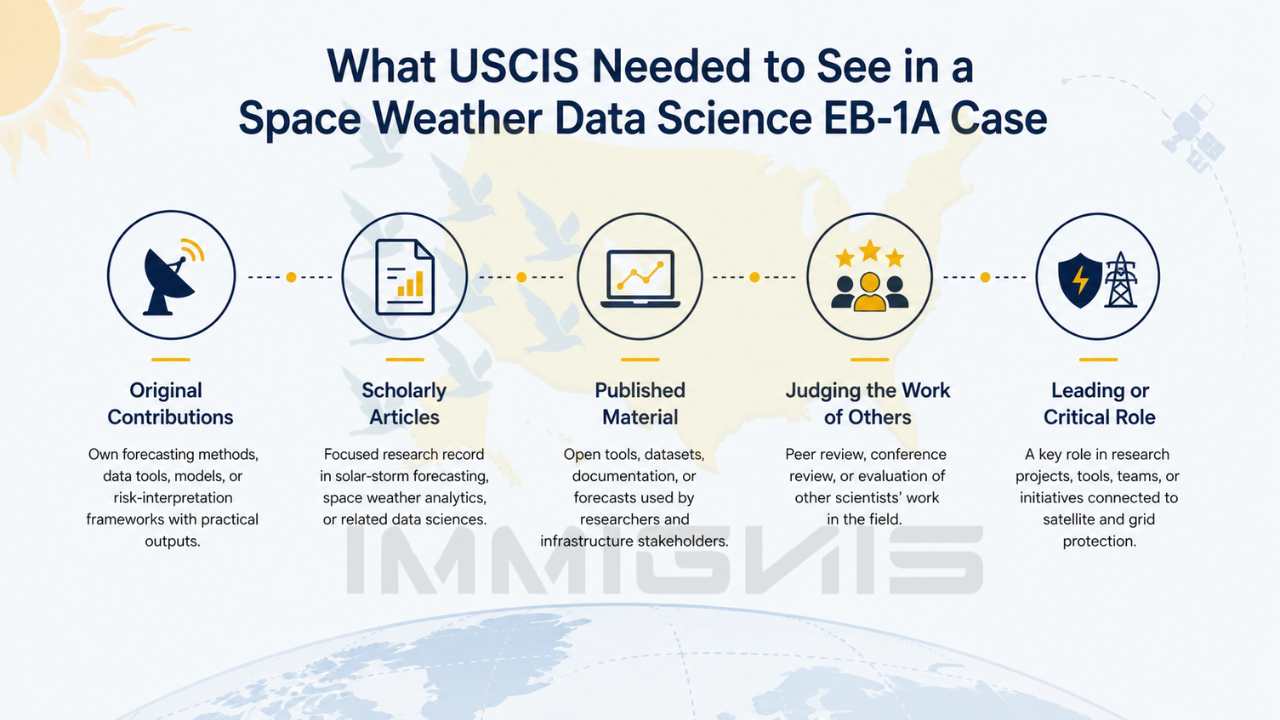
For original contributions, the petition had to identify the scientist’s own forecasting methods, data tools, model-development work, risk-interpretation framework, or infrastructure-facing outputs. A general statement that space weather affects satellites or grids would not be enough.
Scholarly articles needed to show a focused research record in solar-storm forecasting, space weather analytics, or related data science. The petition also had to explain the role of the publications in the broader record rather than treating publication count as a substitute for acclaim.
Published material required independent coverage about him, his work, or his expertise. Media quotes during solar events were useful only where they showed that journalists or public-facing outlets looked to him for explanation because of his expertise.
Judging required evidence that he evaluated other specialists’ work, such as peer review for journals or scientific venues. Simply attending conferences or being listed as a participant would not meet that standard.
For a leading or critical role, the record had to show more than employment at a respected institute. It needed evidence that his forecasting work, data judgment, or tool development was important to a distinguished research program or organization.
At final merits, USCIS could still ask whether the full record showed the level of sustained national or international acclaim required for EB-1A. The petition therefore had to connect the criteria into one coherent professional profile.
The record was reorganized around forecast decisions
The evidence was strongest when it followed the path from observation to decision. What solar data entered the model? Which signals mattered? How did the model handle uncertainty? What threshold or pattern suggested that a warning deserved closer attention? How could a stakeholder understand risk without treating the forecast as a guarantee?
Those questions helped organize research summaries, tool documentation, role evidence, publications, and expert letters. The case avoided unnecessary technical overload, but it did not flatten the science into generic language.
The petition explained that useful forecasting is not only about predicting whether an event may occur. It also involves classifying severity, timing, uncertainty, and operational relevance. A signal can be scientifically interesting while still being too uncertain for an infrastructure-facing decision. Another signal may carry enough risk to justify review, planning, or communication with affected stakeholders.
By presenting the work in that sequence, the petition made the contribution visible. USCIS did not have to guess why a data model mattered. The record showed the forecasting problem, the scientist’s role, and the way his work helped translate solar data into actionable interpretation.
The publications showed more than academic productivity
The publication record was important, but it had to be handled carefully. A long list of papers can still leave an adjudicator asking a basic question: what is this person known for?
The profile was strengthened with focused publications on solar-storm forecasting, model uncertainty, geomagnetic risk, satellite exposure, and data-driven warning methods. The papers were not described as proof of extraordinary ability simply because they existed. They were used to show a consistent research direction and a body of work connected to the claimed field.
One part of the publication strategy addressed forecasting accuracy and model interpretation. Another dealt with the difficulty of communicating risk when solar-event data is incomplete, changing, or uncertain. These subjects matched the real professional problem: infrastructure stakeholders do not need a dramatic explanation of the Sun; they need reliable information about what a forecast means and what level of risk it suggests.
That framing helped the articles support the original-contribution and final-merits arguments. The record showed a scientist building a recognizable body of work, not a researcher collecting unrelated papers.
Open forecast tools made the work easier to evaluate
One of the strongest parts of the profile was the documentation of open forecast tools. In a technical EB-1A case, open tools can matter because they allow others to examine the method outside an employer or laboratory file.
The petition described the purpose of the tools, the type of solar or geomagnetic data involved, the forecasting question addressed, and how users could understand the output. It did not claim that an open tool could predict every event or remove uncertainty from space weather forecasting.
That restraint made the evidence stronger. A credible forecast tool does not need exaggerated claims. Its value may lie in making data easier to interpret, improving warning logic, supporting research comparison, or helping stakeholders understand the limits and meaning of a forecast.
Independent experts could then evaluate the work based on actual method, use, and technical relevance rather than vague praise.
The policy brief connected the science to infrastructure without turning the case into NIW
The case also included a policy brief for satellite and grid stakeholders. This was useful because space weather forecasting sits close to public-interest questions, but the petition had to remain an EB-1A case.
The brief explained why solar-storm forecasting can matter to satellite operations, communications, navigation, and electric-grid awareness. It discussed warning thresholds, uncertainty, response timing, and the difference between scientific prediction and operational planning.
The brief did not argue that every forecast automatically prevents damage. It also did not claim that one scientist controlled national infrastructure outcomes. Instead, it showed that his expertise could be translated for stakeholders who needed to understand the practical meaning of space weather data.
That helped the original-contribution and published-material record. It also helped final merits by showing that the scientist’s work had a professional audience beyond a narrow academic circle.
Media quotes during solar events showed why people looked to him for explanation
Media evidence can be weak when it only repeats a title or gives a passing mention. In this case, the useful media evidence came from public explanations during solar events.
He was quoted or featured because reporters needed technical interpretation: what a solar event might mean, why forecasts carry uncertainty, which systems could be affected, and why preparation depends on the severity and timing of the disturbance.
The petition treated this evidence as recognition of expertise. It did not turn every quote into an award. The point was narrower and stronger: independent public-facing outlets relied on him to explain a specialized field at moments when the public was paying attention.
That evidence supported the published-material criterion and helped show wider recognition of his space weather expertise.
Invited talks gave the field a chance to test the forecasting logic
The invited talks were important because they moved the profile from written research into professional exchange. He presented on solar-storm forecasting, model uncertainty, warning thresholds, satellite risk, and the interpretation of geomagnetic data for infrastructure-facing audiences.
The stronger talks were not general presentations about space weather. They focused on decisions: when a signal should raise concern, how uncertainty should be communicated, and how a forecasting model can remain useful even when it cannot offer certainty.
Audience questions and venue records helped show that the talks were part of professional recognition rather than casual appearances. The speaking evidence also reinforced the same authority niche identified throughout the petition.
Peer review created judging evidence in a specialized field
Peer review helped address a common EB-1A problem for researchers. Publications show that a person has contributed work. Judging evidence shows that the field has trusted the person to evaluate work by others.
The petition documented peer-review activity in space weather, forecasting methods, data science, solar-terrestrial physics, or related scientific venues. The record identified the venues, subject matter, and genuine review activity where available.
The reviewed work required technical judgment. He evaluated model claims, data quality, forecasting logic, validation methods, uncertainty treatment, and whether conclusions followed from the evidence.
That distinction was important. Peer review was not included merely as a service activity. It showed that other scientific channels relied on his expertise to assess the work of specialists in the field.
The leading-role evidence focused on responsibility, not job title
A respected research institute can help establish context, but EB-1A still requires individual evidence. The leading or critical role criterion depends on the petitioner’s role for a distinguished organization or program, not the prestige of the workplace alone.
The petition therefore documented where his forecasting work fit within the institute’s research mission, which projects or tools relied on his data science judgment, and how his responsibilities affected the development or communication of space weather forecasting outputs.
The strongest evidence was not a broad statement that he worked at a good institution. It showed a specific role in a serious forecasting effort, the importance of that effort, and why his contribution mattered to its execution.
Independent letters explained significance without exaggeration
Independent letters were used to translate the record for final merits. Strong letters did not simply say that he was excellent. They explained the forecasting problem, identified his contribution, and described why the work mattered to space weather research or infrastructure-facing interpretation.
The most useful letters came from experts who could discuss the scientific context without relying on employer loyalty. They explained how open tools, publications, forecast methods, and public-facing interpretation fit within the field.
They also kept the claims disciplined. Space weather forecasting is probabilistic. The letters did not promise perfect prediction, guaranteed protection, or direct prevention of every satellite or grid problem. They explained contribution, significance, and recognition in terms a scientific record could support.
How the EB-1A evidence came together
The approved petition did not depend on one document. It worked because the evidence described the same specialist from several directions.
- Scholarly articles showed a focused research record in solar-storm forecasting, space weather data science, model uncertainty, and infrastructure-relevant risk interpretation.
- Original contributions were supported by forecast methods, open tool documentation, research outputs, and expert explanations of why the work mattered beyond one laboratory assignment.
- Published material showed that independent media and public-facing sources looked to him for explanation during solar events or on space weather risk.
- Judging evidence came from peer-review activity where he evaluated scientific work by other researchers.
- Leading or critical role evidence connected his responsibilities to a distinguished research institute or program and showed why his forecasting judgment mattered to that work.
Together, those categories gave USCIS a record that was broader than academic productivity and more precise than public-interest framing. It showed scientific authorship, field recognition, technical contribution, peer trust, and institutional responsibility.
Why this approval matters for other specialized researchers
This case is useful for researchers in fields that are important but difficult to explain quickly. A niche field can create an EB-1A advantage if the record clearly shows the problem, the individual contribution, and the way other professionals recognize that contribution.
It can also create risk. When the field is unfamiliar, USCIS may not understand the practical significance unless the petition explains it with discipline. A petition cannot simply say that a topic is important to national infrastructure, medicine, climate, defense, energy, or technology. It must show why this particular person has reached the level required for EB-1A.
The Indian space weather data scientist received approval because the record connected his forecasting work to a defined authority niche and then supported that niche with evidence from multiple directions.
For other data scientists, researchers, and technical specialists, the lesson is clear: the strongest EB-1A story is often not hidden in the most complicated technical sentence. It is found in the professional decision your work helps others make.
What researchers can learn from this case
If your work involves forecasting, modeling, simulation, data interpretation, or infrastructure risk, your strongest evidence may be spread across papers, internal tools, technical presentations, peer review, and expert reputation. The EB-1A task is to connect those materials into one recognizable field identity.
A publication list may start the conversation, but it rarely ends it. USCIS still needs to see original contributions, independent recognition, judging, published material, critical role, or other qualifying evidence. The petition must also survive final merits, where the quality and consistency of the record matter.
Advance My Profile and Immignis help technical professionals identify a defensible authority niche, organize evidence around actual contributions, build credible public recognition, and prepare EB-1A records that can be explained without exaggeration.
If your work is buried inside specialized research, forecasting tools, institutional programs, or technical infrastructure projects, a structured profile assessment can show whether that work can support a stronger EB-1A record.
Frequently asked questions
Can a niche research field support EB-1A?
Yes, a niche field can support EB-1A if the petitioner shows sustained acclaim and recognized achievements within that field. The petition must define the field carefully and explain why the person’s work is significant to that professional community.
Are publications enough for a space weather or data science EB-1A case?
Publications can support the scholarly-articles criterion, but they are usually not enough by themselves. USCIS may still examine citation evidence, contribution, independent recognition, judging, media coverage, role evidence, and final merits.
Can open-source or open forecast tools support original contributions?
They can help when the record identifies the method, documents the petitioner’s role, shows use or professional relevance, and includes independent explanation of significance. The tool should not be overstated beyond what the evidence can prove.
How can media coverage help a scientific EB-1A petition?
Media coverage is useful when it is independent and discusses the petitioner or the petitioner’s expertise. Quotes during public solar events can help if they show that outside sources relied on the scientist to explain a specialized field.
Does critical-infrastructure relevance make EB-1A easier?
It can help explain why the work matters, but it does not replace EB-1A evidence. The petition still needs to prove the petitioner’s individual accomplishments, recognition, and standing in the field.
Start with the evidence that shows what others rely on you to explain
The approved case of this Indian space weather data scientist shows how a specialized research career can become a strong EB-1A record when the petition identifies the real professional contribution and supports it with credible evidence.
For scientists and data specialists, the question is not only what you have studied. It is whether your work has become something the field can cite, review, use, question, explain, or rely upon.