Key facts at a glance
| Outcome | EB-1A approval for a Tanzanian wildlife disease surveillance scientist working with a U.S.-linked conservation network. |
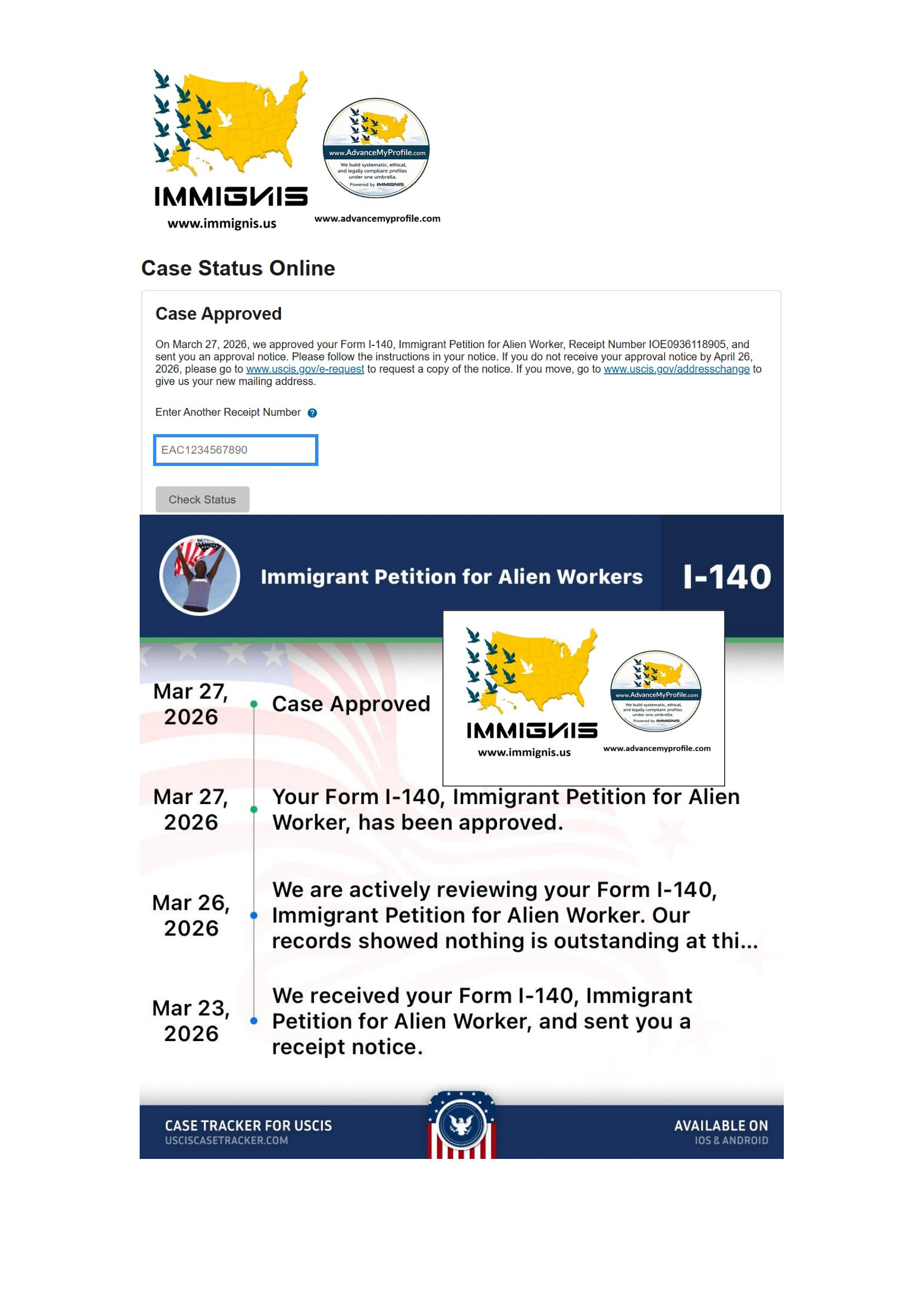
| Approval date | Approved on March 27, 2026. |
| Field niche | Zoonotic disease monitoring at wildlife-human interfaces, with a focus on surveillance signals that can support earlier public health and conservation response. |
| Starting problem | The record looked too conservation-focused. The work was valuable, but the petition needed to show why wildlife surveillance also mattered to human health, disease prevention, and recognized field-level expertise. |
| Evidence developed | Focused publications, surveillance dashboard evidence, a One Health policy paper, media interviews, peer review, invited talks, awards evidence, selective membership documentation, and independent letters from public health and conservation leaders. |
| EB-1A criteria supported in the petition | Scholarly articles, original contributions, published material, awards, judging, and memberships. Leading or critical role evidence also strengthened the final record where supported by the facts. |
| Approval theme | USCIS approved the petition after the record connected wildlife disease surveillance to zoonotic disease prevention and showed recognition beyond a regional conservation role. |
USCIS approved his Form I-140 on March 27, 2026, in this Wildlife Disease Scientist case.
The approval was not built around a dramatic outbreak. It was built around the quieter work that can happen before an outbreak is obvious: tracking signals at the edge of wildlife, livestock, and human communities, then turning scattered observations into a surveillance record that decision makers can use.
He was a Tanzanian wildlife disease surveillance scientist working with a U.S.-linked conservation network. His field sat at the point where conservation biology, field epidemiology, and public health begin to overlap. That overlap was also the problem. In his original record, the work could be read too narrowly as wildlife conservation. For EB-1A, the petition needed to show something more precise: his surveillance methods contributed to zoonotic disease monitoring at wildlife-human interfaces and were recognized by others beyond the immediate projects where he worked.
Advance My Profile, powered by Immignis, reviewed the record with legal strategists and domain specialists and helped define a One Health authority profile. The case did not try to make conservation sound like something else. It showed how disease surveillance in wildlife settings can form part of a broader early-warning system for public health risk.
The question was not whether wildlife mattered. It was whether his contribution was visible
Many scientists who work in conservation, ecology, and field surveillance face the same EB-1A problem. Their strongest work is practical, collaborative, and sometimes remote. They help design monitoring systems, train field teams, improve reporting tools, interpret unusual patterns, and connect local findings to wider health concerns. Yet the public record may show only a project name, a conservation objective, or an institutional program.
That was the initial risk in this case. A reader could see that he was involved in valuable conservation work. The harder question was whether the evidence identified his individual methods, showed recognition of his expertise, and explained why his work had significance in a field that includes public health surveillance, not only wildlife protection.
The petition therefore had to avoid two weak approaches. It could not rely on the importance of wildlife conservation in general. It also could not claim that every surveillance activity directly prevented disease in humans. The stronger strategy was narrower and more credible: document the surveillance questions he worked on, show how his tools and methods were used, and explain why monitoring disease signals at wildlife-human interfaces matters to One Health decision making.
His EB-1A niche was built around the point where field signals become health intelligence
Wildlife disease surveillance often begins with imperfect information. Field teams may see unusual mortality, changes in animal behavior, abnormal movement patterns, clinical signs, carcass reports, livestock contact, or human activity near wildlife habitat. None of those signals is a diagnosis by itself.
The professional question in this case was what happens next. Which observations should be recorded? Which patterns deserve escalation? What information should travel from a field report to a laboratory or public health partner? How should repeated signals across locations be compared without exaggerating risk or missing a trend?
By narrowing the profile this way, the record moved away from a broad conservation biography and toward a defined field: zoonotic disease monitoring at wildlife-human interfaces. That framing allowed USCIS to evaluate his work as a surveillance contribution with practical importance for disease prevention, conservation planning, and public health preparedness.
What did USCIS need to see in a wildlife disease surveillance EB-1A case?
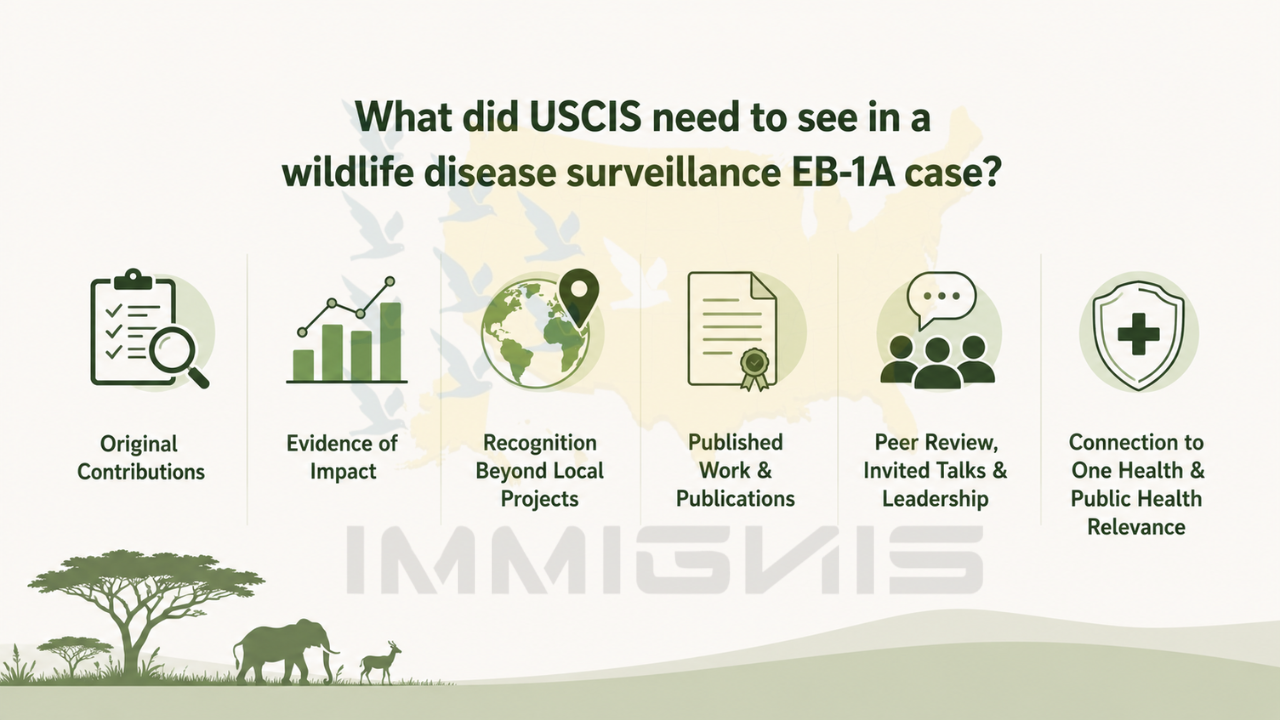
For EB-1A, a strong mission is not enough. USCIS reviews whether the evidence fits the regulatory criteria and then examines the record as a whole to decide whether the petitioner has sustained acclaim and a level of expertise consistent with extraordinary ability.
In this case, the petition needed to show why the scientist was more than a capable project contributor. The record had to identify his own surveillance methods, publications, field tools, expert recognition, peer-review activity, speaking invitations, awards or honors, and selective professional standing.
For original contributions, the file needed evidence of methods or tools linked to him, not only the importance of the conservation network. For scholarly articles, the publications had to connect to zoonotic disease monitoring, field surveillance, One Health systems, or allied subjects. Published material had to be about him or his expertise, not general reporting about wildlife disease. Judging required real evaluation of the work of others, such as peer review or professional review activity. Memberships required selective admission or advancement standards tied to professional achievement. Awards evidence had to be handled carefully, with nominations, finalist selections, and actual wins described accurately.
The final merits question then brought those parts together. Did the record describe a recognized wildlife disease surveillance scientist whose work had significance beyond one local project? That question shaped the case.
The conservation record was reorganized around surveillance decisions
The strongest work was not presented as a list of projects. It was organized around the decisions his work supported.
What should a field team record when animal health changes appear unusual? When should a wildlife report be compared with livestock or community health information? Which signals justify follow-up sampling, mapping, or notification to partner institutions? How should a dashboard distinguish routine background noise from a pattern that deserves closer review?
This structure helped the petition show an individual technical contribution. It traced the relationship between field observations, surveillance data, dashboard logic, reporting methods, escalation pathways, and the public health context of zoonotic risk. It also kept the claims disciplined. The case did not claim that a dashboard alone stops disease transmission. It showed that better surveillance can help specialists notice patterns earlier and make better decisions about investigation, communication, and response.
Publications gave the field a way to evaluate his method
The publication strategy focused on the subject that connected his past work: zoonotic disease monitoring at wildlife-human interfaces. The papers addressed surveillance design, field reporting, early warning signals, data quality, and the role of wildlife health information in One Health systems.
One paper examined how field reports can become more useful when observations are standardized and interpreted with ecological context. Another addressed the challenge of linking wildlife disease indicators to human and livestock risk without treating every animal event as a human outbreak signal.
This mattered because EB-1A cases involving field scientists often fail when publications and professional duties look disconnected. Here, the papers gave USCIS and independent experts a public record that matched the actual surveillance work. They also showed that the scientist was participating in the field as an author, not only as a project implementer.
The surveillance dashboard made the contribution concrete
Dashboard evidence helped move the case from description to function. Non-confidential materials showed how surveillance information could be organized, compared, and reviewed across locations or reporting periods.
The dashboard evidence did not expose protected data, sensitive species locations, or confidential partner information. It focused on the method: what types of signals were recorded, how information was structured, how patterns could be flagged for review, and how the tool supported communication between conservation and health stakeholders.
That kind of evidence was important for the original-contribution argument. A publication can explain an idea. A dashboard or surveillance tool can show how that idea entered practice. The petition connected both.
The One Health policy paper changed the audience
A conservation-only audience would have made the case narrower than it needed to be. The policy paper was written for public health, conservation, and institutional stakeholders who work where animal, human, and environmental health concerns meet.
It explained why wildlife disease surveillance cannot be separated from the systems that receive, interpret, and act on information. A weak field report may never reach the right reviewer. An isolated observation may be overread. A pattern spread across several reports may be missed if information is not organized consistently. The paper placed his work inside that operational problem.
This did not convert him into a clinician or public health official. It showed that his expertise helped one part of a wider One Health chain: the surveillance and data infrastructure needed to notice potential zoonotic risk at an earlier stage.
Media interviews helped explain the public health value without overstating the science
Media coverage and interviews were used to make the field understandable. The strongest public explanations did not depend on alarm. They explained that zoonotic disease monitoring is most useful when it avoids both extremes: ignoring early signals because they are uncertain, or turning every wildlife event into a public health emergency.
He discussed why field observations, animal movement, mortality reports, habitat pressure, and wildlife-human contact can become meaningful when they are recorded in a disciplined way and reviewed with the right context. That public explanation supported the published-material criterion and helped show that his expertise was visible outside internal project documents.
Peer review and invited talks showed that other specialists relied on his judgment
Peer review became important because it showed professional judgment being used outside his own projects. Journals and professional venues asked him to evaluate work involving wildlife disease, surveillance methods, One Health systems, field epidemiology, or conservation health data.
The petition documented actual review activity where available and explained what kind of judgment the reviews required. He was not merely commenting on broad conservation topics. He was assessing study design, surveillance logic, data interpretation, field methods, and whether conclusions followed from the evidence.
Invited talks served a different purpose. They placed his methods before audiences that could question the assumptions behind surveillance design. Those talks addressed practical questions: how to interpret weak signals, how to connect field and institutional data, when to escalate uncertainty, and how to build communication between wildlife and public health teams.
Awards and memberships were treated as evidence, not decoration
The awards record was documented with care. Where the evidence showed an actual award, the petition explained the basis, scope, and relevance of that recognition. Where the evidence showed a nomination, finalist position, or submission, it was not inflated into a win.
The membership evidence was handled the same way. Open enrollment in a professional association is not the same as selective membership. The petition identified membership or advancement evidence only where the organization used standards tied to achievement, expertise, or professional evaluation.
That discipline helped the record. EB-1A petitions become weaker when every badge or affiliation is treated as acclaim. This case focused on the evidence that could be defended.
Independent letters connected the work to One Health significance
Independent letters from public health, wildlife disease, and conservation leaders helped explain the significance of the work. The most useful letters did not simply praise the scientist. They identified the surveillance problem, described how his methods addressed it, and explained why structured monitoring at wildlife-human interfaces matters beyond one project site.
Those letters also helped translate the field for USCIS. A general reader may understand that outbreaks are dangerous. Fewer readers immediately understand why early wildlife surveillance, data discipline, and cross-sector reporting can matter before an outbreak is confirmed. The letters helped bridge that gap without making unsupported claims.
How the EB-1A evidence came together
The petition did not ask USCIS to approve him because wildlife conservation is important. It built a more specific record.
- Scholarly articles: Focused publications connected his authorship to zoonotic disease monitoring, One Health surveillance, field reporting, and wildlife-human interface risk.
- Original contributions: Dashboard evidence, surveillance methods, field-reporting logic, policy work, and expert letters showed how his contribution affected disease-monitoring practice.
- Published material: Media interviews and independent coverage explained his expertise in wildlife disease surveillance and public health risk monitoring.
- Judging: Peer-review activity showed that journals or professional venues relied on his judgment to evaluate the work of other specialists.
- Awards: Recognition was documented according to the actual evidence and tied to wildlife disease, One Health, conservation health, or surveillance work where supported.
- Memberships: Selective membership evidence was presented only where admission or advancement standards reflected professional achievement or expert assessment.
Together, these evidence streams told one coherent story. The scientist was not just part of conservation projects. He had developed and communicated disease-surveillance expertise that other specialists could evaluate, cite, invite, review, and recognize.
Why the approval matters for conservation and public health professionals
This approval is useful for scientists whose work sits between disciplines. A wildlife disease scientist may not fit neatly into one professional box. The work may involve ecology, data systems, public health, veterinary science, field surveillance, and conservation management. That can make the EB-1A story harder to tell, but not weaker.
The key is to define the professional contribution with enough precision. In this case, the strongest framing was not simply conservation leadership. It was zoonotic disease monitoring at wildlife-human interfaces, supported by public evidence, independent recognition, and a record showing that the work mattered to One Health surveillance.
For many field scientists, the lesson is clear: do not assume that valuable fieldwork speaks for itself. EB-1A requires an organized record of individual contribution, recognized expertise, and sustained acclaim. The work may begin in a forest, reserve, laboratory, dashboard, or community monitoring program. The petition still has to show why the field recognizes the person behind the work.
What similar professionals can learn from this case
A strong EB-1A record for wildlife disease, conservation health, or One Health work should usually answer four questions.
- What exact surveillance or disease-monitoring problem does the professional solve?
- Which methods, tools, publications, or programs can be attributed to the individual?
- Who outside the immediate employer or project recognizes the professional expertise?
- How does the work matter beyond a local implementation or routine project assignment?
When those answers are missing, even important work can look ordinary. When they are documented clearly, the record can show an expert whose contribution extends beyond a job description.
FAQs
Can wildlife disease surveillance support an EB-1A petition?
Yes, where the evidence shows more than routine project participation. The petition should identify the person’s own methods, tools, publications, recognition, and significance in a defined field such as zoonotic disease monitoring, One Health surveillance, or wildlife health systems.
Is conservation work enough by itself?
Not usually. Conservation importance may provide context, but EB-1A requires evidence of individual extraordinary ability. The record must show recognized achievements and sustained acclaim, not only participation in meaningful conservation projects.
Can a surveillance dashboard count as an original contribution?
It can support an original-contribution argument if the evidence shows what the dashboard did, how it was linked to the petitioner, how it changed surveillance or decision making, and why independent experts consider the contribution significant.
Do media interviews help EB-1A cases in scientific fields?
They can help if they qualify as published material about the applicant or the applicant’s expertise. General news about disease outbreaks or conservation issues is not enough unless it meaningfully discusses the professional or their work.
Why does public health framing matter in a wildlife disease case?
Public health framing can explain why monitoring disease at wildlife-human interfaces matters beyond species protection. It must still be accurate. The petition should not claim that wildlife surveillance alone prevents outbreaks, but it can show how disciplined surveillance supports earlier investigation and response.
Build an EB-1A record around the disease-surveillance work your field already uses
If you work in wildlife disease monitoring, One Health systems, conservation health, field epidemiology, veterinary surveillance, public health data, or environmental disease risk, your strongest EB-1A evidence may already exist across publications, tools, dashboards, field programs, peer review, speaking invitations, and institutional recognition.
Immignis and Advance My Profile help professionals identify a defensible authority niche, document individual contributions, build credible recognition, and prepare an EB-1A record around evidence that can be verified and professionally defended.