
Key facts at a glance
| Category | Details |
| Outcome | EB-1A approval for a Chinese microelectronics EDA researcher working at a Singapore-based chip design firm. |
| Approval date | Approved on September 17, 2024. |
| Field niche | EDA automation for secure chip design, with a focus on tool logic, design-flow security, verification support, and trusted microelectronics development. |
| Starting problem | The record looked like software engineering. It did not yet show why his automation work mattered as a microelectronics contribution or why the wider field recognized him. |
| Profile-building path | The record was developed through focused EDA papers, open-source tool adoption evidence, patent filing materials, technical media, conference committee work, peer review, selective membership evidence, and independent letters from microelectronics experts. |
| EB-1A evidence presented | Original contributions, scholarly articles, published material, judging, and memberships. Patent evidence supported attribution and the original-contribution record rather than functioning as a separate EB-1A criterion. |
On September 17, 2024, USCIS approved the Form I-140 petition of a Chinese microelectronics EDA researcher working at a Singapore-based chip design firm.
The approval did not come from presenting him as a general software engineer. It came from proving that his software work belonged to a narrower and more demanding field: electronic design automation for secure chip design.
That distinction mattered. Many professionals in chip design write code, automate tests, build scripts, or improve internal design flows. For EB-1A, the question is not whether the person uses software in a technical job. The question is whether the record shows original work, field recognition, and sustained acclaim in a specialty that other experts can identify and evaluate.
His case had to show that his tools were not merely convenient internal utilities. The petition needed to explain how his automation methods helped engineers address secure chip design problems and why those methods were visible beyond one employer.
Why the original record looked too much like ordinary software engineering
At first, the career record contained strong technical work but weak positioning. It described software, design support, automation, internal development, and engineering collaboration. Those descriptions were accurate, but they did not answer the EB-1A question clearly enough.
USCIS could have looked at the file and seen a capable engineer who built tools for a chip company. That would not be enough. EB-1A requires evidence that the person has risen to the top of the field through sustained national or international acclaim and recognized achievements.
The problem was not a lack of value. The problem was translation. His work sat inside design environments, automation flows, security checks, code repositories, internal reports, and chip development programs. Much of it was not written in language that an immigration officer, or even an outside microelectronics expert, could immediately connect to field-level significance.
Advance My Profile and Immignis reviewed the record with legal and technical attention and narrowed the case to one question: how did his automation work help make secure chip design more reliable, reviewable, or reusable?
The field was not generic EDA. It was automation for secure chip design
Electronic design automation is broad. It can include design entry, simulation, synthesis, verification, place-and-route, timing analysis, power analysis, testing, and many other parts of semiconductor development. A broad EDA label would have made the record less convincing because it would have described a large industry rather than the client’s actual contribution.
The case therefore focused on EDA automation for secure chip design. That niche connected his work to tool logic, design-flow controls, analysis automation, verification support, and the need to identify or reduce security-related design risk before a chip reaches later stages of development.
Secure chip design is not only about adding a security feature at the end. Security questions can arise in architecture, hardware logic, access controls, data paths, debug functions, interfaces, verification assumptions, and design reuse. A design-flow weakness may not look like a dramatic failure during ordinary development, but it can create risk if the wrong function is exposed, the wrong assumption is carried forward, or a review step is skipped.
His automation work was organized around those design-flow questions. What should be checked? Where should the tool run? Which design signals, modules, or interfaces require attention? How should the output be documented so that engineers can act on it? Which part of the flow makes the finding reproducible rather than dependent on one engineer noticing it?
What USCIS needed to see in a secure-chip EDA EB-1A case
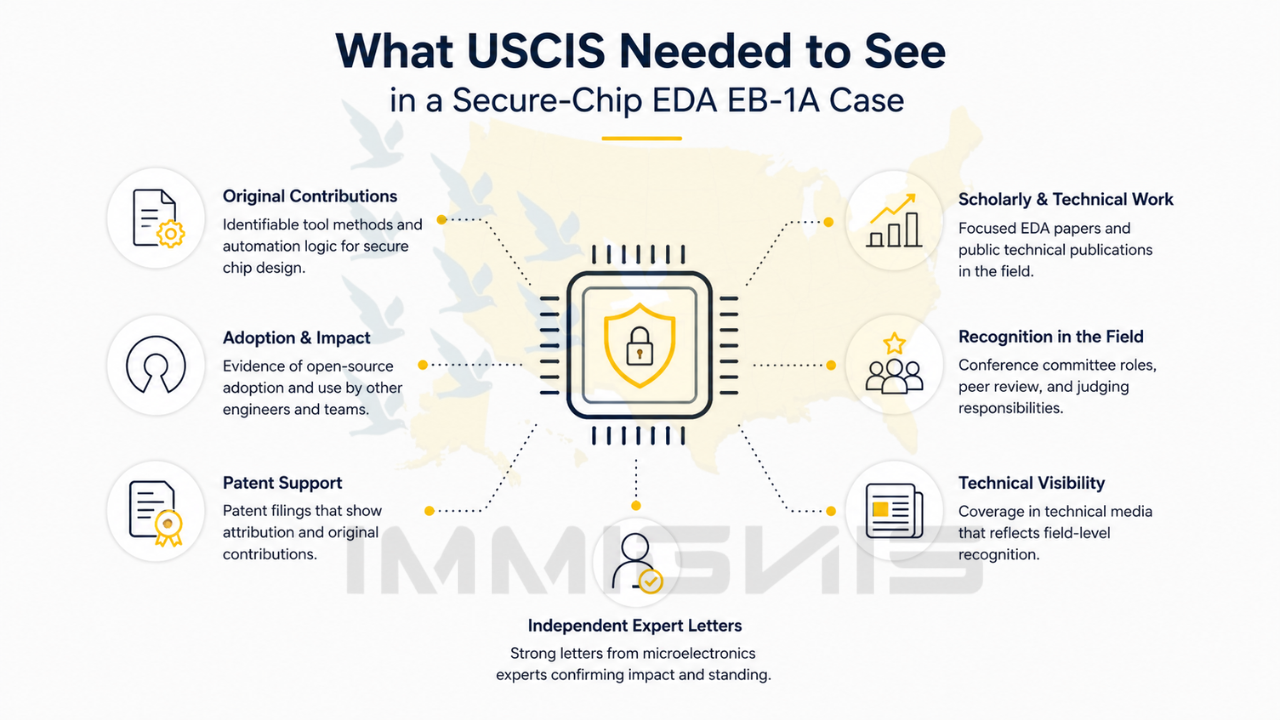
USCIS did not need a tutorial on every stage of semiconductor design. It needed a record showing that this researcher had made identifiable original contributions and that those contributions were recognized in the field.
For original contributions, the petition had to identify the tool methods, automation logic, security-oriented design analysis, open-source adoption, patent-related concepts, and expert explanations that connected the work to secure microelectronics development. Internal importance alone would not carry the argument.
For scholarly articles, the record needed focused authorship in EDA, secure chip design, design-flow automation, or related microelectronics subjects. Publications were most useful when they did not merely prove that he could write papers, but showed continuity between his research, tools, and professional authority.
For published material, the petition used independent coverage and technical media where the material discussed him, his expertise, or the secure-chip design problem. A generic article about semiconductors would not have been enough.
For judging, the record distinguished real evaluation from participation. Peer review, conference committee responsibilities, and review of technical submissions supported the judging criterion only where he actually assessed the work of other specialists.
For memberships, the evidence had to show selective admission or advancement based on achievement and expert assessment. Open professional enrollment was separated from qualifying membership evidence.
Patent evidence was handled carefully. A patent filing can help connect an inventor to a technical concept, but patents are not a separate EB-1A regulatory criterion. In this case, patent materials strengthened the original-contribution discussion and helped trace attribution.
The technical record was rebuilt around design-flow decisions
The strongest evidence was reorganized by engineering decision rather than by employer project name. That made the record easier to understand and more persuasive.
Instead of listing internal tools as a series of software tasks, the petition explained what each method helped a design team decide. Did the automation identify a security-relevant structure? Did it reduce manual review burden? Did it create a repeatable analysis step? Did it allow other engineers to check design assumptions earlier in the flow? Did it produce output that could be reviewed, compared, or reused?
This approach avoided a common weakness in EDA cases. A tool can sound impressive inside a company but vague outside it. By tying the tool to a design-flow decision, the record allowed independent experts to discuss the contribution without seeing protected customer designs, proprietary chip architecture, or confidential implementation details.
The public version did not disclose source code, customer information, protected design files, internal security findings, or proprietary design-flow configurations. It focused on the method, the problem addressed, and the evidence showing that the work was used or recognized.
Open-source adoption helped prove the software mattered outside one company
Open-source evidence was one of the most important parts of the case because it moved the story beyond internal engineering.
The petition did not claim that every download or repository interaction proved major significance. Adoption evidence had to be disciplined. Where the record supported it, the case documented outside use, technical engagement, community interest, references, implementation examples, or evidence that other engineers could examine and build from the work.
That evidence helped answer a difficult EB-1A question: if the work began inside a chip design environment, how did it become visible to the field?
Open adoption gave outside experts something concrete to evaluate. They could examine the tool purpose, its place in the design flow, its relationship to secure chip development, and why such automation can matter when design teams face complex review tasks.
The papers gave the tool work a research language
With domain support, he developed focused papers on EDA automation, secure hardware design flows, design-analysis methods, verification support, and automation for trusted microelectronics development.
The papers did not try to turn confidential engineering into public disclosure. They translated the research questions into non-confidential technical subjects. One paper examined how automation can make security-oriented design review more repeatable. Another discussed how design-flow tools can help engineers identify security-relevant structures before later verification or validation stages.
This was important because EB-1A adjudication often turns on coherence. A long publication list can still feel scattered if the subjects do not support a clear authority niche. In this case, the papers connected the researcher’s software, chip-design work, and secure-hardware expertise into one recognizable specialty.
The patent filing helped trace a technical concept to him
The patent filing was not presented as automatic proof of extraordinary ability. That would have overstated the evidence.
Instead, the petition used the filing to connect him to a technical concept in EDA automation or secure chip design. Where the filing record identified his role as an inventor, the case explained the problem the concept addressed and how it fit with the wider evidence.
The significance argument came from the surrounding record: the technical problem, his documented methods, open-source adoption, research authorship, independent expert analysis, and recognition from professional activities. The patent evidence supported attribution; it did not replace proof of field significance.
Technical media made the security problem understandable
Secure chip design can sound abstract to non-specialists. Technical media helped explain why automation matters in this field.
The coverage and commentary focused on practical questions: how chip teams review increasingly complex designs, why security-related assumptions should be checked earlier, and how automation can reduce dependence on one manual review step. It also helped separate the client’s work from general software development.
The article strategy avoided exaggerated claims. It did not say that one tool makes a chip secure. It explained that automation can make specific checks more repeatable, help engineers surface issues earlier, and give design teams a clearer record of what was reviewed.
Conference committee work and peer review showed that others trusted his judgment
Judging evidence required careful handling. Attendance at a conference would not qualify. Speaking at an event would not automatically qualify either. The file needed evidence that he evaluated work produced by others.
The record documented peer-review assignments and conference committee activity connected to microelectronics, EDA, secure hardware, design automation, or related technical fields. These activities showed that journals, conferences, or technical venues relied on his judgment when assessing other specialists’ work.
The reviews were significant because they asked him to evaluate technical methods, experimental claims, design-flow logic, tool usefulness, security relevance, and whether conclusions followed from the evidence. That is different from being listed as a participant or attendee.
Selective membership evidence was tied to the admission standard
Professional membership evidence can be weak when it only shows that a person paid dues. The petition avoided that problem.
The file identified the relevant selective membership or advancement standard, the professional criteria used, and the evidence that admission or elevation depended on achievement and expert assessment. That allowed the membership evidence to support recognition rather than serve as a generic resume item.
In the final record, membership did not stand alone. It reinforced the same identity shown by the papers, judging work, open-source evidence, and expert letters: a microelectronics specialist recognized for secure-chip EDA automation.
Independent letters explained why the contribution mattered
The independent letters were not used as compliments. They were used as technical analysis.
Microelectronics experts explained why secure chip design requires structured review, why EDA automation can affect the reliability of that review, and why the client’s work was more than a company coding assignment. The strongest letters connected the contribution to an actual technical problem and then explained its importance in the field.
This was essential because USCIS does not have to accept a company’s view of its own employee as proof of extraordinary ability. Independent experts helped bridge the gap between internal use and field significance.
How the EB-1A evidence worked together
The case did not depend on one document. It succeeded because the evidence pointed in the same direction.
- Original contributions: Tool methods, design-flow automation, open-source adoption, patent-related technical concepts, and independent expert analysis showed a contribution in secure-chip EDA automation.
- Scholarly articles: Focused papers connected his authorship to EDA, secure hardware, trusted microelectronics, and design automation rather than unrelated software topics.
- Published material: Technical coverage and expert commentary made the secure-chip design problem understandable and connected the client to that field.
- Judging: Peer review and conference committee records documented genuine evaluation of other specialists’ work.
- Memberships: Selective membership evidence was supported by admission or advancement standards based on professional achievement and expert assessment.
At final merits, the petition asked USCIS to view these pieces as one professional record. The client was not simply a software engineer who happened to work near chips. He was presented as an EDA researcher whose automation methods contributed to secure microelectronics design and whose work had become visible through adoption, publication, expert review, and professional recognition.
Why the approval matters for EDA and secure-hardware professionals
USCIS approved the Form I-140 on September 17, 2024. The approval is a useful example for professionals whose strongest work is technical, confidential, and difficult to explain outside their employer.
Many EDA researchers and chip-design automation specialists face the same problem. Their contributions may sit inside scripts, tools, design flows, verification support, review systems, or internal engineering records. Those materials can be valuable, but they are not automatically an EB-1A record.
A successful petition has to identify the method, prove attribution, show why the method matters, and connect it to recognition beyond ordinary employment. It must also protect confidential information while giving USCIS enough substance to understand the contribution.
This case shows how that can be done when the evidence is built around a precise technical niche and supported by public, independent, and field-specific recognition.
What this case teaches future EB-1A applicants
The first lesson is that software work can support EB-1A, but only when the record explains what the software did in the field. A coding role by itself does not prove extraordinary ability.
The second lesson is that open-source adoption can be powerful, but it must be documented carefully. The record should show real outside engagement, technical relevance, and a connection to the claimed contribution. Numbers without context can be weak; a clear adoption story can be stronger.
The third lesson is that confidentiality is not the end of the case. A petitioner does not need to expose protected chip designs or proprietary code. The public record can focus on methods, tool logic, non-confidential examples, expert explanation, and professional recognition.
The fourth lesson is that EB-1A profile building should not invent a new identity. It should reveal the real one. In this case, the work already existed. The strategy was to document it, make it intelligible, and build independent recognition around a defensible professional niche.
Frequently asked questions
Can EDA software work qualify for EB-1A?
Yes, EDA software work can support an EB-1A petition when the record shows original contributions, field recognition, and significance beyond routine employment. The petition should explain the technical problem, the method, attribution, and why other specialists recognize or use the work.
Is open-source adoption useful in an EB-1A case?
It can be useful when properly documented. Adoption evidence may show outside use, technical engagement, references, community interest, or implementation by others. The evidence should not exaggerate downloads or repository activity. It should explain what the tool does and why adoption matters.
Does a patent filing count as a separate EB-1A criterion?
No. Patent evidence is not a separate EB-1A regulatory criterion. It may help prove inventorship, attribution, and original contribution, but the case still needs evidence that the contribution has significance in the field.
Can confidential chip-design work be used without exposing company information?
Yes. A petition can use non-confidential summaries, public invention materials, safe technical descriptions, expert letters, publications, and adoption evidence. The goal is to explain the method and its significance without disclosing protected code, customer data, or proprietary chip details.
What is the main risk for software engineers filing EB-1A?
The main risk is presenting the case as ordinary software development. EB-1A requires a record of extraordinary ability in a defined field. The petition must show why the person is recognized for a specific contribution, not merely that they worked on important products.
Build an EB-1A record around the technical work the field can recognize
If you work in EDA, secure chip design, semiconductor verification, hardware security, microelectronics automation, or related engineering fields, your strongest contribution may not be obvious from your job title. It may be hidden inside tools, design-flow decisions, open-source projects, patent filings, review work, or technical methods used by other engineers.
Immignis and Advance My Profile help professionals identify a defensible authority niche, document original contributions, develop credible public recognition, and prepare EB-1A records around evidence that can be verified and defended professionally.