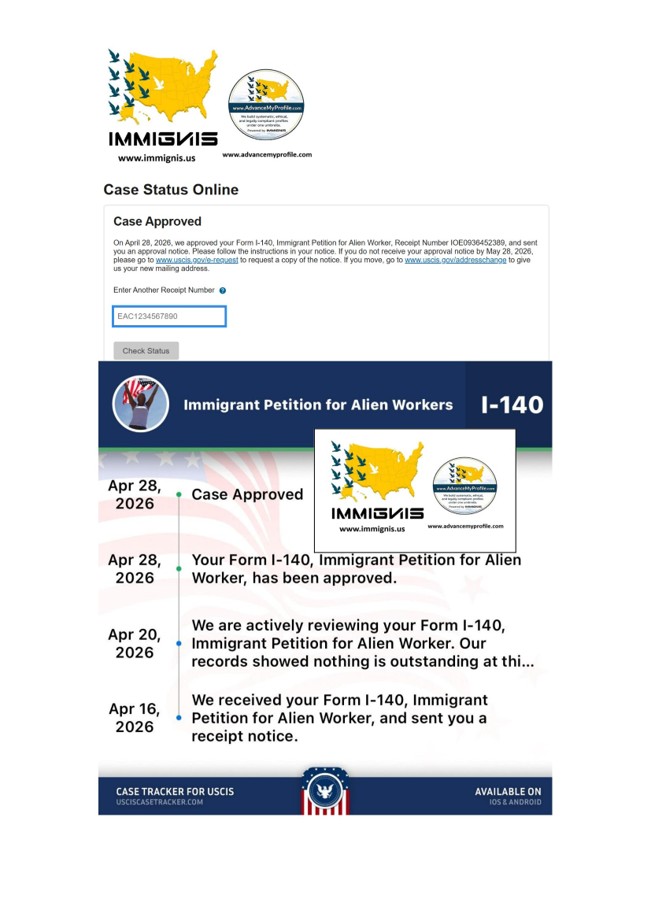
How a Filipino customer experience executive operations leader secured EB-1A approval by turning BPO performance into a field level record built on industry awards, methodology publication, CX-conference keynotes, analyst firm citations, judging roles, and compensation benchmarking.
Key facts at a glance
| Petition outcome | Form I-140 approved under EB-1A on April 28, 2026. |
| Professional profile | Filipino operations leader who built award-winning customer-experience programs serving global enterprises. |
| Field niche | Large scale customer-experience operations design. |
| Starting weakness | The industry looked like commodity outsourcing, while the petitioner’s best evidence lived inside confidential performance dashboards and internal systems. |
| Profile-building focus | Industry-award record, methodology publication, CX-conference keynotes, analyst-firm citations, judging for industry awards, and compensation benchmarking. |
| EB-1A criteria supported | Awards, published material, judging, leading role, and high remuneration. |
| Central issue | Proving that a BPO and customer-experience leader had recognized, field-level expertise rather than ordinary outsourcing management experience. |
| Approval lesson | A “commodity” industry role can become a strong EB-1A case when the petition shows a named methodology, external recognition, peer trust, and premium market value. |
The approval
On April 28, 2026, USCIS approved the Form I-140 petition of a Filipino customer experience executive whose work helped global enterprises improve customer service performance through large scale operational design and delivery.
Inside the outsourcing and customer-experience industry, the petitioner was already respected. Enterprise clients trusted his judgment. Internal teams relied on his systems. Senior leadership valued his ability to scale service quality across large programs and demanding performance environments.
For EB-1A, however, the petition had to prove more than strong management or successful delivery. It had to show extraordinary ability in a defined field, supported by evidence that reached beyond a company’s internal dashboards and client contracts.
That became the center of the case: converting a role that outsiders often dismiss as ordinary outsourcing management into a record of recognized expertise in customer experience operations design.
The evidence problem in customer-experience and BPO work
Customer experience leadership is difficult to document because the strongest proof often lives inside confidential client scorecards, quality dashboards, retention metrics, service level performance reports, internal playbooks, and enterprise contracts. Those materials may show real impact, but they are rarely presented in a way that clearly supports an immigration petition.
The petitioner’s starting weakness was not lack of impact. The weakness was how the field appeared on paper. To a non-specialist reader, BPO work can sound interchangeable: staffing, call handling, and routine service delivery. That oversimplified image hides the fact that some CX leaders design repeatable, high value operating systems that materially improve customer satisfaction, efficiency, and business performance.
This required a focused field definition. The case was not presented as generic outsourcing or ordinary customer support management. It was framed as large-scale customer experience operations design, with emphasis on methodology, enterprise service transformation, and industry-recognized execution.
That field definition gave the petition a usable measuring stick. The question was not simply whether the company served clients successfully. The question was whether this executive had built and led customer-experience systems in a way that the field itself recognized as exceptional.
Why customer experience work was not a commodity function
It would have been risky to present the case as ordinary BPO success. To many readers, outsourcing still sounds like volume based labor rather than expertise. In reality, advanced customer experience operations require specialized decisions about quality architecture, workforce design, escalation systems, performance controls, customer journey improvement, analytics, and enterprise delivery strategy.
The petition therefore treated customer service as the setting, not the achievement. The evidence had to show what the petitioner personally built, how his systems improved customer-experience performance, and why respected institutions in the field considered his work notable.
The strongest evidence came from industry award recognition, methodology publication, CX-conference keynotes, analyst firm citations, judging service, and carefully presented compensation data. Together, those materials showed that his work was not routine team supervision. It was recognized operating expertise with industry relevance.
That distinction changed the case. Instead of asking USCIS to accept a private outsourcing success story, the petition translated customer-experience leadership into evidence of extraordinary ability in a defined professional field.
Awards helped prove that the field recognized the work
In some EB-1A cases, acclaim appears through research citations, patents, or artistic exhibitions. In customer experience operations, recognition often appears through industry awards, quality distinctions, service-excellence rankings, and competitive recognition from respected organizations that evaluate operational performance.
The petition used that evidence carefully. The goal was not to claim that every company award automatically belonged to the petitioner. The goal was to show that he played a leading role in the systems and programs that won external recognition, and that the field recognized those results as exceptional rather than routine.
Good evidence did not say only that an award was won. It explained the petitioner’s role, the methodology behind the performance, the scale of the program, and why the result mattered to enterprise clients and the wider customer experience industry.
Those materials gave USCIS a concrete way to understand the petitioner’s standing. Awards became the public facing proof of operational excellence that otherwise would have remained buried in private service metrics.
Leading role evidence had to show strategic authority, not job title alone
Executives often assume that a senior title proves a leading role. For EB-1A, that is not enough. The petition had to show that the petitioner carried responsibility that was important to the organization and meaningful within the field.
The record documented his authority over customer experience strategy, operating design, client delivery standards, service quality systems, team performance architecture, and enterprise account outcomes. It showed that he was not merely managing an inherited process. He was helping create and refine the methodology that guided results at scale.
That evidence helped separate real leadership from ordinary operations employment. The case showed that his role influenced how programs were structured, how enterprise clients experienced service quality, and how large teams executed customer experience strategy across demanding environments.
For business professionals, this distinction matters. A company may have strong customer metrics. An EB-1A petition has to prove the individual’s responsibility inside those outcomes.
A methodology based case for top level CX leadership
Customer-experience executives do not always fit traditional EB-1A expectations. They may not invent a patentable technology or publish academic research. Their value often appears through systems thinking: building scalable methods that improve service consistency, customer satisfaction, resolution speed, and commercial performance.
For this petitioner, the case was built around named and repeatable operational methodology. The evidence showed how his approach improved delivery outcomes, structured service quality, and supported large enterprise relationships in a way that went beyond routine people management.
That mattered because USCIS looks for recognized distinction, not ordinary job competence. The record had to show that his work produced notable results and was acknowledged by external stakeholders, not only praised internally by his employer.
The petition did not claim that he transformed the entire global BPO industry alone. It made a narrower and stronger point: within the specialized field of large scale customer experience operations design, his leadership and methodology were significant enough to attract awards, speaking invitations, citations, and judging roles.
Published material and analyst visibility
The original profile had limited public visibility because many customer experience achievements are reported through client case studies, vendor announcements, analyst summaries, or internal leadership channels rather than through traditional media profiles of individual executives.
Trade coverage, analyst firm citations, and conference visibility helped make the petitioner’s expertise visible beyond private corporate systems. This mattered because published material gave USCIS an independent way to see that his work belonged to a broader industry conversation about customer-experience design, service transformation, and enterprise operations excellence.
The petition treated published material as support rather than decoration. The most useful public evidence connected his name to CX strategy, operational methodology, industry commentary, or recognized performance outcomes.
Judging roles showed that the field trusted his expertise
Judging evidence can be especially valuable in business cases because it shows that the field trusts the petitioner to evaluate the work of others. In customer-experience and BPO industries, service on award panels, benchmarking committees, or industry-recognition programs can show meaningful professional standing.
The petition therefore used judging evidence in context. It showed where the petitioner was not just attending events, but was trusted to assess excellence in customer experience programs, service design, or operational leadership.
That evidence mattered because it moved the record beyond self-promotion. A judging role signals that peers and institutions consider the petitioner knowledgeable enough to evaluate professional quality in the field.
High remuneration strengthened the market-valuation argument
Compensation evidence can be persuasive in EB-1A business cases when the numbers are placed in proper market context. Large salaries alone do not prove extraordinary ability, but they can help show that the market places unusual value on the petitioner’s specialized skill set.
In this case, compensation benchmarking supported the broader story. The petitioner was not paid merely as a routine operations manager. The record positioned his remuneration against comparable roles in customer experience leadership and showed that the market rewarded his level of expertise at an unusually high level.
That fit well with the rest of the evidence. When awards, publications, speaking roles, and judging service are already present, high remuneration helps confirm that the field values the petitioner in a way that matches the claimed standing.
Why the petition worked
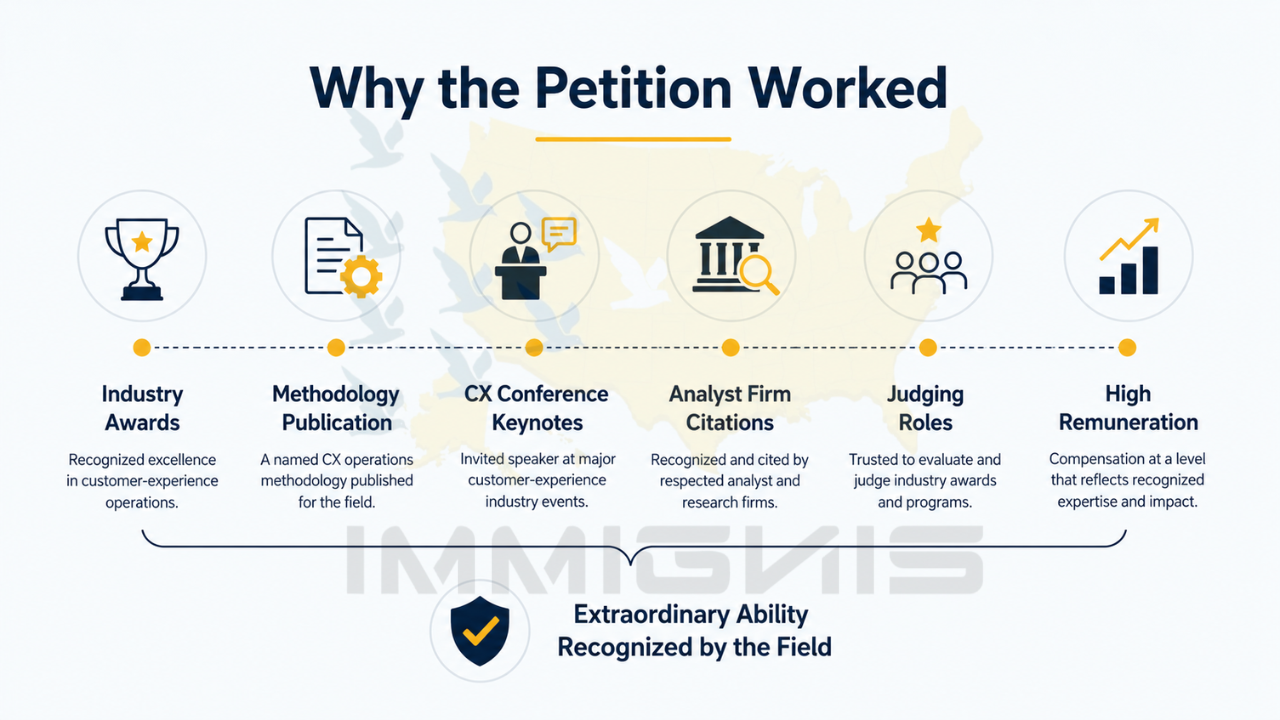
The success of the case came from disciplined framing. Instead of fighting USCIS on the broad question of whether outsourcing matters, the petition defined a narrower professional niche and then supported that niche with evidence the agency could recognize.
- It showed that the petitioner was not simply part of a large BPO machine. He was a recognized CX operations leader whose methods, judgment, and leadership had earned external recognition, public visibility, peer trust, and premium market value.
- That framing allowed the evidence to work together. Awards showed recognition. Published material and analyst citations showed visibility. Judging showed peer trust. Leading-role evidence showed organizational importance. Compensation showed market valuation.
- Most importantly, the petition repositioned the field itself. It taught USCIS that advanced customer-experience operations design is not a commodity function when the work is method-driven, externally recognized, and valuable enough that the industry seeks out the petitioner’s expertise.
- The broader lesson for customer experience and BPO professionals
- This case offers a useful roadmap for BPO executives, CX leaders, operations directors, enterprise-delivery heads, service-design specialists, and business-process strategists whose careers are often misread as ordinary management rather than top-level professional distinction.
A strong EB-1A case in this space usually depends on identifying evidence that translates operational value into public and peer-recognized achievement. That means moving beyond internal dashboards and showing how the field itself has recognized the petitioner.
For many professionals in customer experience, that evidence may include industry awards, conference speaking, trade bylines, analyst recognition, judging roles, compensation benchmarking, and employer cleared summaries of business impact.
It also helps to define the field precisely. “Customer service” sounds generic. “Large scale customer-experience operations design” is a more specific and measurable niche, especially when the record shows methodology, enterprise scale, and independent validation.
This case worked because the petition made that shift clearly and consistently.
Approval showed that a BPO executive can qualify when the evidence speaks the field’s language
USCIS approved the petition because the final record did not rely on vague claims about leadership or general business success. It showed external recognition, measurable professional standing, and a clear field niche supported by multiple forms of evidence.
The case did not ask the agency to assume that BPO success equals extraordinary ability. It showed why this petitioner, in this field, stood above the ordinary through awards, visibility, judging, authority, and market value.
That is the central lesson of the approval. A professional role that appears ordinary at first glance can become a compelling EB-1A case when the petition identifies the real field, explains the methodology, and presents evidence that the industry itself already recognizes.
For this Filipino customer experience executive, the petition did not overstate internal corporate metrics or depend solely on client confidentiality. It identified the public and disclosure safe proof that could fairly show his own standing: awards, publications, analyst references, keynote platforms, judging roles, and compensation.
The approval confirmed the central lesson of the case: when an industry is wrongly treated as a commodity, the petition must show the named expertise, recognized methodology, and external validation that make the petitioner exceptional within it.
Lessons for CX leaders, BPO executives, and operations professionals
This case is useful for customer-experience executives, BPO leaders, service-delivery heads, operations directors, quality leaders, and enterprise-account professionals whose strongest proof often stays inside company systems or confidential client relationships.
A strong record usually begins with the following questions:
- Can awards, analyst mentions, or conference invitations connect clearly to the petitioner’s own leadership rather than just the company brand?
- Can employer-cleared materials explain the petitioner’s operational methodology and why it improved customer-experience outcomes?
- Do trade publications, conference organizers, analyst firms, or awards bodies recognize the petitioner by name?
- Can compensation benchmarking show that the market values the petitioner’s expertise above ordinary operational roles?
- Can judging or panel service show that the industry trusts the petitioner to evaluate excellence in the work of others?
When those questions are answered with documents, a private operations career becomes much easier for USCIS to evaluate. That is often the difference between respected internal leadership and a successful EB-1A record.
Frequently asked questions
Can a customer-experience or BPO executive qualify for EB-1A?
Yes. A customer-experience or BPO executive may qualify for EB-1A if the evidence shows sustained acclaim and extraordinary ability in a clearly defined field such as customer-experience operations design, service transformation, or enterprise CX leadership.
Can industry awards help a BPO executive qualify for EB-1A?
Yes. Industry awards can be valuable when the petition explains the significance of the award, the competitiveness of the recognition, and the petitioner’s personal role in the work that received the distinction.
Do analyst-firm citations and trade publications help prove extraordinary ability?
Yes. Analyst commentary, trade press coverage, and professional publications can help show that the petitioner is visible in the field and recognized independently of the employer’s private records.
Can judging industry awards support an EB-1A petition?
Yes. Judging evidence can be powerful because it shows that peers or institutions trust the petitioner to evaluate the work of other professionals in the field.
Does high remuneration matter for an EB-1A customer experience executive?
High remuneration can support EB-1A when it is compared against relevant market benchmarks and helps show that the field values the petitioner at a level above ordinary operations leaders.
Can Immignis and Advance My Profile help BPO and CX professionals build EB-1A evidence?
Immignis and Advance My Profile help customer-experience leaders, BPO executives, and operations professionals define a credible field niche, document impact, improve visibility, and build a petition-ready EB-1A evidence record.
Build an EB-1A record around customer experience leadership and verifiable recognition
Many customer experience professionals create measurable business value, but their strongest proof stays inside dashboards, client programs, and enterprise reporting systems.