Green hydrogen engineer EB-1A approval was secured by a Moroccan chemical engineer who converted confidential process-performance evidence, water-use and energy-integration work, hydrogen publications, patent records, international conference roles, industry working-group participation, expert letters, and project-attribution documentation into a clear record of extraordinary ability.
Key facts at a glance
| Petition outcome | Form I-140 approved under EB-1A on October 21, 2024. |
| Professional profile | Moroccan chemical engineer developing electrolysis and process-integration methods for renewable hydrogen and green-ammonia production. |
| Field niche | Green-hydrogen process efficiency in arid, renewable-energy regions. |
| Starting weakness | Major projects drew investment and media attention, but the engineer’s water-use, energy-integration, and process-design contributions remained behind corporate announcements and confidential project files. |
| Profile-building focus | Cleared process-performance evidence, hydrogen-technology publications, patent records, international energy-conference roles, industry working-group participation, expert letters, project-attribution records, and published material. |
| Principal EB-1A evidence areas developed | Original contributions of major significance, authorship of scholarly articles, leading or critical role, achievement-based professional recognition where supportable, and published material about the petitioner and the petitioner’s work. |
| Central issue | Showing that the petitioner did more than participate in a large clean-energy project and instead made identifiable process decisions that improved water use, energy integration, reliability, and practical hydrogen production. |
| Approval lesson | Green-hydrogen work can support EB-1A when confidential project results are translated into cleared evidence, technical authorship, independent attribution, professional recognition, and a precise field definition. |
The project was visible; the process decisions were not
Green-hydrogen projects are easy to recognize from the outside. They are announced through investment figures, renewable-power capacity, production targets, export plans, and partnerships. The individual engineering work that determines whether those plans can operate efficiently is far less visible.
The petitioner worked on electrolysis and process integration for hydrogen and green-ammonia production in a region with strong solar and wind resources but limited water. Her most valuable work concerned the points where a project could lose efficiency: electricity variability, electrolyzer operation, water treatment, compression, storage, heat management, downstream synthesis, and the coordination of these systems under real operating constraints.
USCIS approved the Form I-140 petition on October 21, 2024. Immignis and Advance My Profile organized the record around one central question: how could a large corporate clean-energy project be separated into evidence of one engineer’s original work without disclosing protected information or claiming credit for the entire project?
Why green hydrogen cases can look stronger in the news than in a petition
Hydrogen projects often receive broad public attention before their technical record is mature. Announcements describe scale, investment, strategic importance, or national energy policy. Those facts may explain why a project matters, but they do not identify what one engineer personally contributed.
The technical evidence also tends to be scattered. It may appear in process simulations, design reviews, mass and energy balances, pilot reports, operating envelopes, water-quality studies, equipment specifications, patent files, conference abstracts, and internal decision records. Much of it was created to move the project forward, not to document an immigration profile.
The petition therefore defined the field narrowly as green-hydrogen process efficiency in arid, renewable-energy regions. That field definition connected the petitioner’s work on electrolysis, water use, process integration, and green-ammonia production without turning the case into a general claim about renewable energy.
Cleared process performance evidence converted confidential work into reviewable proof
The strongest evidence existed inside project files that could not be submitted without review. Raw design documents could contain proprietary process conditions, vendor information, commercial assumptions, equipment choices, or future production plans. The case did not solve that problem by omitting the achievements. It solved it through cleared summaries and corroborating records.
Each summary identified the technical problem, the petitioner’s role, the analysis or design decision involved, and the resulting improvement that could be disclosed. Depending on the record, this included reduced parasitic energy demand, better coordination between variable renewable power and electrolyzer operation, lower water losses, improved equipment utilization, or stronger integration with downstream ammonia production.
The petition avoided unsupported precision. Where exact commercial figures were confidential, it used authorized ranges, relative performance, documented design changes, or evidence that the petitioner’s recommendation was adopted. This made the record specific enough to evaluate without exposing protected information.
Water use made the field narrower and the contribution easier to understand
Hydrogen production is often described as an electricity problem, but in arid regions it is also a water-management problem. Water treatment, purification losses, brine management, cooling demand, and competing local uses can affect whether a project is technically and socially workable.
The petitioner’s profile became clearer when water use was treated as part of process engineering rather than as a separate environmental topic. The evidence showed how water-quality requirements, treatment systems, recovery rates, cooling strategy, and electrolyzer operation interacted with overall plant efficiency.
This helped establish a distinct professional niche. The case was not simply about producing hydrogen from renewable power. It was about making that production practical in places where sunlight and wind were abundant but water could not be treated as an unlimited utility.
Energy integration showed the difference between equipment knowledge and system design
A project can contain advanced equipment and still perform poorly if the systems are not integrated well. Renewable generation varies. Electrolyzers have operating limits. Compression, storage, synthesis, utilities, and maintenance requirements do not always follow the same profile.
The petition documented the petitioner’s work at those interfaces. Process models, design reviews, control concepts, operating scenarios, and technical correspondence showed how she evaluated renewable-power availability, electrolyzer loading, buffer storage, downstream demand, and plant reliability as one system.
This evidence supported the argument that her contribution was not routine equipment selection. It involved technical judgment about how separate units should operate together so that the project could produce useful fuel with less waste and fewer avoidable constraints.
Green ammonia integration connected hydrogen science to a usable product chain
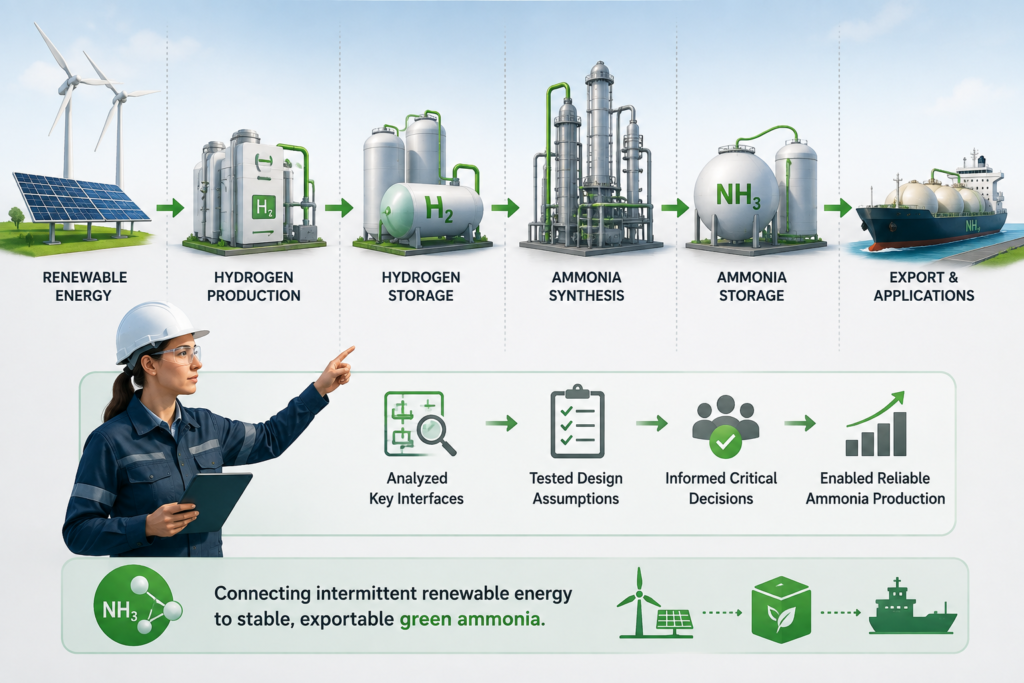
Hydrogen is difficult to store and transport. Many large projects therefore connect renewable hydrogen to ammonia production. That connection creates another layer of process complexity because hydrogen generation, nitrogen supply, compression, synthesis, heat recovery, storage, and export conditions must be coordinated.
The record explained the petitioner’s role in that integration without claiming that she designed every unit. It identified the interfaces she analyzed, the design assumptions she tested, and the decisions that depended on her work. Where a project team adopted her recommendations, the evidence documented who made the decision and why her analysis mattered.
This made the contribution understandable to a non-specialist. The petitioner was not credited merely because she worked on a high-profile green-ammonia project. She was credited because the record showed how her process work helped connect intermittent renewable energy to stable, exportable chemical production.
Publications gave the engineer a record beyond project announcements
Hydrogen-technology publications helped establish authorship and technical depth outside confidential corporate work. The strongest articles addressed process efficiency, electrolysis integration, water management, hydrogen or ammonia systems, plant optimization, or related engineering methods.
The petition did not rely only on publication count. It identified the petitioner’s contribution to each paper, especially where the work was collaborative. First-author or corresponding-author roles were emphasized when accurate, while contribution statements and coauthor evidence explained her responsibility in multidisciplinary publications.
This evidence supported the scholarly-articles criterion and strengthened the original-contribution analysis. It showed that the petitioner could translate project experience into technical knowledge available to the wider profession.
Patent records documented inventive work, but not significance by themselves
Patent and invention records were useful because they identified the petitioner as an inventor and described technical solutions in a formal public record. Relevant inventions could concern electrolysis operation, process control, water treatment, heat integration, storage, or system configuration.
The petition explained the problem addressed by each invention and the petitioner’s role in the inventive concept. It did not treat the existence of a patent as automatic proof of major significance.
Implementation, testing, adoption, licensing, project reliance, or independent expert evidence was used separately where available. This distinction made the patent evidence more credible and prevented novelty from being confused with field-level impact.
Project attribution letters identified who made the consequential decisions
Letters from project leaders, technical directors, equipment partners, consultants, and independent experts were important because large energy projects divide responsibility across many organizations. A job title alone could not show which decisions belonged to the petitioner.
The strongest letters identified the process issue, the petitioner’s assigned responsibility, the analysis she performed, and the effect of her recommendation. They also explained the writer’s basis of knowledge and avoided generic praise.
Independent experts provided field context, while direct collaborators supplied attribution. Used together with project records, publications, and patents, the letters helped USCIS distinguish personal technical contribution from general participation in a prestigious project.
International conferences and working groups showed recognition beyond one employer
International energy and hydrogen conferences gave the petitioner a public technical platform. Invited presentations, panel roles, technical sessions, and workshop participation were documented through programs, speaker pages, correspondence, and presentation materials.
Industry working groups and technical committees also helped show that others relied on her judgment. The case described the actual work performed, such as contributing to technical guidance, reviewing process issues, discussing safety or efficiency methods, or helping shape professional recommendations.
Ordinary membership was not treated as achievement-based membership. Where the evidence did not meet the regulatory membership standard, it was used as supporting proof of professional recognition, technical service, or final merits rather than overstated as a separate criterion.
Published material connected the engineer’s name to the clean energy work
Corporate announcements often describe a project without naming the engineers behind it. Published material became useful when professional, trade, or major media coverage identified the petitioner and discussed her work rather than merely mentioning the employer.
Technical interviews, profiles, conference coverage, and articles about hydrogen process design could help establish public recognition when the outlet and content met the regulatory requirements. Articles written by the petitioner were kept under the scholarly-articles criterion and evaluated separately.
This distinction mattered. It allowed the petition to show both authorship by the petitioner and independent coverage about her without blending the two categories.
Leading role was shown through technical authority rather than corporate rank
Large energy projects often have complex management structures. A process scientist may hold technical authority over a critical workstream without being the project director or highest-ranking executive.
The petition examined who approved design assumptions, led process reviews, resolved integration problems, coordinated technical interfaces, advised equipment decisions, or was called upon when the project encountered difficult performance questions.
Evidence of leading or critical role came from responsibility matrices, meeting records, design-review documents, project letters, work-package ownership, and the importance of the petitioner’s function to a distinguished organization or project. The argument rested on actual responsibility, not title inflation.
Why the case worked
• The field was defined precisely as green-hydrogen process efficiency in arid, renewable-energy regions.
• Confidential project achievements were converted into cleared evidence rather than omitted or described vaguely.
• Water use, electrolysis, renewable-power variability, storage, and green-ammonia integration were treated as connected process problems.
• Project records and direct-witness letters identified the petitioner’s decisions without attributing the whole project to her.
• Publications and patents created a technical record outside corporate announcements.
• International conference roles and working-group participation showed recognition beyond one employer.
• Published material connected the petitioner’s name to the work while authored articles remained under the correct criterion.
• The petition separated originality, major significance, authorship, professional recognition, published material, and leading role instead of blending them together.
The approval did not rest on the general importance of hydrogen or climate policy. It rested on evidence that this engineer made identifiable process contributions, was trusted with consequential technical work, and had a record of recognition extending beyond one internal project file.
What other hydrogen and process engineering professionals can learn
Clean-energy professionals often have stronger records than their public profiles suggest. A project may depend on their models, integration decisions, troubleshooting, or water and energy analysis, while public materials credit only the company or project consortium.
The practical lesson is to preserve attribution as the work develops. Keep contribution records, cleared design summaries, decision logs, presentation materials, publication roles, patent documents, working-group evidence, and letters from people who directly observed the technical responsibility.
A successful profile does not need to expose confidential project information. It needs enough authorized detail to show what the engineer did, why the problem was difficult, how the work was used, and why others in the field recognized the contribution.
How ethical profile building changed the record
The profile-building work did not create an achievement that had not occurred. It made genuine work legible. Existing project results were organized, personal contribution was separated from institutional reputation, and public-facing activities were developed only where they reflected the petitioner’s real expertise.
That included preparing accurate technical publications, documenting completed conference and working-group service, obtaining specific attribution letters, preserving patent and invention records, and identifying media opportunities tied to verified work.
Profile building should never manufacture acclaim, disclose protected information, or present ordinary participation as field leadership. Its purpose is to create a clear, accurate record of achievements that already have professional substance.
Frequently asked questions
Can a green-hydrogen process engineer qualify for EB-1A?
Yes, when the evidence establishes sustained acclaim and shows that the engineer belongs among the small percentage at the top of the defined field. Working on a major hydrogen project alone is not enough; the petition must document personal contribution, significance, recognition, and the final merits record.
Does participation in a large hydrogen project prove a leading role?
Not by itself. The record should show actual technical authority, such as ownership of process integration, design assumptions, water strategy, work-package leadership, technical approvals, or responsibility for resolving consequential engineering issues.
Can confidential process data be used in an EB-1A petition?
Often yes, through authorized summaries, redacted records, relative performance evidence, ranges, expert letters, and other material that explains the contribution without revealing protected information.
Can water-efficiency work support an original-contribution claim?
It can when the petitioner developed or applied a method that produced a documented improvement, was adopted or relied upon, and had significance beyond ordinary project duties. The general importance of water conservation is not enough by itself.
Do hydrogen patents automatically prove a contribution of major significance?
No. A patent may establish inventorship and novelty, but major significance generally requires additional evidence of implementation, use, adoption, licensing, project reliance, or independent recognition.
Can hydrogen publications satisfy the scholarly-articles criterion?
Yes, when the petitioner authored qualifying scholarly articles in the field. The petition should explain the petitioner’s role in collaborative papers and connect the publications to the defined specialty.
Can conference speaking count as an EB-1A criterion?
Speaking is not a standalone regulatory criterion. It may support original contribution, leading role, published material, or final merits when the event, selection, audience, and subject matter show professional recognition.
Can reviewing hydrogen papers or proposals count as judging?
Yes. Completed review of journal manuscripts, conference submissions, research proposals, technical competitions, or comparable work may support the judging criterion when the subject matter and completed duties are documented.
Does ordinary membership in a hydrogen association satisfy the membership criterion?
Usually not. The criterion requires admission based on outstanding achievements judged by recognized experts. Working-group or committee service may still support professional recognition, leading role, or final merits.
How can an engineer prove individual credit in a corporate project?
Contribution maps, responsibility matrices, design-review records, technical correspondence, patent files, publications, meeting records, and letters from people with direct knowledge can separate the engineer’s work from the broader project.
What counts as published material about the engineer?
Qualifying material generally discusses the engineer and the engineer’s work in professional, major trade, or major media outlets. Articles authored by the engineer belong under the scholarly-articles criterion and should be treated separately.
Can compensation evidence support a green-hydrogen case?
It may support the high-remuneration criterion when reliable comparisons show that the petitioner’s pay was significantly high relative to others in the same or a closely comparable field and market. Salary alone does not prove extraordinary ability.
Does the strategic importance of hydrogen prove extraordinary ability?
No. The importance of hydrogen provides context, but the petition must still prove the petitioner’s own achievements, significance, recognition, and standing in the field.
How can ethical profile building strengthen this type of case?
It can organize existing evidence, preserve contribution attribution, develop accurate publications and presentations, document completed professional service, obtain specific validation letters, and connect the record to the correct EB-1A criteria without fabricating achievements.
Make the process scientist visible behind the project announcement
A strong green-hydrogen record may already exist across design reviews, process models, water studies, pilot reports, patents, publications, conference programs, working-group files, expert correspondence, and project decisions. The weakness may be that the records describe the project more clearly than the engineer.
to identify which achievements can be documented now, which confidential records need cleared summaries, and which ethical profile-building activities may strengthen a future petition.