USCIS approved the Form I-140 after the petition showed that his EHR analytics work was not ordinary hospital IT, but a patient-safety infrastructure contribution.
Key facts at a glance
| Outcome | EB-1A approval for a Lebanese health informatics architect working in a Qatar-based hospital system. |
| Approval date | Approved on September 15, 2025. |
| Field niche | Interoperable EHR analytics for hospital safety and staffing, with a focus on connecting clinical, operational, and staffing data so hospital teams can make safer decisions. |
| Starting problem | His work sat inside hospital IT and analytics programs. The record needed to show a field-wide health informatics contribution rather than routine implementation or dashboard development. |
| Profile-building path | Focused health-informatics papers, safety dashboard evidence, a hospital-association white paper, invited webinar, expert commentary, peer review, professional membership evidence, leading-role documentation, and independent letters. |
| EB-1A criteria supported | Scholarly articles, original contributions, published material, judging, memberships, and leading or critical role. |
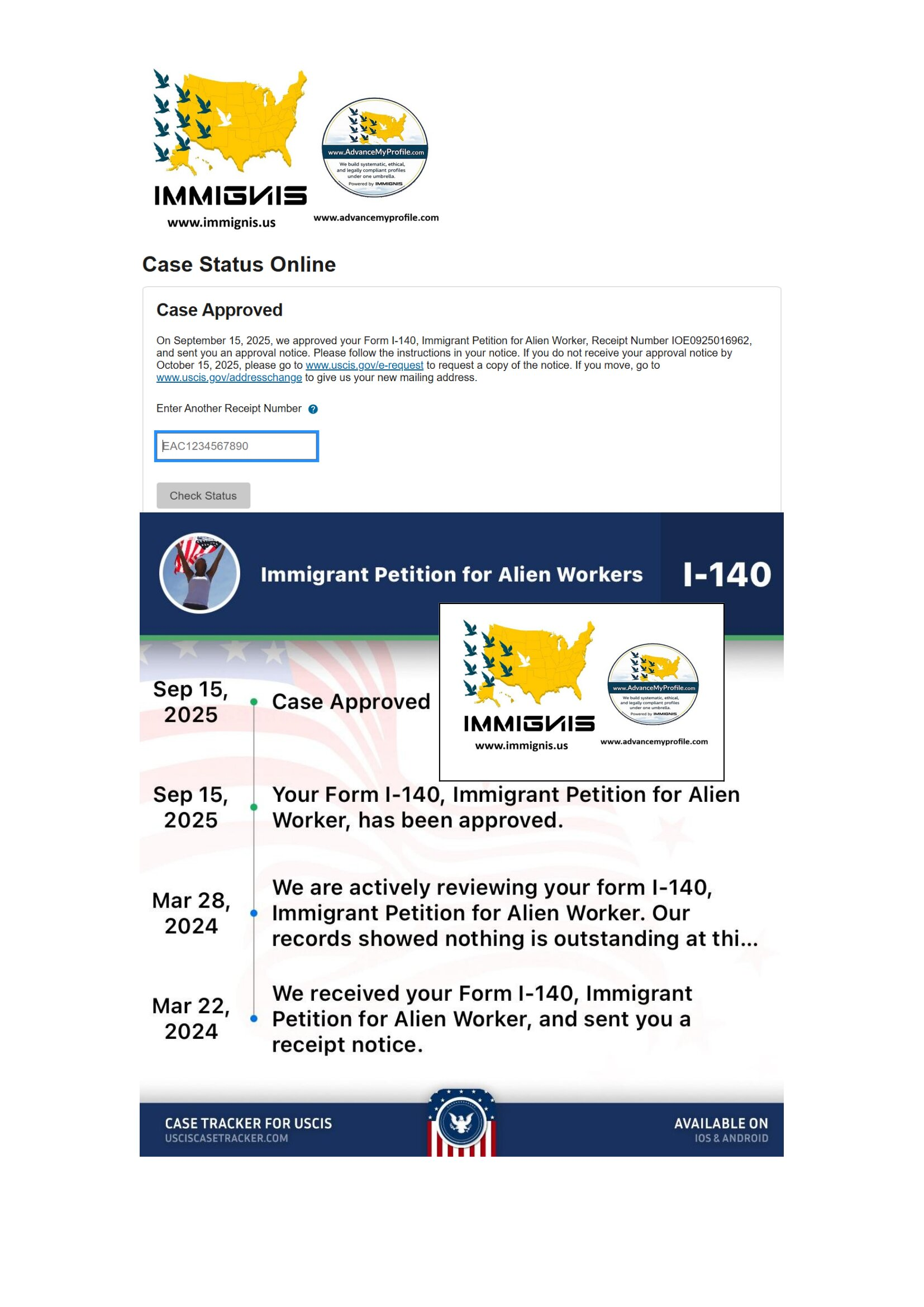
USCIS approved his Form I-140 on September 15, 2025.
The approval was not based on the idea that hospital data is important in the abstract. Many hospitals have electronic health records, dashboards, reporting teams, and analytics projects. The harder question in this EB-1A case was whether the record showed a health informatics architect whose own work had been recognized as significant beyond ordinary hospital IT duties.
He was a Lebanese health informatics architect working in a Qatar-based hospital system. His focused area was interoperable EHR analytics for hospital safety and staffing. In practical terms, his work concerned what happens when clinical data, bed-status information, staffing inputs, acuity signals, and operational records have to move from separate systems into a form that patient-safety and hospital leaders can actually use.
Before profile building, his record had a familiar weakness. The work was useful, technical, and relied upon inside hospital operations, but the story sounded like implementation: dashboards, data flows, system integration, reporting, and internal analytics. That can be valuable work. It is not automatically an EB-1A record.
Advance My Profile, powered by Immignis, reviewed the evidence with legal strategists and health informatics specialists. The case was narrowed to a clear authority niche: interoperable EHR analytics for hospital safety and staffing. That focus helped the petition explain why his work mattered, how it was attributable to him, and why independent experts considered it significant.
Why hospital IT work can disappear inside the system it improves
Health informatics professionals often work in places where success is quiet. A data feed becomes more reliable. A staffing dashboard updates before a unit is already in crisis. A patient-safety committee receives cleaner information. A hospital leader sees a risk pattern earlier than before. None of that necessarily creates a public record.
That was the problem. His strongest work lived inside hospital infrastructure. It appeared in technical architecture, analytics design, safety dashboard evidence, workflow documentation, and leadership reliance. To an immigration officer, however, those records could look like ordinary employment unless the petition explained the method, the impact, and the recognition around it.
The case could not simply say that he worked with EHR data. It had to answer better questions. Which problem did he repeatedly solve? Which methods were his? How did his work affect safety or staffing decisions? Who outside his immediate employer recognized his health informatics judgment? What evidence showed that the contribution belonged to him and was not just a hospital-wide project?
Those questions shaped the final petition.
His niche was the point where hospital data becomes a safety decision
Electronic health records contain large amounts of clinical information, but patient-safety and staffing decisions often depend on more than one system. A hospital may need to understand patient acuity, admissions, discharges, transfers, staffing levels, bed capacity, alerts, handoffs, and timing. If those signals are delayed, inconsistent, or poorly mapped, the hospital may have data without a dependable decision process.
His work focused on that gap. He helped design analytics structures that connected clinical and operational information in a usable way. The evidence showed work on data definitions, interoperability logic, dashboard design, safety metrics, staffing-related indicators, role-based access, update timing, and the documentation needed to make analytics useful inside a hospital setting.
The petition did not present him as a general IT manager or a generic data analyst. It focused on the architecture and health informatics judgment behind interoperable EHR analytics, especially where the analytics supported patient-safety review and staffing decisions.
That narrower field gave the EB-1A record a coherent center.
What USCIS needed to see in a health informatics EB-1A case
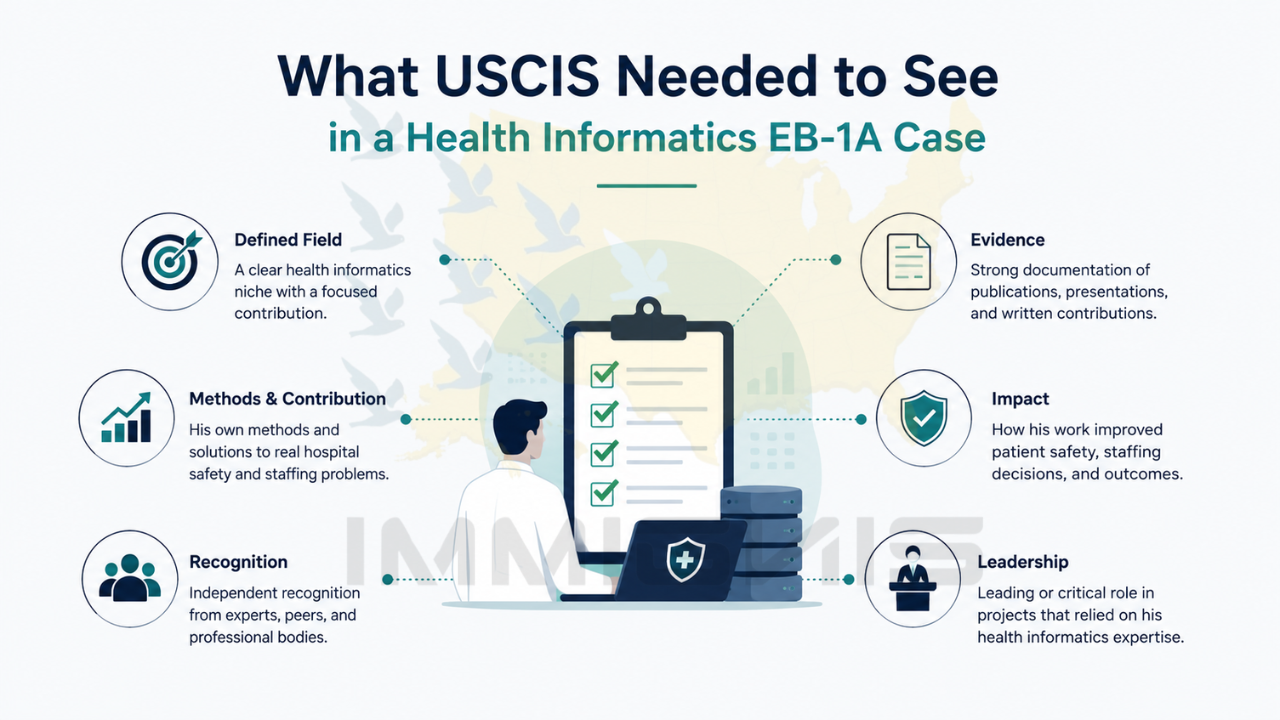
USCIS needed evidence that the applicant was recognized for extraordinary ability in a defined field, not merely employed in an important hospital technology role.
For original contributions, the petition identified his interoperable analytics methods, safety dashboard work, data-integration logic, and documented use of his work inside hospital decision processes. Independent experts explained why those contributions mattered to health informatics, patient-safety infrastructure, and staffing visibility.
Scholarly articles had to do more than mention digital health. They needed to connect his authorship to the same professional niche: EHR analytics, interoperability, hospital safety, staffing intelligence, data reliability, and the operational use of clinical information.
Published material required independent coverage about him or his expertise. Expert commentary helped show that he was explaining hospital data and safety analytics to a wider audience, not only managing internal systems.
Peer review supported judging only where he actually evaluated the work of other specialists. Professional membership evidence had to show a meaningful admission or advancement standard, not open enrollment. Leading or critical role evidence needed to show that significant health informatics work depended on his judgment, architecture decisions, or technical leadership.
At final merits, the petition still had to show that the record as a whole described a professional with sustained acclaim and recognized achievements in health informatics. A group of criteria labels was not enough. The evidence needed to tell one consistent story.
The internal record was rebuilt around hospital decisions, not software tasks
The profile-building work began by separating hospital technology activity from health informatics contribution.
Instead of organizing the evidence by project name or system name, the petition grouped records by decision problem. What information did safety leaders need? Which data sources had to connect? What definition or timing issue could mislead the dashboard? How did staffing context change the interpretation of patient load? Which workflow used the analytics output?
This structure helped the case avoid a common weakness in health IT petitions: treating the existence of a dashboard as if the dashboard itself proves extraordinary ability.
The evidence focused on the architecture behind the dashboard. It showed how clinical and operational signals were selected, connected, defined, refreshed, and presented. It also showed how his role affected the development or use of those analytics in hospital safety and staffing contexts.
Protected patient information, internal security details, hospital identifiers, and confidential implementation documents stayed outside the public story. The petition used safe descriptions, role evidence, non-confidential dashboard material, expert analysis, and public-facing work to prove the contribution without exposing sensitive health data.
The health informatics papers gave the case a public technical record
With domain support, he developed focused papers on interoperable EHR analytics, patient-safety dashboards, staffing-related data indicators, and the practical limits of using clinical information across hospital systems.
One paper examined why patient-safety analytics can fail when data definitions are inconsistent across clinical and operational systems. Another addressed the relationship between staffing visibility, patient acuity, and dashboard timing. The papers did not claim that analytics alone can solve hospital safety. They explained how better data architecture can support safer review and decision-making.
This mattered because internal hospital evidence can be difficult for USCIS to evaluate. The publications gave independent experts and the petition a public technical language for the same work that had previously been buried inside hospital infrastructure.
The safety dashboard evidence showed practical use without overstating outcomes
The safety dashboard evidence was one of the most important parts of the case because it connected the method to hospital practice.
The record showed non-confidential dashboard structures, use contexts, role documentation, and the decision points the analytics supported. It identified where the dashboard helped organize information about safety indicators, staffing pressure, patient movement, or operational status.
The petition stayed disciplined. It did not claim that one dashboard prevented every safety event, solved staffing shortages, or produced clinical outcomes that the records did not prove. Instead, it showed that his analytics work improved the hospital information infrastructure used for safety and staffing review.
That distinction strengthened the case. EB-1A evidence does not become stronger when it exaggerates. It becomes stronger when it explains exactly what changed, who relied on it, and why the change matters in the field.
The white paper translated hospital analytics for a wider professional audience
The hospital-association white paper addressed a problem many health systems recognize: hospitals may collect large amounts of data while still struggling to turn that data into timely safety and staffing intelligence.
The paper organized the issue around EHR interoperability, data definitions, patient-flow signals, staffing context, safety indicators, dashboard reliability, governance, and the need to preserve clinical judgment. It was not a product brochure. It explained the informatics problem and the decision logic behind better analytics.
For the EB-1A petition, the white paper helped move the record outside one hospital system. It showed that the applicant could explain a technical health informatics issue to the professional community and that his expertise was relevant to broader hospital safety infrastructure.
Invited speaking and commentary made the expertise visible
An invited webinar gave him a public platform to explain the practical side of interoperable analytics. He discussed why hospital leaders need more than raw EHR extracts, how timing and definitions affect dashboard reliability, and why staffing analytics must be read in clinical context.
His expert commentary addressed the same theme for a broader audience. He explained that hospital safety analytics depends on trust in the underlying data. A dashboard may look precise, but if the inputs are delayed, mismatched, or stripped of context, the display can create false confidence.
Those public explanations helped establish recognition outside internal hospital meetings. They also made the article record, media record, and expert letters point toward the same professional identity.
Peer review and membership evidence showed professional trust
Peer review created judging evidence because he evaluated work produced by other health informatics, digital health, data analytics, or hospital-safety specialists. The petition documented actual review activity where available and explained the substance of the judgment involved.
He assessed whether studies used appropriate methods, whether analytics claims followed from the data, whether interoperability assumptions were clear, and whether conclusions were supported by the evidence presented.
The membership evidence was handled carefully. The petition did not treat open professional association membership as proof of extraordinary ability. It documented the applicable admission or advancement standard and explained how the evidence supported the regulatory requirement.
Independent letters connected the technology to patient-safety infrastructure
Independent letters were important because a hospital system can value an employee for many reasons that do not necessarily show EB-1A-level recognition.
The strongest letters did not simply call him talented. They explained the health informatics problem, described why interoperable EHR analytics is difficult, identified the part of the work linked to him, and discussed why that work mattered to safety and staffing infrastructure.
Experts addressed the difference between building a report and building a reliable decision system. They explained that hospitals need analytics that can connect clinical information to operational realities, including acuity, staffing, patient movement, and timing. That outside explanation helped USCIS see the field significance of work that otherwise might have looked like internal hospital technology support.
How the EB-1A evidence came together
The final record did not depend on one document. It worked because the evidence reinforced the same narrow field niche from several directions.
The scholarly articles showed public authorship in interoperable EHR analytics, safety dashboards, and staffing-related health informatics. The original-contribution evidence connected his methods and dashboard work to hospital safety and staffing infrastructure. Published material and expert commentary showed public recognition of his expertise. Peer review showed that other professionals trusted his judgment. Membership evidence helped support recognition where the admission or advancement standard was selective. Leading-role evidence showed that significant hospital analytics work relied on his technical judgment.
The petition also handled final merits directly. It explained why the whole record described a health informatics architect with recognized expertise, not merely a hospital employee who had worked on data projects.
The approval
On September 15, 2025, USCIS approved his Form I-140.
The approval did not mean that every hospital IT professional with dashboard experience qualifies for EB-1A. It showed that a carefully documented health informatics record can succeed when it identifies the applicant’s own contribution, connects that contribution to a meaningful field problem, and shows recognition beyond ordinary employment.
For this client, the case turned hospital analytics work into an immigration record that could be understood by an adjudicator. The story was no longer only about systems and reports. It was about interoperable EHR analytics for hospital safety and staffing, supported by publications, practical evidence, judging, membership documentation, leading-role evidence, public explanation, and independent expert recognition.
What other health informatics professionals can learn from this case
Many health informatics professionals assume their work will be understood because hospitals rely on it. That is risky. USCIS does not see the daily consequences of better data architecture unless the petition explains them.
The strongest EB-1A cases in this area usually do three things well. First, they define the field narrowly. Second, they show how the applicant’s work is different from ordinary implementation. Third, they support the record with independent recognition, public authorship, judging, and evidence that the work entered real health-system decision processes.
A long list of dashboards, systems, committees, and implementation projects can still leave the officer asking what the applicant personally contributed. A stronger record identifies the method behind the projects and shows why others in the field recognize it.
Frequently asked questions
Can a health informatics professional qualify for EB-1A?
Yes. A health informatics professional may qualify if the record shows extraordinary ability through sustained acclaim and recognized achievements. The petition must prove more than routine hospital IT work or ordinary analytics responsibilities.
Can EHR analytics support an original-contribution argument?
Yes, when the evidence identifies the applicant’s own methods, shows practical use or significance, and includes independent expert explanation. A dashboard by itself is usually not enough. The petition should explain the data architecture, decision problem, and field relevance.
Can internal hospital work be used in an EB-1A petition?
Yes. Internal hospital work can be useful when documented safely. The petition should protect patient information and confidential systems while using non-confidential summaries, role evidence, public technical work, and expert letters.
Does working for a major hospital system prove leading or critical role?
No. The organization may be important, but the petition still must show why the applicant’s own role was leading or critical. Evidence may include leadership records, responsibility for important analytics infrastructure, reliance by hospital teams, and expert or employer documentation.
Is peer review useful for a health informatics EB-1A case?
Yes. Peer review can support the judging criterion when the applicant actually evaluated work by other specialists. The record should document review invitations, completed reviews where available, and the relevance of the reviewed work to the field.
Should a health informatics EB-1A petition claim improved patient outcomes?
Only if the evidence supports that claim. Many strong cases can succeed by showing improved safety infrastructure, better decision support, or documented use without overstating clinical outcomes that cannot be proven.
Build an EB-1A record around the health informatics method your hospital already relies on
If you work in EHR analytics, hospital interoperability, patient-safety dashboards, clinical data architecture, staffing analytics, digital health operations, or hospital decision support, your strongest EB-1A evidence may already exist inside your work. The challenge is showing what part belongs to you and why it matters beyond routine implementation.
Immignis and Advance My Profile help professionals identify a defensible authority niche, document original contributions, develop credible public recognition, and prepare an EB-1A record around evidence that can be verified and defended professionally.