Kyrgyz Glaciologist EB-1A: How a Kyrgyz scientist secured EB-1A approval by documenting authorship of Tien Shan glacier datasets, strengthening first author publications, developing international cryosphere roles, expanding climate media visibility, and turning fieldwork that supported foreign led studies into a personal record of extraordinary ability.
Key facts at a glance
| Petition outcome | Form I-140 approved under EB-1A on September 16, 2024. |
| Professional profile | Kyrgyz glaciologist tracking Central Asian glacier retreat and its effect on downstream water planning. |
| Field niche | Tien Shan glacier mass-balance and water security modeling. |
| Starting weakness | The fieldwork was demanding and scientifically valuable, but publication access was limited and foreign principal investigators received much of the visible credit. |
| Profile-building focus | First-author repositioning, dataset authorship documentation, international cryosphere-network roles, climate media coverage, conference platforms, peer review, expert letters, and immigration specific profile building. |
| Principal EB-1A evidence areas developed | Scholarly articles, original contributions, published material, judging, and leading role. |
| Central issue | Showing that the scientist who produced and maintained foundational glacier data had an individual record of distinction, even when many papers and collaborations were led by larger foreign institutions. |
| Approval lesson | In data-heavy science, the person responsible for the numbers can have field level influence even when someone else appears first on the paper. |
The approval
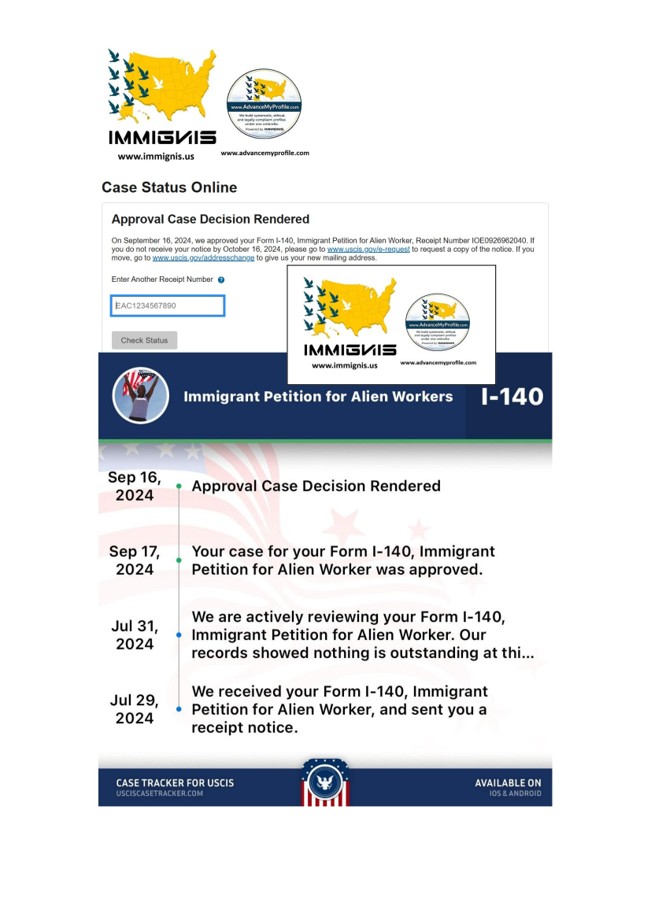
On September 16, 2024, USCIS approved the Form I-140 petition of a Kyrgyz glaciologist whose work focused on Tien Shan glacier mass balance and the connection between glacier change and long-term water security.
EB-1A is the first preference immigrant classification for people who can demonstrate extraordinary ability in the sciences, arts, education, business, or athletics through sustained national or international acclaim.
This case did not begin with a shortage of serious work. It began with a shortage of visible credit. The petitioner had spent years helping collect, clean, interpret, and preserve glacier measurements from difficult mountain environments. Those measurements fed research papers, models, and regional discussions. Yet the public record often placed the foreign principal investigator, grant holder, or corresponding author at the center.
Immignis and Advance My Profile built the immigration record around a simple question: who made the data dependable? Once the answer was documented, the case stopped looking like a junior role inside international projects and began to show a scientist whose work supported much of the research around it.
The numbers came before the recognition
Glacier mass-balance research measures whether a glacier gains or loses ice over time. A useful record depends on repeated field observations, consistent methods, instrument checks, weather data, elevation measurements, careful calculations, and enough continuity to distinguish a real trend from a single unusual season.
That work is easy to overlook in a publication list. Readers see a graph or a modeled projection. They do not see the travel to remote sites, the maintenance of measurement points, the decisions made when instruments fail, or the long process of checking whether one year’s data can be compared honestly with the next.
For this petitioner, the scientific product was not only a paper. It was a trusted time series. The petition had to explain why producing and safeguarding that record was intellectual work, not routine assistance.
Why glacier science created an authorship problem
International climate research often joins local scientists with universities, donors, and principal investigators from larger research systems. The arrangement can bring equipment, funding, and publication opportunities, but it can also hide the person who understands the field site best.
In the petitioner’s collaborations, the most visible authorship frequently followed the institution controlling the grant or journal submission. The petitioner might have carried responsibility for the local measurements, data continuity, quality checks, and interpretation, while appearing later in the author list or only in acknowledgments.
That imbalance was the starting weakness. The work was respected enough to be used, but the professional profile did not yet make the petitioner’s ownership of the scientific foundation easy to see.
Data authorship became the strongest evidence
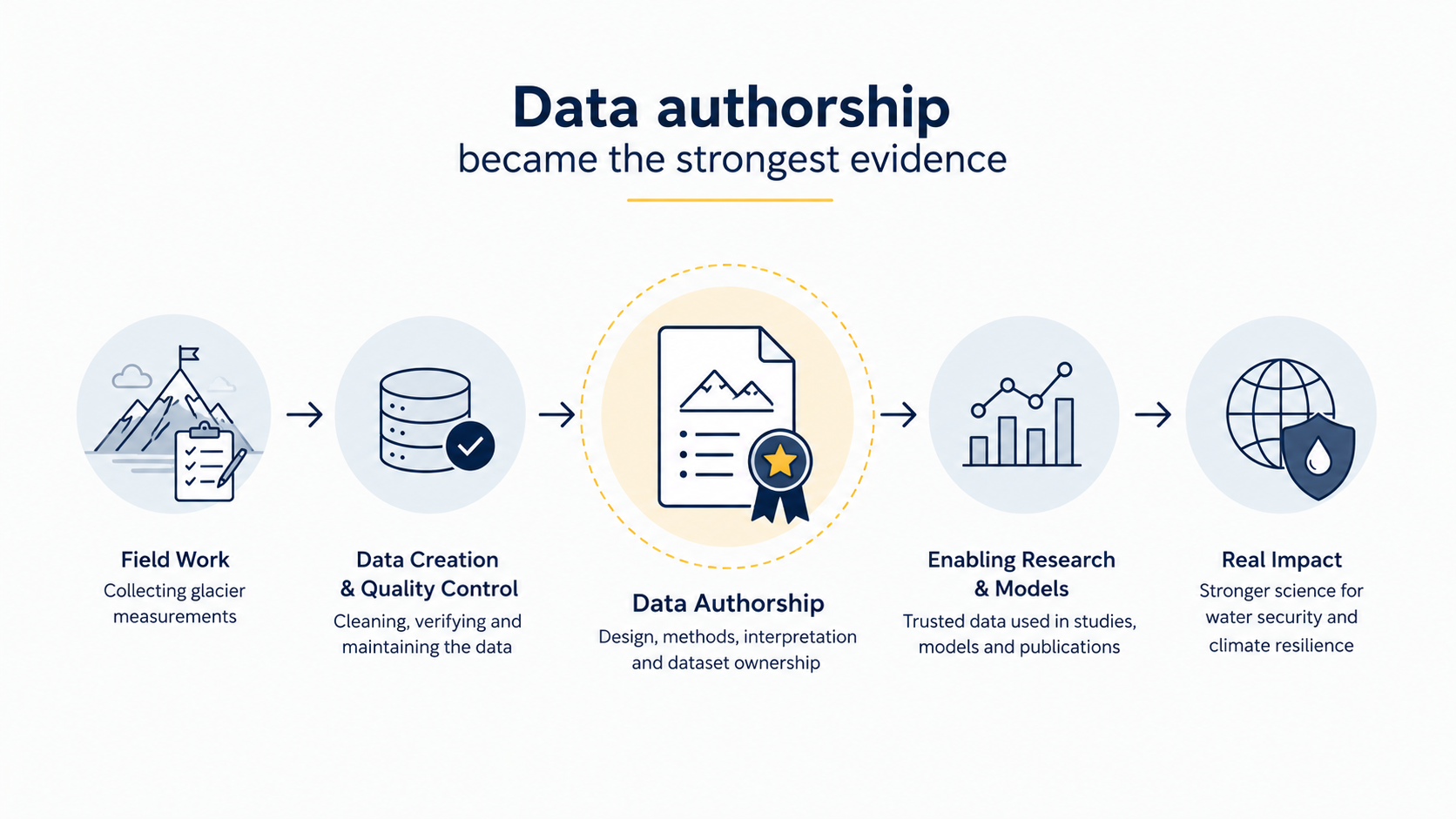
The case was reorganized around dataset authorship. Instead of treating data collection as background support, the petition mapped the petitioner’s responsibility for how the glacier record was created, verified, maintained, and prepared for use.
The documentation connected field responsibility with the intellectual decisions behind the numbers: measurement design, method consistency, calibration, quality control, metadata, corrections, interpretation, and the conversion of raw readings into model-ready information. Where available, field records, dataset descriptions, collaboration documents, repository records, and expert letters helped trace that responsibility to the petitioner.
This mattered because a dataset can influence far more work than one article. Other researchers may use it to test a model, compare glacier behavior, estimate runoff, study hazards, or examine water availability. When the petition showed that other work depended on the petitioner’s data, the original contribution argument became much more concrete.
The approval hook was therefore not a slogan. It was a documentary theory of the case: the petitioner owned the scientific responsibility behind numbers that other researchers needed.
First-author repositioning corrected the public record
Dataset documentation alone was not enough. The petitioner also needed a clearer written record under their own authorship. The profile building strategy placed greater emphasis on first author and lead author work tied directly to Tien Shan mass balance, glacier change, runoff modeling, and water security interpretation.
This did not mean claiming sole credit for collaborative science. It meant choosing subjects where the petitioner’s own methods, data knowledge, and conclusions could be stated plainly. New publications and conference papers gave the scientist a visible research identity that matched the work already being performed.
The publication record then served two purposes. It supported the scholarly articles criterion, and it helped the officer understand that the petitioner was not simply supplying measurements to other people’s research. The petitioner was also formulating questions, explaining methods, and drawing conclusions from the record.
Original contribution was shown through reliance on the data
A paper can be cited for many reasons. A dataset is used because another researcher believes it is dependable enough to build on. That distinction became useful in this case.
The petition focused on independent reliance: research teams incorporating the measurements, models using the data as inputs, regional analyses drawing on the time series, and specialists explaining why continuity in the petitioner’s field record mattered. The strongest evidence linked outside use to the petitioner’s identifiable work rather than to the project name alone.
This approach also avoided an exaggerated claim that every study using Tien Shan data belonged to one person. The argument was narrower and more credible. The petitioner made an original contribution by producing and stewarding a scientific resource that others could not easily replace.
Cryosphere networks moved recognition beyond one project
International cryosphere network roles helped separate the petitioner’s reputation from the foreign-led collaborations that had initially dominated the profile. Participation in specialist networks, technical groups, glacier monitoring communities, and cross border research platforms showed that the petitioner was recognized as a professional in the field, not only as a local contact for one project.
These roles also gave context to the work. Glacier monitoring depends on comparable methods and long-term cooperation across countries. A scientist trusted in those networks contributes to how measurements are discussed, shared, checked, and used.
For immigration profile building, the value was straightforward: the petition could point to professional reliance beyond the home institution and beyond a single principal investigator.
Conference platforms and peer review strengthened judging and standing
The case also developed public and peer-facing roles. Conference presentations, technical panels, workshops, and cryosphere meetings gave the petitioner a place to explain the data and its implications directly.
Peer review and evaluation work were documented where the petitioner assessed journal submissions, abstracts, methods, datasets, or other scientific work. These activities were relevant to the judging criterion because they showed trust in the petitioner’s ability to evaluate the work of other professionals.
The point was not to collect titles for their own sake. Each role had to fit the field niche. A glacier scientist reviewing work on cryosphere methods, hydrology, climate observations, or mountain hazards tells a more coherent story than unrelated professional activity.
Climate media coverage made the water security connection understandable
Glacier mass balance is technical. Water security is immediate. Climate media coverage helped connect the two without turning the petition into a general climate change argument.
The strongest public facing material explained how changes in mountain ice can alter the timing and reliability of downstream water, affect planning, and increase concern about drought, floods, and glacial hazards. The petition linked that larger issue back to the petitioner’s measurements and modeling rather than relying on generic reporting about climate change.
This supported published material evidence when the coverage discussed the petitioner or the petitioner’s work. It also made the final record easier for a non-specialist officer to follow.
A leading role did not require being the foreign principal investigator
One of the most useful lessons from this case is that leadership in field science is not limited to the person whose name appears on the grant. In remote monitoring work, the scientist who preserves continuity, knows the site, trains field teams, resolves measurement problems, and protects the integrity of the record may hold a central role even without the largest institutional title.
The petition documented that kind of responsibility. It explained why the collaboration would lose scientific value if the measurements became inconsistent, the metadata were incomplete, or local interpretation was removed from the analysis.
That framing helped support the leading-role argument. It showed operational and scientific dependence on the petitioner, not just participation in someone else’s project.
How Immignis and Advance My Profile built the record
Before profile building, the petitioner’s career could be summarized too easily as difficult fieldwork, several collaborative papers, and participation in international research. That description was true but incomplete.
Immignis and Advance My Profile reorganized the record around authorship, reliance, and professional trust. The work included first author repositioning, dataset-authorship documentation, field specific publication planning, conference visibility, cryosphere-network roles, peer-review activity, climate media coverage, and expert letters explaining why the data mattered.
The process did not manufacture acclaim. It corrected the way the career was documented. The petitioner already had the measurements and the scientific responsibility. Immigration specific profile building made those facts visible under the evidence categories USCIS evaluates.
Why this case worked
The case worked because each part of the evidence answered the same authorship problem. First author publications showed a clear research voice. Dataset records traced responsibility for the underlying numbers. Independent use showed that the data mattered beyond one paper. Network roles and conferences showed recognition outside the home institution. Peer review showed that the field trusted the petitioner’s judgment.
The field niche was also narrow enough to be meaningful. The petition did not present a general climate scientist. It presented a specialist in Tien Shan glacier mass balance and water-security modeling, then explained how achievement is recognized in that work.
Most importantly, the petition did not ask USCIS to equate difficult fieldwork with extraordinary ability. It documented why the fieldwork produced a scientific resource, who was responsible for that resource, and how other professionals relied on it.
What other field scientists can learn
Researchers in hydrology, ecology, geology, public health, agriculture, archaeology, and other field based sciences often face the same problem. They generate the observations that make larger studies possible, while senior investigators or better-funded institutions receive the visible authorship.
A stronger immigration record begins by separating participation from ownership. Who designed the protocol? Who maintained the time series? Who made the quality control decisions? Who prepared the data others used? Who was contacted when the record needed interpretation? Those questions often reveal evidence that a publication list alone misses.
The lesson is not that data automatically prove EB-1A eligibility. The lesson is that data responsibility can become persuasive when it is documented through attribution, outside reliance, authorship, peer trust, and a coherent final record.
Conclusion
The Kyrgyz glaciologist’s EB-1A approval shows how a team-based scientific career can become a personal immigration record when the petition identifies the person behind the foundational data.
The strongest part of the case was data authorship. First author publications, glacier-dataset documentation, international cryosphere roles, conference platforms, peer review, media coverage, and expert validation worked together because they all pointed to the same conclusion: other research depended on the petitioner’s scientific responsibility.
The client’s name and identifying details are omitted to protect privacy. The professional field, approval date, and evidence strategy reflect the case record.
Frequently asked questions
Can a glaciologist qualify for EB-1A?
Yes. A glaciologist can qualify when the record demonstrates sustained recognition through original scientific contributions, scholarly authorship, judging, leading roles, published material, or other qualifying evidence, followed by a persuasive review of the record as a whole.
Can dataset authorship support the original contributions criterion?
It can. Dataset authorship is stronger when the petition proves the person’s intellectual responsibility, the quality and continuity of the data, independent use by other researchers, and the importance of the dataset to the field.
Does difficult fieldwork by itself prove extraordinary ability?
No. Fieldwork alone is not an EB-1A criterion. It becomes useful when the record connects the work to original methods, a leading role, a relied upon dataset, publications, independent recognition, or other evidence of distinction.
Can team-based research support an EB-1A petition?
Yes. The petition should identify the applicant’s personal contribution instead of relying on the reputation of the project or institution. Contribution mapping, authorship records, collaborator letters, data documentation, and outside use can help.
Can a scientist succeed with limited first-author publications at the start?
Possibly. A limited first-author record is a weakness, but it can be addressed through stronger attribution, new lead-author work, evidence of data or method ownership, peer review, professional roles, and independent validation. The complete record still must meet the EB-1A standard.
Can Immignis and Advance My Profile help climate and environmental scientists build immigration evidence?
Yes. Immignis and Advance My Profile help scientists define a precise field niche, document authorship and impact, improve professional visibility, develop field relevant recognition, and organize petition-ready evidence for EB-1A and EB-2 NIW strategies.
Yes. Immignis and Advance My Profile help scientists define a precise field niche, document authorship and impact, improve professional visibility, develop field relevant recognition, and organize petition ready evidence for EB-1A and EB-2 NIW strategies.
Build an immigration record around the scientific work others depend on
Many scientists already have high value work, but the evidence is scattered across datasets, field logs, collaborative papers, institutional projects, conference records, peer review, and expert networks. A focused profile building strategy can identify the work that is truly theirs and document why it matters.