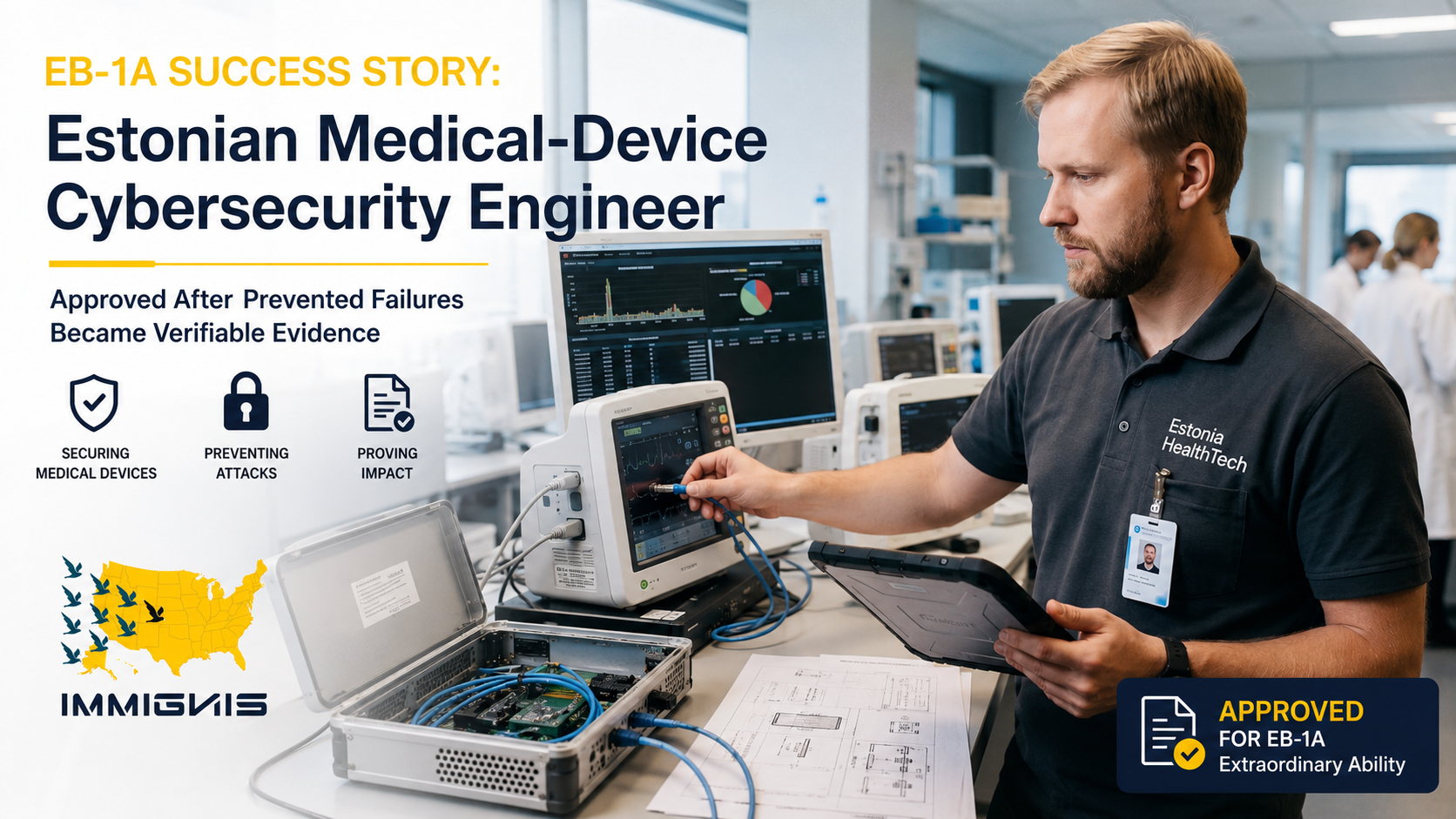
How an Estonian medical device cybersecurity engineer secured EB-1A approval by documenting disclosure safe vulnerability work, device security methods, standards participation, completed peer review, critical technical responsibility, and ethical immigration specific profile building without exposing patient, hospital, or manufacturer information.
Key facts at a glance
| Petition outcome | Form I-140 approved under EB-1A on November 9, 2024. |
| Professional profile | Estonian cybersecurity engineer protecting connected medical devices, clinical networks, and hospital technology from vulnerabilities that could create operational or patient-safety risk. |
| Field niche | Cybersecurity and vulnerability management for networked medical devices. |
| Starting weakness | The strongest achievements were incidents that did not occur, confidential vulnerabilities that could not be publicly described, and security fixes credited to manufacturers or hospital systems rather than to the engineer who found the weakness. |
| Profile-building focus | Disclosure-safe vulnerability documentation, security-methodology papers, device and hospital-system risk records, standards and working-group participation, completed peer review or judging, critical-role evidence, expert letters, and carefully limited public visibility. |
| Principal EB-1A evidence areas developed | Original contributions, authorship of scholarly or professional articles, judging the work of others, selective membership where the admission standard could be proven, and a leading or critical role for distinguished organizations or projects. |
| Central issue | Showing major significance when the best result was prevention: a vulnerability was identified, corrected, or contained before it became a visible failure. |
| Approval lesson | Medical-device cybersecurity cases become stronger when the record explains the risk, attributes the technical work, documents reliance on the engineer’s methods, and protects the confidential details that made the work important. |
The strongest result was something the public never saw
A connected medical device can sit at the intersection of software, hardware, clinical workflow, hospital networks, remote support, patient data, and physical care. When a security weakness is found early, the best outcome may be silence. No outage. No unsafe device behavior. No emergency patch announced to patients. No public incident carrying the engineer’s name.
That made this professional record unusually difficult to present. The petitioner had identified vulnerabilities, helped shape fixes, and improved how risks were assessed. Much of the work was protected by coordinated-disclosure rules, employer controls, manufacturer confidentiality, hospital-security limits, and the simple fact that publishing too much could create a new risk.
The absence of a public incident did not mean the absence of impact. It meant the security process worked. The EB-1A challenge was to prove that work without revealing exploit paths, affected products, hospital architecture, patient information, credentials, source code, or proprietary remediation details.
USCIS approved the Form I-140 petition on November 9, 2024. Immignis and Advance My Profile organized the evidence around a practical idea: prevention can be documented, but only when the petition distinguishes a general security responsibility from a specific technical contribution that others trusted and used.
Why medical-device cybersecurity is different from ordinary enterprise security
Medical-device cybersecurity is not limited to protecting office computers or preventing data theft. A connected device may exchange clinical information, receive software updates, rely on network services, communicate with hospital systems, or influence how care is delivered. A security problem can therefore affect availability, integrity, confidentiality, interoperability, maintenance, and clinical operations at the same time.
The environment is also constrained. Some devices remain in service for years. Updates may require testing, regulatory review, manufacturer coordination, hospital change control, or downtime planning. Clinical teams cannot always treat a device like a consumer laptop that can be replaced or rebooted without consequence.
The engineer’s work had to account for this reality. A technically elegant fix would not be enough if it interrupted care, broke compatibility, created an unsupported configuration, or transferred risk somewhere else in the system. Security analysis had to remain tied to device function, clinical use, and the conditions under which the product was actually deployed.
The petition therefore defined the field narrowly as cybersecurity and vulnerability management for networked medical devices. That definition prevented the case from being evaluated as generic information technology work and gave USCIS a clearer way to understand why the evidence mattered.
Disclosure-safe vulnerability records replaced the missing public paper trail
The first task was to create an evidence record that could be reviewed without turning the petition into a vulnerability disclosure. The case used authorized summaries, redacted technical records, responsibility statements, remediation histories, issue classifications, cleared correspondence, and letters from people with direct knowledge of the work.
These materials answered the questions an immigration officer needed answered: What type of risk was involved? What did the petitioner personally identify or design? Why was the issue difficult? Who relied on the analysis? What changed because of it? How was the result verified?
The evidence did not need to reveal a device model, hospital name, source-code location, credential structure, exploit sequence, or exact attack path. In fact, including those details could have weakened the presentation by creating unnecessary security and confidentiality concerns. The petition focused on technical responsibility and significance, not operational secrets.
This was the central profile-building step. Confidentiality was treated as a documentation constraint, not as an excuse to make unsupported claims.
Original contribution was shown through remediation and repeated reliance
Finding a vulnerability does not automatically establish an original contribution of major significance. The petition had to show more than novelty. It needed evidence that the petitioner’s work changed how a device, process, development team, or healthcare environment handled risk.
The record connected the engineer’s analysis to concrete follow-on action. Depending on the underlying item, that could include a design change, a revised security control, a new validation step, a remediation plan, a monitoring rule, a risk-scoring method, a secure-update requirement, a supplier requirement, or a change in how vulnerabilities were triaged and closed.
The strongest evidence showed reliance. Manufacturers, clinical engineering teams, hospital-security personnel, software developers, or external specialists used the petitioner’s findings or methods because they solved a problem that ordinary testing had missed or had not adequately addressed.
That distinction was important. The contribution was not described as significant merely because medical-device cybersecurity is important. Its significance came from documented use, technical consequence, and the professional judgment of people who understood the affected environment.
Prevented incidents were explained without inventing hypothetical disasters
Cybersecurity writing often becomes exaggerated. A weak petition might claim that every discovered flaw “saved lives” or prevented a catastrophic breach. The case avoided that language unless the record could support it.
Instead, the evidence described the realistic risk the work addressed: unauthorized access, loss of availability, manipulation of data, unsafe configuration, interruption of clinical workflow, insecure remote maintenance, unsupported software components, weak authentication, or another verified category of device or network exposure.
The argument remained disciplined. It showed that the petitioner reduced a recognized risk and improved the security position of a real device or clinical environment. It did not claim a patient outcome, attack, financial loss, or regulatory consequence that had never occurred.
This made the prevention narrative credible. The officer did not have to accept a dramatic hypothetical. The evidence showed that qualified organizations changed their behavior because of the engineer’s work.
Security-methodology papers made confidential expertise reviewable
The petitioner’s technical knowledge could not remain entirely inside internal reports. Scholarly or professional authorship helped create a public record around methods that could be discussed safely: secure product development, vulnerability assessment, threat modeling, coordinated disclosure, risk prioritization, network segmentation, update security, device inventory, or validation of security controls.
The publication strategy did not reproduce confidential findings. It separated generalizable methods from protected implementation details. That allowed the petitioner to contribute useful field knowledge while respecting manufacturer, hospital, and patient-security obligations.
For the scholarly articles criterion, the record documented authorship, publication type, intended professional audience, and the relationship between the article and the defined field. Employer blog posts, internal policies, and marketing pieces were not automatically treated as scholarly work.
The publications also helped the final merits analysis. They showed a consistent technical identity rather than a collection of unrelated security tasks.
Standards and working-group participation required careful legal framing
Medical-device security develops through standards bodies, technical committees, industry groups, healthcare-security forums, and cross-sector working groups. Participation can show that an engineer is trusted beyond one employer, particularly when the person contributes to technical review, method development, guidance, or implementation discussions.
The petition did not assume that every professional membership met the EB-1A membership criterion. That criterion requires proof that admission demanded outstanding achievements judged by recognized experts. A paid subscription, open membership, or ordinary professional registration is different.
Where a selective admission standard could be documented, membership evidence was developed accordingly. Where it could not, the working-group role still supported other arguments by showing technical responsibility, external reliance, judging, invited service, or sustained professional recognition.
This distinction made the case more accurate. It also prevented a useful professional role from being weakened by placing it under the wrong regulatory criterion.
Completed peer review and technical evaluation supported the judging criterion
Cybersecurity professionals often review the work of others without calling the activity “judging.” They may assess conference submissions, technical papers, security research, vulnerability reports, grant proposals, standards drafts, product-security designs, or formal competition entries.
The petition used completed service, not invitations alone. Records showed what type of work was evaluated, who requested the review, why the petitioner was selected, and whether the review concerned the same or an allied field.
Routine review of one’s own staff, internal quality control required by a job, or ordinary collaborative feedback was distinguished from independent judging. The stronger evidence involved external selection or a formal process in which the petitioner evaluated the professional work of other specialists.
This gave USCIS a familiar evidentiary category for a field where trust is often expressed through confidential review rather than public awards.
Critical-role evidence showed why the organization depended on this engineer
A security engineer can work for a respected manufacturer, hospital, research organization, or technology company without personally holding a leading or critical role. The case therefore did not rely on the employer’s reputation alone.
The record documented the petitioner’s actual responsibility: authority over a vulnerability-management function, ownership of a security method, responsibility for a device-risk workstream, leadership in remediation decisions, coordination across engineering and clinical teams, or another function whose failure would materially affect the project or organization.
The organization’s distinguished reputation was documented separately through its field standing, products, clinical role, research activity, regulatory environment, market reach, or recognized technical work. The petition then connected the petitioner’s function to that distinguished activity.
This showed why the role was critical. The organization did not merely employ the petitioner; it relied on the petitioner’s judgment for a technically sensitive area that could not be handled as routine support.
Expert letters explained the work, but the documents did not stand alone
Expert letters were useful because non-specialists may not understand why a particular vulnerability class, remediation decision, or security methodology was difficult. The strongest letters came from people with a clear basis of knowledge and explained the petitioner’s contribution in concrete terms.
The letters were tied to underlying records wherever possible: project documents, publication history, issue summaries, standards work, peer-review service, remediation evidence, role descriptions, or independent use of the methodology. They did not simply repeat that the petitioner was “among the best.”
Independent experts helped place the work in field context. Direct supervisors or collaborators helped establish attribution. Both types were useful when their roles were transparent and their statements matched the documentary record.
The final merits analysis connected secrecy, trust, and sustained responsibility
Meeting at least three regulatory criteria is only the first stage of the EB-1A analysis. USCIS then reviews the record as a whole to decide whether the petitioner has sustained national or international acclaim and is among the small percentage at the top of the field.
The final presentation connected the evidence across time. Vulnerability records showed technical originality. Remediation and adoption showed reliance. Publications showed that the expertise entered professional circulation. Completed reviews showed trust in the petitioner’s judgment. Standards work and selective roles showed recognition outside one organization. Critical-role evidence showed that distinguished entities depended on the petitioner’s decisions.
The confidential nature of the work was not presented as a substitute for acclaim. It explained why the evidence looked different from a conventional academic case. The acclaim still had to be shown through selection, reliance, authority, authorship, professional service, and independent validation.
Why this case worked
The case worked because it did not confuse invisibility with weakness. It accepted that good medical-device cybersecurity often leaves no public incident and then built a record around what could be proven: the risk was real, the petitioner’s contribution was identifiable, qualified teams acted on the work, and the same professional judgment was trusted repeatedly.
The petition also respected the limits of the evidence. It did not publish exploit details, name affected systems without authorization, claim patient outcomes that were never measured, or treat routine membership and internal review as extraordinary recognition.
The failures never happened. The evidence still did.
What other medical-device and healthcare cybersecurity professionals can learn
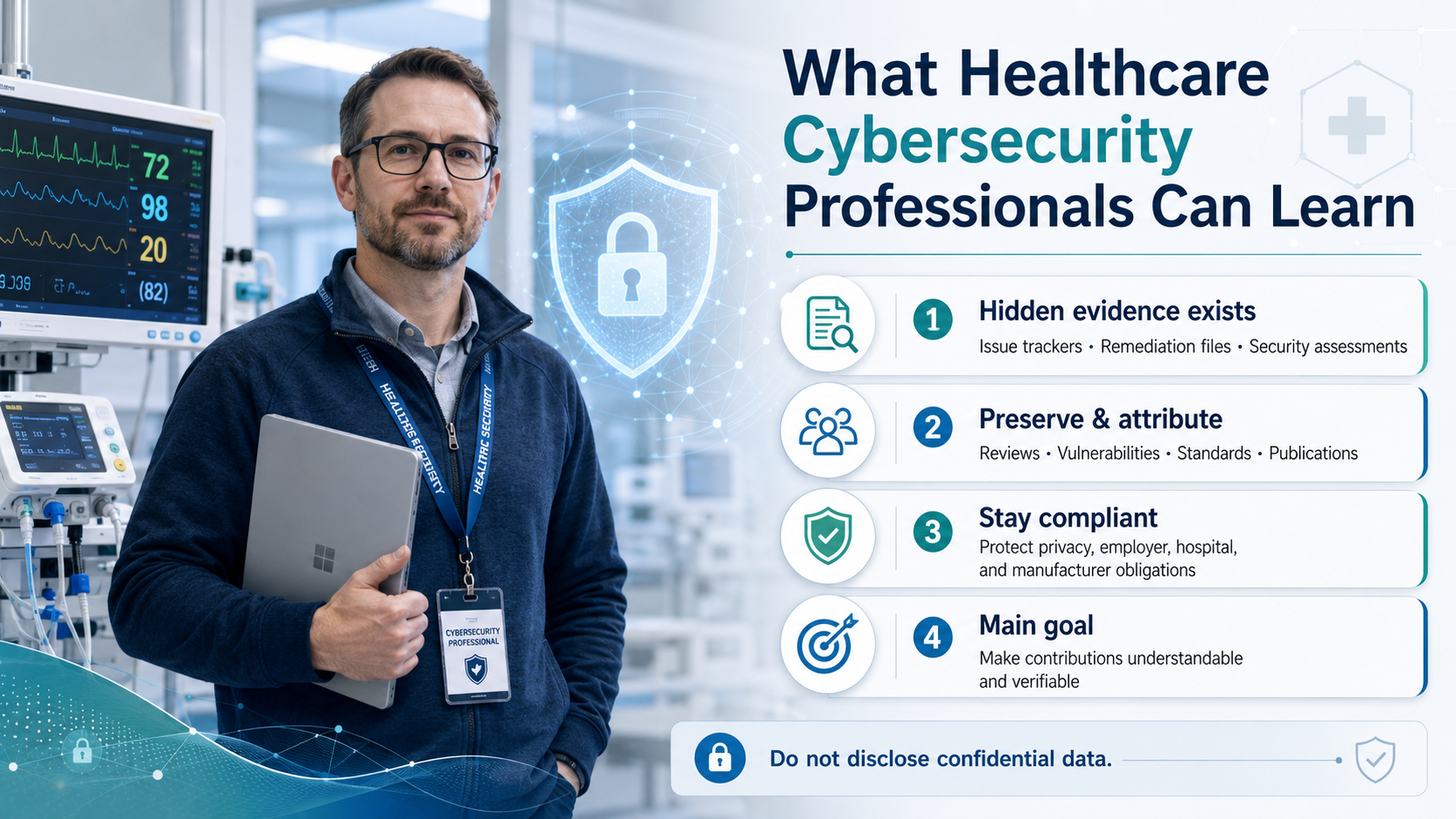
Professionals in device security, clinical engineering, digital health, healthcare IT, embedded systems, software assurance, vulnerability research, and connected-device risk management often possess stronger evidence than their public profiles suggest. The record may be dispersed across issue trackers, remediation files, security assessments, standards comments, conference systems, review platforms, internal role documents, and the knowledge of teams that relied on the work.
A useful profile-building process begins with preservation and attribution. Keep authorized records of completed reviews, project responsibility, disclosed vulnerabilities, approved summaries, remediation decisions, methodology development, standards contributions, publications, invited technical service, and compensation evidence where relevant. Do not retain or disclose data in violation of security, privacy, employer, manufacturer, or hospital obligations.
The goal is not to make confidential work public. It is to make the professional contribution understandable and verifiable at the level the law requires.
Frequently asked questions
What is EB-1A?
EB-1A is an employment-based immigrant classification for a person of extraordinary ability in the sciences, arts, education, business, or athletics. The petitioner must satisfy the applicable evidentiary framework and demonstrate sustained national or international acclaim in the final assessment.
Can a medical-device cybersecurity engineer qualify for EB-1A?
Potentially. Eligibility depends on the individual record. Original contributions, scholarly or professional authorship, judging, leading or critical roles, qualifying membership, published material, awards, or high remuneration may be relevant when supported by appropriate evidence.
Can a confidential vulnerability support the original-contributions criterion?
Yes, if the petition can document the petitioner’s role and show that the work was of major significance. Authorized summaries, redacted records, remediation evidence, adoption, independent reliance, and letters from people with direct knowledge may be useful without exposing exploit details.
Does discovering a vulnerability automatically prove major significance?
No. Discovery may show originality, but major significance generally requires evidence of meaningful technical consequence, remediation, adoption, reliance, field influence, or qualified independent validation.
How can prevented incidents be documented?
The case can document the recognized risk, the petitioner’s analysis, the action taken, the validation performed, and the organizations or teams that relied on the work. It should not invent a breach, patient harm, financial loss, or regulatory consequence that never occurred.
Can security-methodology papers satisfy the scholarly-articles criterion?
They may, depending on the publication, audience, subject matter, and authorship. The work should be written by the petitioner and published in an appropriate professional or scholarly outlet in the field or an allied field.
Can peer review satisfy the judging criterion?
Yes, when the petitioner actually completed reviews of the work of others through a journal, conference, standards process, grant program, competition, or other formal evaluation system. Invitations alone are weaker than completed service.
Does internal code review count as judging?
Routine review required by ordinary employment is generally less persuasive. Independent or formally selected evaluation of work by other professionals is usually stronger, particularly when the process and the petitioner’s selection can be documented.
Does participation in a cybersecurity society satisfy the membership criterion?
Not automatically. The criterion requires evidence that admission demanded outstanding achievements judged by recognized experts. Open or paid membership may still provide context but does not by itself satisfy that requirement.
Can standards work strengthen an EB-1A petition?
Yes. Technical committee or working-group service may support judging, original contributions, critical role, or final merits when the petitioner’s selection, responsibility, and contribution are documented. It supports membership only when the admission requirements meet the regulatory standard.
How can a cybersecurity engineer prove a leading or critical role?
The evidence should show the distinguished reputation of the organization or project and explain the petitioner’s actual authority, responsibility for a security function, ownership of a methodology, control over remediation decisions, or another role on which the work depended.
Can employer letters be used?
Yes, but they are stronger when detailed, fact-based, and supported by records. Independent evidence and independent experts can add context, while supervisors and direct collaborators can establish personal attribution.
How should patient, hospital, or manufacturer information be handled?
Protected and confidential information should not be disclosed without authorization. The petition may use cleared summaries, redaction, generalized descriptions, and authorized letters while preserving enough detail to show the professional contribution.
Does EB-1A require a permanent U.S. job offer or labor certification?
EB-1A does not require a permanent job offer or labor certification, and an eligible person may self-petition. The record must still show that the person intends to continue work in the area of extraordinary ability in the United States.
How does EB-1A differ from EB-2 NIW for a cybersecurity engineer?
EB-1A focuses on extraordinary ability and sustained acclaim under its own criteria. EB-2 NIW requires EB-2 qualification and a showing that waiving the job-offer and labor-certification requirements is in the national interest. The better fit depends on the person’s evidence and proposed U.S. work.
How does ethical profile building help in a confidential cybersecurity field?
It identifies existing evidence, improves lawful attribution, develops legitimate publications and review service, preserves role and remediation records, and organizes the case without inventing incidents, exposing vulnerabilities, purchasing false recognition, or overstating ordinary job duties.
Make prevention visible without making systems less secure
A confidential cybersecurity record can still be organized into a persuasive professional profile. The evidence may exist in authorized vulnerability summaries, remediation files, publications, standards contributions, review systems, role documents, conference records, and the testimony of specialists who relied on the work.
Start with a free EB-1A profile assessment to identify what can be documented safely, which contributions need clearer attribution, and which ethical profile-building steps can strengthen a medical-device cybersecurity record without exposing protected information.