Nuclear materials scientist EB-1A case: How a Polish scientist secured approval by turning disclosure-cleared testing records, first-author publications, reactor-materials conference presentations, international network roles, peer review, expert letters, and patent documentation into a coherent record of extraordinary ability.
Key facts at a glance
| Petition outcome | Form I-140 approved under EB-1A on June 13, 2024. |
| Professional profile | Polish materials scientist studying radiation-resistant alloys and protective coatings for safer, longer-lasting nuclear energy systems. |
| Field niche | Radiation-tolerant materials for advanced reactors. |
| Starting weakness | Laboratory access was restricted, testing records were tightly controlled, and much of the strongest work appeared in consortium reports rather than public-facing evidence. |
| Profile-building focus | Disclosure-cleared testing records, first-author publications, reactor-materials conference presentations, international nuclear-materials network roles, peer review, expert letters, and patent documentation. |
| Principal EB-1A evidence areas developed | Authorship of scholarly articles, original contributions of major significance, judging the work of others, membership evidence where admission standards supported it, and leading or critical role. |
| Central issue | Showing that controlled laboratory work and consortium participation reflected identifiable personal scientific responsibility rather than ordinary involvement in a restricted research program. |
| Approval lesson | Restricted nuclear-materials work can support EB-1A when the petition protects sensitive information while documenting authorship, scientific responsibility, peer trust, and the practical significance of the work. |
The material had to survive radiation. The evidence had to survive restrictions.
The petitioner worked on alloys and coatings intended to retain their properties under heat, stress, corrosion, irradiation, and other demanding reactor conditions. The scientific problem was difficult. The immigration evidence problem was different: much of the work could not simply be copied from controlled laboratory files into a public petition.
Important results appeared in testing programs, consortium reports, technical reviews, protected inventions, and restricted facilities. Those records showed that the work existed, but they did not automatically show what the petitioner personally designed, tested, interpreted, or changed. Institutional security and collaborative research practices made individual attribution harder to establish.
USCIS approved the Form I-140 petition on June 13, 2024. Immignis and Advance My Profile organized the record around a narrow question: how could the petition show personal scientific authorship and field-level significance without disclosing information that the petitioner was not permitted to release?
Why nuclear materials cases are unusually difficult to document
Nuclear-materials science brings together metallurgy, surface engineering, solid-state physics, corrosion science, mechanical testing, radiation effects, thermodynamics, and reactor safety. A material may need to resist swelling, embrittlement, oxidation, cracking, phase change, and loss of strength over long periods in harsh operating environments.
Many of the most useful records in this field are not public. Experimental parameters may be controlled. Facility access may be limited. Results may belong to a consortium, laboratory, government program, or industrial partner. Even when a scientist makes an important contribution, the public record may identify only the project or institution.
The petition defined the field as radiation-tolerant materials for advanced reactors. That definition prevented the case from becoming a broad claim about nuclear energy. It also explained why testing authorship, publication record, peer review, patent evidence, network roles, and scientific responsibility were the right measures of professional standing.
Disclosure cleared testing records made controlled work usable
The first task was to separate sensitive technical detail from evidence of scientific responsibility. The petition did not need proprietary compositions, restricted facility information, or protected operating parameters. It needed records that identified the problem addressed, the petitioner’s role, the type of testing performed, and the significance of the findings.
Cleared summaries, approved technical statements, contribution records, laboratory responsibility documents, and letters from people with direct knowledge helped reconstruct the petitioner’s role. The record showed where the petitioner designed a testing approach, selected comparison conditions, interpreted failure behavior, connected microstructural observations to performance, or recommended a change in material or coating strategy.
This approach protected the underlying program while allowing USCIS to evaluate more than job duties. The evidence showed scientific choices and responsibility, not merely presence in a restricted laboratory.
First author publications supplied a public scientific record
First-author publications were especially useful because they gave the petitioner an identifiable voice outside controlled project files. The articles explained radiation effects, alloy behavior, coating performance, corrosion resistance, mechanical stability, or related materials questions in a form that other scientists could examine and build upon.
The petition did not rely on authorship position alone. It connected each paper to the petitioner’s actual work: the experimental design, analysis, interpretation, or method that the article reported. Collaborative publications remained relevant, but their value increased when contribution statements and technical records showed what the petitioner personally supplied.
This evidence supported the scholarly-articles criterion and also helped the original-contribution analysis. The publications showed that the petitioner’s findings had moved beyond internal reports into the professional literature.
Patent documentation helped show protected technical originality
Patent records provided another public route into work that could not be fully described elsewhere. A patent did not prove major significance by itself, but it could establish inventorship, technical novelty, and the fact that a solution was considered worth protecting.
The petition explained the engineering problem behind the protected method or material, the petitioner’s contribution to the inventive concept, and how the invention related to radiation tolerance, coating durability, corrosion control, or reactor-material performance. Where ownership belonged to an employer or consortium, the record kept ownership and inventorship separate.
That distinction was important. The petition did not present every patent as a commercial success. It used patent documentation as one part of a broader record that included testing, publication, expert explanation, and professional reliance.
Conference presentations gave peers a non confidential view of the work
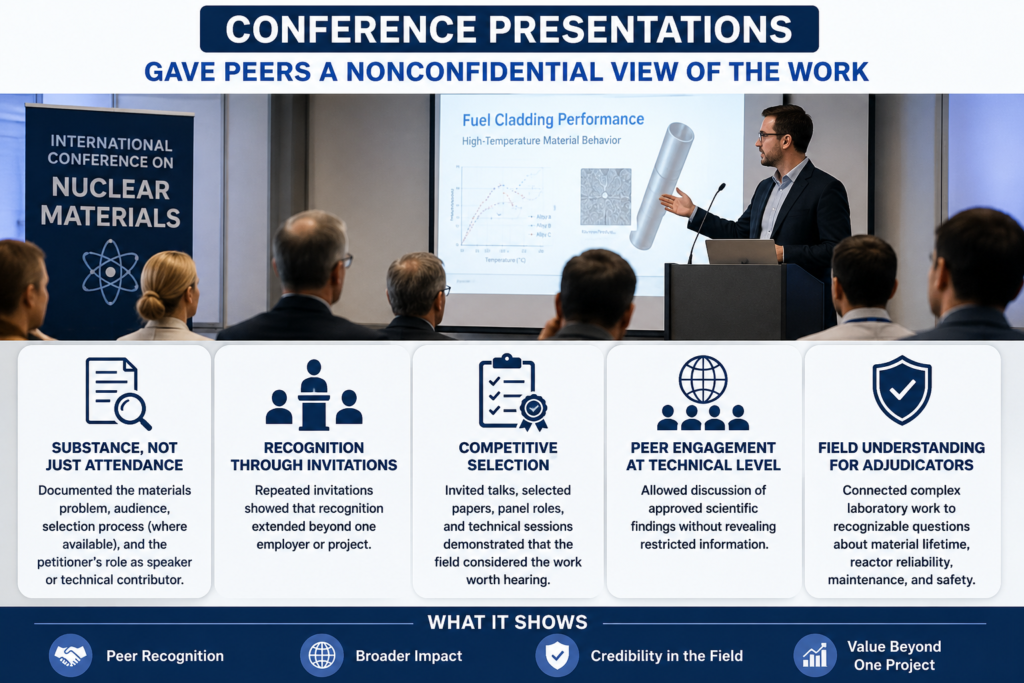
Reactor-materials conferences and technical meetings allowed the petitioner to discuss approved scientific findings without revealing restricted information. Invited talks, competitively selected papers, panel roles, and technical sessions showed that the field considered the work worth hearing and discussing.
The petition documented the substance of the presentations, not merely attendance. It identified the materials problem, the audience, the selection process where available, and the petitioner’s role as speaker or technical contributor. Repeated invitations were useful because they showed recognition extending beyond one employer or project.
Conference evidence also helped make the field understandable to a non-specialist adjudicator. It connected complex laboratory work to recognizable questions about material lifetime, reactor reliability, maintenance, and safety.
International network roles showed recognition beyond one laboratory
International nuclear-materials networks and technical groups helped place the petitioner’s work within a wider professional community. The strongest evidence described substantive participation in working groups, coordinated research, technical exchanges, method discussions, or collaborative testing programs.
Ordinary membership was not overstated. The EB-1A membership criterion requires more than paying dues or joining a professional association. Where the record addressed membership, it documented the admission standard, the role of recognized experts in selection, and the achievements on which admission depended.
Other network roles supported the final merits and leading-role analysis even when they did not independently satisfy the membership criterion. The petition focused on what the petitioner was asked to do and why the field trusted that person with the responsibility.
Peer review documented trust in the petitioner’s scientific judgment
Peer-review evidence was presented as judging the work of others. Completed reviews of journal manuscripts, research proposals, conference papers, technical studies, or related materials were documented with the subject matter and the petitioner’s role.
The record did not rely on an invitation alone. It showed that the reviews were actually completed and that the work evaluated fell within the petitioner’s area of expertise. Repeated requests from journals or technical bodies helped show that the trust was sustained rather than incidental.
This evidence mattered because nuclear-materials research often depends on careful interpretation of limited or difficult data. Selection as a reviewer showed that other professionals relied on the petitioner to assess whether methods, findings, and conclusions were technically sound.
Expert letters explained significance without disclosing protected details
Expert letters played a narrow but important role. The most useful letters did not repeat the petitioner’s resume or use broad praise. They explained the materials problem, the petitioner’s identifiable contribution, why the work was difficult, and how it influenced testing practice, material selection, research direction, or later work.
Independent experts were particularly helpful when they could explain how the petitioner’s findings fit within the field. Project collaborators could provide direct attribution, while independent specialists could address broader significance. The petition kept those functions separate.
The letters also respected confidentiality. They described technical value at the level needed for adjudication without publishing restricted formulas, facility details, security-sensitive information, or proprietary data.
Leading role was shown through scientific responsibility, not access alone
Restricted laboratory access can appear impressive, but access by itself does not prove a leading or critical role. The petition therefore focused on decisions and accountability: who designed the work, resolved technical questions, interpreted results, guided other researchers, or supplied findings on which a distinguished program depended.
Titles were treated as context rather than proof. The evidence identified the responsibilities that would have affected the program if they had not been performed properly. It also documented the distinction of the laboratory, consortium, project, or organization in which those responsibilities were carried out.
This made the leading-role argument specific. The petitioner was not presented as important merely because the work involved nuclear technology. The record showed why the petitioner’s scientific role mattered inside the particular program.
The final merits argument relied on a connected record
No single test report, article, patent, review assignment, conference talk, network role, or expert letter carried the case. The testing records established personal responsibility. Publications and patents provided public authorship signals. Peer review showed trust. Conference and network roles showed recognition beyond one workplace. Expert letters explained why the work mattered.
Together, the materials showed a sustained professional pattern. The petitioner had not simply worked near advanced reactor research. The record showed repeated responsibility for creating, evaluating, and communicating materials knowledge used in a demanding scientific field.
Why this case worked
The case did not treat confidentiality as a reason to make unsupported claims. It treated confidentiality as a documentation problem and used cleared summaries, contribution records, public publications, patent materials, and precise letters to solve it.
The field was defined narrowly. Radiation-tolerant materials for advanced reactors gave the evidence a coherent frame and prevented the general importance of nuclear energy from substituting for proof of personal achievement.
Different evidence categories were kept separate. Authored articles were not confused with published material about the petitioner. Patents were not treated as automatic proof of major significance. Ordinary membership was not presented as achievement-based membership. Peer-review invitations were not counted without completed service.
Most importantly, the petition connected authorship to use and professional trust. The laboratory restrictions remained in place, but the scientist’s contribution no longer remained hidden behind them.
What nuclear scientists and materials engineers can learn from this approval
Professionals working in controlled research environments should preserve attribution while projects are active. Approved contribution statements, invention disclosures, publication records, testing responsibility documents, presentation clearances, review confirmations, and detailed project letters may later become essential evidence.
They should also plan for a lawful public record. A cleared paper, conference presentation, patent, or technical article can explain expertise without disclosing protected information. Public visibility should never come at the expense of security, confidentiality, or contractual duties.
Ethical profile building does not invent technical influence. It identifies existing achievements, protects restricted information, improves accurate attribution, and organizes a diffuse record so that a non-specialist can understand what the scientist actually contributed.
Frequently asked questions
Can a nuclear materials scientist qualify for EB-1A?
Yes. A scientist may qualify when the evidence satisfies the regulatory criteria and, viewed together, shows sustained acclaim and standing among the small percentage at the top of the defined field.
Can restricted or confidential research be used in an EB-1A petition?
Potentially. The record can use disclosure-cleared summaries, public publications, patents, approved letters, contribution records, and other evidence that establishes the petitioner’s role without revealing protected information.
Do testing reports prove an original contribution of major significance?
Not automatically. The petition should identify the petitioner’s contribution, the problem solved, the reliability of the result, and evidence that the work influenced a distinguished program, later research, testing practice, material selection, or field activity.
Are first-author papers stronger than collaborative papers?
First-author papers often provide a clear attribution signal, but collaborative papers may also be valuable. The key is to document the petitioner’s identifiable contribution and explain how the work relates to the defined field.
Does a patent automatically satisfy the original-contribution criterion?
No. A patent can show inventorship and novelty, but major significance usually requires additional evidence such as use, adoption, technical reliance, licensing, implementation, expert analysis, or measurable influence.
Can peer review satisfy the judging criterion?
Completed review of journal manuscripts, research proposals, conference submissions, technical reports, or other professionals’ work may qualify when the selection, subject matter, and completed duties are documented.
Does membership in a nuclear-materials society satisfy the membership criterion?
Ordinary membership does not. The criterion requires admission based on outstanding achievements judged by recognized experts. Technical network roles may still support leading role, judging, or final merits when described accurately.
How can a scientist prove a leading role without a senior management title?
The evidence may show responsibility for experimental design, testing strategy, interpretation, research direction, quality control, technical decisions, or work that was essential to a distinguished laboratory, project, consortium, or organization.
Can conference presentations strengthen a nuclear-materials EB-1A case?
Yes, especially when the presentation was invited, competitively selected, or connected to a substantive technical role. Attendance alone carries limited weight.
What counts as published material about the petitioner?
Qualifying material generally discusses the petitioner and the petitioner’s work in professional, major trade, or major media outlets. Articles authored by the petitioner belong under the scholarly-articles criterion and should not be counted as coverage about the petitioner.
Does work connected to nuclear safety automatically establish extraordinary ability?
No. Nuclear safety and advanced energy provide important context, but the petition must still prove the petitioner’s own achievements, recognition, influence, and standing in the defined field.
How can ethical profile building help scientists working under restrictions?
It can organize cleared evidence, preserve technical attribution, develop accurate public publications and presentations, document peer review and network roles, obtain specific letters, and connect the petitioner’s work to independent recognition without disclosing protected information.
Make restricted technical work understandable without making it public
A strong nuclear-materials record may already exist across testing files, publications, patents, consortium reports, conference clearances, review records, network roles, and expert correspondence. The main weakness may be that these materials do not yet identify one coherent scientific contribution.
Identify which achievements can be documented now, which controlled projects need disclosure-safe attribution, and which ethical profile-building steps may strengthen a future petition.