How an Indian engineer working in Germany secured EB-1A approval after his grid-scale converter work was documented beyond product development
Key facts at a glance
| Outcome | EB-1A approval for an Indian renewable power electronics engineer working at a Germany-based energy company. |
| Approval date | Approved on August 20, 2024. |
| Field niche | Grid-scale power converters for renewable integration, with a focus on converter design, control behavior, grid reliability, and the safe connection of renewable generation to power systems. |
| Starting problem | His achievements were mostly recorded as product-development work. The evidence showed engineering value, but it did not yet show sustained acclaim or explain why his converter methods mattered outside one employer. |
| Evidence-building path | The record was developed through focused power-electronics papers, patent filing evidence, standards engagement, an industry white paper, a conference panel, trade-media coverage, peer review, selective membership evidence, and independent letters from power-system and power-electronics experts. |
| EB-1A criteria supported | Original contributions, scholarly articles, published material, judging, and memberships. Patent filing evidence strengthened the original-contribution record, but it was not treated as a separate EB-1A criterion. |
USCIS approved the case on August 20, 2024
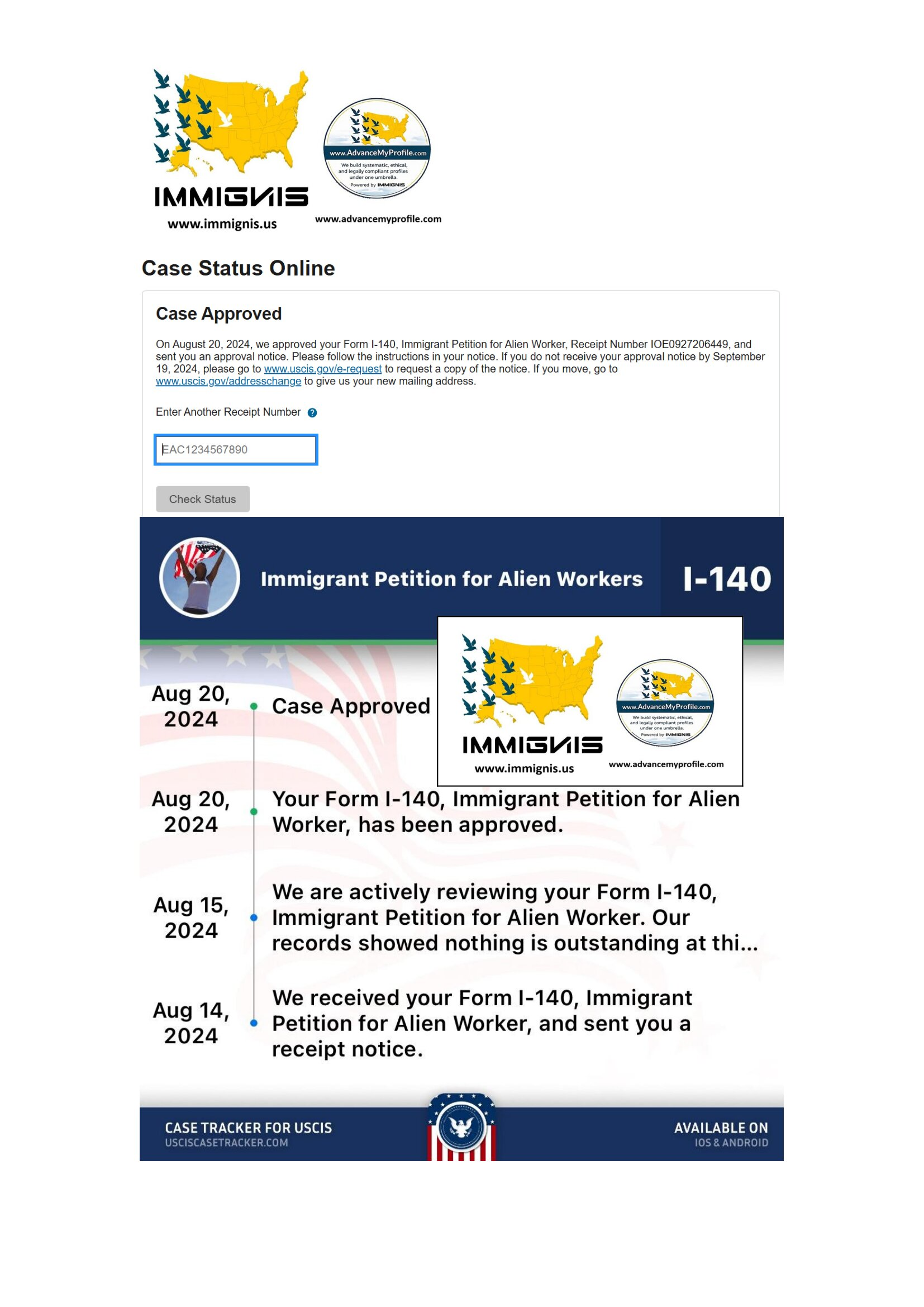
On August 20, 2024, USCIS approved the Form I-140 petition of an Indian renewable power electronics engineer working with a Germany-based energy company.
The approval did not come from presenting him as a general energy engineer. It came from making one professional question visible: how grid-scale power converters help renewable generation behave reliably inside a power system.
His career record already contained serious engineering work. The difficulty was that much of it looked like product development. Converter requirements, validation notes, design reviews, prototype records, testing decisions, and internal product milestones can prove that an engineer is useful to an employer. They do not automatically prove that the engineer has sustained acclaim or recognized achievements in the field.
Advance My Profile, powered by Immignis, reviewed the record with legal strategists and power-electronics specialists. The work was narrowed to grid-scale power converters for renewable integration. That focus gave the petition a technical center and helped the evidence speak in one direction.
The case was not about one product
A power converter can be described as a product: an inverter, a converter cabinet, a control platform, a device that sits between a renewable-energy source and the grid. That description is too flat for EB-1A.
The better question is what engineering problem the converter work solved. Renewable power does not enter the grid as a simple replacement for conventional generation. Solar and wind resources are variable. Power-electronics interfaces must manage electrical behavior, protection requirements, control response, efficiency, thermal limits, harmonics, and interaction with other grid equipment.
The petition did not claim that one engineer made renewable integration possible by himself. That would have been both inaccurate and unhelpful. It showed that his work addressed specific converter-design and control problems that matter when renewable generation has to connect to larger power systems without weakening reliability.
That distinction changed the case. It moved the story from product participation to professional contribution.
Why strong product-development evidence can still look ordinary
Many engineers make the same mistake in EB-1A preparation. They collect product materials and assume the importance of the product will carry the case.
USCIS asks a different question. The officer must evaluate the person. A company may build an important converter platform, a battery system, a chip, a medical device, or a software product. The petition still needs evidence of the applicant’s individual contribution, recognition, and place in the field.
In this case, the early record showed product-development achievements, but the individual engineering method was not yet clear enough. The file needed to explain what he contributed to converter behavior, what technical decisions could be traced to him, and why independent experts considered that work significant.
The approval strategy therefore had two jobs. First, document the real engineering contribution without disclosing protected company information. Second, build a public authority record that showed recognition outside the employer.
His field sat between renewable generation and grid behavior
The niche was defined as grid-scale power converters for renewable integration.
That may sound narrow, but it is exactly the kind of field definition that can help an EB-1A petition. It was broad enough to show field importance and narrow enough to identify his recurring technical role.
The evidence addressed converter design, control behavior, electrical stability, validation, fault response, power-quality concerns, thermal considerations, and the practical limits of connecting renewable resources to a grid that must remain reliable under changing conditions.
A converter can pass a product milestone and still raise difficult questions. How should it respond to a grid disturbance? How should protection settings interact with control behavior? What happens when renewable output changes quickly? How should engineers validate behavior without relying on assumptions that only hold under ideal test conditions?
These were the kinds of questions that helped define him as a power electronics specialist, not simply as an engineer assigned to an energy product.
What USCIS needed to see in a renewable power electronics EB-1A case
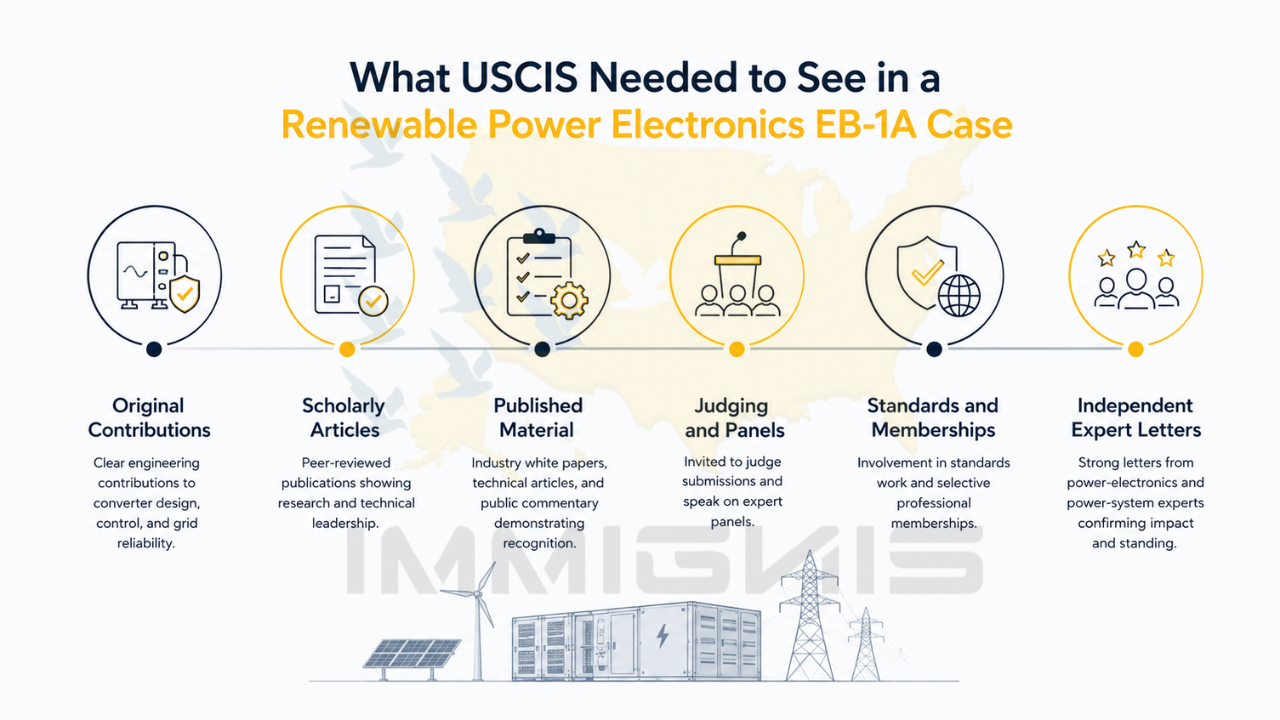
The petition had to do more than show that renewable energy is important. EB-1A is not approved because a field is valuable. It is approved when the individual record meets the regulatory criteria and, at final merits, shows sustained acclaim and the level of expertise expected for extraordinary ability.
For original contributions, the file identified converter-design methods, control concepts, validation approaches, or technical improvements linked to him. Internal product value was not enough. The petition had to explain why the work had significance beyond a routine engineering assignment.
Scholarly articles needed to connect his authorship to power electronics, converter behavior, renewable integration, or related grid-reliability questions. Published material had to be independent coverage about him or his expertise, not general articles about renewable energy.
Judging evidence required real evaluation of other engineers’ work, such as peer review or technical review assignments. Membership evidence required selective admission or elevation standards tied to achievement. Open enrollment in a professional organization was kept separate from qualifying membership evidence.
Patent filing evidence helped trace inventorship and technical concepts. The petition used that evidence carefully. A patent filing can support an original-contribution argument, but patents are not a separate EB-1A regulatory criterion and do not automatically prove major significance.
Product files were reorganized around engineering decisions
The internal evidence was not presented as a pile of product documents. It was reorganized around the decisions a power electronics engineer makes.
What electrical condition was being addressed? Which converter behavior was under review? What control or design assumption was tested? What measurement or simulation result changed the engineering decision? Which part of the work could be attributed to him?
The record grouped safe, non-confidential evidence around converter design logic, control response, validation, reliability concerns, and the relationship between converter behavior and grid integration. Product names, proprietary specifications, customer details, and protected design information stayed outside the public record.
This made the file easier for independent experts to evaluate. They did not need access to confidential product drawings to understand the engineering problem or the applicant’s role in addressing it.
The papers gave the engineering method a public record
Focused publications became one of the most important parts of the profile.
With domain support, he developed papers on grid-scale power converters, renewable integration, converter control behavior, validation, and reliability questions affecting power systems. The point was not to create generic renewable-energy articles. The papers had to reflect the same technical personality shown in his engineering work.
One paper examined how converter response affects renewable-grid integration under changing electrical conditions. Another addressed validation issues that can arise when laboratory assumptions do not fully match grid-connected operation.
The publications helped translate product-development experience into a public technical record. They also gave USCIS a way to see continuity: the engineer in the papers was the same engineer shown in the product and patent evidence.
Patent evidence helped identify the technical concept
The case included patent filing evidence connected to power electronics or converter technology. The filing helped show that a technical concept could be traced to him as an inventor or contributor, depending on the available records.
That evidence was useful, but it was not overstated. The petition did not argue that the existence of a filing, by itself, proved extraordinary ability. It connected the filing to the broader record: the technical problem, the converter work, the publications, the standards-related activity, and independent expert explanations.
This approach avoided a common weakness in engineering cases. A patent or patent filing can look impressive, but USCIS still needs to understand what problem the concept addressed and why the field should regard it as significant.
Standards engagement showed that the work belonged to a wider professional conversation
Power converters do not operate in isolation. Their behavior must be understood by utilities, manufacturers, project developers, grid operators, testing bodies, and engineers responsible for reliability.
Standards engagement helped show that his work was connected to professional discussions beyond one employer. The record identified the standards-related activity, subject matter, his role, and the technical comments or participation that could be verified.
This evidence was not treated as a shortcut. Merely attending a standards meeting is not the same as field recognition. The petition focused on documented technical participation and its relationship to converter behavior, integration, and reliability issues in the original-contribution record.
The industry white paper made converter reliability understandable
The industry white paper served a different purpose from the academic papers. It explained the converter problem for people who make energy, manufacturing, project, and infrastructure decisions.
It discussed why renewable integration depends on more than generation capacity. A project may have panels, turbines, equipment, and a connection point, but converter behavior still affects how power is delivered, controlled, protected, and validated.
The white paper organized the issue around control response, power quality, grid events, thermal and efficiency limits, testing assumptions, and the need to evaluate converter behavior as part of a larger power system.
The document did not disclose employer-owned designs. Its value was that it gave his professional niche a public explanation and helped non-specialist readers understand why converter design can affect renewable-grid reliability.
Conference and trade-media evidence brought the specialty outside the employer
The conference panel and trade-media coverage added another layer of recognition.
In the panel, he discussed the kinds of engineering questions that arise when renewable generation depends on power-electronics interfaces. Audience discussion focused on grid events, validation, reliability expectations, and the gap between a converter that performs under controlled conditions and one that must operate as part of a complex power system.
Trade-media explanations helped make the subject accessible. He discussed why renewable energy projects need reliable conversion and control, why grid connection is an engineering question, and why converter behavior matters when renewable resources supply a larger share of electricity.
This evidence was useful because it connected his name to the field in public. It also showed that his expertise could be explained outside internal product teams.
Peer review and membership evidence strengthened the recognition record
Peer review supported the judging criterion because it showed that journals or technical venues trusted him to evaluate work by other specialists.
The record documented review activity in power electronics, renewable integration, converter systems, electrical engineering, or related technical areas. The review assignments required him to assess methods, assumptions, experimental design, simulations, validation logic, and whether conclusions followed from the evidence.
Membership evidence was handled separately. The petition documented the professional organization, the grade or class of membership, and the admission or advancement standard. Where the standard required professional achievement or expert assessment, the evidence supported the membership criterion. Where participation was open to anyone who paid dues, it was not presented as qualifying membership evidence.
Independent letters connected the work to field significance
Independent expert letters were important because they explained why the technical work mattered beyond the company that employed him.
The strongest letters did not simply praise his character or repeat his job title. They described the converter problem, identified the part of the work linked to him, and explained why converter design, control behavior, and validation are important to renewable integration and grid reliability.
They also helped USCIS understand the difference between being assigned to an important product and making an identifiable contribution to a technical field. That difference can decide the strength of an engineering EB-1A case.
How the EB-1A record came together
The final record worked because the evidence pointed toward the same professional identity.
His product-development evidence showed where the engineering work began. The focused papers gave the work a public technical language. Patent filing evidence helped trace technical concepts. Standards engagement showed participation in wider professional discussions. Trade media and conference activity connected his expertise to audiences outside the employer. Peer review and selective membership evidence supported recognition by other professionals. Independent letters explained significance.
No single item carried the petition alone. The approval came from a coherent record that allowed USCIS to see a renewable power electronics engineer with an identifiable specialty, documented contributions, and evidence of recognition beyond internal product files.
Approval and lesson for other renewable-energy engineers
USCIS approved the Form I-140 on August 20, 2024.
The case is useful for engineers because it shows why strong technical work must be translated carefully for EB-1A. Product success may be relevant, but the petition must still identify the engineer’s own methods, explain their significance, and connect the record to recognized achievements in the field.
For renewable-energy professionals, the lesson is direct. Your work may sit inside converter platforms, grid studies, commissioning records, product validation, control updates, testing files, standards discussions, or customer-facing engineering support. Those materials may contain the foundation of an EB-1A case, but they usually need to be organized around a defensible professional niche.
A strong EB-1A record does not ask USCIS to admire a product. It helps USCIS understand the person behind the engineering decisions.
Build an EB-1A record around the engineering problem you actually solve
If you work in renewable power electronics, grid integration, converter design, energy storage, power quality, grid controls, or electrical infrastructure, your strongest contribution may not be obvious from your resume.
Immignis and Advance My Profile help professionals identify a defensible field niche, document individual methods, build credible public recognition, and prepare an EB-1A record around evidence that can be verified and defended professionally.
FAQ
Can product-development work support an EB-1A petition?
Yes, but it usually needs careful documentation. USCIS must see the applicant’s individual contribution, not only the importance of the product or employer. Product files can be useful when they show methods, technical decisions, adoption, results, and attribution.
Do patents or patent filings count as a separate EB-1A criterion?
No. Patents are not a separate EB-1A regulatory criterion. They can support original contributions when the record explains the technical concept, inventorship, significance, and relationship to the broader field.
Can a renewable-energy engineer outside the United States qualify for EB-1A?
Yes. EB-1A is not limited to applicants already working in the United States. The record must still show extraordinary ability through the required evidence and final-merits analysis.
Does standards participation help an engineering EB-1A case?
It can help when the record documents meaningful technical participation, comments, working activity, or recognition. Mere attendance or open participation is usually not enough by itself.
Are publications enough for a power electronics EB-1A case?
Usually not by themselves. Publications are important, but USCIS also looks at the quality of the work, recognition, judging, original contributions, membership evidence, independent letters, and whether the full record shows sustained acclaim.