How a Venezuelan pediatrician working in crisis pediatric malnutrition management secured EB-1A approval by turning field hospital innovation into a petition ready immigration profile built on protocol documentation, NGO adoption evidence, humanitarian medicine publication, international pediatric society engagement, media coverage, expert letters, and ethical profile building.
Key facts at a glance
| Petition outcome | Form I-140 approved under EB-1A on August 23, 2024. |
| Professional profile | Venezuelan pediatrician who developed malnutrition-treatment protocols during national crisis conditions. |
| Field niche | Crisis pediatric malnutrition management. |
| Starting weakness | Protocols spread hand-to-hand during a collapsing health system, but the formal record was thin because emergency work moved faster than documentation. |
| Profile building focus | Protocol documentation with NGO adoption evidence, humanitarian medicine publication, international pediatric society engagement, media coverage of the response, and independent expert letters. |
| EB-1A criteria supported | Original contributions, published material, scholarly articles, leading role, and membership. |
| Central issue | Showing that the petitioner was not merely providing emergency pediatric care, but had created practical treatment methods that other clinicians and humanitarian partners relied on in crisis conditions. |
| Approval lesson | In humanitarian medicine, EB-1A evidence must often turn field innovation into a formal record after the fact, without overstating the work or losing the urgency that made it important. |
The approval
On August 23, 2024, USCIS approved the Form I-140 petition of a Venezuelan pediatric nutrition physician whose work focused on crisis pediatric malnutrition management during severe national health system stress.
The approval was significant because the petitioner’s strongest achievements did not come from a traditional academic environment. They came from emergency conditions where children needed immediate care, hospitals had limited supplies, and treatment methods had to be practical enough to work outside ideal clinical settings.
That reality created a difficult EB-1A evidence problem. The petitioner’s protocols had spread among doctors, clinics, and humanitarian partners, but much of that circulation happened informally. In a crisis, professionals share what saves lives. They do not always stop to create the publication record, institutional attribution, or formal documentation that USCIS later expects to see.
Immignis and Advance My Profile helped convert that under-documented record into a petition ready EB-1A profile. The profile-building strategy focused on protocol documentation, NGO adoption evidence, humanitarian-medicine publication, international pediatric-society engagement, media coverage, and expert letters explaining why the petitioner’s work mattered in the field.
The evidence problem in crisis pediatric malnutrition cases
Crisis pediatric malnutrition management is a field where real impact often happens before the paperwork exists. A physician may develop treatment pathways, triage tools, feeding protocols, clinical guidance, or simplified monitoring systems that other professionals quickly adopt because children need care immediately. Yet the formal academic record may appear years later, if it appears at all.
That was the petitioner’s starting weakness. The protocols were useful, and the work mattered, but the evidence was scattered. Some proof lived in NGO records. Some lived in clinician statements. Some appeared in media coverage of the health crisis. Some existed in draft protocols, training materials, or humanitarian communications. None of it automatically looked like a clean EB-1A record.
The petition therefore defined the field precisely as crisis pediatric malnutrition management. It did not present the case as general pediatrics or ordinary nutrition counseling. It presented a specialized medical niche involving child malnutrition, resource-limited treatment decisions, emergency protocol development, humanitarian health response, and practical clinical systems for fragile environments.
That field definition was essential for EB-1A profile building. It helped USCIS understand why rapid field adoption, NGO reliance, protocol development, and expert letters could be meaningful indicators of extraordinary ability in a crisis health context.
Why hand to hand protocol adoption needed a formal paper trail
The petitioner’s protocols had circulated in the way crisis medicine often circulates: from clinician to clinician, from hospital team to NGO partner, and from urgent need to practical use. That kind of spread can be powerful, but it is also difficult to prove unless the record is rebuilt carefully.
The petition did not simply claim that the protocols were widely used. It reconstructed the paper trail. It identified who used the materials, why they trusted them, how they were applied, and what kinds of pediatric malnutrition problems they helped address.
This was an important immigration-specific profile building step. USCIS needed more than a story about difficult conditions. It needed evidence that could be evaluated: adoption letters, protocol copies, implementation records, training confirmations, NGO documentation, and expert explanations connecting the work to recognized pediatric and humanitarian-medicine standards.
The result was a stronger, person centered record. The petitioner no longer appeared as one pediatrician working heroically in a crisis. The record showed a physician whose clinical methods were useful enough for others to adopt and rely upon in an emergency field.
Protocol documentation and NGO adoption evidence made the contribution verifiable
Protocol documentation became the backbone of the case. In crisis pediatric malnutrition management, protocols are not ordinary paperwork. They can define how children are screened, stabilized, monitored, referred, fed, hydrated, and followed under conditions where full hospital resources may not exist.
The petition organized the petitioner’s protocols in a way USCIS could understand. It explained the medical problem, the resource constraints, the practical solution, and the reason the protocol represented more than routine pediatric care. The evidence showed that the petitioner’s approach helped structure treatment decisions in difficult humanitarian settings.
NGO adoption evidence strengthened the original-contributions argument because it showed external reliance. If independent humanitarian organizations adopted, adapted, distributed, or relied on the petitioner’s protocols, that indicated that the work had value beyond one clinic or one hospital.
For professionals searching for profile building, immigration profile building, EB-1A profile building, EB-2 NIW profile building, or USCIS evidence building in medicine, this is a key lesson: adoption evidence becomes powerful when it is specific, attributed, and tied to field significance.
Humanitarian medicine publication gave the emergency work academic structure
Humanitarian medicine publication helped give the petitioner’s emergency work the academic wrapper it never had time for during the crisis. The publication evidence did not replace the field impact. It helped explain the field impact in a formal medical language that USCIS could evaluate.
The petition used publication evidence to support the scholarly articles criterion and to reinforce the original contributions argument. The publication showed that the petitioner’s crisis protocols, clinical observations, or treatment framework could be articulated as professional medical knowledge rather than only emergency improvisation.
This mattered because crisis innovation is often misunderstood. A solution developed under pressure can be dismissed as informal unless the petition shows why it reflected expertise, clinical judgment, and field-relevant methodology. Publication helped make that link clear.
As part of publication profile building and medical profile building, this evidence turned a practical crisis response into a record with academic credibility while preserving the reality that the work began because children urgently needed care.
International pediatric society engagement supported professional recognition
International pediatric society engagement helped show that the petitioner’s work was not isolated inside Venezuela’s crisis. Engagement with pediatric societies, medical groups, or professional forums showed that the petitioner was part of broader pediatric and humanitarian-health conversations.
This evidence supported membership and recognition when the engagement reflected meaningful professional standing rather than ordinary attendance. Society involvement, invited participation, committee activity, expert forums, or recognized clinical exchange can help show that a physician’s expertise is valued by professionals outside the immediate crisis setting.
The petition connected this engagement to the petitioner’s field niche. It did not present membership as a box checking exercise. Instead, it explained how pediatric-society involvement showed professional trust in the petitioner’s knowledge of child malnutrition, emergency treatment, and resource limited pediatric care.
For profile improvement, this was important because it helped move the case beyond local crisis response and into a broader international medical frame.
Media coverage made the crisis response visible without sensationalizing it
Media coverage helped support published material and public visibility, but it had to be handled carefully. A medical EB-1A case should not rely on sensational descriptions of crisis or suffering. The coverage must connect the petitioner to professional action, clinical expertise, or recognized response work.
The petition used media documentation of the response to show that the petitioner’s work was visible in a public health context. The strongest coverage identified the petitioner’s role, explained the nature of the malnutrition challenge, and showed why the clinical response mattered.
This helped USCIS understand the context without turning the case into a general humanitarian narrative. The point was not simply that Venezuela faced difficult conditions. The point was that the petitioner responded to those conditions with methods that others trusted and used.
This is also valuable for online search and AI visibility. When used naturally, terms such as medical profile building, humanitarian medicine EB-1A, pediatrician EB-1A profile building, and professional profile building for immigration can help the story reach the right audience without keyword stuffing.
Expert letters connected field hospital innovation to pediatric standards
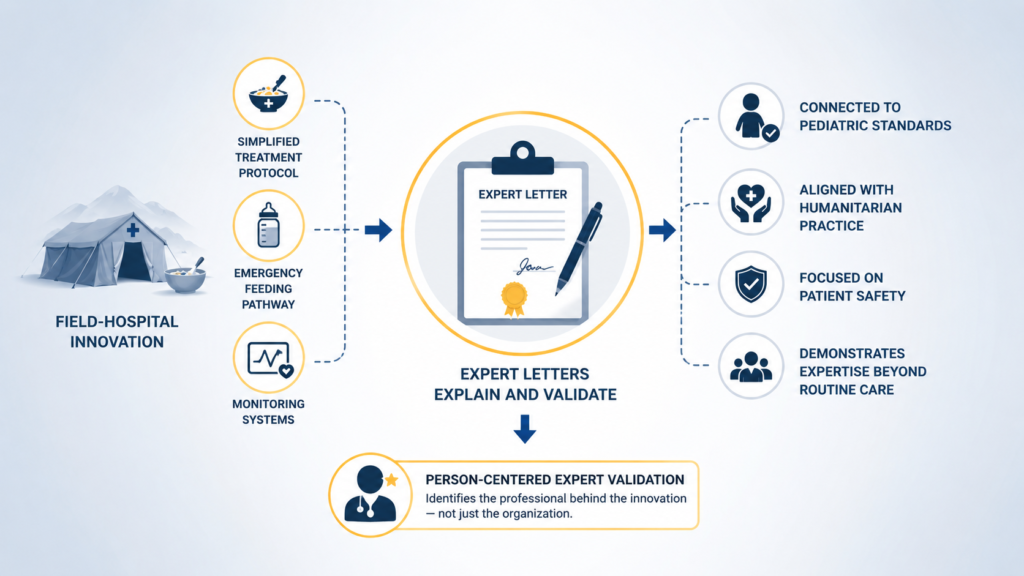
Expert letters were essential because they explained why the petitioner’s work mattered medically. In crisis pediatric care, non-specialist adjudicators may not understand why a simplified malnutrition treatment protocol, emergency feeding pathway, or monitoring system can represent a serious contribution.
The strongest letters connected the petitioner’s work to pediatric standards, humanitarian practice, patient safety, and field conditions. They explained what was original or significant, how the work was used, and why the petitioner’s approach demonstrated expertise beyond routine clinical service.
These letters also helped separate the petitioner’s personal role from the broader crisis response. They identified the petitioner as the professional who developed, adapted, taught, or guided specific clinical methods rather than treating the protocols as anonymous organizational products.
That kind of person-centered expert validation is central to ethical profile building. It does not invent recognition. It helps credible experts explain the recognition and impact that already exist but may not be obvious in raw documents.
The approval hook: field hospital innovation given the academic wrapper it never had time for
The approval hook was that field-hospital innovation received the academic and documentary structure it never had time for during the emergency. The petitioner had built practical protocols under pressure, but EB-1A required a record that could be reviewed calmly, line by line, after the crisis work had already happened.
The petition achieved that by combining protocol documentation, NGO adoption evidence, humanitarian medicine publication, international pediatric society engagement, media coverage, and expert letters. Each category gave USCIS a different way to verify the same central point: the petitioner’s work was not ordinary pediatric service. It was a field relevant contribution to crisis malnutrition care.
This approach also avoided exaggeration. It did not claim that one physician solved a national crisis. Instead, it showed that within a collapsed or strained health system, the petitioner developed and helped spread treatment methods that other professionals found useful, credible, and necessary.
That balance made the story believable and strong. The case respected the limits of the evidence while still showing extraordinary ability in a field where the normal prestige markers are often unavailable.
How profile building changed the case
This case shows how profile building can change the outcome of an under-documented but high impact medical record. The petitioner already had meaningful achievements, but the achievements were scattered across protocols, NGO communications, clinical practice, humanitarian response, publication work, professional engagement, and expert recognition.
Immignis and Advance My Profile helped organize those materials into a coherent EB-1A profile. The profile building process clarified the petitioner’s niche, reconstructed adoption evidence, strengthened attribution, explained medical significance, and connected the record to specific EB-1A criteria.
This kind of profile improvement is especially important for physicians, pediatricians, humanitarian doctors, NGO linked medical professionals, public health specialists, and clinician researchers whose work happens in crisis settings. Their impact may be real, but without immigration specific profile building, USCIS may not see it clearly.
For professionals searching for profile building, immigration profile building, EB-1A profile building, EB-2 NIW profile building, medical profile building, physician profile development, or USCIS evidence building, this case shows how ethical evidence development can turn scattered crisis work into a petition ready immigration profile.
Why this case worked
The case worked because it did not rely on emotion alone. It transformed emergency medical work into structured evidence. Protocol documentation showed what the petitioner created. NGO adoption evidence showed external use. Publication evidence provided academic framing. Pediatric society engagement showed professional recognition. Media coverage gave visibility. Expert letters explained significance.
Together, these categories showed that the petitioner was not simply reacting to crisis conditions. The petitioner was creating clinical tools and treatment approaches that helped other professionals manage pediatric malnutrition in a resource-limited environment.
The petition also made a difficult field understandable. USCIS could see why crisis pediatric malnutrition management is a specialized field and why practical protocol development can represent original contribution when the work is adopted, documented, and validated by independent experts.
Most importantly, the evidence was person-centered. The record did not ask USCIS to approve a crisis, an NGO, a hospital, or a health system. It showed why this physician’s specific work deserved recognition.
Conclusion
The Venezuelan pediatric-nutrition physician’s EB-1A approval shows that extraordinary ability can be proven even when a health system collapses before it can preserve a clean paper trail.
The petition succeeded because it used ethical profile building to document crisis malnutrition protocols, NGO adoption, humanitarian-medicine publication, pediatric society engagement, media visibility, and expert validation. It gave emergency medical innovation the formal structure USCIS needed without losing the real context in which the work developed.
The broader lesson is clear: in humanitarian medicine, crisis does not excuse weak evidence, but it does change what strong evidence looks like. With careful profile building and evidence reconstruction, field-hospital innovation can become a credible EB-1A record.
Frequently asked questions
Can a pediatric nutrition physician qualify for EB-1A?
Yes. A pediatric-nutrition physician may qualify for EB-1A when the evidence shows extraordinary ability through original contributions, scholarly articles, published material, leading roles, membership, expert letters, and documented influence on clinical practice.
Can crisis medical protocols support an EB-1A petition?
Yes. Crisis medical protocols can support EB-1A evidence when they are clearly attributed to the petitioner, documented, adopted by others, and explained by independent experts as significant in the field.
Do NGO adoption letters help a medical EB-1A case?
Yes. NGO adoption letters can be valuable when they confirm how the petitioner’s protocols, methods, or clinical guidance were used and why the work mattered in humanitarian or public health practice.
Can humanitarian medicine publication strengthen an EB-1A profile?
Yes. Publication can give academic structure to emergency or field hospital work and can help USCIS understand the clinical contribution behind practical crisis response.
Does media coverage of a medical crisis help EB-1A?
Yes, if the coverage identifies the petitioner and connects the person to professional action, clinical expertise, protocol development, or recognized response work.
Can Immignis and Advance My Profile help physicians build EB-1A evidence?
Yes. Immignis and Advance My Profile help doctors, pediatricians, clinician researchers, humanitarian health specialists, and public-health professionals define a precise niche, document achievements, improve visibility, and build a petition ready EB-1A profile through ethical profile building and immigration specific evidence development.
Build an EB-1A record around crisis medical innovation, protocol adoption, and expert validation
Many physicians working in crisis medicine, pediatric nutrition, humanitarian response, public health, or resource limited care already have meaningful impact, but the evidence is often scattered across protocols, NGO records, publications, media coverage, training work, and expert statements.
Find out whether your medical, clinical, humanitarian, pediatric, nutrition, or public-health record can be developed into a stronger immigration profile through ethical profile building, profile improvement, and USCIS evidence building.