
How a Vietnamese semiconductor packaging engineer secured EB-1A approval by turning confidential thermal and interconnect work, patent attribution, cleared reliability records, technical publications, supplier validation, conference activity, peer review, leadership evidence, and remuneration benchmarking into a documented record of extraordinary ability.
Key facts at a glance
| Petition outcome | Form I-140 approved under EB-1A on September 11, 2024. |
| Professional profile | Vietnamese semiconductor packaging engineer developing thermal management and interconnect solutions for high density packages used in advanced computing and communications products. |
| Field niche | Advanced semiconductor packaging and thermal reliability engineering. |
| Starting weakness | The finished products reached global markets, but individual engineering credit disappeared behind chipmakers, assembly partners, suppliers, confidential qualification programs, and large product-development teams. |
| Profile-building focus | Patent and invention attribution records, cleared reliability documentation, technical publications, electronics-conference presentations, standards related participation, supplier validation letters, peer-review evidence, leadership records, and remuneration benchmarking. |
| Principal EB-1A evidence areas developed | Original contributions, authorship of scholarly articles, leading or critical role, judging the work of others, and high remuneration in relation to others in the field. |
| Central issue | Showing that the petitioner did not merely support a chip-development program, but solved thermal and interconnect problems that affected package reliability, manufacturability, performance, and successful product qualification. |
| Approval lesson | Semiconductor engineers can build persuasive EB-1A records when confidential product work is translated into evidence of personal invention, adoption, reliability influence, technical authorship, peer trust, organizational reliance, and sustained professional standing. |
The chip carried a brand. The engineering credit did not.
A semiconductor device may be sold under one company name, fabricated by another, assembled by a packaging partner, tested by a separate operation, and built from materials supplied by several more organizations. By the time the product reaches a server, phone, network system, vehicle, or communications device, the names of the engineers who solved its packaging problems have usually disappeared.
That was the evidence problem in this case. The petitioner worked on thermal and interconnect challenges at a scale measured in microns, but the public record was dominated by product brands and corporate announcements. Reliability reports, design reviews, qualification records, failure analyses, invention disclosures, and supplier discussions showed what happened technically. They did not automatically show who made the decisive contribution.
USCIS approved the Form I-140 petition on September 11, 2024. Immignis and Advance My Profile organized the record around attribution. The case had to connect confidential engineering decisions to one identifiable professional without disclosing protected product information or claiming sole ownership of team achievements.
Why packaging can determine whether an advanced chip succeeds
A semiconductor package is more than a protective shell. It connects the silicon die to the outside system, carries power and electrical signals, removes heat, protects delicate structures, and helps the device survive manufacturing, transport, installation, and repeated operation. A high-performance chip can fail commercially if its package cannot manage those demands.
As devices become denser and more powerful, packaging problems become harder. Heat may concentrate in small regions. Materials expand at different rates. Solder joints, bumps, vias, substrates, underfill, interfaces, and other connections must survive temperature cycling, mechanical stress, moisture, current, and long operating periods. Small defects can become open circuits, delamination, cracking, signal loss, or early product failure.
Advanced packaging can also bring several dies or functional elements into one package. That creates opportunities for greater performance, but it increases the number of interfaces that must work together. Thermal behavior, power delivery, signal integrity, assembly tolerances, and reliability become linked engineering problems rather than separate tasks.
The petition explained this in practical language. The petitioner was not simply checking whether a package passed a test. The record showed work that helped identify failure mechanisms, improve designs, select or refine materials and processes, and guide products through demanding reliability and qualification decisions.
The field was defined as advanced semiconductor packaging and thermal-reliability engineering
The petition did not describe the beneficiary as a general electrical engineer, mechanical engineer, materials engineer, or manufacturing employee. It defined the field more precisely as advanced semiconductor packaging and thermal reliability engineering.
That definition mattered because it connected the evidence to the problems the petitioner actually solved: moving heat away from dense devices, protecting interconnects, understanding material interactions, identifying failure causes, improving package structures, and supporting reliable manufacturing at scale.
A narrow field also made the peer comparison more credible. Publications, patents, conference work, leadership responsibilities, review service, and compensation could be evaluated against professionals working on similar packaging and reliability challenges rather than against every engineer in the electronics sector.
For EB-1A profile building, field definition is not a cosmetic label. It determines whether the evidence forms one coherent professional record or looks like a collection of unrelated product tasks.
Cleared reliability records made confidential failures reviewable
The strongest technical evidence often began with information that could not be filed in raw form. Qualification reports, thermal simulations, failure analysis images, process windows, customer data, package cross-sections, yield information, material specifications, and design-review records may contain proprietary details or identify products that remain confidential.
The profile-building process therefore separated the protected technical content from the evidentiary facts USCIS needed to understand. Cleared summaries identified the problem category, the petitioner’s responsibility, the method used, the decision influenced, and the significance of the result without exposing restricted designs, customer identities, formulas, dimensions, or production data.
Where available, contemporaneous records supported the summaries. Invention disclosures, approved technical memoranda, review comments, work-package assignments, qualification decisions, presentation files, internal recognition, and correspondence helped show that the contribution existed before the immigration case was prepared.
This approach preserved credibility. The petition did not ask the officer to accept a vague claim that the engineer had improved reliability. It presented enough authorized detail to show what type of problem was solved, why it mattered, and how the petitioner was personally connected to the solution.
Patent and invention attribution showed where originality began
Patent records and invention documentation became an important part of the original-contributions analysis. In semiconductor engineering, a patent can provide a public or formally recorded trail of technical authorship when ordinary product materials do not identify individual contributors.
The petition did not treat the existence of a patent as automatic proof of major significance. It explained the engineering problem, the petitioner’s inventive role, the relationship between the protected idea and the defined field, and the evidence showing that the work was used, evaluated, licensed, adopted, incorporated, or relied upon where such facts could be verified.
Invention disclosures and employer records were also useful when patent ownership belonged to a company. Corporate ownership did not erase personal inventorship. The record distinguished between legal ownership of intellectual property and the engineer’s identifiable contribution to creating the technical solution.
This was especially important in a field where collaborative development is normal. The petition did not claim that one person invented an entire product. It isolated the package structure, interconnect method, thermal approach, material choice, reliability method, or other contribution that could be fairly attributed to the petitioner.
Thermal and interconnect evidence was connected to product consequence
A technical improvement becomes more persuasive when the record explains what depended on it. For thermal work, that may include temperature control, performance stability, component life, package size, cooling requirements, or the ability to operate at a demanding power level. For interconnect work, the consequence may involve electrical continuity, signal performance, assembly yield, mechanical durability, or survival through repeated environmental stress.
The case used this cause-and-effect structure carefully. It identified the failure risk, the petitioner’s analysis or solution, the validation process, and the decision or product requirement affected. It avoided unsupported claims that one change alone created the success of a complex commercial device.
Supplier and project records helped demonstrate reliance. When materials specialists, package assemblers, test teams, design groups, or customers adjusted their work because of the petitioner’s findings, the evidence showed that the contribution moved beyond personal opinion and entered the product development process.
That distinction helped support major significance. The argument was not that semiconductor packaging is important in general. It was that other qualified professionals relied on this petitioner’s work to address specific reliability and integration problems.
Supplier validation letters separated the engineer from the product program
Letters from suppliers and technical collaborators were valuable because people outside the petitioner’s immediate reporting line could explain who solved what. In a supply chain with many organizations, those witnesses may have direct knowledge of material selection, process qualification, design changes, failure resolution, or joint development work.
The strongest letters described the writer’s qualifications, how the writer knew the work, the exact technical responsibility attributed to the petitioner, and why the contribution mattered. They also explained any adoption or repeat reliance without revealing confidential customer or product information.
Generic praise was avoided. Statements such as highly skilled or essential to the team carry limited weight without facts. The useful letters identified the problem, the petitioner’s role, the resulting technical decision, and the reason an experienced semiconductor professional considered the contribution unusual or significant.
Project-attribution evidence was reinforced with contemporaneous documentation wherever possible. Letters explained the record; they did not replace it.
Technical publications created a record outside the cleanroom
Authorship helped move the petitioner’s knowledge beyond confidential product programs. Publications and conference papers addressed non-confidential questions in semiconductor packaging, thermal management, interconnect reliability, material behavior, failure analysis, qualification, or manufacturing process control.
The petition distinguished articles written by the petitioner from articles written about the petitioner. Authored technical work was presented under the scholarly-articles criterion where the publication and subject matter satisfied the applicable requirements. Editorial profiles or trade coverage about the engineer were evaluated separately as published material.
Publication strategy also helped clarify the petitioner’s professional identity. Instead of producing disconnected articles on fashionable topics, the record emphasized a consistent technical line: how dense packages can be designed, tested, and manufactured so that heat and interconnect stress do not undermine device performance.
Citations, downloads, technical use, conference selection, invitations, or later reliance were described only when supported. The case did not equate publication with major significance automatically. Authorship was one part of a broader record of technical influence.
Conference presentations showed that the expertise traveled beyond one employer
Electronics and packaging conferences gave the petitioner a public professional platform that confidential product programs could not provide. Presentations, accepted papers, panels, workshops, or invited talks helped show that the field considered the underlying engineering questions worth discussing.
The evidence identified the event, organizer, selection process where known, audience, subject, and the petitioner’s role. A conference logo or registration receipt was not treated as recognition by itself. The petition focused on technical contribution and selection rather than attendance.
Conference activity also helped connect publications, professional networks, and later review service. A coherent record showed that the petitioner did not remain invisible inside one company. The expertise was communicated, tested in professional settings, and recognized by people working on related packaging problems.
Judging required actual evaluation of other professionals’ work
The judging criterion was addressed through documented evaluation service, such as reviewing technical papers, conference submissions, research proposals, award entries, or other professional work where the petitioner was asked to assess quality or merit. The record identified the organization, invitation, review activity, and completed service.
Standards-body participation was not automatically described as judging. Standards work may demonstrate technical trust and professional standing, but it satisfies judging only when the person actually evaluates the work of others in a manner consistent with the criterion. The petition kept those concepts separate.
This accuracy strengthened the case. Semiconductor professionals often perform design reviews and internal technical assessments, but ordinary job duties are not necessarily judging under EB-1A. The record relied on review activity that could be documented as evaluation beyond routine supervision of the petitioner’s own work.
Standards participation showed trust, but selective membership had to be proven
Participation in packaging, reliability, materials, testing, or electronics standards work can show that a professional is trusted to contribute to technical rules used by others. Committee assignments, working-group responsibilities, authored comments, ballots, and technical contributions helped place the petitioner within broader field activity.
The petition did not assume that ordinary membership in an engineering association satisfied the EB-1A membership criterion. That criterion requires evidence that admission demanded outstanding achievements judged by recognized experts. Ordinary paid membership, open enrollment, or attendance at meetings is usually different.
Professional-society and standards roles still strengthened the final merits analysis. They showed that the petitioner’s knowledge was sought outside a single employer and that the engineer participated in technical conversations affecting wider practice.
Leading or critical role was proved through technical authority
A senior title alone does not establish a leading or critical role. The petition documented how the petitioner’s decisions affected important package-development or qualification work within organizations or projects of distinguished reputation.
Relevant evidence included ownership of technical work packages, authority over reliability interpretation, responsibility for cross-functional resolution, leadership in supplier qualification, influence on design release, coordination of critical failure analysis, or responsibility for methods used across programs. The exact role depended on what the underlying record supported.
The case also explained why the organization, laboratory, business unit, project, or product program was distinguished. A critical role must be evaluated in relation to an entity or activity with a strong reputation, not merely through the petitioner’s job description.
By connecting technical authority to organizational consequence, the petition showed that the engineer was not simply one name on a large development roster. Other teams depended on the petitioner’s judgment at points where reliability decisions could determine whether a package advanced, changed, or failed qualification.
High remuneration was compared with the right professional market
Compensation evidence was used cautiously. A salary number has little meaning without a credible comparison to others in the same or closely related field. The analysis considered occupation, location, experience, seniority, employer type, technical specialization, and the components of remuneration that could be documented.
The petition avoided comparing a Vietnamese professional only with broad U.S. engineering averages or with unrelated semiconductor occupations. Where cross border compensation, bonuses, allowances, equity, or specialized benefits were relevant, they were explained and supported rather than converted into an exaggerated headline figure.
High remuneration reinforced the market value of specialized packaging expertise. It did not replace proof of invention, technical influence, leadership, authorship, judging, or sustained acclaim.
Published material had to focus on the engineer, not the semiconductor industry
Articles about global chip demand, advanced packaging, a company, or a product do not automatically qualify as published material about a petitioner. The case separated general industry coverage from professional or major media material that discussed the engineer and the engineer’s work in a substantial way.
Where qualifying coverage existed, the record included publication details, author, date, audience or circulation context, and translated text where needed. Independent editorial treatment was distinguished from employer publicity, sponsored content, press releases, and copied biographies.
This prevented overclaiming. The petition did not try to turn every product announcement into personal acclaim. It relied on coverage that actually attached recognition to the petitioner.
The final merits analysis connected repeated technical trust
Meeting at least three regulatory criteria is only the first stage of an EB-1A analysis. USCIS also evaluates the evidence as a whole to determine whether the petitioner has sustained national or international acclaim and belongs among the small percentage at the top of the field.
The final presentation therefore connected the record over time. Patent and invention evidence showed originality. Cleared reliability records showed real product consequence. Publications and conference work placed the knowledge in professional circulation. Review service showed peer trust. Standards and society roles showed broader participation. Leadership records demonstrated organizational reliance. Remuneration supported market recognition.
Later assignments, repeated supplier reliance, continued publication, invitations, review service, and growing technical responsibility helped show that recognition was sustained rather than tied to one isolated project.
The resulting professional identity was clear: an advanced-packaging engineer trusted to solve difficult thermal and interconnect problems where reliability, manufacturability, and product performance meet.
Why this case worked
The case worked because it did not ask USCIS to infer extraordinary ability from the success of a famous chip or company. It mapped personal contribution inside a confidential and collaborative development system.
Each major assertion was tied to a practical chain of evidence: a technical problem existed, the petitioner performed identifiable work, qualified professionals relied on that work, a design or qualification decision followed, and the significance could be explained without disclosing protected information.
The petition also respected the limits of team engineering. It did not claim that one person created an entire semiconductor product, guarantee that a design would never fail, or treat every patent and publication as major significance. The strength came from repeated, verified technical trust across inventions, reliability work, authorship, review service, leadership, professional activity, and compensation.
The technology was measured in microns. The evidence was built at human scale, with the engineer’s name, role, and influence made visible.
What other semiconductor and confidential technology professionals can learn
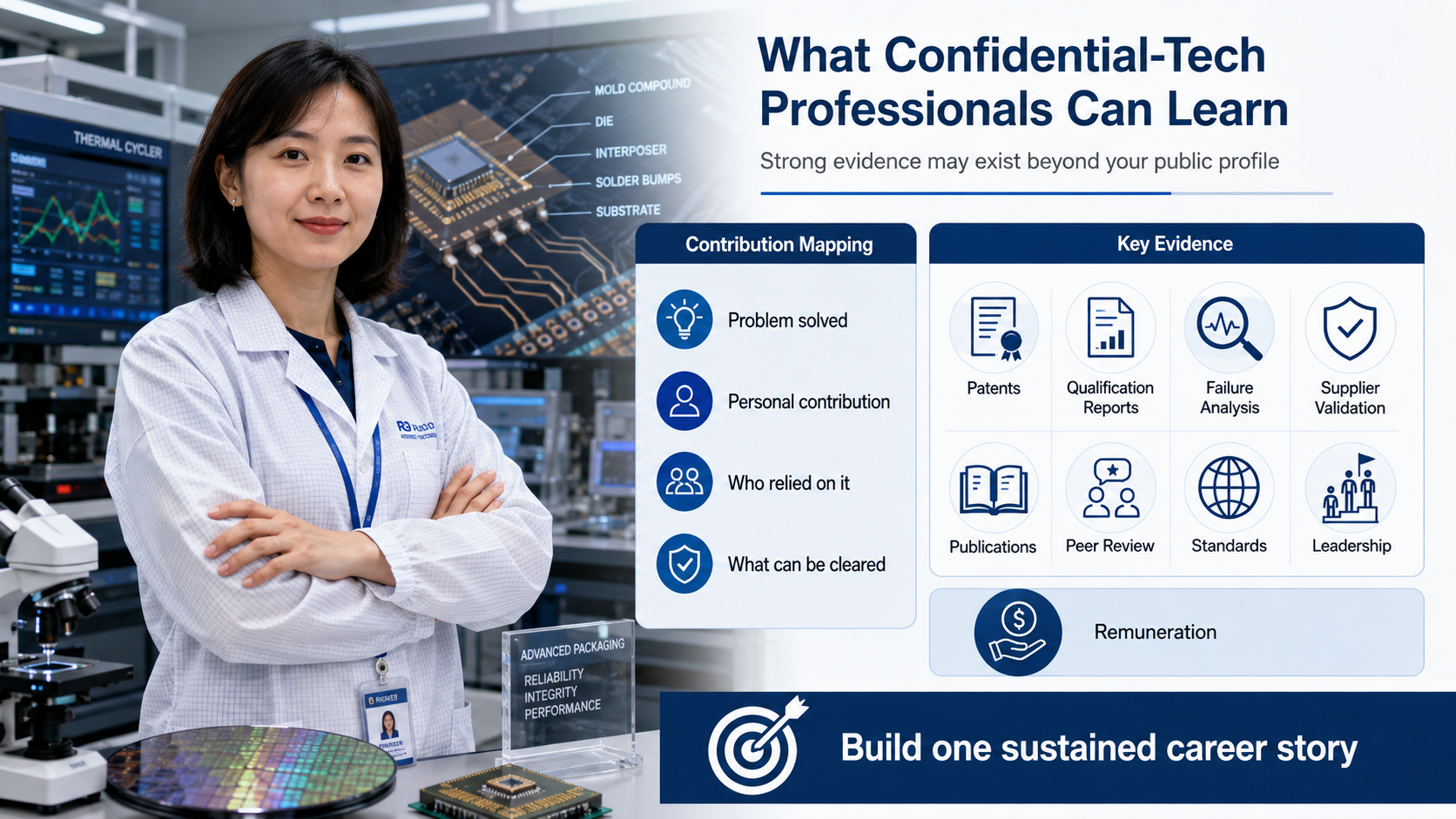
Professionals in semiconductor design, packaging, process engineering, electronics manufacturing, photonics, batteries, medical devices, aerospace, and other confidential industries often have stronger records than their public profiles suggest. Their achievements may sit in invention portals, qualification reports, failure-analysis systems, technical reviews, supplier communications, patents, and the knowledge of colleagues who relied on their judgment.
A useful evidence-building process begins with contribution mapping. What technical problem did the person address? What part was personally created or materially advanced? Which records existed at the time? Who relied on the work? What design, qualification, manufacturing, or reliability decision changed? Which facts can be cleared for immigration use?
For this Vietnamese engineer, the profile became persuasive when patent attribution, thermal and interconnect evidence, supplier validation, publications, conference activity, peer review, standards participation, leadership, and remuneration were presented as one sustained career rather than as disconnected entries in confidential product files.
Frequently asked questions
What is EB-1A?
EB-1A is an employment-based immigrant classification for a person of extraordinary ability in the sciences, arts, education, business, or athletics who satisfies the applicable evidentiary framework and demonstrates sustained national or international acclaim in the final assessment.
Can a semiconductor-packaging engineer qualify for EB-1A?
Potentially. The petition must be based on the person’s own record. Original technical contributions, patents, scholarly authorship, judging, leading roles, qualifying membership, published material, high remuneration, awards, or comparable evidence may be relevant depending on the facts.
Can confidential chip-development work be used in an EB-1A petition?
It may be documented through authorized summaries, redacted records, invention documents, cleared technical descriptions, project-attribution evidence, and letters from people with direct knowledge. Protected customer, product, design, process, and production information should not be disclosed without authorization.
Does having a patent automatically prove an original contribution of major significance?
No. A patent can help establish inventorship and originality, but major significance usually requires additional evidence such as adoption, use, technical reliance, commercial integration, licensing, industry influence, or qualified independent validation.
Can thermal management work support the original-contributions criterion?
Yes, when the record identifies an original method, design, material approach, model, or reliability solution and shows why it significantly affected package performance, qualification, manufacturability, or wider technical practice.
Can interconnect-reliability work support EB-1A?
Potentially. The evidence should explain the failure risk, the petitioner’s identifiable contribution, the validation performed, and how others relied on the work. Routine testing or execution of an existing procedure is usually less persuasive than a significant original solution.
What counts as scholarly authorship for a packaging engineer?
Qualifying work may include peer-reviewed or appropriate professional articles and conference papers on packaging, thermal management, interconnects, materials, failure analysis, qualification, or related engineering subjects. The petitioner must be an author, and the publication must meet the applicable requirements.
Can conference presentations help an EB-1A case?
They can strengthen the record by showing technical contribution, selection, invitations, or professional recognition. Attendance alone is weak. The petition should explain how the presentation supports authorship, original contribution, leading role, judging, or the final merits analysis.
What activities can satisfy the judging criterion for a semiconductor engineer?
Examples may include completed peer review of journal manuscripts, conference papers, research proposals, technical awards, or other professional work. Internal design review and ordinary supervisory duties do not automatically satisfy the criterion.
Does standards-body participation satisfy the judging criterion?
Not by itself. Standards work can show professional trust, but judging requires actual evaluation of the work of others. The record should document the nature of the review activity rather than rely on a committee title.
Does ordinary IEEE or engineering-society membership satisfy the membership criterion?
Usually not. The membership criterion requires evidence that admission demanded outstanding achievements judged by recognized experts. Open or fee-based membership can still support professional context but is generally different from selective achievement-based membership.
How can a packaging engineer prove a leading or critical role?
The evidence should establish the distinguished reputation of the organization or project and document the petitioner’s actual authority, work-package ownership, reliability responsibility, cross-functional influence, supplier leadership, design-release role, or other function on which the activity depended.
What counts as published material about the petitioner?
The strongest evidence is professional or major media material substantially about the petitioner and the petitioner’s work. General articles about a chip, company, or semiconductor market are weaker when the individual is not discussed.
How is high remuneration evaluated for an engineer outside the United States?
USCIS considers whether the person commanded a high salary or other significantly high remuneration in relation to others in the field. Comparisons should account for geography, occupation, seniority, sector, specialization, and the documented compensation structure.
Can supplier letters support an EB-1A petition?
Yes, especially when the writers have direct technical knowledge and explain the petitioner’s specific contribution, the problem solved, the reliance placed on the work, and the significance. Letters are strongest when supported by contemporaneous records.
Does EB-1A require a U.S. employer or labor certification?
EB-1A does not require a permanent job offer or labor certification, and an eligible person may self-petition. The petition must still show that the person intends to continue work in the area of extraordinary ability in the United States.
How does EB-1A differ from EB-2 NIW for a semiconductor engineer?
EB-1A focuses on extraordinary ability and sustained acclaim under its own evidentiary framework. EB-2 NIW requires EB-2 qualification and a showing that waiving the job-offer and labor-certification requirements is in the national interest. The stronger category depends on the professional record and proposed U.S. work.
How does ethical profile building help a semiconductor engineer?
It identifies existing evidence, creates truthful attribution records, develops cleared publications and presentations, improves professional visibility, and organizes the record without inventing product results, exposing confidential data, purchasing false recognition, or overstating team contributions.
Make the engineer inside the package visible
Confidential technology professionals often have stronger evidence than their public profiles reveal. The record may be spread across patents, invention disclosures, package reviews, qualification files, failure analysis reports, supplier records, technical papers, conference proceedings, compensation data, and the knowledge of specialists who relied on their work.