
Wildfire engineer EB-1A: How a South African engineer documented autonomous wildfire-detection systems, thermal-imaging performance, emergency deployments, agency reliance, technical publications, judging activity, patent evidence, and professional recognition for an approved EB-1A petition.
Key facts at a glance
| Petition outcome | Form I-140 approved under EB-1A on August 8, 2024. |
| Professional profile | South African engineer using autonomous drones, thermal imaging, and predictive analytics to detect and map wildfires before they spread. |
| Field niche | Unmanned aerial wildfire detection and fire-behavior intelligence. |
| Starting weakness | Fire agencies valued the operational results, but the strongest evidence appeared in emergency deployments, sensor logs, and prevention outcomes rather than conventional academic recognition. |
| Profile-building focus | Deployment records, detection-performance data, drone and remote-sensing publications, fire-agency letters, international safety-conference roles, patent evidence, completed judging activity, and clear attribution of technical leadership. |
| Principal EB-1A evidence areas developed | Original contributions of major significance, leading or critical role, authorship of scholarly articles, judging the work of others, and published material about the petitioner and the petitioner’s work. |
| Central issue | Showing that fires detected early, mapped accurately, or contained more effectively reflected the petitioner’s own engineering decisions rather than the work of an unnamed emergency response team. |
| Approval lesson | Operational science can support EB-1A when the record connects the individual engineer to the system design, field use, documented performance, independent reliance, and recognition by the relevant professional community. |
The strongest evidence was found in fires that never became disasters
Wildfire technology is often judged by what does not happen. A thermal anomaly is detected before flames cross a ridge. A drone maps a fast-moving fire before a crew enters unsafe terrain. A predictive model directs attention to a vulnerable area before wind changes make access impossible. When the system works, the event may remain small enough to attract little public attention.
That success created the central challenge in this case. The petitioner had contributed to autonomous aerial systems used for wildfire detection, mapping, and situational awareness. Fire agencies and emergency teams understood the value of the work because they had seen it operate in the field. An immigration record, however, could not rely on institutional confidence alone. It had to explain what the petitioner designed, how the system performed, who relied on it, and why the contribution was important within wildfire science and disaster-response engineering.
USCIS approved the Form I-140 petition on August 8, 2024. The case was organized around a simple idea: prevention outcomes are evidence only when the record preserves the engineering chain that produced them.
Why emergency response technology can hide individual achievement
Wildfire response is inherently collaborative. Drone pilots, remote-sensing specialists, fire-behavior analysts, incident commanders, communications teams, software engineers, and field crews may all contribute to one operation. Public reports usually identify the agency or emergency program, not the person who developed the sensing, autonomy, mapping, or analytical methods.
The petitioner’s work also crossed several technical boundaries. It involved unmanned aircraft, thermal sensors, geospatial analysis, communications, autonomy, machine-assisted prediction, and the practical constraints of operating near smoke, heat, wind, limited visibility, and changing airspace restrictions. A general description such as “drone engineer” would have missed the value of that combination.
The petition therefore defined the field as unmanned aerial wildfire detection and fire-behavior intelligence. That definition was narrow enough to identify the petitioner’s expertise and broad enough to explain why the work mattered to emergency agencies, remote-sensing professionals, aviation specialists, and wildfire researchers.
Deployment records converted field operations into attributable evidence
A deployment log can look administrative unless it is connected to the technical work. The record therefore did more than list dates and locations. It identified the operational problem, the system used, the petitioner’s responsibility, and the result that could be disclosed.
Relevant records included mission plans, flight logs, thermal-image archives, mapping outputs, system configurations, incident summaries, after-action reports, technical memoranda, and letters from people who had direct knowledge of the deployments. Where emergency or agency records were restricted, authorized summaries explained the petitioner’s role without revealing sensitive locations, response procedures, or security information.
The strongest deployment evidence showed continuity between design and field use. It connected the petitioner’s work on sensor integration, autonomous navigation, image processing, communications, or predictive analysis to the system that emergency personnel actually used. This helped distinguish technical leadership from simple attendance at an operation.
Performance evidence had to explain more than whether the drone flew
A successful flight does not establish a significant contribution. For wildfire work, the important questions concern detection, coverage, reliability, response time, image quality, geolocation, endurance, communications, and usefulness to decision-makers.
The petition organized available performance evidence around those practical questions. Sensor tests, comparison studies, detection records, false-alarm reviews, mapping accuracy, communications tests, endurance results, and agency feedback showed how the system behaved under relevant operating conditions. The evidence was presented in understandable terms rather than as an unexplained collection of technical tables.
Where exact operational figures could not be disclosed, the record used verified ranges, summarized findings, redacted reports, and letters from authorized officials. The goal was not to expose protected emergency data. It was to give USCIS enough information to understand that the technology had been tested, used, and relied upon in circumstances where failure would matter.
Agency reliance showed that the work extended beyond one laboratory
Fire-agency letters were important because they addressed use from the perspective of the people responsible for public safety. The most useful letters did not merely describe the petitioner as talented. They explained the operational need, the system or method used, the petitioner’s contribution, and the effect on detection, mapping, planning, or responder safety.
The record also distinguished between participation and reliance. A one-time demonstration may show technical promise. Repeated deployment, integration into operating procedures, requests for further support, training of agency personnel, or adaptation by another team can show that the work became useful outside the petitioner’s immediate research environment.
This evidence supported the argument that the contribution had practical significance. It also helped establish why the petitioner’s role was critical within projects or organizations whose wildfire-response work had a distinguished reputation.
Original contribution was built around a technical chain, not a broad public safety claim
Wildfire prevention is plainly important, but the importance of the problem does not prove that one engineer made an original contribution of major significance. The petition therefore focused on the petitioner’s own work.
The record separated the contribution into identifiable parts: the engineering problem, the petitioner’s technical solution, the difference from prior practice, the validation process, the field deployment, the users who relied on it, and the resulting professional or operational effect. Patent records, design documents, technical reports, user letters, performance summaries, and independent recognition were used together rather than treated as interchangeable proof.
This approach also avoided overstating causation. The petition did not claim that one engineer prevented every loss associated with a fire. It showed that the petitioner developed or improved tools that gave responders earlier, clearer, or safer information and that qualified institutions considered those tools useful.
Technical leadership had to be separated from ordinary project participation
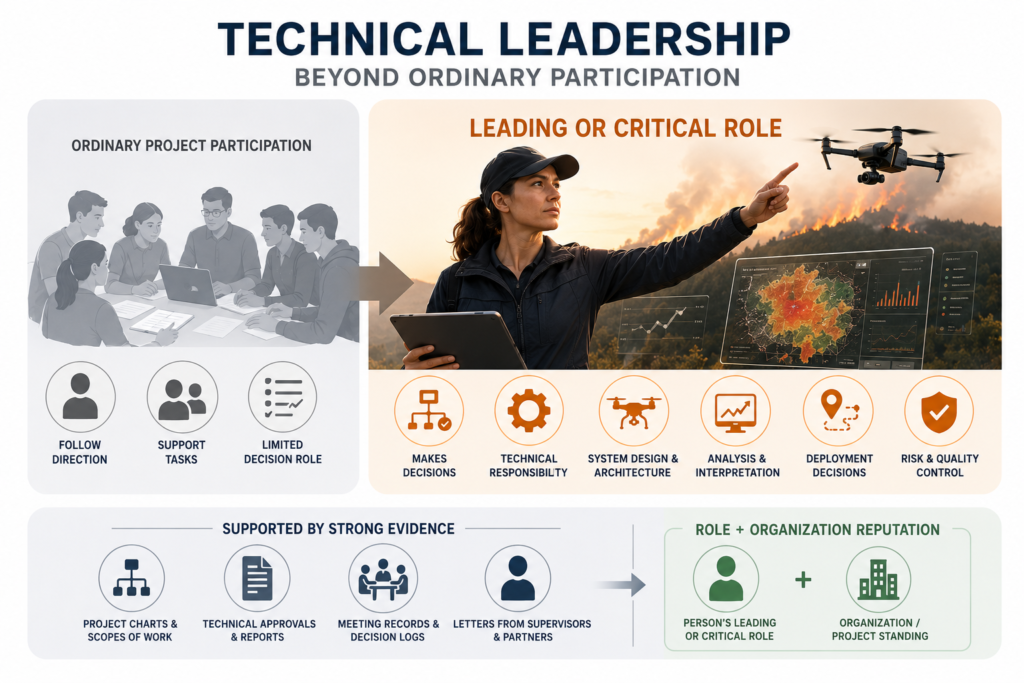
Emergency technology projects often involve many capable professionals. A job title alone cannot show that a person held a leading or critical role. The record therefore documented decision-making authority and technical responsibility.
Evidence identified the petitioner’s responsibility for system architecture, sensor selection, autonomy, flight planning, thermal-data interpretation, geospatial outputs, field validation, risk controls, or deployment decisions where applicable. Project charts, scopes of work, technical approvals, meeting records, internal reports, and letters from supervisors or agency partners helped explain why the petitioner’s work was central to the project’s outcome.
The reputation of the relevant organization or project was documented separately. This was important because the leading-or-critical-role criterion examines both the person’s role and the standing of the organization, establishment, or division for which that role was performed.
Publications translated operational engineering into a record the field could examine
Field success may remain invisible if the methods are never described outside internal reports. The profile-building strategy therefore treated publication as a way to preserve technical knowledge, not as a way to manufacture credentials.
Suitable subjects included thermal-detection methods, autonomous flight in difficult environments, wildfire mapping, sensor fusion, communications limitations, deployment validation, geospatial workflows, and lessons from emergency operations that could be disclosed responsibly. Authorship records, contribution statements, manuscript correspondence, conference proceedings, and citation or use evidence helped connect the publications to the petitioner.
The petition kept authorship evidence separate from published material about the petitioner. Articles written by the petitioner were used under the scholarly-articles criterion. Independent coverage discussing the petitioner and the work was analyzed under the published-material criterion when the outlet and content met the regulatory requirements.
Judging activity showed that the field trusted the petitioner’s technical judgment
The judging criterion was supported through completed evaluation of the work of others. Relevant activity could include manuscript peer review, technical-paper review, innovation or robotics competitions, grant or proposal evaluation, and formal assessment of engineering projects in the same or an allied field.
Invitations alone were not enough. The record preserved completed-review confirmations, editor correspondence, score sheets, reviewer certificates, program records, or other evidence showing that the petitioner actually performed the evaluation. It also identified the subject matter and the connection to the petitioner’s expertise.
This evidence served a wider purpose in final merits. It showed that professional bodies, editors, or organizers trusted the petitioner to assess technical work produced by other specialists.
Patent evidence was useful when connected to implementation and recognition
A patent may establish inventorship, but it does not automatically prove major significance. The petition used patent records as one part of a broader evidentiary chain.
The record explained the technical problem addressed by the invention, the petitioner’s role, its relationship to wildfire detection or aerial operations, and any evidence of testing, licensing, implementation, citation, adaptation, or independent interest. This prevented the patent from appearing as an isolated legal document with no demonstrated connection to the field.
Published coverage helped attach the engineer’s name to the public result
Wildfire stories often focus on the fire, the aircraft, or the agency response. They may mention that drones were used without identifying the person responsible for the technical system. Profile development therefore sought accurate attribution in professional, trade, or major media coverage where the facts supported it.
Qualifying material identified the petitioner and discussed the petitioner’s work. The record documented the article, title, date, author, publication, circulation or audience information where relevant, and a reliable translation when the material was not in English. Promotional posts and employer-controlled content were not treated as substitutes for independent coverage.
Why this case worked
The case did not depend on a dramatic claim that one person stopped wildfires. It worked because the evidence answered a more credible set of questions: What did the petitioner design? How was it tested? Where was it used? Who relied on it? What professional recognition followed?
The strongest evidence was cumulative. Deployment records established real-world use. Performance documentation explained technical value. Agency letters showed reliance. Publications and presentations placed the work before the professional community. Judging activity showed trust in the petitioner’s expertise. Patent and attribution records preserved ownership of the engineering contribution.
Together, those records allowed USCIS to evaluate the petitioner as an individual rather than as an unnamed member of an emergency-response program.
What other disaster technology professionals can learn
Professionals in wildfire science, emergency robotics, remote sensing, unmanned aviation, geospatial analysis, disaster communications, and public-safety engineering often have evidence that does not resemble a conventional academic résumé. Their strongest work may be found in incident logs, technical decisions, restricted reports, deployment records, training materials, and systems that prevented a situation from becoming worse.
That evidence can be useful when it is preserved ethically and explained precisely. The record should distinguish the individual’s work from the team’s work, document independent or institutional reliance, and avoid turning the public importance of disaster response into a substitute for evidence of personal acclaim.
Frequently asked questions
Can a wildfire drone engineer qualify for EB-1A?
Potentially. The person must satisfy the EB-1A legal standard through qualifying evidence and the final-merits analysis. Work in an important public-safety field is relevant context, but it does not replace proof of the individual’s achievements and recognition.
Can emergency deployment records support an EB-1A petition?
Yes. Mission logs, after-action reports, technical memoranda, agency records, flight data, mapping outputs, and authorized summaries may help document the petitioner’s role, the system used, and the practical effect of the work.
How can confidential wildfire response evidence be presented?
The record may use redacted documents, authorized summaries, verified performance ranges, de-identified examples, and letters from officials with direct knowledge. Sensitive operational, security, personal, and location information should remain protected.
Does successful drone operation prove an original contribution of major significance?
Not by itself. The petition should identify the technical contribution and show significance through performance, adoption, reliance, independent use, documented improvement, recognition, or other field-level evidence.
Can preventing a disaster be proved when no major loss occurred?
The evidence should avoid unsupported claims. It can document early detection, response time, mapping coverage, operational decisions, agency reliance, or other measurable outcomes that show how the technology contributed to prevention or risk reduction.
Can fire agency letters establish a leading or critical role?
They can help when they explain the writer’s basis of knowledge, the petitioner’s actual responsibility, why the role was important, and the reputation of the agency, program, project, or division. General praise is less useful.
Do patents automatically satisfy the original-contributions criterion?
No. A patent proves inventorship or ownership of an invention, but major significance usually requires additional evidence such as implementation, licensing, adoption, citation, independent interest, or documented field impact.
Can conference speaking count as a separate EB-1A criterion?
Conference speaking is not a standalone regulatory criterion. It may support original contribution, leading role, published material, or final merits when the selection, event, subject, and audience show professional recognition.
Can peer review satisfy the judging criterion?
Yes, when the petitioner completed evaluation of the work of others in the same or an allied field. Invitations, editor confirmations, reviewer records, certificates, and completed assessments can document the activity.
Can technical papers from emergency-response work satisfy the scholarly articles criterion?
They may qualify when they are scholarly articles in professional or major trade publications or other major media. The petition should document authorship, the nature of the publication, and the article’s technical content.
What is published material about the petitioner?
It generally means qualifying material in professional, major trade, or major media outlets that discusses the petitioner and the petitioner’s work. Material authored by the petitioner belongs under the scholarly-articles criterion and should be analyzed separately.
Does professional-society membership satisfy the membership criterion?
Ordinary membership usually does not. The criterion generally requires admission based on outstanding achievements judged by recognized experts. Society roles may still support leading role, judging, original contribution, or final merits.
How can a drone engineer prove high remuneration?
Compensation records should be compared with reliable data for similarly situated professionals in the same field, geography, career stage, and employment context. A high salary in isolation may not be meaningful without an appropriate comparison.
How can ethical profile building help a disaster-technology professional?
It can preserve deployment attribution, organize cleared technical records, develop accurate publications and presentations, document completed judging, seek independent professional coverage, and obtain specific letters based on genuine work without inventing achievements.
Make early detection visible as professional evidence
A strong wildfire-technology record may already exist across flight logs, thermal imagery, mapping files, performance tests, incident reports, patent records, publications, agency correspondence, judging histories, conference programs, and media coverage. The problem may be that the records describe the emergency program more clearly than the engineer who built its technical core.
Identify which achievements can be documented now, which evidence requires institutional clearance, and which ethical profile building activities may strengthen a future petition.