Zimbabwean Ethnopharmacologist EB-1A: A Zimbabwean pharmacologist secured EB-1A approval after compound-characterization research, scientific publications, research-ethics leadership, professional-society roles, conference evaluation, media coverage, and engagement with international traditional-medicine programs were organized into a clear record of extraordinary ability.
Key facts at a glance
| Petition outcome | Form I-140 approved under EB-1A on September 5, 2024. |
| Professional profile | Zimbabwean ethnopharmacologist working to move traditional-medicine compounds from community use and laboratory observation toward standardized, testable, and ethically governed pharmacological evidence. |
| Field niche | Pharmacological validation of African traditional-medicine compounds. |
| Starting weakness | The field was often misread in opposite ways: dismissed as unscientific by some audiences and treated as automatically effective by others. The petitioner needed a record grounded in methods, data, safety, and research ethics. |
| Profile-building focus | Compound-characterization publications, attributable research methods, WHO-related traditional-medicine engagement, pharmacology-society roles, research ethics leadership, conference platforms, judging activity, media coverage, and independent expert letters. |
| Principal EB-1A evidence areas developed | Authorship of scholarly articles, original contributions, membership based on professional distinction, judging the work of others, and published material about the petitioner. |
| Central issue | Teaching USCIS what rigorous ethnopharmacology is before asking the officer to evaluate distinction within it. |
| Approval lesson | A contested or misunderstood field can support EB-1A when the petition defines the discipline precisely, separates scientific validation from cultural or commercial claims, and documents the applicant’s personal contribution through reproducible evidence. |
The approval
On September 5, 2024, USCIS approved the Form I-140 petition of a Zimbabwean ethnopharmacologist whose work focused on the pharmacological validation of compounds used in African traditional medicine.
The case did not begin with an easy public narrative. The petitioner was working in a discipline that many readers approach with a fixed opinion before looking at the evidence. One audience may hear traditional medicine and assume folklore. Another may hear that a preparation has been used for generations and assume that safety and effectiveness are already established. Neither assumption is a scientific conclusion.
The petition therefore had to educate before it could persuade. Immignis and Advance My Profile organized the record around what the petitioner actually did: identify candidate materials, characterize compounds, standardize laboratory methods, evaluate biological activity and toxicity, publish results, protect research participants and knowledge holders, and help other professionals assess work in the field.
The field had to be explained before the career could be judged
Ethnopharmacology studies medicines and biologically active materials in their cultural and traditional use context, then examines them through disciplines such as pharmacology, chemistry, toxicology, botany, microbiology, and clinical research. Its task is not to certify every traditional claim. Its task is to ask testable questions about identity, composition, dose, mechanism, activity, safety, quality, and possible therapeutic value.
That distinction became the foundation of the case. The petitioner was not presented as a promoter of unverified remedies or as a general academic interested in medicinal plants. His field was defined narrowly as the pharmacological validation of African traditional-medicine compounds.
Once the niche was clear, the evidence stopped looking like a collection of unrelated plant studies. Publications, laboratory methods, ethics work, society roles, conference activity, and international engagement all pointed toward one professional identity: a scientist helping turn inherited knowledge into evidence that can be examined, repeated, challenged, and improved.
A field fighting for legitimacy on two fronts
The starting weakness was unusual because the petitioner had to resist two opposite forms of oversimplification. Scientific skeptics could dismiss the field because the research began with traditional knowledge. At the same time, enthusiastic supporters could overstate preliminary laboratory findings as proof of clinical benefit.
The petition avoided both positions. It described traditional use as a source of research questions, not as a substitute for evidence. It also explained that laboratory activity, chemical characterization, animal studies, and clinical evidence answer different questions and should not be collapsed into one claim.
This careful framing improved credibility. The case did not need USCIS to endorse any particular treatment. It needed the officer to understand why rigorous validation is difficult, why the petitioner’s methods mattered, and how the field recognized professionals trusted to perform that work responsibly.
Compound characterization turned a remedy name into scientific evidence
A traditional preparation may be known by a local name, a plant name, or a description of how it is used. That is not enough for reproducible pharmacology. Species can be confused, growing conditions can alter composition, extraction methods can change what is present, and different batches may produce different results.
Compound characterization became one of the strongest parts of the petition. The record connected the petitioner to work identifying botanical material, preparing extracts, separating chemical fractions, describing active constituents, and documenting analytical results through accepted laboratory methods.
This work mattered because it created a defined object of study. Other researchers could understand what was tested, under which conditions, and with what chemical profile. The contribution was not that a community had long used a preparation. The contribution was the petitioner’s role in making the material scientifically identifiable and open to independent evaluation.
Standardization made the research repeatable
A promising result has limited value if no one can reproduce it. The petition therefore documented the petitioner’s role in standard operating procedures, extraction conditions, reference markers, assay selection, dose preparation, stability controls, or other methods used to reduce variation between experiments.
This evidence was especially important for the original-contributions argument. A method can have significance when it allows laboratories to compare results, improves quality control, exposes inconsistent samples, or gives later researchers a reliable starting point.
The case did not claim that every protocol changed the entire pharmaceutical field. It showed where a particular method solved a recognized validation problem, who used or relied on it, and why the work was more than routine execution of a laboratory instruction.
The publication record created a formal scientific trail
The petitioner’s publications were organized around a coherent research identity rather than presented as a simple count. Articles connected to compound identification, pharmacological activity, toxicology, extraction methods, quality control, or research ethics were mapped to the defined field niche.
Authorship position, the petitioner’s specific responsibility, peer-review status, journal scope, citation history, and use by later researchers were documented where available. The strategy was not to imply that every paper was famous. It was to show sustained scientific authorship and a body of work that other professionals could examine.
First-author or corresponding-author work was particularly useful when it reflected intellectual responsibility for study design, analysis, or interpretation. Collaborative articles were still valuable, but the petition explained the petitioner’s identifiable contribution instead of assuming that a name in a long author list spoke for itself.
Original contribution required more than a positive laboratory result
Many substances show activity in an early assay. That alone does not establish a contribution of major significance. The petition looked for evidence that the petitioner had added something durable to the field: a characterized compound, a validated method, a reference dataset, a safety finding, a quality-control approach, or a research framework that others used.
Adoption and reliance were important. The record considered whether other laboratories followed the method, whether a dataset supported later studies, whether a compound became the subject of additional research, or whether the petitioner’s work affected how a research program selected candidates and managed risk.
Independent experts helped interpret this evidence. Their letters explained the scientific problem, what the petitioner contributed, and why the work mattered in comparison with ordinary activity in ethnopharmacology. General praise was not used as a substitute for technical facts.
WHO related engagement supplied context, not borrowed prestige
International traditional medicine programs gave the case useful context because global health institutions increasingly emphasize research, evidence, safety, quality, effectiveness, ethics, and appropriate integration. The petition documented the petitioner’s participation in relevant consultations, technical meetings, working processes, or program activities where the case record supported it.
The strategy was careful not to imply that any contact with a large institution proved extraordinary ability. Attendance at a public event would carry little weight by itself. Stronger evidence involved selection for a technical role, contribution to a working document, responsibility for an evidence review, or participation that depended on subject-matter expertise.
This distinction kept the argument personal. WHO related material helped explain why rigorous validation matters globally, while the EB-1A case still depended on what the petitioner personally authored, evaluated, developed, or led.
Research ethics leadership became a substantive part of the profile
Ethnopharmacology raises ethical questions that are not incidental to the science. Research may involve community knowledge, biological resources, benefit sharing, informed consent, intellectual-property concerns, biodiversity, and the risk of commercial extraction without fair recognition.
The petitioner’s research-ethics leadership therefore supported more than an administrative narrative. Committee service, protocol review, guidance development, training, or oversight roles showed that institutions trusted him to evaluate whether research involving people, knowledge holders, samples, or biological materials met ethical requirements.
Where the work involved reviewing other researchers’ protocols or studies, it also supported the judging criterion. The petition documented the actual evaluation function, the standards applied, and the basis on which the petitioner was selected. A committee title alone was not treated as enough.
Professional society roles had to show selectivity or responsibility
Professional membership was reviewed closely. Open enrollment in a pharmacology or scientific association would not automatically satisfy the EB-1A membership criterion. The stronger evidence involved selective grades, fellowships, elected positions, technical committees, or appointments requiring accomplishment and peer assessment.
The petition included admission rules, nomination procedures, selection records, appointment letters, and evidence of the petitioner’s responsibilities. This showed why a particular role reflected recognition rather than simply participation.
Society work also reinforced the final merits analysis when it placed the petitioner in responsibility for standards, scientific programs, peer review, ethics, training, or professional evaluation beyond his home institution.
Judging evidence came from real scientific evaluation
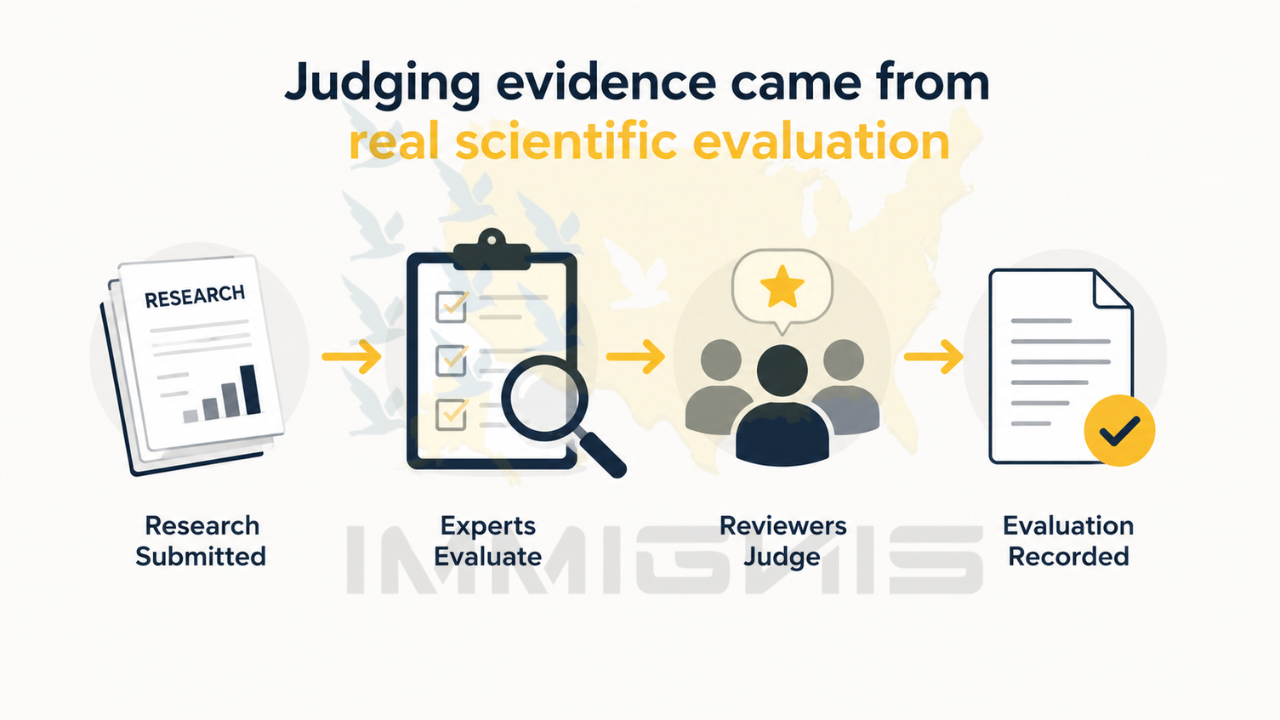
Judging did not need to look like a prize competition. In this field, it could appear through peer review of journal manuscripts, assessment of conference abstracts, research-ethics review, grant evaluation, student examination, or technical review of pharmacological studies.
The petition documented completed reviews rather than invitations alone. Editorial confirmations, review records, committee assignments, certificates, or other evidence established that the petitioner actually evaluated the work of other professionals.
This was a natural criterion for the case because scientific validation depends on critical assessment. The petitioner was not merely producing studies; other institutions trusted him to decide whether research questions, methods, interpretations, and ethical safeguards were adequate.
Published material helped correct the public misunderstanding
Media coverage was used selectively. A general article about traditional medicine in Zimbabwe would not become published material about the petitioner merely because it discussed the same topic. The stronger evidence named him and described his research, methods, publications, ethics work, or role in explaining scientific validation.
Science-media features and interviews were particularly useful when they allowed the petitioner to distinguish traditional use from proven clinical effect. This showed public visibility while preserving scientific caution.
The coverage also helped USCIS understand the broader role of the work. The petitioner was contributing to a public conversation where both dismissal and exaggeration could cause harm, and his expertise offered a more disciplined way to evaluate claims.
Conference platforms showed that the field wanted the methodology
Conference presentations gave the petitioner a public professional record beyond his institution. Accepted papers, invited talks, panel participation, session leadership, and technical workshops were documented with programs, abstracts, invitations, and organizer evidence.
The case emphasized what the petitioner was asked to contribute. A talk on compound standardization, toxicology, ethics, or reproducibility was more informative than a bare attendance certificate. Selection processes and audience relevance were explained where available.
These platforms helped show that the petitioner’s value was not limited to one laboratory. Other researchers and professional bodies regarded his methods and judgment as useful enough to place before wider scientific audiences.
How Immignis and Advance My Profile changed the record
Before profile building, the career could have been misunderstood as a collection of medicinal plant studies from a small research environment. The professional record did not clearly show how compound characterization, method development, ethics leadership, international engagement, and peer evaluation belonged to the same high-level specialty.
Immignis and Advance My Profile reorganized the evidence around scientific validation. Publications established formal authorship. Method and dataset documentation addressed original contribution. Society and ethics roles showed trust. Completed reviews supported judging. Conference and media records made the work visible, while expert letters translated its technical importance without overclaiming clinical outcomes.
The result was not a more promotional version of the same career. It was a more accurate one. The petition showed a pharmacologist applying rigorous methods in a field where rigor itself was the central professional contribution.
Why the case held together
The case worked because it did not ask USCIS to accept traditional medicine on faith. It asked the officer to evaluate a scientist who subjected traditional claims to identification, standardization, testing, safety analysis, peer review, and ethical oversight.
Each evidence category answered a different question. Publications showed authorship. Characterization and standardization records showed what the petitioner created. Adoption and expert analysis addressed significance. Ethics and review roles showed professional trust. Society appointments, conferences, and media coverage showed recognition beyond ordinary laboratory duties.
The approval hook was therefore simple but serious: the petition educated first. Once the field was understood correctly, the petitioner’s standing within it became much easier to see.
What researchers in misunderstood fields can learn from this case
A specialized field should not be simplified merely to make it sound familiar. The better strategy is to define it accurately, identify how excellence is recognized inside it, and explain why its native evidence differs from the evidence commonly seen in larger disciplines.
Researchers should also separate the stages of proof. Traditional use can guide investigation. Chemical characterization identifies what is present. Laboratory studies explore activity and mechanism. Toxicology addresses risk. Clinical research tests effects in people. A credible immigration profile should not claim that one stage automatically proves another.
Finally, an applicant should document personal authorship. Research teams, institutions, international programs, and community partnerships may all be important, but USCIS still needs to see what the petitioner personally designed, wrote, reviewed, standardized, or led.
Conclusion
The Zimbabwean ethnopharmacologist’s EB-1A approval grew from a record that refused two easy stories. It did not dismiss traditional knowledge as irrelevant, and it did not present historical use as automatic proof of medical benefit.
Instead, the petition showed a scientist building the bridge between those positions: defining compounds, improving methods, publishing results, evaluating risk, protecting research integrity, and helping others judge the evidence responsibly.
The client’s name and identifying details are omitted to protect privacy. The professional field, approval date, and evidence strategy reflect the underlying case information provided for this success story.
Frequently asked questions
Can an ethnopharmacologist qualify for EB-1A?
Yes. A researcher in ethnopharmacology can qualify when the evidence addresses the regulatory criteria and the record as a whole demonstrates the required level of sustained professional recognition. The field does not need to be large or widely understood by the public.
Does research on traditional medicine count as scientific work for EB-1A?
It can. The strength of the evidence depends on the actual research: compound identification, analytical chemistry, pharmacology, toxicology, standardization, clinical methodology, publication, peer review, and other scientifically documented work. Traditional use alone is not the same as pharmacological validation.
Can a medicinal plant study prove an original contribution of major significance?
Not automatically. The petition should identify what the researcher contributed and show significance through adoption, later research, method use, citations, datasets, validated compounds, safety findings, independent expert analysis, or another form of professional reliance.
How can a researcher avoid overstating early laboratory results?
The evidence should distinguish chemical findings, in-vitro activity, animal studies, toxicology, and clinical evidence. A laboratory signal should not be described as a proven treatment unless the supporting research actually establishes that conclusion.
Can research ethics committee work satisfy the judging criterion?
Potentially. The record should show that the applicant actually evaluated the work or protocols of other professionals, document completed reviews, and explain the standards and selection basis. Holding a committee title without evidence of evaluation is weaker.
Does ordinary membership in a pharmacology society satisfy EB-1A?
Usually not by itself. The regulatory membership criterion focuses on associations that require outstanding achievement as judged by recognized experts. Selective fellowship, elected status, or achievement-based admission may be more relevant when properly documented.
Can WHO-related activity strengthen an EB-1A petition?
It may strengthen the record when the applicant was selected for substantive technical work, consultation, authorship, review, or another role based on expertise. General attendance or use of a WHO logo does not by itself prove extraordinary ability.
Why is field education important in this type of petition?
An officer may otherwise confuse ethnopharmacology with untested commercial claims or general cultural practice. A precise explanation helps USCIS understand what the scientist studies, how the work is validated, and why the submitted evidence matters within the field.
Build a scientific immigration record around work that is difficult to explain
Researchers in pharmacology, traditional medicine, natural products, toxicology, public health, and other specialized fields may already have strong evidence that is scattered across papers, laboratory methods, ethics committees, professional societies, conferences, and institutional programs.